One-on-One Meeting Checklist Template

One-to-ones slip when they have no shape: the meeting is moved twice, turns into a status update on the manager’s list, and the action agreed three weeks ago is never mentioned again.

Last reviewed: October 2026

This free one-on-one meeting checklist is for managers, team leads and the HR teams who support them. One run is one one-to-one between a manager and a direct report, weekly, fortnightly or monthly. The employee adds their topics first and both of you prepare. The meeting starts with how they are and their agenda, then covers progress against goals, blockers and the support needed, feedback both ways, development and career, and the actions agreed. Afterwards the notes are shared and confirmed, actions are followed up, anything escalated is checked and open actions carry into the next agenda. The meeting type adds prompts for a first one-to-one, a quarterly goals review or a check-in after a difficult period.

A One-to-One Is Not a Small Performance Review

A one-to-one is a manager’s regular, private conversation with one person who reports to them. It belongs to the employee as much as the manager: their topics come first, and most of the time goes on what they need to do good work. It is not a status meeting, and it is not a performance review. Ratings and formal decisions happen elsewhere, but a steady run of one-to-ones means nothing in the annual review comes as a surprise.

This checklist runs one meeting, from the employee adding their topics to the actions being done, and is built to run again on the same rhythm. A new manager’s first round of one-to-ones is part of the New Manager Onboarding Checklist; after that, this is the meeting that keeps going. Two other checklists cover the formal side of managing performance.

This checklist

The regular one-to-one

Asks: how is the employee, what do they need, and what happens next?

When: weekly, fortnightly or monthly, for as long as you manage them.

Output: shared notes the employee has confirmed, and a short list of actions with owners and dates.
Once or twice a year

The performance review

Asks: how did the period go against the goals, and what is the overall assessment?

When: on the review cycle, in the Employee Performance Review Checklist.

Output: a formal review, signed and filed, with goals for the next period.

Only when needed

The improvement plan

Asks: can a specific capability gap be closed in a set time, with support?

When: after the gap has been raised in one-to-ones and a review, in the PIP Process Checklist.

Output: a written plan, documented check-ins and an outcome.

What the One-on-One Meeting Checklist Covers

Seven phases follow one one-to-one, from setting it up to the follow-up. The meeting type adds the tasks for a first one-to-one, a quarterly goals review or a check-in after a difficult period. A development request or a wellbeing or conduct concern adds its own tasks, and the employee confirms the notes and actions before the follow-up can be completed.

  1. Phase 1

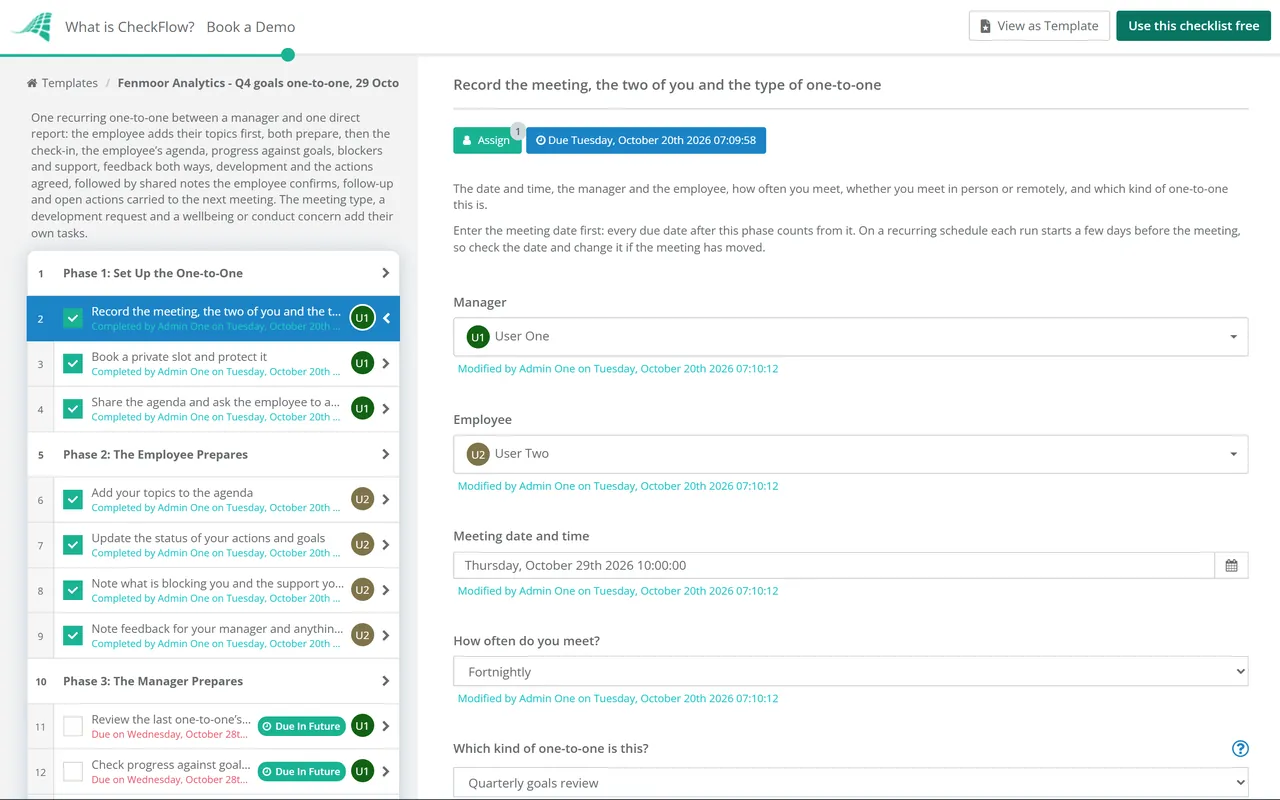
    Phase 1: Set Up the One-to-One

    3 tasks

    The manager sets up each one-to-one. Answer the meeting type and the meeting date first: the type decides which prompts appear, and every later due date counts from the meeting.

    • Record the meeting, the two of you and the type of one-to-one — the date and time, the manager and the employee, how often you meet, whether you meet in person or remotely, and which kind of one-to-one this is
    • Book a private slot and protect it — a time you both keep, long enough for the employee’s topics; move it rather than cancel it, and give the reason when you do
    • Share the agenda and ask the employee to add their topics first — one shared notes page or document you can both edit, with the last one-to-one’s actions at the top and space for the employee’s topics before the manager’s
  2. Phase 2

    Phase 2: The Employee Prepares

    4 tasks

    The employee adds their topics before the manager adds theirs. It is their meeting as much as the manager’s, so the agenda starts with what is on their mind.

    • Add your topics to the agenda — anything you want to talk about: your work, your workload, ideas, worries, people or how you are, with the most important first
    • Update the status of your actions and goals — each action from the last one-to-one marked done, in progress or stuck, and a line on where each goal stands
    • Note what is blocking you and the support you need — anything slowing you down, waiting on someone else or unclear, and what would help: a decision, a contact, time, training or a change of priority
    • Note feedback for your manager and anything about your development — one thing your manager could keep doing and one thing they could change, and whether you want to ask about a course, a skill, a project or your next role
  3. Phase 3

    Phase 3: The Manager Prepares

    7 tasks

    Prepare once the employee has added their topics. The tasks for a first one-to-one, a quarterly goals review or a check-in after a difficult period appear only for that kind of meeting.

    • Review the last one-to-one’s notes and open actions — what was agreed, who owned it, what is done and what is late, including the actions you owned yourself
    • Check progress against goals and the current workload — where each goal stands, what has changed in the team’s priorities, and whether the workload, hours or overtime look sustainable
    • Read the employee’s topics and plan time for them first — their topics take the first part of the meeting; move your own to the end, or to another time if the list is long
    • Prepare specific feedback to give — something recent they did well and, if needed, something to change, each with a specific example and its effect, rather than points saved up for months
    • First one-to-one: read up on the new report’s role and plans — their job description, their onboarding or transition plan, the goals they inherited and anything the previous manager handed over
    • Quarterly goals review: gather the goals and evidence for the quarter — each goal agreed for the quarter, the results so far with examples, and any change in the team’s priorities for the next quarter
    • Check-in after a difficult period: plan an open, low-pressure conversation — what has happened, such as a return from leave or illness, a bereavement, a hard project or a change in the team, what you already know, and the support your organisation offers
  4. Phase 4

    Phase 4: Check In & the Employee’s Agenda

    4 tasks

    Start with how the employee is, then their topics. If a wellbeing or conduct concern comes up, the next task appears: follow your organisation’s policy and involve HR. This checklist records what you did; it is not legal or medical advice.

    • Check in on how they are — open with a real question about how they are and how the workload feels, listen more than you talk, and do not push for detail they do not offer
    • Raise the concern under your organisation’s policy and with HR — tell HR, or the person your policy names, the same day, record only the facts needed, and tell the employee what happens next; do not investigate or give advice yourself
    • First one-to-one: agree how your one-to-ones will work — how often and for how long, that the employee’s topics come first, where the notes live, and what stays between you and what you would have to pass on
    • Work through the employee’s topics first — in their order, with enough time for each, ending each one with an answer, an action or a date to come back to it
  5. Phase 5

    Phase 5: Progress, Support & Feedback

    8 tasks

    Goals, blockers, feedback both ways and development, in that order. A quarterly goals review and a development request each add a task here.

    • Recognise what has gone well — specific work or behaviour since the last one-to-one, said plainly and with its effect
    • Review progress against goals and the last one-to-one’s actions — each action closed, moved or dropped with a reason, and each goal on track, at risk or off track
    • Quarterly goals review: review each goal and agree next quarter’s priorities — what was achieved against each goal, what to stop, change or carry over, and a few priorities for the next quarter, each written so you will both know when it is done
    • Talk through blockers and agree the support needed — what is in the way, what the manager will do about it and by when, and what the employee will do
    • Give feedback with specific examples — what you saw, its effect and what to keep or change, then ask how they see it
    • Ask for feedback on how you manage them — one thing to keep doing and one thing to change, and thank them for it whatever it is
    • Talk about development and career — what they want to learn or try next, and how their current work can help; a few minutes in a regular one-to-one, longer in a quarterly review
    • Record the development request and agree the next step — what they asked for, such as a course, a skill, a stretch project, a mentor or a move, the next step, who takes it and when you will both look at it again
  6. Phase 6

    Phase 6: Actions, Notes & Confirmation

    5 tasks

    Agree the actions before the meeting ends. The employee confirms the notes and actions, and nothing after that confirmation can be completed until they have.

    • Agree the actions, owners and dates — each action written so either of you could tell when it is done, with one owner and a date, read back before you finish
    • Agree what goes in the notes and what stays between you — a short, factual record of the topics, decisions and actions, leaving out personal detail the employee asked you not to record unless your policy requires it
    • Agree the date and focus of the next one-to-one — the next date in both diaries, and anything either of you wants to start with next time
    • Write up and share the notes — within a working day, in the shared document, with the actions at the top
    • Employee confirms the notes and actions — the employee reads the notes, corrects anything wrong or missing and confirms each action and its owner as agreed
  7. Phase 7

    Phase 7: Follow-Up & the Next One-to-One

    5 tasks

    Actions only count when they happen. Anything escalated is followed up, and open actions go to the top of the next agenda.

    • Put each action where the work is tracked — in the team’s task list, project board or calendar, with its owner and date, so it does not live only in the notes
    • Follow up the escalated concern — check with HR that the concern has been picked up and ask the employee how they are; record the date, not the detail
    • Take the next step on the development request — do what was agreed: look into the course or project, speak to HR or learning and development, or add it to the employee’s development plan
    • Complete the actions you each own — each of you closes your own actions by the date agreed, or says early if one will be late
    • Carry open actions to the next agenda — anything not done goes to the top of the next one-to-one’s agenda with a new date, so it is discussed rather than forgotten

What to Cover in Each Type of One-to-One

The meeting type you choose on the first task changes the prompts and adds the matching tasks. These are practical starting points, not rules: adapt them to the person and the team. The first column matches the choices in the checklist.

Type of one-to-one When to use it Spend most of the time on Questions that help
RegularEvery week, fortnight or month, as agreedThe employee’s topics, then progress, blockers and actions“What is on your mind?” “What is getting in your way?” “What could I do differently?”
First one-to-one with a new reportIn the first week or two with a new starter, or when you take over a teamGetting to know each other and agreeing how your one-to-ones will work“What do you enjoy?” “How do you like to get feedback?” “What did your last manager do that helped?”
Quarterly goals reviewOnce a quarter, in place of a regular one-to-oneEach goal’s results, what to stop or change, and the next quarter’s priorities“What are you most pleased with?” “What would you drop?” “What does done look like next quarter?”
Check-in after a difficult periodAfter leave, illness, a bereavement, a hard project or a change in the teamHow they are and what would help; goals can wait“How are you, really?” “What would help right now?” “What, if anything, should the team know?”

In person or remote. In person, book a room where you cannot be overheard. Remote, put the link in the invitation, find somewhere private and ask directly how someone is, because it is harder to tell on a call.

When a concern comes up. Whatever the type, a wellbeing or conduct concern goes to HR under your organisation’s policy the same day. The one-to-one is where it is heard, not where it is investigated.

Why Run One-to-Ones in CheckFlow?

1

A one-to-one that keeps its slot

A weekly, fortnightly or monthly recurring schedule starts each one-to-one from the template, and naming the manager and the employee on the first task assigns every task to the right person. Due dates count from the meeting, so the employee’s preparation is due two days before it and the notes a day after. One-to-ones still open show on the Reports Grid, and overdue alerts go to the people assigned.

2

The right prompts for each meeting

One answer on the first task shows the tasks for a first one-to-one, a quarterly goals review or a check-in after a difficult period. A development request adds a task to record it and a follow-up, and a wellbeing or conduct concern adds a task to involve HR the same day and a check a few days later.

3

A record you both agree

The actions sit in a table with an owner and a date for each. The employee confirms the notes, and nothing after that step can be completed until they do. Each meeting is its own checklist, so the history is there when the review comes round.

CheckFlow does not record or transcribe the meeting, and it does not judge how it went. That stays with the two people in the room. It makes sure the meeting happens, that the employee’s topics come first, that every action has an owner and that anything escalated is followed up. HR checklist software shows how one-to-ones, reviews and development plans run from templates across a team.

Hold a first one-to-one with every new direct report in the New Manager Onboarding Checklist, turn a development request into a plan with the Employee Development Plan Checklist, and bring the year together in the Employee Performance Review Checklist or, for a distributed team, the Remote Performance Review Checklist. If a performance gap needs a formal plan, the PIP Process Checklist starts from the evidence your one-to-ones have built up.

AI generator

Didn’t find what you need? Describe it.

Describe the process in a sentence and the AI checklist generator drafts the phases and tasks for you.

Frequently Asked Questions

What is a one-on-one meeting?

A regular, private meeting between a manager and one person who reports to them, usually called a one-to-one in the UK. The employee brings their topics first; then the two of you cover how they are, progress against goals, what is in the way, feedback both ways and development, and agree a short list of actions. It is not a status update or a performance review, though it feeds both.

How often should one-on-ones happen?

Weekly or fortnightly suits most teams, and monthly can work for experienced people who work independently. What matters more is that the meeting happens: move it rather than cancel it. A new report, someone in a new role or someone going through a difficult period often needs more frequent meetings for a while. Agree the rhythm together in the first one-to-one and change it if it stops working for either of you.

How long should a one-to-one last?

Around 30 minutes is a common length for a weekly meeting, and 45 to 60 minutes for a fortnightly or monthly one or a quarterly goals review. Book enough time to get through the employee’s topics without rushing. If you regularly run out of time, meet more often rather than for longer.

Who sets the agenda for a one-on-one?

The employee goes first. They add their topics to a shared agenda a couple of days before the meeting, and the manager adds theirs afterwards, at the end. The manager still prepares: last meeting’s actions, progress against goals, the workload and any feedback to give. If the employee has nothing to add, open questions about their work, their workload and what they need usually bring the topics out.

What questions should a manager ask in a one-on-one?

Open questions the employee can take where they need to: How are things, really? What is on your mind this week? What is getting in your way? What could I do differently to help? What would you like to learn or try next? Is anything coming up I should know about? Ask one at a time and listen to the whole answer. The table above suggests questions for each type of one-to-one.

What should a manager do if a wellbeing or conduct concern comes up?

Listen, thank the employee for telling you and follow your organisation’s policy, which usually means involving HR the same day. Point them to the support your organisation offers, such as occupational health or an employee assistance programme. Do not investigate a conduct concern yourself, and do not promise to keep it confidential if your policy says you must pass it on. If anyone is in immediate danger, contact the emergency services. This is not legal or medical advice.

Should one-to-one notes be shared with the employee?

Yes. Keep one set of notes you can both see, write them up within a working day and ask the employee to confirm them. A short, factual record of the topics, decisions and actions is enough; personal detail the employee shares does not need to go in unless your policy requires it. Notes both people have confirmed also make the performance review easier, because the evidence is already there.

Is CheckFlow free for this template?

14-day free trial, no card required. The Business plan is $10 per user per month after the trial. Full details at checkflow.io/pricing.

Make Every One-to-One Count

Free trial — no credit card required.

14-day free trial, no credit cardFull refund in your first 30 daysUS hosting, EU on request