Disciplinary cases rarely go wrong on the facts. They go wrong on the process: a manager who investigated and then judged their own case, a hearing letter without the evidence, or a sanction harsher than the last person got for the same thing.
This free disciplinary procedure checklist takes a misconduct case from the first report to the final appeal. It separates the investigation from the decision, builds the hearing letter from a checklist, asks HR to sign off the sanction before the outcome letter goes out, and keeps a dated record of every step. A jurisdiction question at the start switches on the United Kingdom steps from the Acas Code of Practice or the United States steps for at-will employers. Capability and poor performance follow a similar route, but usually start with a plan rather than a hearing: see the Performance Improvement Plan (PIP) Process Checklist.
The steps are much the same on both sides of the Atlantic. Find out what happened, tell the employee what they are accused of, listen to their answer, decide, write it down and let them challenge it. What differs is why each step matters. In the UK, a tribunal will judge the process itself. In the US, the process is rarely required by law, but it becomes the employer’s evidence if the employee later claims the real reason was discrimination or retaliation.
Consistency is the thread that runs through both. Two employees who did the same thing should get the same outcome unless there is a recorded reason for the difference, such as a live warning or a much longer service record. The template asks the decision-maker to check past cases before choosing a sanction, and to write down why.
Keep the case moving. Delay hurts everyone. Memories fade, a suspended employee waits at home, and colleagues fill the silence with rumour. Each task carries a due date set from the date the concern was logged or the date of the hearing, so a stalled case shows up as overdue rather than forgotten.
United Kingdom
The Acas Code sets the floor
The Code: employment tribunals take the Acas Code of Practice on disciplinary and grievance procedures into account, and can raise or cut an award by up to 25% for an unreasonable failure to follow it.
Companion: at a hearing that could end in a formal warning or other action, a worker may bring a colleague or a trade union representative.
Moving: from 1 January 2027 the unfair dismissal qualifying period falls from two years to six months, for dismissals taking effect on or after that date. Acas has also consulted on a revised Code; until a new one takes effect, the current Code applies.
United States
At will, but on the record
At-will: in most states either side can end employment for any lawful reason. Montana is the exception, requiring good cause once probation is over.
The risk: the EEOC says retaliation is now the most frequently alleged basis of discrimination. A shifting explanation can suggest the stated reason is a pretext; consistent records of similar cases help.
Unions and pay: union-represented employees can ask for a representative at an investigatory interview (Weingarten rights). If the outcome is dismissal, final-pay deadlines are set by state law.
This template turns those rules into process steps; it is not legal advice. For any case likely to end in dismissal, or one where the employee has recently raised a complaint, it is worth taking advice from an employment lawyer before the decision is made.
What the Disciplinary Procedure Checklist Covers
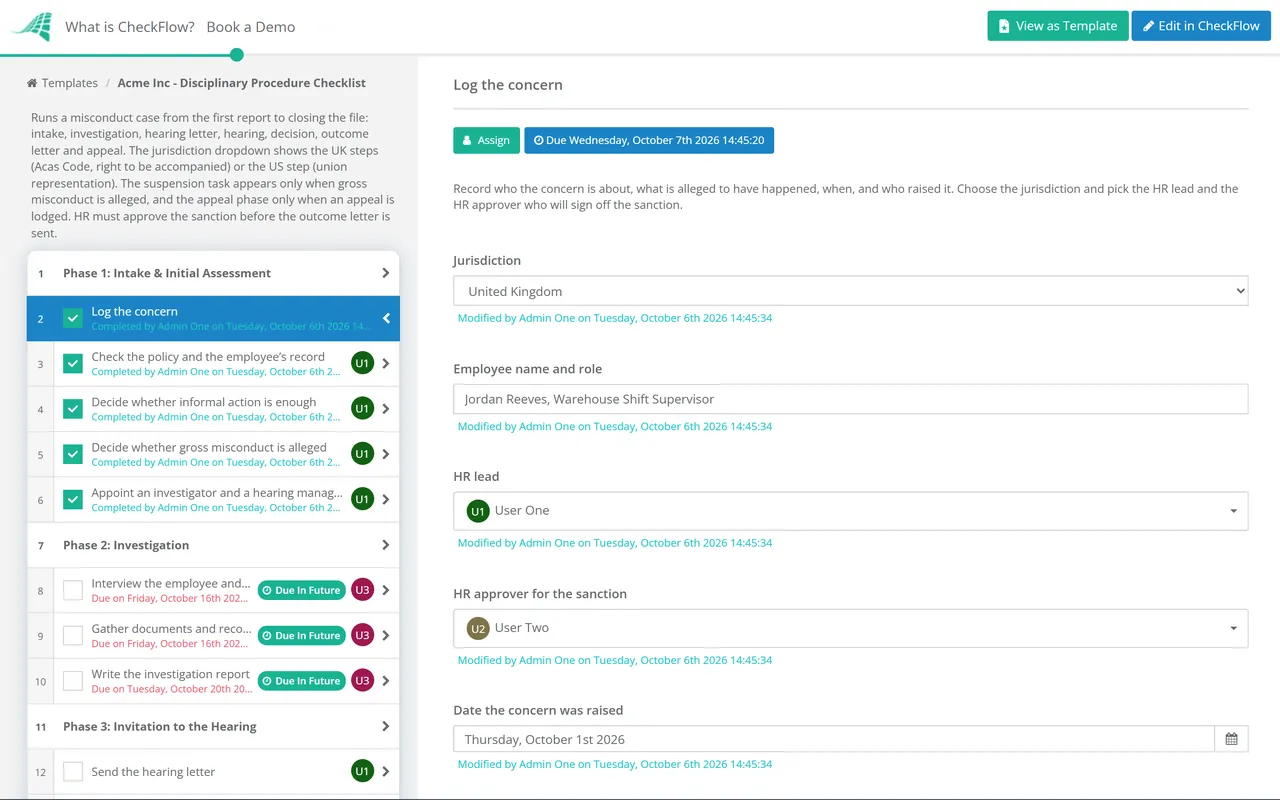
Seven phases, from the first report to closing the file. The suspension step appears only when gross misconduct is alleged, and the appeal phase only when the employee appeals.
Phase 1
Phase 1: Intake & Initial Assessment
Log the concern — who, what, when, who raised it and the jurisdiction
Check the policy and the employee’s record — live warnings, length of service and similar past cases
Decide whether informal action is enough — a private word often settles a minor first issue
Decide whether gross misconduct is alleged
Appoint an investigator and a hearing manager — two different people where practicable
Phase 2
Phase 2: Investigation
Consider suspension only if it is necessary — on full pay, as short as possible, reviewed and confirmed in writing as a neutral act
Check union representation rights (US) — a union-represented employee can ask for a representative at an investigatory interview
Interview the employee and the witnesses — notes agreed by each person
Gather documents and records — emails, rotas, system logs, CCTV
Write the investigation report — facts found, both accounts and whether there is a case to answer
Phase 3
Phase 3: Invitation to the Hearing
Send the hearing letter — the allegations, the possible outcome, and the date, time and place
Send copies of the evidence with the letter
Confirm the right to be accompanied (UK) — and move the hearing up to five working days if the companion cannot attend
Ask about reasonable adjustments — disability, language, access or timing
Arrange a note-taker with no other role in the case
Phase 4
Phase 4: The Disciplinary Hearing
Explain the allegations and go through the evidence
Hear the employee’s response — their account, questions, evidence and any mitigation
Adjourn to check any new points before deciding
Agree and file the hearing notes — and give the employee a copy
Phase 5
Phase 5: Decision & Outcome
Decide the outcome and check it against past cases — record the reasons and any warning expiry date
HR approves the sanction — before anything is said or sent to the employee
Send the outcome letter — reasons, sanction, expiry, the change expected and the right of appeal
Process final pay and offboarding if dismissed — state deadlines in the US, notice or pay in lieu in the UK
Record whether the employee appeals — by the deadline given in the letter
Phase 6 — If Appealed
Phase 6: Appeal
Shown when the employee lodges an appeal.
Appoint an appeal manager not involved so far — more senior than the hearing manager where possible
Invite the employee to the appeal meeting — with their grounds, the date and the right to be accompanied
Hold the appeal meeting — focus on the grounds of appeal
Send the appeal outcome — upheld, overturned or a lesser sanction, with reasons
Phase 7
Phase 7: Close & Review
Diary the warning expiry date — so a lapsed warning is not relied on later
Tell the person who raised the concern that it has been dealt with — without disclosing the sanction
File the case record under your retention policy
Note any lessons — unclear rules, training gaps or a delay worth fixing
Most policies use a ladder of warnings, each live for a set period. How long each one lasts is a policy choice, not a legal rule, so write the periods into your procedure and use them every time. The examples below follow the Acas guide on discipline and grievances at work, which suggests a first written warning might be live for up to six months and a final written warning for twelve. Serious misconduct can start higher up the ladder, and gross misconduct can lead straight to dismissal, but only after the same fair process.
Stage
Typically used for
Example live period
The letter should say
Informal word
A minor first issue, such as occasional lateness
Not a formal sanction; keep a brief note
No letter needed; a short follow-up email confirming what was agreed helps
First written warning
Misconduct confirmed at a hearing, with no live warning
Up to 6 months
What happened, the change needed, how long the warning lasts and what further misconduct could lead to
Final written warning
Further misconduct during a live warning, or a serious first offence
12 months, longer only in exceptional cases
As above, plus a clear statement that further misconduct may lead to dismissal
Other sanction
Demotion, transfer or loss of a pay increment instead of dismissal
Set by the contract
Only if the contract allows it; state the effect on pay and role
Dismissal
Further misconduct during a final written warning
Not applicable
The reasons, the termination date, notice or pay in lieu, and the right of appeal
Summary dismissal
Gross misconduct, such as theft, fraud, violence or gross negligence
Not applicable
The reasons, that the dismissal is without notice, and the right of appeal
Before the hearing
What the hearing letter must cover
Each allegation, in enough detail to answer it
The possible outcome, including dismissal if that is a possibility
The date, time and place, with time to prepare
Copies of the investigation report and witness statements
The right to be accompanied, and by whom (UK)
Who will hear the case and who will take notes
How to ask for adjustments or a new date
After the hearing
What the outcome letter must cover
Which allegations were upheld, and why
The sanction and when it takes effect
How long a warning stays live
The improvement or change expected, and any support
What further misconduct could lead to
How to appeal, to whom and by when
For dismissal: the last day and final pay arrangements
Why Run Disciplinary Cases in CheckFlow?
1
The right steps for each case
One dropdown sets the jurisdiction and shows the UK or US steps. Another shows the suspension task only when gross misconduct is alleged, and the appeal phase appears only if an appeal is lodged. Managers follow one template instead of guessing which rules apply.
2
A sign-off before the letter
The sanction is an approval task assigned to the HR approver picked at the start. The checklist halts until it is approved, so no outcome letter goes out on one manager’s judgement alone.
3
A record that stands up
Interview notes, letters and evidence are uploaded to the task they belong to. The audit trail shows who completed each step and when, and reports show how long cases take and where they stall.
Discipline is one part of the employee lifecycle. CheckFlow’s HR checklist software runs recruitment, onboarding, performance reviews, disciplinary cases and departures from templates, with assignments, due dates and approvals shared between HR and line managers.
A disciplinary procedure is the set of steps an employer follows when it believes an employee has broken its rules or fallen short of the standard expected. It normally covers an investigation, a written invitation to a hearing, the hearing itself, a written decision and a chance to appeal. Following the same steps every time protects the employee from an unfair outcome and the employer from a claim that it acted on a hunch or for a hidden reason.
Is the Acas Code of Practice legally binding?
+
Not directly, but it has teeth. Employment tribunals must take the Code into account when they hear claims such as unfair dismissal, and they can increase an award by up to 25% if the employer unreasonably failed to follow it, or reduce it if the employee did. The Code does not apply to redundancy dismissals or to fixed-term contracts that simply end. Acas consulted on a revised Code between July and September 2026, and the current Code applies until a new one takes effect.
Who can accompany an employee to a disciplinary hearing?
+
In the UK, a worker can bring a fellow worker, a trade union representative or an official employed by a trade union, under section 10 of the Employment Relations Act 1999. The companion can put and sum up the worker’s case and confer with them, but cannot answer questions for them. If the chosen companion cannot attend, the worker can propose another time within five working days. In the US there is no general right, but union-represented employees can ask for a union representative at an investigatory interview.
How long does a disciplinary warning last?
+
As long as your policy says, and the employee should be told the period in the warning letter. A common pattern, used as an example in the Acas guide, is up to six months for a first written warning and twelve months for a final written warning. Once a warning lapses it should be disregarded for disciplinary purposes, so diary the expiry date when the warning is issued.
Can you dismiss for gross misconduct without any previous warnings?
+
Yes. Gross misconduct is conduct serious enough to justify dismissal for a first offence, without notice or pay in lieu. Your policy should give examples, such as theft, fraud, violence or gross negligence. What you cannot skip is the process: the employee still needs an investigation, a hearing, a written decision and a right of appeal. Suspension on full pay while you investigate is sometimes justified, but it should be brief and is not a sanction in itself.
Do US employers need a disciplinary process if employment is at will?
+
Federal law does not require one, but it is still worth having. If a dismissed employee claims discrimination or retaliation, the employer has to show a legitimate reason, and a reason that was investigated, written down and applied the same way to others is far easier to show. Check your handbook as well: a written procedure you promised to follow and then skipped can cause its own problems. Montana and union contracts also limit at-will dismissal.
Is CheckFlow free for this template?
+
14-day free trial, no card required. The Business plan is $10 per user per month after the trial. Full details at checkflow.io/pricing.
Run Every Disciplinary Case the Same Fair Way
Free trial — no credit card required.
Do you like cookies? 🍪 We use cookies to ensure you get the best experience on our website. Learn more