New Manager Onboarding Checklist Template

Most new managers inherit a team, a set of promises the last manager made and a pile of HR approvals on the same morning. Few are told which of those they now own, or what the law expects of someone who supervises people.

This free new manager onboarding checklist is for HR partners and the managers of first-time or newly moved team leads. It covers the part of the job a standard induction leaves out: taking over a team from the outgoing manager, the absence, approval and performance admin that now sits with the new manager, a first one-to-one with every direct report, a map of the people the team depends on, management and harassment-prevention training, and a 30/60/90 plan that ends in the manager’s first decisions. One answer on the first task switches between an internal promotion, which adds a peer-to-manager phase and the backfill of the old role, and an external hire. An external hire still needs the company induction in the Employee Onboarding Checklist. For a director, vice president or C-suite appointment with a board and investors to meet, use the Executive Onboarding Checklist instead.

Use This Template Free See Live Example
No Credit Card Required

Last reviewed: October 2026

Two Ways Into the Same Job

A manager’s first weeks are mostly about other people. The team wants to know what will change. The outgoing manager has half-finished conversations about pay, workload and careers that nobody wrote down. HR needs someone to approve leave, sign off timesheets and run probation reviews. Meanwhile the new manager is expected to keep delivering. Without a plan, the urgent admin crowds out the slower work of getting to know each person, and the team’s first impression is of someone who is too busy to talk.

How someone arrives in the role changes what they need. A promoted team member already knows the work and the people, but now has to manage friends, keep confidences and let go of their old job. An external hire brings a fresh view and has to learn the organisation, the product and the unwritten rules at the same time. The checklist keeps the shared core identical and adds the extra phase only when the answer on the first task is “internal promotion”.

Internal promotion

Knows the team, has to change the relationship

Main risk: doing the old job and the new one at once, and treating friends differently from everyone else.

Extra tasks: telling close peers first, handing over old work, the backfill and declaring personal relationships.

Ready when: the old role has an end date and someone else owns its work.
External hire

Knows management, has to learn the place

Main risk: changing things before understanding why they are the way they are.

Extra tasks: the company induction, more stakeholder meetings and a longer listening period before any decisions.

Ready when: every report has had a first one-to-one and the stakeholder map is complete.

What the New Manager Onboarding Checklist Covers

Six phases dated from the first day in the role. The peer-to-manager phase and the US or UK training tasks appear only when the answers on the first task call for them.

Phase 1

Phase 1: Appointment & Handover

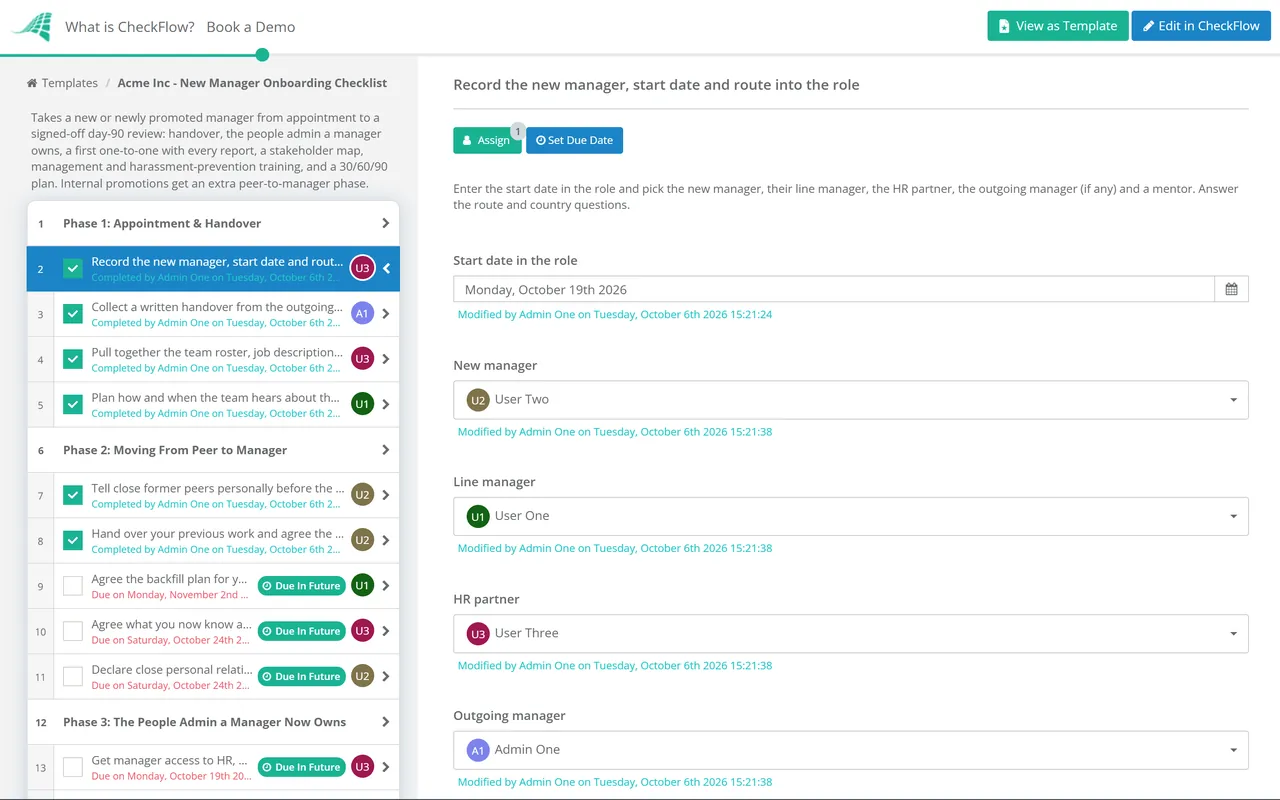
  • Record the new manager, start date and route into the role — plus the line manager, HR partner, outgoing manager, a mentor and the country the team works in
  • Collect a written handover from the outgoing manager — open commitments to individuals, live projects and risks; from the line manager if the post was empty
  • Pull together the team roster, job descriptions and contracts — including working patterns and probation end dates
  • Plan how and when the team hears about the appointment — one message, from the line manager, before rumours do the job
Phase 2 — If Internal Promotion

Phase 2: Moving From Peer to Manager

Shown only when the route into the role is an internal promotion. Most of these tasks happen in the first fortnight.

  • Tell close former peers personally before the wider announcement
  • Hand over your previous work and agree the date it stops — so the new role does not start as two jobs
  • Agree the backfill plan for your old role with the line manager
  • Agree what you now know and cannot share with former peers — pay, performance ratings and people cases
  • Declare close personal relationships in the team to HR — and agree who handles any review or case involving them
Phase 3

Phase 3: The People Admin a Manager Now Owns

  • Get manager access to HR, payroll and approval systems — and remove any access the old role no longer needs
  • Learn the approval limits for spend, overtime, hiring and expenses — and name who approves when the manager is away
  • Walk through the absence and leave process with HR — which requests the manager approves and which must reach HR the same day
  • Review every open people case with the HR partner — grievances, disciplinary matters, agreed adjustments and long absences
  • Diary the performance cycle, probation reviews and pay review dates — probation reviews are easy to miss when the manager changes
Phase 4

Phase 4: One-to-Ones & the Stakeholder Map

  • Hold a first one-to-one with every direct report — the same questions for everyone, notes kept privately
  • Set a regular one-to-one rhythm and a shared notes format — weekly or fortnightly, protected from cancellation in the first quarter
  • Run a first team meeting on how you will work together — how decisions are made, how to reach you and what stays the same for now
  • Build a stakeholder map of peers, internal customers and suppliers
  • Meet each key stakeholder and ask what they need from the team
Phase 5

Phase 5: Management Training & Legal Duties

A process step, not legal advice. The US and UK tasks appear according to where the team works.

  • Start the company’s management essentials training — feedback, performance, absence, recruitment and handling personal data
  • US: complete supervisor harassment-prevention training on time — within six months of becoming a supervisor in California, and in the yearly cycle in New York, Illinois and Chicago
  • UK: learn your part in the duty to prevent sexual harassment — the policy, the risks in this team and how reports are handled
  • Learn how to receive, record and escalate a complaint — to HR the same day, even when it is raised informally
  • Rehearse a difficult conversation with the HR partner or mentor — under-performance, a refused request or a complaint about a colleague
Phase 6

Phase 6: 30/60/90 Plan & First Team Decisions

The approval at day 90 halts the checklist until the line manager signs off the transition.

  • Agree a 30/60/90 plan as a manager with the line manager — outcomes for the team, not a list of meetings
  • Play back what you heard at day 30 and name the first priorities
  • Make and record the first team decisions — with the reasons, shared with the people affected
  • Ask the line manager to hold skip-level conversations at day 60 — short, confidential and fed back as themes, not names
  • Line manager signs off the transition at day 90

What Changes in Law When Someone Starts Managing

Becoming a supervisor brings a handful of legal duties straight away, mostly because the employer acts through its managers. Harassment-prevention training is where the US and UK differ most: several US states and cities set hours and deadlines for supervisors, while UK law sets a duty on the employer to prevent harassment and leaves the method to it. The table shows what the Phase 3 and Phase 5 tasks are built around. Use it to plan the process, not as legal advice.

Duty United States United Kingdom
Harassment-prevention trainingNo general federal requirement. California (employers with five or more employees): two hours for supervisors within six months of taking the role, then every two years. New York: yearly training for all employees, covering supervisors’ conduct and extra responsibilities. Illinois: yearly training for every employee. Chicago: two hours a year for supervisorsNo set course or hours. The Equality and Human Rights Commission’s eight-step guide includes training managers to recognise harassment and handle complaints
Preventing harassmentSet out in the employer’s policy and complaint procedure; New York requires the policy to include a complaint formA duty to take reasonable steps to prevent sexual harassment of employees since 26 October 2024. A tribunal can raise compensation by up to 25% where it is breached
Leave and absenceUnder the FMLA, a covered employer must give an eligibility notice within five business days of learning that leave may qualify, so a manager who hears about a medical or family reason passes it on at onceSince April 2026, Statutory Sick Pay runs from the first day of sickness with no lower earnings limit, and paternity leave and unpaid parental leave are day-one rights
Probation and dismissalSet by state law and the employment contract; agree any dismissal with HR firstOrdinary unfair dismissal protection currently needs two years’ service; from 1 January 2027 it is due to need six months

Two UK changes are close. The government’s timeline, updated in September 2026, says employers must take “all reasonable steps” to prevent sexual harassment, and must not permit harassment by third parties such as customers, from 30 October 2026. It also plans regulations listing specific steps, expected in 2027 or 2028 after consultation. The shorter unfair dismissal period makes the timing of probation reviews in Phase 3 matter more. Re-check each date against its source before you rely on it: the Employment Rights Act timeline, the EHRC eight-step guide, the California Civil Rights Department and DOL Fact Sheet #28D.

Why Run New Manager Onboarding in CheckFlow?

1

Promotion or hire, one template

The route into the role on the first task decides whether the peer-to-manager phase appears, and the team’s country decides which training task does. A promoted lead gets the backfill and handover tasks, and an external hire never sees them.

2

Deadlines from the first day

Every task is due a set number of days after the start date in the role: one-to-ones within two weeks, the stakeholder map within a month, supervisor training well inside the California six-month window. The mentor, HR partner and line manager are picked once and assigned their own tasks.

3

A transition someone signs off

The day-90 review is an approval for the line manager, and nothing after it opens until it is given. The handover notes, training certificates and recorded decisions stay on one record with names and timestamps.

CheckFlow’s onboarding software runs a new manager’s transition alongside the company induction, so HR can see both on one dashboard.

The 90-day onboarding plan guide has a section on why new managers should listen before they lead, with example goals for each month.

Frequently Asked Questions

What should a new manager onboarding checklist include?

+

A handover from whoever ran the team before, access to the systems a manager approves things in, a review of open people cases with HR, a first one-to-one with each direct report, a map of the people the team works with, management and any legally required harassment-prevention training, and a 30/60/90 plan agreed with the manager’s own manager. It should end with a review at around day 90 that someone signs off.

How is onboarding a promoted manager different from an external hire?

+

A promoted manager skips the company induction but has work to give up: their previous tasks need a new owner and an end date, the old role needs backfilling, and relationships with former peers need resetting. They also need to know what they may no longer share. An external hire needs the full induction and more time to learn how the organisation works before making changes.

Do new managers have to complete harassment-prevention training?

+

In some places, yes. California requires employers with five or more employees to give supervisors two hours of training within six months of taking up a supervisory role. New York and Illinois require yearly training for all employees, and Chicago requires two hours a year for supervisors. UK law sets no fixed course, but employers must take reasonable steps to prevent sexual harassment, and the EHRC lists manager training among them.

What should a new manager ask in the first one-to-ones?

+

Ask everyone the same few questions so the answers can be compared: what they work on and what gets in the way, what the last manager did that helped or did not, what they were promised about pay, progression or training, how they like to receive feedback, and what they would change first. Listen more than you talk, and follow up on anything you said you would check.

When should a new manager start making changes?

+

Usually after the first round of one-to-ones and the day-30 playback, unless something is unsafe or unlawful, in which case act at once. Early decisions work best when they are small, visible and explained, such as fixing a meeting that wastes time or filling a vacancy. Record each decision and the reason, so the team can see the link between what they said and what changed.

Who should own a new manager’s onboarding?

+

The new manager’s own line manager, with the HR partner running the people admin and training tasks. Ownership matters because the hardest parts, such as the handover, the backfill and the day-90 review, need someone with authority to make decisions. A mentor who has managed in the same organisation helps with the questions a new manager may not want to ask their boss.

Is CheckFlow free for this template?

+

14-day free trial, no card required. The Business plan is $10 per user per month after the trial. Full details at checkflow.io/pricing.

Give Every New Manager a Team They Know by Day 90

Free trial — no credit card required.