Performance Improvement Plan (PIP) Process Checklist

A PIP is supposed to give someone a fair chance to improve. Too often it is written to paper over a decision that has already been made, and everyone in the room can tell.

A plan that works starts before anything is written down. The manager checks that the standard was clear, rules out causes a plan cannot fix, such as a health condition, a training gap or an impossible workload, and only then sets a small number of measurable objectives with real support behind them. This free performance improvement plan checklist covers that whole process: deciding whether a PIP fits, drafting and approving the plan, the meeting, documented check-ins and the final outcome. It usually follows an Employee Performance Review that found a gap, and if the plan does not succeed it hands over to the formal capability or disciplinary procedure.

Use This Template Free See Live Example
No Credit Card Required

When a PIP Is the Right Tool, and When It Isn’t

A PIP is for capability, not conduct. It suits someone who is trying but not reaching the standard: missed targets, repeated errors, slow output. Deliberate behaviour, such as rudeness, refusing instructions or breaking a rule, is misconduct and belongs in the disciplinary procedure. Putting a conduct issue on a PIP muddles both processes.

It should never be the first conversation. The employee should already have heard about the problem in one-to-ones or a review, with examples. A PIP that arrives as a surprise reads as a step towards dismissal, and the employee spends the period defending themselves instead of improving.

Rule out causes a plan cannot fix. Acas advises employers to find out why performance has dropped before acting. A health condition or disability, caring pressures, a missing piece of training, an unrealistic workload or broken tools will not be fixed by objectives. Each needs its own response, and some, like reasonable adjustments, are a legal duty.

Decide what success looks like before you start. The manager, HR and, ideally, the employee should all be able to say at the outset what result at the end of the plan would count as success. If nobody can, the objectives are not ready. Agree too what happens if the plan is only partly met: an extension, a different role, or the formal process.

Use a PIP when

The gap is about capability

The standard is clear: written down, explained and met by others in the same role.

The gap is documented: dated examples, not a general impression.

Informal feedback has not worked: the employee has heard about it and had a chance to adjust.

Other causes are ruled out: health, training, workload and tools have been checked.
Use something else when

A plan will not fix the cause

It is misconduct: use the disciplinary procedure.

Health or disability is involved: look at adjustments or accommodation first, with occupational health where available.

The role or tools changed: start with training and a development plan.

The whole team is struggling: fix the workload or the process, not one person.

United Kingdom. The Acas Code of Practice on disciplinary and grievance procedures covers poor performance as well as misconduct. Acas guidance says a performance plan should set specific objectives, a reasonable timeline and the support offered, with a written record shared with the employee. An informal plan meeting carries no statutory right to bring a companion, but a formal meeting that could lead to a warning does. Under the Equality Act 2010, employers must make reasonable adjustments for disabled employees. From 1 January 2027 the unfair dismissal qualifying period falls from two years to six months, so a fair process matters for far more of your workforce.

United States. No federal law requires a PIP, and most employment is at will. But the EEOC says employers may hold an employee with a disability to the same performance standards, and that accommodation is not retroactive. When an employee on a PIP asks for an accommodation, the EEOC’s own example postpones the plan while the request is discussed. Absences protected by the Family and Medical Leave Act cannot be counted against the employee. State laws add their own protections, so check the state where the employee works. If a plan may end in dismissal, take advice from an employment lawyer on the specific case.

What the PIP Process Checklist Covers

Six phases, from deciding whether a plan fits to the final outcome. The adjustments phase appears only when health or disability may be a factor, and the last phase changes with the outcome.

Phase 1

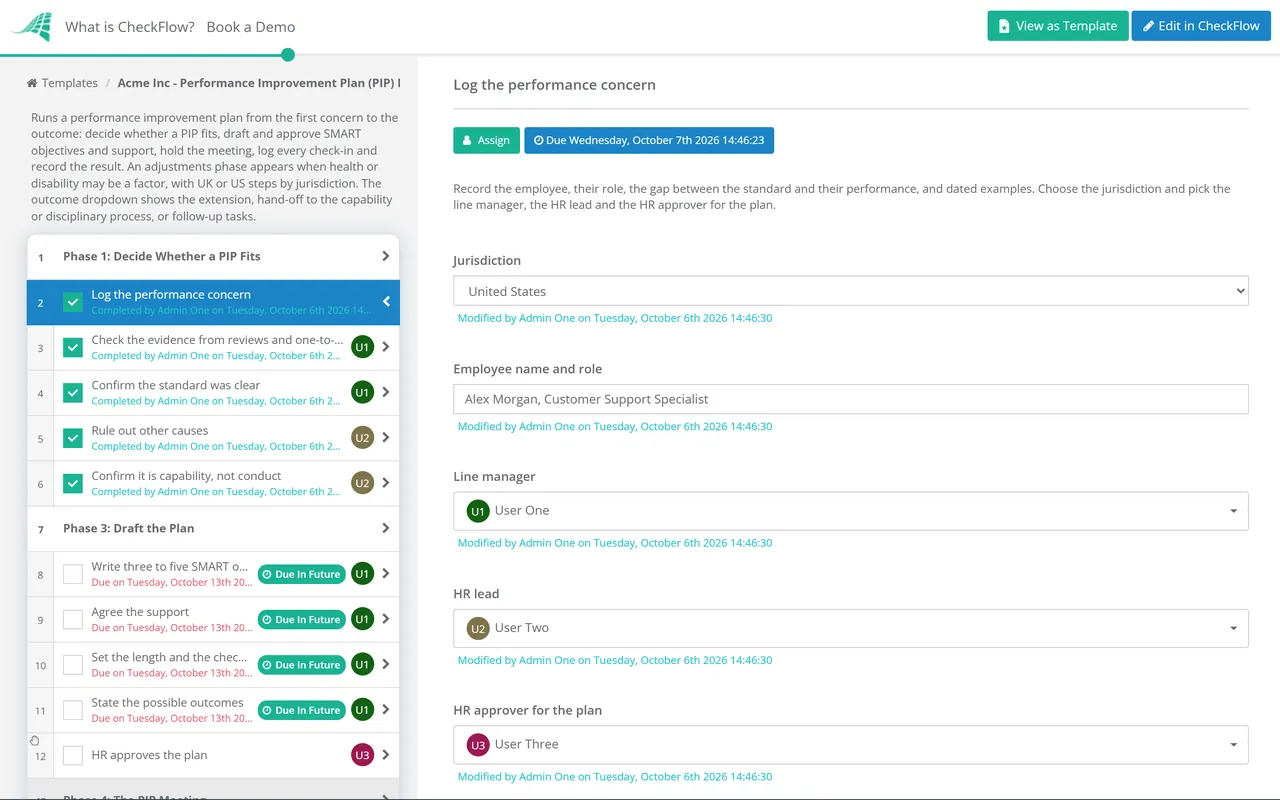
Phase 1: Decide Whether a PIP Fits

  • Log the performance concern — the role, the gap and dated examples
  • Check the evidence from reviews and one-to-ones
  • Confirm the standard was clear — job description, targets and earlier feedback
  • Rule out other causes — health or disability, training, workload, tools and personal circumstances
  • Confirm it is capability, not conduct — misconduct goes to the disciplinary procedure
Phase 2 — If Needed

Phase 2: Health & Adjustments

Shown when health or disability may be a factor.

  • Hold the plan while adjustments are considered
  • Consider reasonable adjustments (UK) — with an occupational health referral if the employee agrees
  • Start the ADA interactive process (US) — discuss the limitation and possible accommodations
  • Record the adjustments agreed and when they start
Phase 3

Phase 3: Draft the Plan

  • Write three to five SMART objectives — each tied to a documented gap
  • Agree the support — training, coaching, tools, workload changes and a named contact
  • Set the length and the check-in dates — commonly 30, 60 or 90 days
  • State the possible outcomes — success, an extension, or the formal capability or disciplinary route
  • HR approves the plan — before the employee sees it
Phase 4

Phase 4: The PIP Meeting

  • Invite the employee in writing — the purpose, the date and who will attend
  • Walk through the gap, the objectives and the support
  • Ask for the employee’s view — and adjust the plan if they raise something new
  • Share the written plan — a signature confirms receipt, not agreement
Phase 5

Phase 5: Check-ins

  • Hold each check-in on schedule — weekly or fortnightly, never skipped
  • Record progress against each objective — with evidence for each measure
  • Confirm the promised support was delivered
  • Hold a mid-point review — say plainly whether the employee is on track
  • Flag anything that changes the picture — new health information, a role change or a workload spike
Phase 6

Phase 6: Outcome & Hand-off

  • Hold the final review meeting
  • Record the outcome — successful, extended or unsuccessful
  • Confirm the outcome in writing
  • Set a new end date for an extension — once, with reasons
  • Hand off to the capability or disciplinary process — if the plan was unsuccessful
  • Book a follow-up three months on — if the plan succeeded

Weak vs SMART PIP Objectives

Most PIPs fail at the objectives. “Improve communication” cannot be met or missed, so the final review becomes an argument about impressions. A SMART objective is specific, measurable, achievable, relevant and time-bound: the employee can see on any day whether they are on track, and so can anyone who reviews the file later. The examples below show the same intent written both ways.

Role Weak objective SMART objective Evidence at check-ins
Customer supportImprove customer serviceResolve at least 85% of tickets within the 24-hour target each week from week 3, up from 68% now, with no more than two reopened a weekWeekly ticketing report
SalesBe more proactiveBook at least eight qualified discovery calls a week by week 4 (currently four; team average ten), each logged in the CRM with a next stepCRM activity report
Software developerWrite better codeBy day 60, have four in five pull requests approved after no more than one round of changes, and include a test with every bug fixCode review history
Accounts payableMake fewer mistakesKeep the invoice error rate below 2% on the weekly sample check from week 4, down from 9% nowSample check results
Project coordinatorCommunicate betterSend the status report, with risks and next steps, to all stakeholders by 10am every Monday for the length of the planSent reports and stakeholder feedback
Team leadShow more leadershipHold a documented one-to-one with each direct report every two weeks, and agree a development goal with each by day 45One-to-one notes and goals
Do

Objectives that hold up

  • Start from a measured baseline
  • Set the target at what others in the role achieve, not above it
  • Pair every objective with the support offered for it
  • Keep to three to five objectives
  • Agree how each will be measured before the plan starts
Avoid

Objectives that fall apart

  • Personality traits such as “attitude” or “energy”
  • Targets nobody else in the team meets
  • Measures that depend on other people’s work
  • New objectives added halfway through
  • Anything the employee has never been told about before

What to write at each check-in. Keep every entry in the same shape: the date, each objective, the measure this week against the target, the support given since the last meeting, anything the employee raised, and the agreed next step. Write it the same day and share it with the employee. Short, factual entries are more useful than long ones. At the final review, the log should tell the story on its own: whether the objectives were met, whether the support was delivered as promised, and whether anything changed along the way. If the log is thin, the outcome will be hard to defend, whichever way it goes.

Why Run Performance Improvement Plans in CheckFlow?

1

Check-ins that happen

Check-in tasks are due a set number of days after the plan start date and assigned to the line manager. Each one adds a row to the check-in log, so a skipped week shows up as overdue rather than being discovered at the final review.

2

The right path for each case

One dropdown shows the adjustments phase when health may be a factor, with UK or US steps by jurisdiction. The outcome dropdown shows the extension, hand-off or follow-up tasks, so nobody has to remember what comes next.

3

A plan HR has signed off

The plan is an approval task for the HR approver, and the checklist halts until it is approved. Evidence and letters are uploaded to their tasks, and the audit trail shows who did each step and when.

Performance management runs across the year. CheckFlow’s HR checklist software runs reviews, development plans, PIPs and disciplinary cases from templates, with assignments, due dates and approvals shared between HR and line managers.

A PIP sits between two other processes. The Employee Performance Review Checklist is where the gap is usually found, and the Disciplinary Procedure Checklist is where an unsuccessful plan goes next, with the same evidence carried across.

Frequently Asked Questions

What is a performance improvement plan?

+

A performance improvement plan, or PIP, is a written plan for an employee who is not meeting the standard of their role. It sets out the gap, a small number of measurable objectives, the support the employer will give, how long the plan lasts, when progress will be reviewed and what happens at the end. Done well, it is a genuine attempt to help someone succeed, with a clear record of what was tried.

How long should a PIP last?

+

Long enough for the employee to show sustained improvement, which depends on the role. Thirty days can work for high-volume tasks with weekly measures; sixty or ninety days suits roles where results take longer to show. No law sets a period. Set the length in the plan, review it at the mid-point, and extend only once, for a clear reason such as an absence or an adjustment that started late.

Is a PIP a disciplinary action?

+

It depends on your policy. Many employers use an informal PIP first and move to a formal capability procedure only if it fails. Others make the plan the first formal stage: the Acas guide describes an “improvement note” for poor performance that is equivalent to a first written warning. In the UK, if the meeting could lead to a formal warning, the employee has the right to be accompanied. Tell the employee which kind of plan this is.

What if the employee says a health condition is affecting their work?

+

Pause and look at it before going further. In the UK, consider reasonable adjustments under the Equality Act 2010 and an occupational health referral. In the US, start the ADA interactive process; the EEOC’s example postpones the PIP while an accommodation request is discussed. Once adjustments are in place, restart the plan with fresh dates. Past poor performance does not have to be excused, but the plan should give a fair chance with the adjustments in place.

Does the employee have to sign the PIP?

+

No. Ask them to sign to confirm they have received the plan, and say clearly that a signature does not mean they agree with it. If they decline, note that the plan was handed over and when. Invite their comments in writing and keep them with the plan: disagreement often points to something the manager missed.

What happens if a PIP is unsuccessful?

+

The case moves to your formal capability or disciplinary procedure, which can lead to a written warning, a final warning and, if improvement still does not follow, dismissal. Redeployment to a more suitable role is worth considering first. Carry the plan, the check-in log and the evidence across, so the formal stage starts from a clear record rather than a fresh argument.

Is CheckFlow free for this template?

+

14-day free trial, no card required. The Business plan is $10 per user per month after the trial. Full details at checkflow.io/pricing.

Give Every Improvement Plan a Fair Chance of Working

Free trial — no credit card required.