Petty Cash Reconciliation Checklist Template

A petty cash box is only right if the cash and the receipts in it still add up to the float. Counted by the custodian, checked by someone else and approved before the top-up, any gap is explained while the receipts are still to hand.

Last reviewed: October 2026

Printed from checkflow.io/templates/finance-accounting/petty-cash-reconciliation-checklist

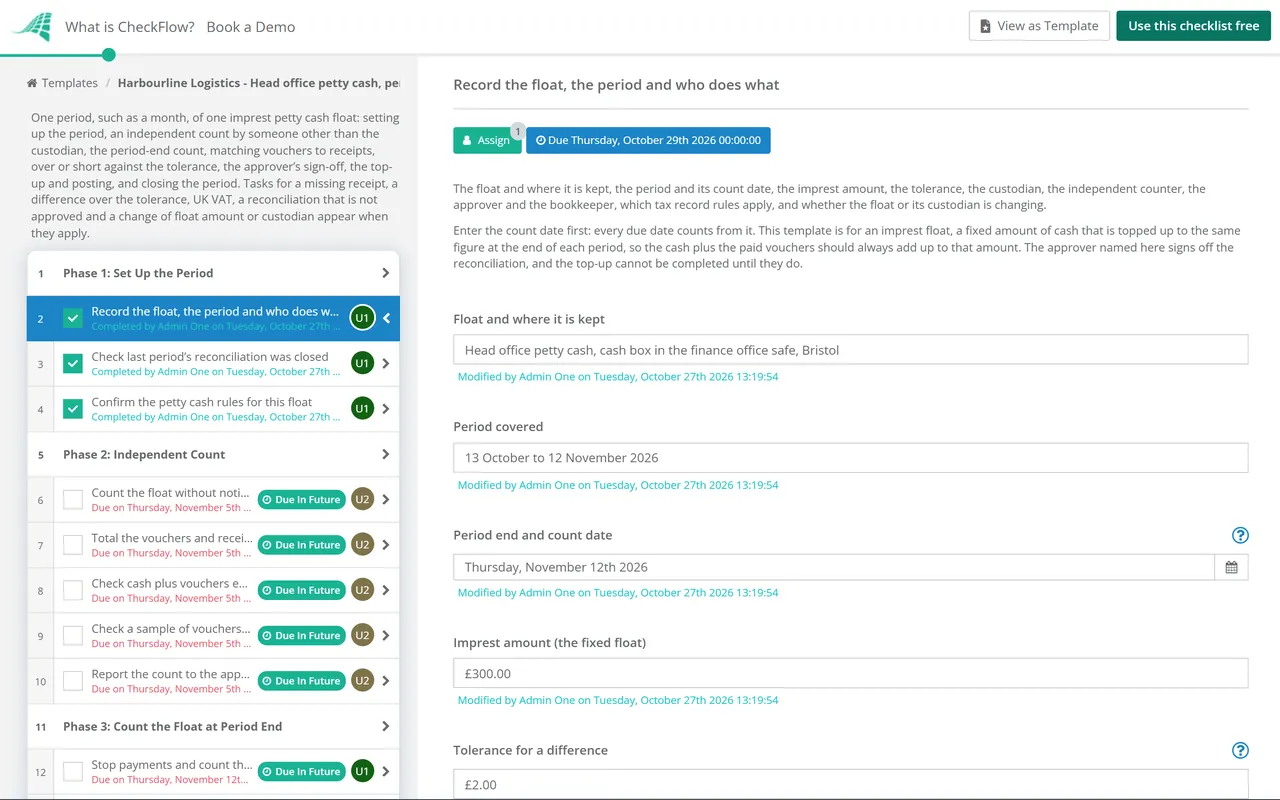
This free petty cash reconciliation template is for the petty cash custodian, the person who counts the float independently, the manager who approves the top-up and the bookkeeper who posts it. One run is one period, such as a month, of one imprest float: a fixed amount of cash that is topped up to the same figure each time. It has someone other than the custodian count the float during the period, counts it again at period end by note and coin, matches every voucher to its receipt and checks each payment against your petty cash rules. Then it works out over or short against your tolerance, adds a recount and an explanation for a difference over it, and has the approver sign off before the top-up is drawn, posted to the expense accounts, with the VAT where it applies, and the records filed. Answers on the first task add a VAT task for a UK VAT-registered business and the tasks to change the float or hand it to a new custodian.

Petty Cash Reconciliation, Not One Line in the Month-End Close

Several finance checklists give petty cash a single line. The Balance Sheet Reconciliation Checklist agrees petty cash to a count, the Month-End Close Checklist asks you to confirm the petty cash reconciliation, and the Monthly Bookkeeping Checklist says to count and reconcile petty cash if the business keeps any. This checklist is that line done in full: one period of one imprest float, from the count to the top-up and the posting.

It is not the till either. The End-of-Day Cash-Up Checklist records petty cash paid out of the tills on one trading day. This checklist is for a separate float in a box or safe, held by a custodian and topped up at the end of each period. Its top-up then appears in the Bank Reconciliation Checklist like any other payment from the bank.

This checklist

One period of one petty cash float

Covers: an independent count, the period-end count by denomination, vouchers and receipts, the petty cash rules, over or short against tolerance, the approval, the top-up, the posting, VAT where it applies, and a change of float or custodian.

When: monthly, or at the end of whatever period the float is topped up.

Output: an approved reconciliation, a float back at its imprest amount and the period’s spending posted.


One trading day

The End-of-Day Cash-Up Checklist

Covers: Z reports, till counts, card terminals, petty cash paid out of the tills, over or short and banking for one site’s day.

Use it: every trading day, at close. End-of-Day Cash-Up Checklist.

What the Petty Cash Reconciliation Checklist Covers

Nine phases follow one petty cash float through one period, from setting up the run to closing it. The answers on the first task assign every task, set each due date from the count date and decide what else appears: a VAT task for a UK VAT-registered business, a note on keeping records for the UK or the US, and the float change and handover tasks when the amount or the custodian changes. A payment with no receipt, a difference over the tolerance and a reconciliation that is not approved each add their own tasks. The approval is the gate: the top-up and posting tasks wait until it is done.

  1. Phase 1

    Phase 1: Set Up the Period

    3 tasks

    The custodian starts the run about two working weeks before the period ends. The answers on the first task assign every task, set each due date from the count date and add the tasks this period needs.

    • Record the float, the period and who does what — the float and where it is kept, the period and its count date, the imprest amount, the tolerance, the custodian, the independent counter, the approver and the bookkeeper, which tax record rules apply, and whether the float or its custodian is changing
    • Check last period’s reconciliation was closed — last period’s reconciliation approved, its top-up counted into the float and the petty cash balance in the ledger equal to the imprest amount, so this period starts from a known figure
    • Confirm the petty cash rules for this float — the most that can be paid in one payment, what petty cash may and may not be used for, who can authorise a payment and how a cash advance is handled, taken from your own petty cash policy
  2. Phase 2

    Phase 2: Independent Count

    5 tasks

    Someone other than the custodian counts the float during the period, on a day of their choosing up to the due date. The due date is the latest day for it; an earlier, unannounced day tests the float better. Where your policy asks for a surprise count, the custodian is not told the day in advance. Cash plus paid vouchers should equal the imprest amount on any day, so this count stands on its own.

    • Count the float without notice, with the custodian present — the cash counted by note and coin by the independent counter, with the custodian watching and the box never left with one person while it is open
    • Total the vouchers and receipts in the box — every paid voucher and receipt in the box added up, with any signed slip for a cash advance totalled separately
    • Check cash plus vouchers equals the imprest amount — the cash counted plus the vouchers and any advances set against the imprest amount, with the difference over or short written down
    • Check a sample of vouchers against their receipts — a few vouchers picked at random, each checked for a receipt for the same amount, an authorising signature, an amount within the limit and a business purpose
    • Report the count to the approver — the count sheet signed by the independent counter and the custodian, and the difference and anything found in the sample sent to the approver
  3. Phase 3

    Phase 3: Count the Float at Period End

    4 tasks

    The custodian counts the float on the count date, after the last payment of the period. The cash, the paid vouchers and any advances still out should add up to the imprest amount.

    • Stop payments and count the cash by note and coin — no more payments from the box once the count starts, then every note and coin counted and entered by denomination
    • Collect and total the paid vouchers — every petty cash voucher for the period taken out of the box, put in date order and added up
    • Record any cash advances still out — any cash handed out against a signed slip for a purchase not yet made, with who has it, how much and when the receipt and change are due back
    • Add the count up against the imprest amount — cash counted plus vouchers plus advances, set against the imprest amount before any voucher is checked
  4. Phase 4

    Phase 4: Match Vouchers & Receipts

    7 tasks

    Every payment needs a voucher, a receipt and an authorisation. A payment with no receipt adds a task, and for a UK VAT-registered business another task records the VAT on valid VAT receipts.

    • List every voucher for the period — each voucher numbered in sequence with its date, who was paid, what for and the amount, so a missing or repeated number shows
    • Match each voucher to its receipt — each voucher matched to a till receipt or invoice for the same amount, with the receipt attached to the voucher
    • Missing receipt: record the payment and get it approved — a signed note from the person who spent the money saying what was bought, when, from whom and for how much, approved by the approver before the payment is accepted
    • Check each payment is within the petty cash rules — each payment under the single payment limit, for something petty cash may be used for, authorised by someone allowed to, and not split into smaller payments to get under the limit
    • Code each voucher and total by expense account — each voucher given the expense account or cost centre it belongs to, such as postage, travel, refreshments or office supplies, and the vouchers added up by account
    • VAT: record the VAT on each valid VAT receipt — the VAT on each receipt that is a valid VAT invoice recorded apart from the net cost, and no VAT claimed on a receipt that is not one
    • Check the coded total equals the vouchers total — the totals by expense account added up and checked against the vouchers total from the count, so nothing is left uncoded or counted twice
  5. Phase 5

    Phase 5: Over or Short

    5 tasks

    Set the count against the imprest amount. A difference over the tolerance adds three tasks: recount, trace the cause and record the explanation for the approver.

    • Work out the difference, over or short — the imprest amount less the cash, the vouchers and any advances; short means less than the float should hold, over means more
    • Over tolerance: recount the cash and re-add the vouchers — the cash counted again by a second person and the vouchers added up again, because a counting or adding error is the first thing to rule out
    • Over tolerance: trace the cause — the voucher list checked for a missing or repeated voucher, change not returned from a purchase, a payment made without a voucher, an advance not recorded, or last period’s top-up drawn for the wrong amount
    • Over tolerance: record the explanation for the approver — the amount, the likely cause, who had access to the box and what happens next, written as fact; nobody is accused without evidence
    • Record how any difference will be posted — any difference that is left, within the tolerance or explained, written down with the account it will be posted to, such as cash over and short, so the float can be topped up to the full imprest amount
  6. Phase 6

    Phase 6: Reconciliation & Approval

    4 tasks

    The custodian puts the reconciliation and the top-up request together, and the approver checks them against the vouchers and receipts. The approval is the gate: the top-up and posting tasks cannot be completed until it is done.

    • Prepare the reconciliation and the top-up request — one sheet with the imprest amount, the cash counted, the vouchers by expense account, any advances, the difference and the top-up asked for, which is the vouchers total plus any shortage or less any overage, signed by the custodian
    • Approver checks the reconciliation against the vouchers — the count, the vouchers, the receipts and the arithmetic checked, any payment outside the rules questioned, and anything that does not add up sent back to the custodian
    • Approve the reconciliation and the top-up — the reconciliation, any difference and the top-up amount approved by someone other than the custodian; if it is not ready, leave this task open, because the top-up and posting tasks cannot be completed until it is done
    • Not approved: put right what the approver raised — each point the approver raised answered or corrected, the reconciliation sheet updated and sent back, and no top-up drawn until the approver has approved it
  7. Phase 7

    Phase 7: Top-Up & Posting

    6 tasks

    The bookkeeper draws the approved top-up and posts the period’s vouchers. In an imprest system the top-up brings the cash back to the fixed amount, so the petty cash balance in the ledger stays at the imprest amount.

    • Draw the approved top-up — the approved amount drawn from the bank by cheque, transfer or cash withdrawal for petty cash, with the bank reference recorded
    • Count the top-up into the float and sign for it — the top-up counted in front of a second person and put in the box, so the cash now equals the imprest amount, less any advances still out
    • Post the vouchers to their expense accounts — one entry for the period: each expense account debited with its total, the VAT to its own account where it can be reclaimed, and the bank credited with the top-up
    • Post any difference to cash over and short — a shortage or overage left after the investigation posted to its own account, such as cash over and short, with the approver’s decision as the authority, and never hidden in an expense account
    • Check the petty cash ledger balance equals the imprest amount — the petty cash account in the ledger checked after posting; it should equal the imprest amount, and a gap means a posting is missing or wrong
    • File the reconciliation, vouchers and receipts — the signed reconciliation, the vouchers with their receipts, the count sheets and the approval kept together for the period, for as long as your tax rules require
  8. Phase 8

    Phase 8: Float Change & New Custodian

    5 tasks

    Applies only when the first task says the imprest amount or the custodian is changing. A new amount is agreed with the approver and posted, and a new custodian takes over only after a joint count.

    • Float change: agree the new imprest amount — the new fixed amount agreed by the approver, sized to the payments the float makes between top-ups, with the reason recorded
    • Float change: adjust the float and post the change — an increase drawn from the bank and put in the box, or a decrease counted out and paid back into the bank, posted to the petty cash account so its balance equals the new imprest amount
    • New custodian: count the float with both custodians present — the outgoing and incoming custodians count the cash and the vouchers together, check they equal the imprest amount and both sign the count before the box changes hands
    • New custodian: hand over the box, keys and records — the box, every key, a new safe code where there is one, the voucher pad and the period’s records handed to the incoming custodian, with the date recorded
    • New custodian: update who is authorised to hold the float — the custodian’s name changed in the petty cash policy, the list of who may authorise payments and the bank mandate for drawing top-ups, so the next run names the new custodian
  9. Phase 9

    Phase 9: Close the Period

    3 tasks

    Close the run once the float is back to its imprest amount and the records are filed, and note anything the next period should know.

    • Review how the float was used this period — the payments by expense account compared with earlier periods, any payment that should have gone through purchasing or expense claims instead, and whether the float is too large or too small
    • Note anything for the next period — advances still out, receipts promised, a change to the rules or a float that ran short before the period ended, written where the next run will see it
    • Approver confirms the period is closed — the approver confirms the float is back to its imprest amount, the entries are posted and the records are filed, which closes the period

How the Float Adds Up, and the Records Behind It

How an imprest float adds up

On any day, the cash in the box plus the paid vouchers, plus any advance still out, should equal the imprest amount. Each figure has its own evidence, and checking them one at a time is what turns a difference into an explanation.

Figure Where it comes from Checked against What a gap can mean
Imprest amountThe fixed float in your petty cash policy, agreed by the approverThe petty cash balance in the ledgerA top-up or a float change posted wrongly
Cash countedThe count by note and coin on the count dateThe independent count during the periodChange not returned from a purchase, a payment with no voucher, a counting error
Paid vouchersThe vouchers for the period, numbered in sequenceThe receipt attached to each voucherA missing voucher number, a voucher entered twice, a receipt for a different amount
Advances still outSigned slips for cash handed out before a purchaseThe receipt and the change when they come backAn advance that was never settled
DifferenceThe imprest amount less the cash, vouchers and advancesThe tolerance in your policyAny of the above; a difference over the tolerance is investigated before approval
Top-upThe vouchers total plus any shortage, or less any overageThe approved amount and the bank entryA top-up drawn for the wrong amount

What the tax authorities say, UK and US

No law sets out how to run petty cash. The steps in this checklist, from the independent count to the tolerance and the approval, are practice that each business sets in its own policy. The points below come from HMRC and the IRS and are about the records behind the payments. This is not legal or tax advice.

Point United Kingdom (HMRC) United States (IRS)
Proof of each paymentA VAT-registered business must keep all purchase invoices for items it buys; the VAT invoices it receives are the primary evidence for recovering VATSupporting documents should show the amount paid and that it was for a business expense; petty cash slips for small cash payments are on the IRS list
How the fund worksHMRC sets no petty cash procedureIn Publication 583’s example, a slip is attached to each receipt, the unspent cash plus the slips should equal the fixed amount, and a check to “Petty Cash” for the slips restores the fund
Reclaiming VATYou must have valid VAT invoices; you cannot reclaim VAT using an invalid invoice, a pro-forma invoice, a statement or a delivery note. A business on the Flat Rate Scheme cannot reclaim VAT on purchases, except certain capital assets over £2,000Not applicable: there is no VAT
Small purchasesA supplier may give a simplified VAT invoice for a supply of £250 or less including VAT; for some supplies of £25 or less, such as car park charges and coin-operated machines, no VAT invoice is needed if the supplier was VAT-registeredNot applicable
How long to keep the recordsVAT records: at least 6 years. Limited company: 6 years from the end of the last financial year they relate to. Sole trader: at least 5 years after the 31 January deadlineUntil the period of limitations for the return runs out: 3 years in the usual case, longer in the cases the IRS lists

Sources. The IRS on starting a business and keeping records (Publication 583), including its petty cash fund example, and on how long to keep records; HMRC on reclaiming VAT on business expenses, keeping VAT records, record keeping for VAT (VAT Notice 700/21) and the VAT guide (VAT Notice 700), section 19.5.9, and on company records and self-employed records.

Why Reconcile Petty Cash in CheckFlow?

1

The same reconciliation every period

A recurring schedule starts each float’s run about two working weeks before the period ends. Enter the count date and every task gets a due date from it: the independent count before it, the count on it, and the approval and the posting in the week after.

2

Nothing topped up before it is approved

The custodian counts, someone else counts too, the approver signs off and the bookkeeper posts, each assigned from the first task. The approval is a gate: the top-up and posting tasks cannot be ticked off until it is done. See how approval steps work.

3

Every voucher with its receipt

The vouchers and the totals by expense account are recorded in tables, receipts and count sheets are uploaded to the tasks they belong to, and the activity log shows who counted, who approved and who posted. The Reports Grid lists every period’s reconciliation with its answers, so a difference over tolerance stands out.

CheckFlow does not hold cash, count it or post to your ledger; your cash box, your bank and your accounting software do that. CheckFlow runs the process around them: who counts, who checks, what was found, who approved the top-up and when it was posted.

Cash up the tills each day with the End-of-Day Cash-Up Checklist. Use this reconciliation as the evidence for the petty cash line in the Balance Sheet Reconciliation Checklist, the Month-End Close Checklist and the Monthly Bookkeeping Checklist, match the top-up in the Bank Reconciliation Checklist, review petty cash spending with the Expense Audit Checklist, and pay back staff who spent their own money with the Expense Reimbursement Process Checklist.

AI generator

Didn’t find what you need? Describe it.

Describe the process in a sentence and the AI checklist generator drafts the phases and tasks for you.

Frequently Asked Questions

What is a petty cash reconciliation?

A petty cash reconciliation checks that the cash in the petty cash box, plus the receipts for what was paid out, adds up to the amount the float should hold. Any difference is found and explained, the float is topped up and the spending is posted to the accounts. This petty cash reconciliation template runs it for one float and one period, with an independent count, an approval before the top-up and the entries in the ledger.

How do you reconcile petty cash?

Count the cash by note and coin, total the paid vouchers and any advances still out, and set the total against the imprest amount. Match every voucher to its receipt, check each payment against your petty cash rules and code it to an expense account. Investigate any difference over your tolerance, have someone other than the custodian approve the reconciliation, then draw the top-up, post the vouchers and file the records.

What is an imprest petty cash system?

An imprest float is a fixed amount of cash that is topped up to the same figure at the end of each period. Between top-ups, the unspent cash plus the receipts for what was spent should always equal that fixed amount. The IRS describes the same idea in Publication 583: a petty cash slip attached to each receipt, and a check to “Petty Cash” for the total of the slips that restores the fund to its fixed amount.

How often should petty cash be reconciled?

No law sets a frequency; your own policy does. This template runs one period, such as a month, and a recurring schedule can start it about two working weeks before each period ends. Reconcile sooner when the cash runs low, before a new custodian takes over and at the financial year end, so the petty cash figure in the accounts is right. An independent count during the period is part of every run.

What should you do if petty cash is short or over?

Count the cash again with a second person and add the vouchers up again. Then look for a missing or repeated voucher, change not returned from a purchase, a payment made without a voucher, an advance not recorded or a top-up drawn for the wrong amount. Record the amount, the likely cause and the next step as fact, and let the approver decide before the difference is posted to its own account, such as cash over and short.

Who should count and approve petty cash?

This template keeps the jobs apart: the custodian holds the float and counts it, an independent counter who is not the custodian counts it during the period, an approver who is not the custodian signs off the reconciliation and the top-up, and the bookkeeper posts the entries. That split is practice, not a legal requirement. In a small business one person may hold two roles, but the custodian should not approve their own reconciliation.

What journal entry replenishes petty cash?

In an imprest system the top-up is posted as the period’s spending: each expense account is debited with its total, reclaimable VAT goes to its own account, and the bank is credited with the top-up. The petty cash account itself stays at the imprest amount. A shortage or overage that is left goes to its own account, such as cash over and short. Check your chart of accounts with your accountant.

Can you reclaim VAT on petty cash purchases?

In the UK, a VAT-registered business can reclaim VAT on business purchases, but HMRC says you must have valid VAT invoices. A supplier may give a simplified invoice for a supply of £250 or less including VAT. VAT Notice 700 lists a few supplies of £25 or less, such as car park charges and coin-operated machines, where no invoice is needed if the supplier was VAT-registered. A business on the Flat Rate Scheme cannot reclaim VAT on these purchases.

How long should petty cash records be kept?

As long as your tax rules require. In the UK, HMRC says VAT records must be kept for at least 6 years, a limited company keeps its records for 6 years from the end of the last financial year they relate to, and a sole trader for at least 5 years after the 31 January deadline. In the US, the IRS says to keep records until the period of limitations runs out, 3 years in the usual case.

Is CheckFlow free for this template?

14-day free trial, no card required. The Business plan is $10 per user per month after the trial. Full details at checkflow.io/pricing.

Reconcile Petty Cash the Same Way Every Period

Free trial — no credit card required.

14-day free trial, no credit cardFull refund in your first 30 daysUS hosting, EU on request