Expense reimbursement
- One claim at a time, as it is submitted
- Receipts attached, policy limits, business purpose
- Line manager and finance approval
- Run with the Expense Reimbursement Checklist
Last reviewed: October 2026
No Credit Card Required
Printed from checkflow.io/templates/finance-accounting/expense-audit-checklist
An expense audit looks back at claims already approved and paid, to test whether approval worked, whether the tax treatment was right and whether anyone is exploiting the gaps. This free expense audit checklist is for finance managers, controllers and internal auditors who review employee expenses monthly or quarterly. It covers defining and reconciling the population, risk-based and random selection, receipt and policy testing, the tax checks, findings and recovery, and a report to the CFO or audit committee. A scope question at the start shows the UK tax phase, the US tax phase or both, and a second question adds corporate card spend coded to expenses to the population.
Most expense controls look at one claim at a time: a manager approves, finance checks the receipts, the claim is paid. That cannot see patterns: the same hotel bill claimed by two colleagues, a manager who always approves at 11pm without opening the receipts, or an employee whose mileage would mean driving 400 miles every working day.
The audit looks across the whole paid population, picks the claims most likely to be wrong plus a random sample, and tests them properly, including points a line manager is rarely qualified to judge, such as VAT recovery or US accountable plan treatment. Findings go back into the policy and the approval limits.
Seven phases take the audit from population to report. Phase 4 appears for UK claims and Phase 5 for US claims; answer “Both” to see each.
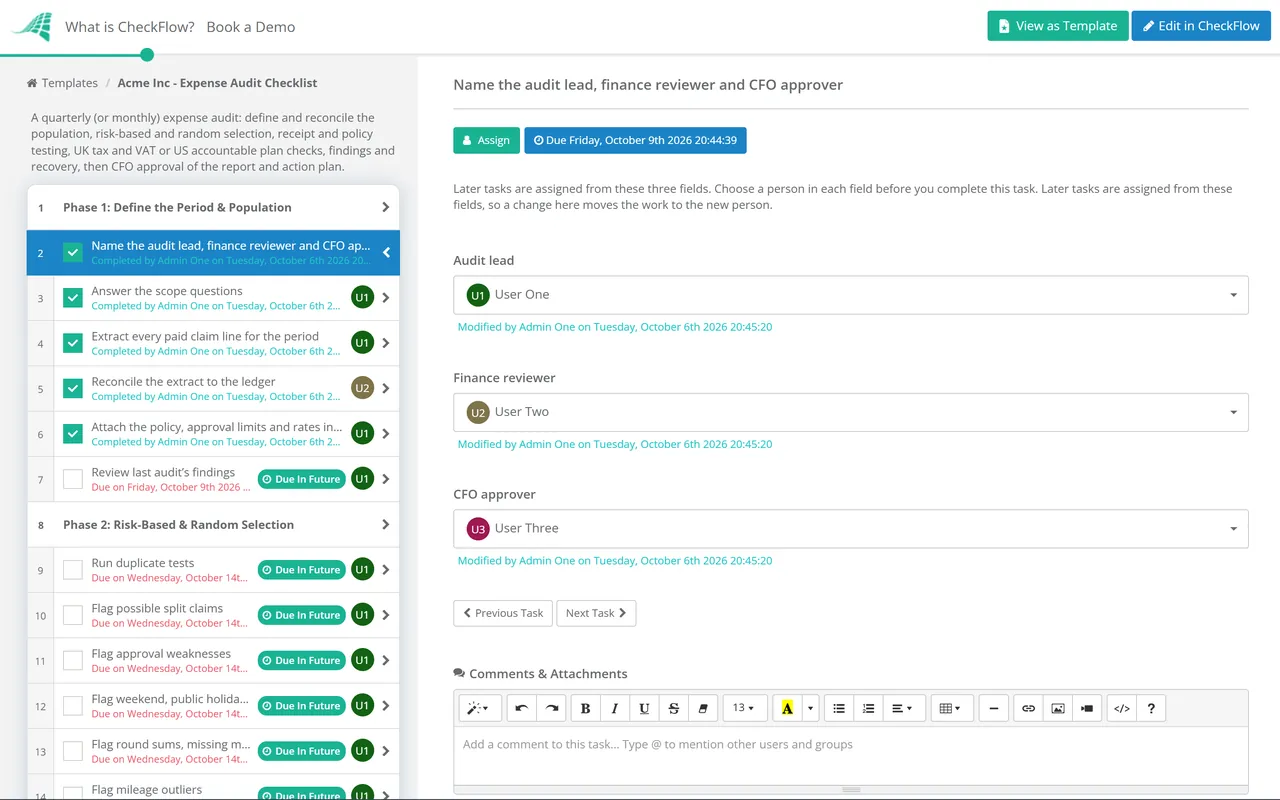
Owned by the audit lead. The two scope questions decide which tax phase appears and whether card spend is tested.
Shown only when the scope answer is UK or Both.
Shown only when the scope answer is US or Both.
Each red flag in Phase 2 points at a way the approval process can fail. None proves anything on its own: a weekend hotel bill may be a Sunday-night flight. They tell you where to look first.
| Red flag | What it can mean | How the audit tests it |
|---|---|---|
| Same amount, date and merchant twice | A receipt claimed twice, or paid on the corporate card and claimed again | Duplicate test across claims and card transactions, then the receipts |
| Several items just under a limit | One expense split to avoid a receipt or approval threshold | Group by claimant, date and merchant; compare the combined total with the limit |
| Claimant approved their own claim | A gap in the approval workflow, or a delegate approving for a senior manager | Approver against the claimant and the delegation of authority |
| Expenses on leave days or public holidays | Personal spend presented as business | Dates against the HR absence record and travel bookings |
| High annual mileage or repeated identical journeys | Inflated distances or commuting claimed as business travel | Distances against a route planner; journeys against diary or client records |
| Claims submitted long after the expense | Old receipts recycled; in the US, loss of accountable plan treatment | Submission date against expense date and the substantiation deadline |
The tax rules differ more than most expense policies admit. The table below sets out the points Phases 4 and 5 test, as in force in October 2026.
| Point tested | United Kingdom | United States |
|---|---|---|
| Tax-free mileage | Approved mileage allowance payments: 55p a mile for the first 10,000 business miles in a car or van from 6 April 2026 (45p before), then 25p; motorcycles 24p, bicycles 20p | IRS business standard mileage rate: 72.5 cents a mile from 1 January 2026, 76 cents from 1 July 2026; reimbursement above the rate is wages |
| Receipts | VAT can be reclaimed only with a valid VAT invoice; a simplified invoice is acceptable at £250 or less including VAT | Documentary evidence for all lodging and for any other expense of $75 or more, plus a record of amount, date, place and business purpose |
| Flat-rate allowances | Benchmark scale rates for subsistence (£5, £10 and £25 for qualifying journeys of 5, 10 and 15 hours, the last ongoing at 8pm) or an HMRC-approved bespoke rate | Per diem at or below the federal rate is treated as substantiated for the amount; the excess is wages |
| When a reimbursement becomes taxable | Non-exempt payments and personal spend go on the P11D, through payroll or into a PAYE Settlement Agreement | Amounts not substantiated or not returned within a reasonable period are paid under a nonaccountable plan and are wages |
What changed in 2026, and what is coming. The UK raised the approved mileage rate for cars and vans from 45p to 55p, backdated to 6 April 2026 and the first change since 2011; legislation is to follow with retrospective effect. Employers that kept paying 45p can top up the difference tax-free, so check which rate each claim used. In the US, the IRS raised the business mileage rate mid-year, from 72.5 to 76 cents for miles driven on or after 1 July 2026, citing fuel prices. From 6 April 2027 UK employers must payroll company cars, vans, fuel and medical benefits in real time, with most other benefits following from 6 April 2028, so taxable items found in an audit will increasingly need to reach payroll during the year.
A recurring schedule creates the audit at the start of each month or quarter with the audit lead, reviewer and CFO assigned and every due date counted from the period end.
The report goes to a named CFO as an approval task. Nothing after it can be completed until the CFO records Approved or Not approved, so the audit committee only sees a reviewed report.
The extract, the selection, receipts and exception notes sit on the task that produced them, and the timestamped activity trail can be exported for external auditors.
Most findings trace back to a weak step earlier in the cycle. The Expense Reimbursement Checklist fixes the approval before payment, the Credit Card Reconciliation Checklist gets card receipts and coding in each month, and the Payroll Audit Checklist checks that taxable expenses reached payroll.
CheckFlow is not an expense management system or a data analytics tool. The duplicate tests run in your expense software, ERP or spreadsheet; CheckFlow runs the audit around them, so every step is assigned, evidenced and approved. Read how approval workflows work, or how conditional logic shows only the tax phase that applies.
Describe the process in a sentence and the AI checklist generator drafts the phases and tasks for you.
A review of employee expense claims, and often corporate card spend, after approval and payment. It selects claims by risk and at random, tests them against receipts, policy and tax rules, recovers anything paid in error and reports the results.
There is no legal minimum. Many teams test every claim that hits a red flag and add a random sample of the rest, sized so each active claimant is likely to be selected over a year. To state an error rate for the whole population, use a statistical sampling method and record it in Phase 2.
Duplicate claims, including a corporate card charge claimed again out of pocket; expenses split to stay under a limit; personal spend on leave days or public holidays; inflated mileage; round-sum or unreceipted claims; and claims approved by the claimant or by someone who reports to them. Each needs investigating before anyone draws a conclusion.
For cars and vans, 55p a mile for the first 10,000 business miles in the tax year and 25p a mile after that, from 6 April 2026. The rate was 45p until 5 April 2026. Motorcycles stay at 24p and bicycles at 20p. Employers can pay up to these approved amounts tax-free; anything above them is taxable.
Sixty days is a safe harbour under the fixed date method, not a hard deadline. But amounts not substantiated, or advances not returned, within a reasonable period are treated as paid under a nonaccountable plan: they become wages, subject to withholding, social security, Medicare and FUTA.
14-day free trial, no card required. The Business plan is $10 per user per month after the trial. Full details at checkflow.io/pricing.
14-day free trial, no credit cardFull refund in your first 30 daysUS hosting, EU on request