Small-business books don’t fall behind in one bad month. They fall behind one uncategorised transaction at a time, until the bank feed holds four hundred unexplained lines and the tax return is due on Friday.
Bookkeeping is mostly small, routine tasks that are easy to put off: coding the bank feed, filing receipts, entering bills and chasing a customer who is a week late. Done weekly, each takes minutes. Left for a quarter, they turn into days of reconstruction and a set of accounts nobody fully trusts. This free monthly bookkeeping checklist is built for small-business owners, in-house bookkeepers and bookkeeping firms that look after several clients. It splits the work into the cadence it actually needs: two short weekly phases to keep the ledger current, four monthly phases to reconcile, record payroll and sales tax, tidy the ledger and report, and a quarter-end phase that appears only in the months that need it. It works alongside Xero, QuickBooks, Sage, FreeAgent or any other accounting software, because it manages the routine rather than the ledger itself.
The two are often confused, and the difference matters when you choose a template. Monthly bookkeeping keeps a small business’s records complete, categorised and reconciled so the owner knows where they stand and the tax returns can be filed. A month-end close is what a finance team does in a larger company: a timed, multi-day process of cut-off, full balance sheet reconciliation, accruals, journals and a management reporting pack signed off by a controller or CFO.
Bookkeeping firms have a second problem: the same routine repeated for thirty or fifty clients, each with its own bank accounts, tax registrations and quirks. The work itself is familiar. What goes wrong is keeping track of which clients are finished, which are waiting on a missing statement and which quietly fell a month behind. A checklist per client per month, with the client’s own questions assigned back to them, turns that into something you can see at a glance.
Many businesses move from one to the other as they grow. A business that has hired its first finance manager, needs accrual accounts for a lender or has more than one entity has usually outgrown this checklist and should use the month-end close instead.
Monthly bookkeeping
For owners, bookkeepers and small teams
Rhythm: weekly upkeep plus a monthly tidy-up and report.
Focus: every transaction coded, every account reconciled, sales tax and payroll recorded, questions answered.
Output: a clean ledger and a simple P&L, balance sheet and cash summary.

Month-end close
For finance teams in larger companies
Rhythm: a timed close over the first working days of the month.
Focus: cut-off, accruals and prepayments, every balance sheet account reconciled, journals approved.
Output: signed-off management accounts with variance analysis.
What the Monthly Bookkeeping Checklist Covers
Two weekly phases keep the ledger current, four monthly phases reconcile and report, and a seventh phase appears only in quarter-end months.
Weekly
Phase 1: Capture & Categorise
Fifteen minutes a week here saves a day at the end of the month.
Categorise the bank feed — every transaction coded; nothing left as uncategorised or in suspense
Capture receipts and bills — photograph or forward them to your receipt capture tool and match them to bank lines
Raise sales invoices for work completed this week — so nothing billable waits until month end
Enter supplier bills with their due dates — so the payables list is complete
Weekly
Phase 2: Cash In & Cash Out
Send reminders on overdue customer invoices — and log any reply or promise to pay
Schedule next week’s bill payments — approved by the owner before the payment run
Check the bank balance against next week’s commitments — payroll, tax payments, rent and supplier runs
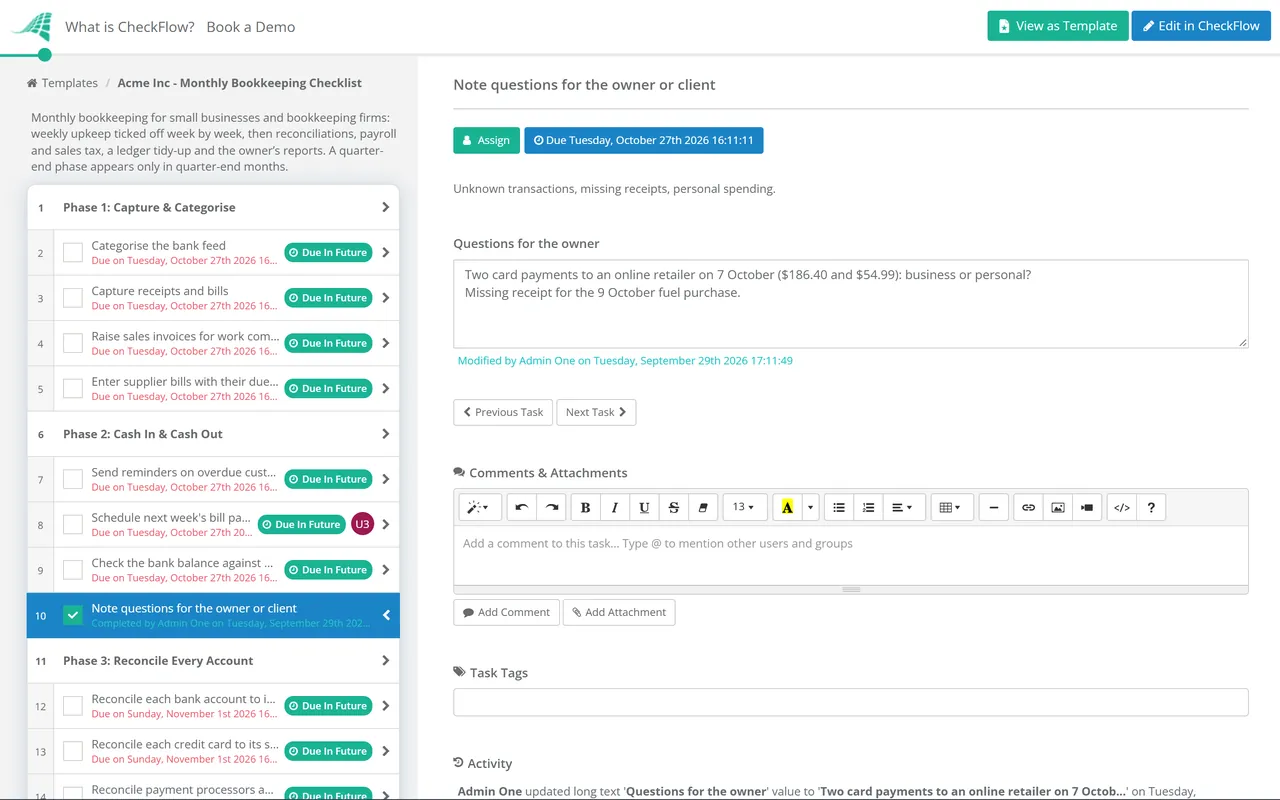
Note questions for the owner or client — unknown transactions, missing receipts, personal spending
Monthly
Phase 3: Reconcile Every Account
Reconcile each bank account to its statement — follow the Bank Reconciliation Checklist for anything that doesn’t agree
Reconcile each credit card to its statement — with a receipt for every transaction
Reconcile payment processors and marketplaces — Stripe, PayPal, Shopify, Amazon and similar: gross sales, fees and refunds recorded separately
Reconcile loans to the lender’s statement — split each repayment between principal and interest
Count and reconcile petty cash — if the business keeps any
Monthly
Phase 4: Payroll & Sales Tax
Record the payroll journal from the payroll provider’s report — gross pay, employer taxes, deductions and net pay
Reconcile payroll liabilities — amounts owed to tax authorities and pension or benefit providers agree to what was paid
Reconcile the sales tax, VAT or GST control account — to the returns filed and the payments made
File and pay any monthly returns that are due — dates depend on the jurisdiction and your registration
Monthly
Phase 5: Tidy the Ledger
Clear the suspense and uncategorised accounts to zero — ask the owner about anything you can’t identify
Review owner and director transactions — drawings, director’s loan account or shareholder distributions correctly recorded
Capitalise equipment purchases above your capitalisation threshold — rather than expensing them
Review the receivables and payables lists — remove duplicates and items that were actually paid
Check recurring bills have all arrived — rent, software, insurance and utilities
Monthly
Phase 6: Reports & Owner Review
Run the P&L, balance sheet and cash summary — for the month and the year to date
Compare with last month and the same month last year — and write a one-line explanation for any large movement
Send the reports and open questions to the owner or client — with a response date
Lock the period in the accounting software — once the owner’s questions are answered
Quarter End Only
Phase 7: Quarter-End Extras
Shown only when the month is marked as a quarter end. The other eight months stay short.
Prepare and file quarterly sales tax, VAT or GST returns — where the business files quarterly
Calculate and pay estimated income tax where it applies — for example US quarterly estimated tax, or UK quarterly updates under Making Tax Digital for Income Tax
Check quarterly payroll filings were made — such as the US Form 941, or the equivalent where you are
Collect missing contractor tax details — such as US Forms W-9, so year-end information returns aren’t held up
Hold a quarterly review with the owner — profit, cash, tax set aside and anything to plan for next quarter
The right frequency for each task depends on volume, but most small businesses land close to the table below. The rule of thumb: anything that gets harder to do the longer you leave it belongs in the weekly phases.
Task
Cadence
Why that cadence
Categorise the bank feed, capture receipts
Weekly
You still remember what each transaction was for
Raise invoices, chase overdue customers
Weekly
Every week of delay is a week of your cash in someone else’s account
Enter and schedule supplier bills
Weekly
Avoids late fees and duplicate payments
Bank, card and processor reconciliations
Monthly
Matches the statement cycle; high-volume accounts may need weekly
Payroll journal and liabilities
Each pay run, reviewed monthly
Liabilities must agree to what the payroll provider paid
Sales tax, VAT or GST returns
Monthly, quarterly or annually
Set by the tax authority, usually according to how much tax you collect
Estimated income tax
Quarterly, where it applies
Set by statute and by the type of business
Owner review of the reports
Monthly
Questions answered while the month is still fresh
Tax dates depend on where the business is. Take them from your tax authority and add them to the template as due dates. For example, US individuals and sole proprietors usually pay estimated tax on 15 April, 15 June, 15 September and 15 January, and each state sets its own sales tax filing frequency. In the UK, a VAT return and payment are normally due one calendar month and seven days after the end of the VAT period. Since 6 April 2026, sole traders and landlords with qualifying income over £50,000 have also had to send quarterly updates under Making Tax Digital for Income Tax, and the threshold falls to £30,000 in April 2027 and £20,000 in April 2028.
Keeping the records. Retention periods also vary. The IRS generally asks for records supporting a return to be kept for three years, and longer in some cases, such as four years for employment tax records. HMRC requires companies to keep records for six years from the end of the financial year they relate to, and sole traders for at least five years after the 31 January submission deadline. A checklist that attaches the month’s reports and reconciliations keeps that archive for you.
Why Run Your Bookkeeping in CheckFlow?
1
Every client’s month starts itself
A recurring schedule creates each month’s checklist automatically, one per client if you run a bookkeeping practice. The dashboard shows which clients are up to date, which are waiting on the owner and which are behind, without anyone keeping a separate tracker.
2
Questions for the owner don’t get lost
Unknown transactions and missing receipts are raised as tasks assigned to the owner or client, with a due date. The monthly report waits until they are answered, so the period isn’t locked with guesses in it.
3
Quarter-end work appears when it’s due
The quarter-end phase is hidden until the month is marked as a quarter end, so quarterly returns and estimated tax aren’t forgotten, and the other eight months aren’t cluttered with tasks that don’t apply.
Bookkeeping firms run the same checklist for dozens of clients every month. CheckFlow’s recurring checklist software shows how one template generates a separate checklist per client on its own schedule, with owners, due dates and a single view of where every client stands.
What should a monthly bookkeeping checklist include?
+
Weekly upkeep and a monthly routine. The weekly tasks are categorising the bank feed, capturing receipts, raising invoices, entering bills and chasing overdue customers. The monthly tasks are reconciling every bank, card, processor and loan account, recording payroll, reconciling sales tax or VAT, clearing suspense and uncategorised items, and producing a P&L, balance sheet and cash summary for the owner. Quarterly returns and estimated tax payments sit in a separate quarter-end section.
Which bookkeeping tasks should be done weekly?
+
Anything that gets harder the longer you leave it: categorising bank transactions while you still remember them, capturing receipts before they are lost, raising invoices as soon as work is done and chasing customers as soon as they are late. Reconciliations and reports can wait for month end, because they depend on the bank statement.
Is monthly bookkeeping the same as a month-end close?
+
No. Bookkeeping keeps a small business’s records complete and reconciled. A month-end close is a larger finance team’s timed process of cut-off, accruals, full balance sheet reconciliation, journal approval and management reporting. If you need accrual-based management accounts signed off by a controller, use the Month-End Close Checklist instead.
How long should bookkeeping records be kept?
+
It depends on the jurisdiction and the type of record. The IRS generally recommends three years from filing, longer for some records. HMRC requires UK companies to keep records for six years from the end of the financial year, and sole traders for at least five years after the 31 January submission deadline. Check the rules where you operate and keep each month’s reconciliations with the records.
Can a bookkeeping firm use this template for multiple clients?
+
Yes. Schedule the template once per client, assign the client’s bookkeeper, and assign owner questions to the client contact. Each client gets their own checklist every month, and the practice can see at a glance which clients are complete, which are waiting on information and which are overdue.
Does this work with Xero, QuickBooks or Sage?
+
Yes. The accounting software holds the ledger and does the matching; the checklist makes sure every step around it happens on time and is signed off. Add software-specific instructions to any task, such as which report to run or which bank rule to review, and attach the reports to the relevant task each month.
Is CheckFlow free for this template?
+
14-day free trial, no card required. The Business plan is $10 per user per month after the trial. Full details at checkflow.io/pricing.
Books That Are Up to Date Every Week, Not Just at Tax Time
Free trial — no credit card required.
Do you like cookies? 🍪 We use cookies to ensure you get the best experience on our website. Learn more