
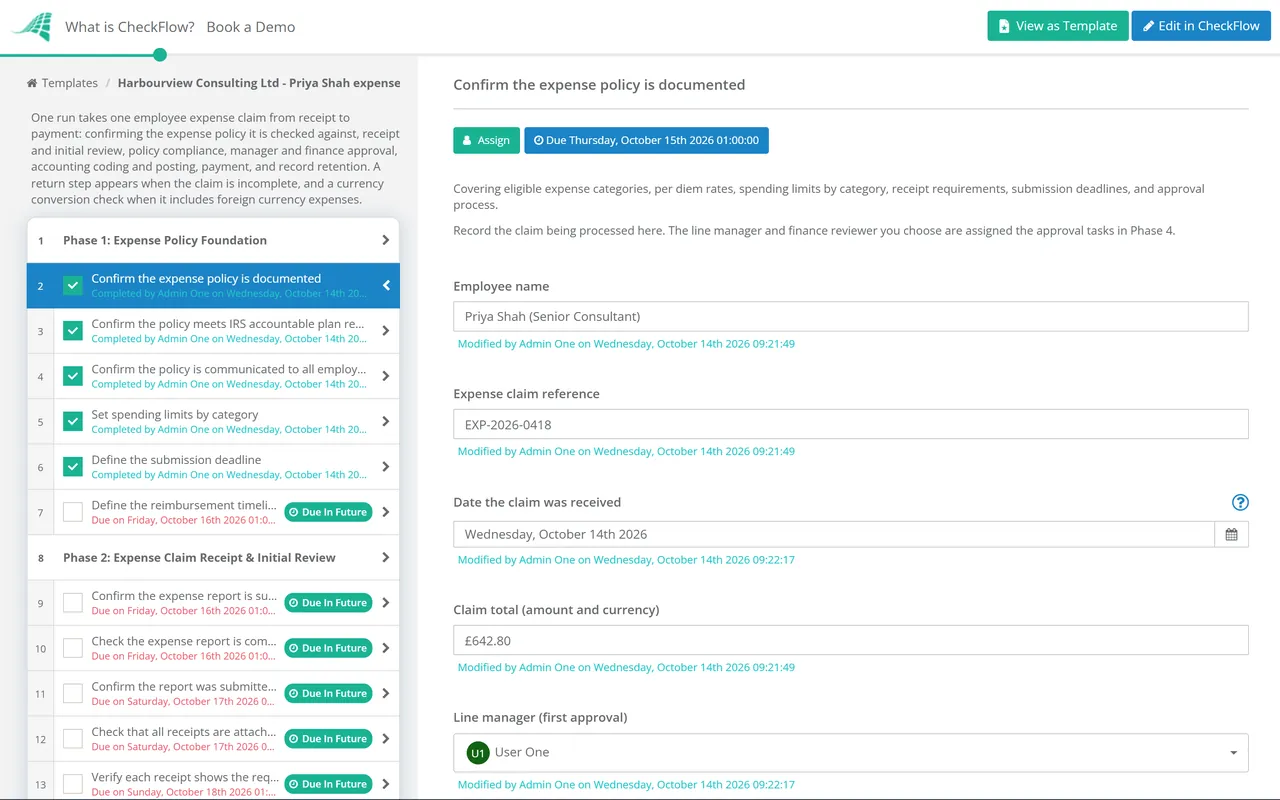
A structured expense reimbursement process that pays employees on time, stays IRS-compliant, and closes the audit trail on every claim.
The expense reimbursement process sits at an uncomfortable intersection of employee experience and financial control. Employees who wait three weeks to be reimbursed for a business trip they paid out of pocket are employees whose trust in the organisation is being tested. Finance teams who approve expense claims without adequate documentation are finance teams whose compliance is at risk. The IRS requires businesses to operate an accountable plan for expense reimbursements — one that documents business purpose, validates receipts, and returns excess advances — or reimbursements become taxable income. A structured expense reimbursement process satisfies both sides: employees are paid promptly and fairly, and finance teams maintain the documentation trail that compliance requires. This free expense reimbursement process checklist gives finance and HR teams a structured framework for handling every expense claim from submission to payment.
The IRS Accountable Plan — the Compliance Foundation of Every Expense Reimbursement
Under IRS rules, expense reimbursements are only excludable from an employee’s taxable income when they are made under an accountable plan. An accountable plan has three requirements: there must be a legitimate business connection for the expense; the employee must substantiate the expense with documentation including amount, date, place, and business purpose; and any excess advance or reimbursement must be returned within a reasonable period. Reimbursements that do not meet all three requirements are treated as taxable wages — subject to income tax withholding, FICA, and FUTA from both the employer and the employee.
The practical implication is that every expense claim your finance team processes needs to be evaluated against these three criteria — not just “is there a receipt?” but “is the business purpose documented, is the amount substantiated, and is there a receipt showing the specific details?” A structured expense reimbursement process builds these checks in systematically, ensuring every claim that is approved and paid is defensible under an IRS or HMRC audit.
What the Expense Reimbursement Process Checklist Covers
This checklist covers seven phases of the expense reimbursement cycle — from policy foundation through to record retention. Each phase ensures claims are processed consistently, compliantly, and on time.
Phase 1
Expense Policy Foundation
The expense reimbursement process only works consistently when it operates against a clear, current, and communicated expense policy. Processing claims without a policy produces inconsistent decisions and unwinnable disputes.
Confirm the expense policy is documented — covering eligible expense categories, per diem rates, spending limits by category, receipt requirements, submission deadlines, and approval process
Confirm the policy meets IRS accountable plan requirements — business connection, substantiation, and return of excess are all addressed
Confirm the policy is communicated to all employees — during onboarding and when updated; employees should not be discovering policy requirements when their claim is rejected
Set spending limits by category — meals, accommodation, travel, entertainment, and any other common categories; confirm limits are current and reasonable
Define the submission deadline — how soon after incurring an expense must it be submitted? Industry practice is within 14–30 days; late submissions should require management approval
Define the reimbursement timeline standard — how soon after approval does the employee receive payment? Setting and meeting a stated standard is important for employee trust
Phase 2
Expense Claim Receipt & Initial Review
Confirm the expense report is submitted via the correct channel — the defined submission method (expense management software, ERP module, or approved form template)
Check the expense report is complete — all required fields populated; total matches the sum of line items
Confirm the report was submitted within the policy deadline — flag late submissions for management review rather than automatic rejection
Check that all receipts are attached — for every line item above the minimum receipt threshold; confirm receipts are legible
Verify each receipt shows the required details — date, vendor name, amount paid, and description of goods or services purchased
Return incomplete claims promptly — with a specific list of what is missing; do not hold incomplete claims in a queue
Phase 3
Policy Compliance & Eligibility Review
Verify each expense is an eligible category — against the expense policy; flag any non-reimbursable categories
Check each expense is within the applicable spending limit — by category; amounts above limits require documented management approval before reimbursement
Verify the business purpose is documented — for each expense; generic descriptions like “lunch” are insufficient; “client meeting with [company name] re: project X” meets the standard
Check entertainment and meals expenses — attendees documented, business purpose clear, and applicable policy limits applied
Check travel expenses — travel was necessary for business purposes; accommodation rate is within policy; class of travel complies with policy
Flag any personal expenses included in the claim — personal expenses mixed with business expenses require separation and return of the personal portion
Phase 4
Manager and Finance Approval
Route to the line manager for first approval — the employee’s direct manager confirms the business purpose and authorises the claim
Apply tiered approval thresholds — claims above defined amounts require additional approval (e.g. department head above $500; finance director above $2,000)
Finance review for policy compliance — a finance team member confirms the fully approved claim meets policy before processing
Document all approvals — named approver, timestamp, and approval level; no verbal approvals; all in the system
Confirm no approver is approving their own expenses — self-approval is not permitted; escalate to the next management level when the approver has their own expenses in the batch
Set and enforce approval turnaround time — claims sitting unapproved for more than the defined period trigger an escalation reminder
Phase 5
Accounting Coding & General Ledger Posting
Code each expense line to the correct GL account — travel, meals, accommodation, office supplies, professional development, or other applicable account
Assign to the correct cost centre or department — expenses must be attributed to the correct business unit for management reporting
Apply correct VAT/GST treatment — confirm input tax claims are only made on business expenses with valid receipts; no input tax on disallowable entertainment
Post to the general ledger — in the correct accounting period; confirm accruals are made for expenses incurred but not yet processed at month-end
Confirm foreign currency expenses are converted correctly — using the exchange rate on the date of the transaction; document the rate used
Phase 6
Payment Processing & Confirmation
Confirm the payment method — direct bank transfer to the employee’s account; confirm bank details are on file and correct
Process the payment — via payroll if included in salary payments, or via AP for out-of-cycle reimbursements; confirm the method is consistent with policy
Confirm the payment amount matches the approved reimbursement amount — any reductions should have been communicated to the employee before payment
Notify the employee of the payment date and amount — particularly for out-of-cycle reimbursements; employees should not have to ask whether their claim was paid
Process the payment within the stated reimbursement timeline standard
Retain proof of payment — payment confirmation filed against the expense claim record
Phase 7
Record Retention & Ongoing Process Management
Archive all expense claims — expense report, receipts, approval records, and payment confirmation stored together and accessible; IRS requires retention for minimum three years (seven years recommended)
Confirm documentation is sufficient for an IRS accountable plan audit — business purpose, amount, date, place, and receipts all present for every claim
Conduct periodic expense report audits — a sample of submitted claims reviewed by finance for policy compliance; identifies systemic issues before they become audit findings
Review the expense policy annually — confirm spending limits, eligible categories, and per diem rates are current; update and communicate any changes
Analyse expense data by category and employee — identifies policy exceptions, spending trends, and opportunities to negotiate better rates on recurring categories
Common Business Expense Categories and Key Policy Considerations
Travel (flights, rail, taxis)
Class of travel permitted (economy vs business), advance booking requirements, whether personal loyalty points from business travel may be retained, and any preferred supplier arrangements.
Accommodation
Maximum nightly rate by city tier, advance booking requirements, whether hotel reward points may be retained, and whether an upgrade is reimbursable.
Meals and subsistence
Per diem rates or maximum spend per meal, whether alcohol is reimbursable, attendees and business purpose documentation required, and any different treatment for international vs domestic travel.
Client entertainment
Attendees documented (with roles and company), business purpose documented, maximum spend per head, and whether certain categories of entertainment are excluded.
Home office and remote working
Equipment eligible for reimbursement, monthly utility allowance (if any), consumables policy, and the tax treatment of home office reimbursements in the applicable jurisdiction.
Professional development and subscriptions
Pre-approval required above a defined threshold, whether the company owns any materials purchased, and the treatment of professional memberships and certifications.
Why Run Expense Reimbursement in CheckFlow?
1
Every claim processed against a consistent standard
Expense claim policy compliance should not depend on which finance team member processes the claim or how well they remember the policy. CheckFlow’s structured checklist walks through every compliance check — eligible category, spending limit, business purpose, receipt validation — for every claim, every time, producing consistent outcomes regardless of who is handling the processing.

2
Segregated approval that cannot be bypassed
Self-approval of expense claims is a control risk that appears in many mid-size businesses — either because the approval system has a gap, or because a senior manager approves their own expenses informally. CheckFlow’s approval task structure ensures no claim moves to payment without a named, timestamped approval from a separate individual.
3
Audit-ready records archived automatically
Every expense claim processed in CheckFlow generates a complete record: the claim details, the compliance checks performed, the named approver with timestamp, and the payment confirmation. The IRS accountable plan audit trail is built automatically as a byproduct of running the process.
Expense reimbursements that are processed outside payroll timing need to be captured as accruals in the month-end close. CheckFlow’s Month-End Close Checklist coordinates expense accruals within the broader financial close cycle. See the Month-End Close Checklist →
For the payroll processing angle of expense reimbursements included in payroll runs, CheckFlow’s Payroll Processing SOP covers the verification steps that ensure reimbursements are included correctly in the correct payroll period. See the Payroll Processing SOP →
What is an IRS accountable plan and why does it matter?
+
An IRS accountable plan is a business expense reimbursement arrangement that meets three requirements: there must be a legitimate business connection (the expense must be ordinary and necessary for the business), the employee must substantiate the expense with documentation showing the amount, date, place, and business purpose within a reasonable time, and any excess reimbursement or advance must be returned to the employer within a reasonable period. When all three requirements are met, reimbursements are excluded from the employee’s taxable income — neither party owes tax on the reimbursed amount. When any requirement is not met, the reimbursement is treated as taxable wages. The practical implication is that every expense claim processed by a finance team needs to be validated against these three criteria before payment.
What documentation is required for expense reimbursement?
+
IRS rules require documentation showing the amount of the expense, the time and place, the business purpose, and the business relationship for entertainment expenses (who was entertained and their role). A receipt should show the vendor name, date, amount paid, and a description sufficient to identify the goods or services purchased. For meals and entertainment the business purpose and attendees must also be documented — a receipt showing the restaurant name and total is necessary but not sufficient on its own. Expense records should be retained for a minimum of three years from the tax return filing date, though seven years is recommended.
How quickly should expense claims be reimbursed?
+
There is no universal legal deadline, but best practice is to process approved claims within 7–14 days of approval, and to communicate the expected timeline to employees clearly. The IRS requires that under an accountable plan, substantiation is provided and excess returned “within a reasonable time” — generally interpreted as within 60 days of incurring the expense. From an employee experience perspective, longer reimbursement timelines consistently generate dissatisfaction, as employees are effectively providing interest-free loans to the business on business expenses.
What expenses are typically not reimbursable?
+
Common categories of non-reimbursable expenses include personal items purchased during business travel (clothing, personal care, entertainment not client-related), upgrades above policy limits (business class when policy requires economy), fines and penalties (parking tickets, speeding fines), personal meals at the normal place of work (where no business travel is involved), and alcohol above any applicable policy limit. The specific list varies by organisation policy, but the defining principle under IRS accountable plan rules is that the expense must have a legitimate business connection and must be ordinary and necessary for the business.
Is CheckFlow free for this template?
+
14-day free trial, no card required. The Business plan is $10 per user per month after the trial. Full details at checkflow.io/pricing.
Process Expense Claims Consistently, Compliantly, and Fast
Free trial — no credit card required.
Do you like cookies? 🍪 We use cookies to ensure you get the best experience on our website. Learn more