
Bank, card and intercompany checklists
Covers: matching transactions line by line for one kind of account.
Cadence: monthly for each account, or more often at high volume.
Output: a reviewed reconciliation that this checklist agrees the balance to.
Last reviewed: October 2026
No Credit Card Required
This free balance sheet reconciliation checklist is for financial controllers, accounting managers and month-end teams who need every balance sheet account reconciled, reviewed and signed off each month, not only the bank. One run is one month-end cycle for one entity. It starts before period end by listing every balance sheet account with a preparer, a reviewer and a risk rating, so high-risk accounts are reconciled monthly and stable, low-risk ones can move to a quarterly cycle. After period end it gathers the standard evidence for each account type, reconciles assets, liabilities, equity and clearing accounts, tests every reconciling item against the variance and ageing thresholds your team sets, and posts approved adjusting journals. Each reconciliation is signed off by its preparer and reviewed by someone else. An escalation phase appears only when an item is over a threshold or too old, and the run ends with a status summary and the controller’s approval.
Most finance teams have a firm routine for the bank. The rest of the balance sheet gets less attention: a prepayment schedule nobody has updated since the auditors left, an accrual nobody can support, a VAT control account that is “roughly right” and a suspense account that grows a little every month. Each of those is a number in the accounts that nobody has proved.
A balance sheet reconciliation proves each balance against something outside the ledger: a statement, a subledger report, a register, a schedule or a calculation someone else can check. This checklist does that for every account in one month-end cycle, with a named preparer and reviewer for each. The reconciliations that need their own detailed process keep their own checklists: bank accounts, corporate cards and intercompany balances. This one picks up their signed-off results and covers everything else.
Covers: matching transactions line by line for one kind of account.
Cadence: monthly for each account, or more often at high volume.
Output: a reviewed reconciliation that this checklist agrees the balance to.
Covers: every balance sheet account, its owner, risk rating, evidence, reconciling items and sign-off.
Cadence: every month end, with low-risk accounts on a quarterly cycle.
Output: a status summary showing each account reconciled, reviewed and approved.
Covers: cut-off, posting, adjusting journals, the financial statements and the management pack.
Cadence: every month end.
Output: the period’s accounts. The Month-End Close Checklist runs it, with this checklist as its reconciliation step.
Phase 1 runs before period end and sets the owners, risk ratings and thresholds. Phases 2 to 6 reconcile, adjust and review every account. Phase 7 appears only when a reconciling item is over a threshold or too old, and Phase 8 is the controller’s sign-off.
An account that isn’t on the list doesn’t get reconciled. Build the list from the trial balance, not from last month’s file, and do it before period end.
Every reconciliation agrees to the same trial balance. Run it once the subledgers are closed and keep that version.
Agree each balance to evidence from outside the ledger. A reconciliation that agrees the ledger to itself proves nothing.
Test every item against the thresholds set in Phase 1. An item over either one adds Phase 7 to this month’s checklist.
Assign review to someone who did not prepare the reconciliation. The reviewer works from the evidence, not from the preparer’s summary.
Shown only when Phase 5 records an item over the variance threshold or older than the ageing limit. In a clean month this phase stays hidden.
The controller signs off the month from one summary. The checklist halts until that approval is given.
Use the table to brief preparers in Phase 1 and to collect evidence in Phase 2. Each account should agree to something produced outside the general ledger, or to a schedule someone other than the preparer can recalculate. The ratings and frequencies are a starting point; rate your own accounts on their volume, judgement, size and history.
| Account type | Agree the balance to | Typical starting rating | Watch for |
|---|---|---|---|
| Cash and bank | The reviewed bank reconciliation for each account; a count for petty cash | High, monthly | Reconciling items carried forward with no explanation |
| Trade receivables | The aged debtors report from the receivables subledger | High, monthly | Unapplied cash and credit balances hidden inside the total |
| Prepayments and other debtors | A prepayment schedule with the invoice and release profile for each item | Medium, monthly | Items that should already have been released to expense |
| Inventory | The stock valuation report and the latest count results | High where material, monthly | Count differences, and slow-moving stock with no provision |
| Fixed assets | The fixed asset register, by asset class | Medium, monthly or quarterly | Disposed assets still on the register; capital items coded to expense |
| Trade payables | The aged creditors report; statements from the largest suppliers | High, monthly | Debit balances, and invoices on hold that were never posted |
| Accruals and deferred income | A schedule giving the basis for each item; contracts and billing for deferred income | High, monthly | Accruals that never reverse, and round sums with no calculation |
| Payroll liabilities | Payroll reports and the payments that cleared each balance | High, monthly | Balances building up in the net pay or deductions control accounts |
| Tax balances | Return workings, the tax computation and the tax authority’s statement | Medium, monthly or with each return | Control accounts that don’t clear after the payment is made |
| Credit cards and loans | Card statements; lender statements and loan schedules | Medium, monthly | Interest, fees and charges not yet posted |
| Intercompany | The counterparty’s confirmation at the same date | High in a group, monthly | A charge booked by one entity and not the other |
| Equity | The share register, board minutes and last year’s signed accounts | Low, quarterly or at year end | Movements with no board minute behind them |
| Suspense and clearing | An item-by-item analysis of the balance | High, monthly | Any balance at period end, and items older than your ageing limit |
Set your own thresholds. The variance and ageing thresholds are a policy your team sets and the controller approves. Teams often use a fixed amount, a percentage of the account balance, or both, and an age after which an item must be escalated rather than rolled forward again. As an example only, a team might escalate any item over £5,000 or 1% of the balance, and anything older than 60 days, with lower limits for cash, suspense and other high-risk accounts. Record the numbers in Phase 1 so every preparer applies the same ones.
Why reconciled balances matter beyond the close. In the UK, section 386 of the Companies Act 2006 requires every company to keep adequate accounting records: records sufficient to show and explain its transactions, to disclose its financial position with reasonable accuracy at any time, and containing a record of its assets and liabilities. Section 388 requires a private company to keep them for three years from the date they are made, and a public company for six. In the US, section 404(a) of the Sarbanes-Oxley Act requires a public company’s annual report to include management’s assessment of the effectiveness of its internal control over financial reporting, and section 404(b) requires its auditor to attest to that assessment, except for emerging growth companies and companies that are neither large accelerated nor accelerated filers. A reconciliation with a named preparer, an independent reviewer and the evidence attached is the kind of record both depend on.
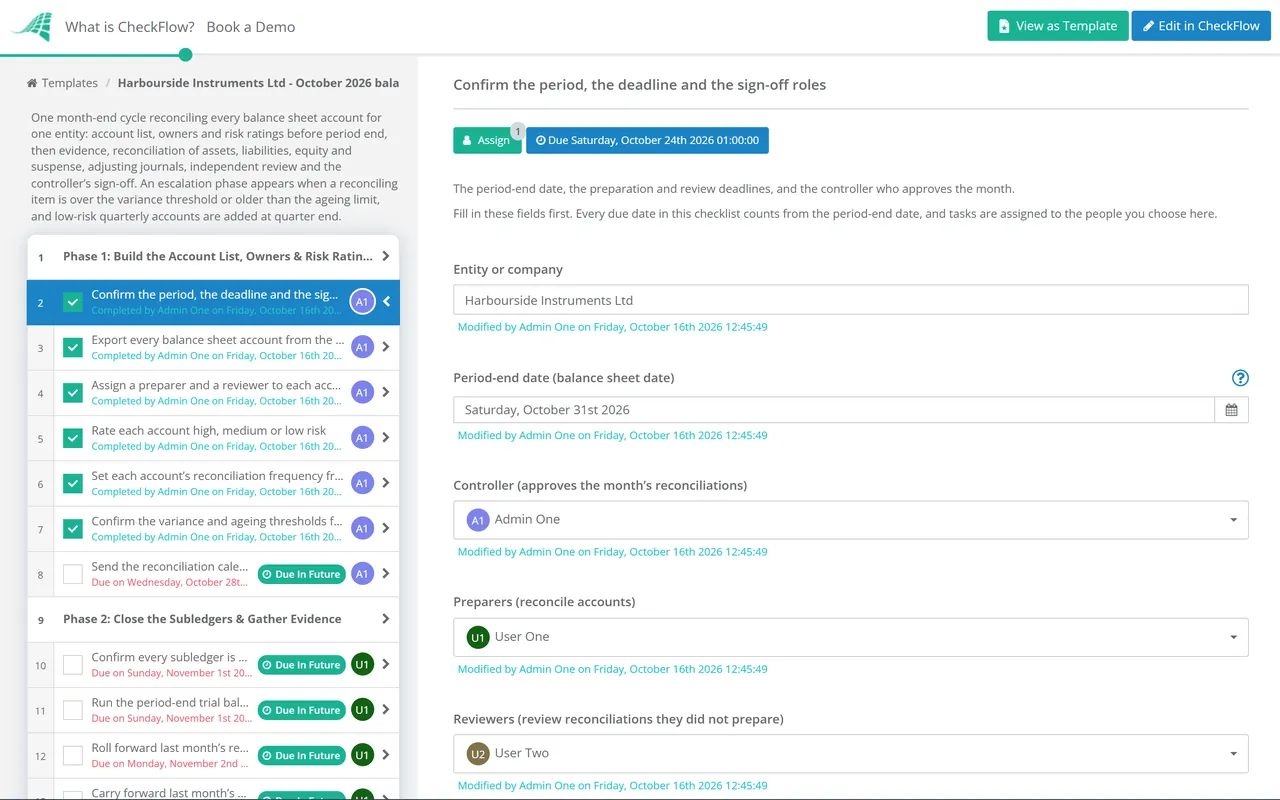
Phase 1 records the preparer, reviewer and risk rating for every account, and the preparation and review tasks are assigned to the people chosen at the start. The Tasks Grid shows what each preparer still has open, so a missing reconciliation shows up before the deadline instead of at the audit.
The reviewer’s decision and the controller’s sign-off are approval steps with an Approved or Not approved answer, and only the person named can give them. The controller’s sign-off halts the checklist, so the period can’t be recorded as locked and archived until it is given.
When a reconciling item passes your variance threshold or ageing limit, the escalation phase appears with its own owner and due dates. A recurring monthly schedule starts the next cycle with the same accounts, roles and thresholds, and every month’s checklist stays on the Reports Grid for the auditors.
Balance sheet reconciliation is one step in the close. The Month-End Close Checklist sets the timetable around it, the Journal Entry Review & Approval Checklist controls the adjusting journals this checklist produces, and our guide to the month-end close shows where reconciliations fit.
CheckFlow doesn’t match transactions or calculate balances; your accounting system and reconciliation tools do that. It runs the process around them: who reconciles which account by when, what evidence is attached, which items are still open and who approved the result. See how recurring checklists start each month’s cycle on time.

Month-End Finance & Accounting Close Checklist

Bank Reconciliation Checklist

Journal Entry Review & Approval Checklist

Intercompany Reconciliation Checklist

Fixed Asset Register Review Checklist
Describe the process in a sentence and the AI checklist generator drafts the phases and tasks for you.
It is the process of proving that the balance on each balance sheet account in the general ledger is supported by something outside it: a bank statement, a subledger report, a fixed asset register, a schedule or a third-party confirmation. Every difference between the two is explained, corrected or tracked to a clearing date, and someone other than the preparer reviews the result. Done for every account at month end, it shows the balance sheet is right, not just that the trial balance balances.
An account list with a preparer, a reviewer and a risk rating for each account; the evidence each account type should agree to; variance and ageing thresholds for reconciling items; steps to investigate items and post adjusting journals; preparer sign-off and independent review; escalation of items that are over a threshold or too old; and a status summary the controller approves. This template covers each of those in eight phases.
Many teams reconcile every account monthly as part of the close. Others use a risk-based approach: high and medium-risk accounts, such as cash, receivables, payables, accruals, payroll liabilities and suspense, every month, and stable low-risk accounts with little activity, such as share capital, quarterly. Whatever you choose, set the frequency per account in advance, record why, and make sure every account is reconciled at least at each quarter end and at year end.
A bank reconciliation is one balance sheet reconciliation: it agrees the cash balance to the bank statement and works through deposits in transit, outstanding payments and bank-only items. A balance sheet reconciliation covers every account, including receivables, prepayments, fixed assets, accruals, payroll and tax liabilities, equity and suspense. Run the detail in the Bank Reconciliation Checklist and agree its signed-off result in this one.
Something produced outside the general ledger, or a schedule someone else can recalculate. Cash agrees to bank statements, receivables and payables to their subledger ageing reports, fixed assets to the register, prepayments and accruals to schedules with invoices or a calculation behind each line, payroll liabilities to payroll reports, tax to the return workings and intercompany balances to the counterparty’s confirmation. The table on this page lists the standard evidence for each account type.
Don’t keep rolling them forward. Give every item an owner and an expected clearing date, and set an age, such as 60 or 90 days, after which it must be escalated to the controller. The controller then decides whether it is corrected with a journal, chased with the third party involved or written off under your authority limits. Never clear an unexplained item with a plug to suspense: that only moves it to another account.
Someone other than the person who prepared the reconciliation, with enough knowledge of the account to challenge it. In a larger team that is usually a senior accountant, the financial controller or a peer in another area; in a small business it may be the finance director, the owner or an external accountant. The reviewer should agree the balance to the trial balance and the evidence themselves, not rely on the preparer’s summary, and record the date of the review.
14-day free trial, no card required. The Business plan is $10 per user per month after the trial. Full details at checkflow.io/pricing.
14-day free trial, no credit cardFull refund in your first 30 daysUS or EU hosting