Bank Reconciliation Checklist Template

A reconciliation that balances is not the same as one that was reviewed. Cash errors, and a fair share of payment fraud, hide in the reconciling items that roll forward unexplained from one month to the next.

Accounting software has made matching bank transactions fast, and that has made it easy to confuse matching with reconciling. A bank reconciliation proves that the cash balance in your ledger agrees to the bank’s record at a fixed date, and that every difference between the two has a known cause, an owner and an expected clearing date. It also gives someone other than the preparer a regular chance to look at every payment that left the account. This free bank reconciliation checklist gives controllers, finance managers and bookkeepers a repeatable process for every account they hold. It covers gathering statements, matching, investigating reconciling items, posting adjustments, preparing the reconciliation and getting an independent review. A conditional escalation phase appears only when there is an unexplained difference or a transaction nobody recognises, and the whole checklist can be scheduled to start itself each month.

Use This Template Free See Live Example
No Credit Card Required

Timing Differences vs Items That Need Action

Every bank reconciliation produces a list of differences between the bank statement and the general ledger. The skill is in sorting that list quickly into two groups. Timing differences are transactions both sides know about but have recorded on different dates. They clear on their own, usually within days. Items that need action are differences only one side knows about, or that one side has recorded wrongly. They never clear on their own, and every month they are left alone makes them harder to explain.

The most common failure is not a reconciliation that doesn’t balance. It is one that balances by carrying the same unexplained items forward month after month, until a small difference from last spring has become part of the furniture. A good checklist makes the age of every item visible and sets a point at which old items must be escalated rather than rolled forward again.

Timing differences

Recorded by both sides, on different dates

Examples: deposits in transit, outstanding cheques and payments, card settlements that land a day or two after the sale.

What to do: list them with dates, confirm they clear early in the next period, and question anything that doesn’t.

Warning sign: a “deposit in transit” that is still in transit at the next month end.
Items that need action

Known to one side only, or recorded wrongly

Examples: bank fees and interest, returned customer payments, direct debits not yet in the ledger, duplicate postings, transposed amounts and debits nobody recognises.

What to do: post a correcting entry with support, or escalate the same day if the transaction can’t be explained.

Warning sign: a round-sum adjustment to a suspense account to “make it balance”.

What the Bank Reconciliation Checklist Covers

Six phases take each account from statement to signed-off reconciliation. A seventh phase appears only when there is a difference or a transaction nobody can explain.

Phase 1

Phase 1: Gather Statements & Confirm the Starting Point

An account that isn’t on the list doesn’t get reconciled. Start from the bank account register, not from memory.

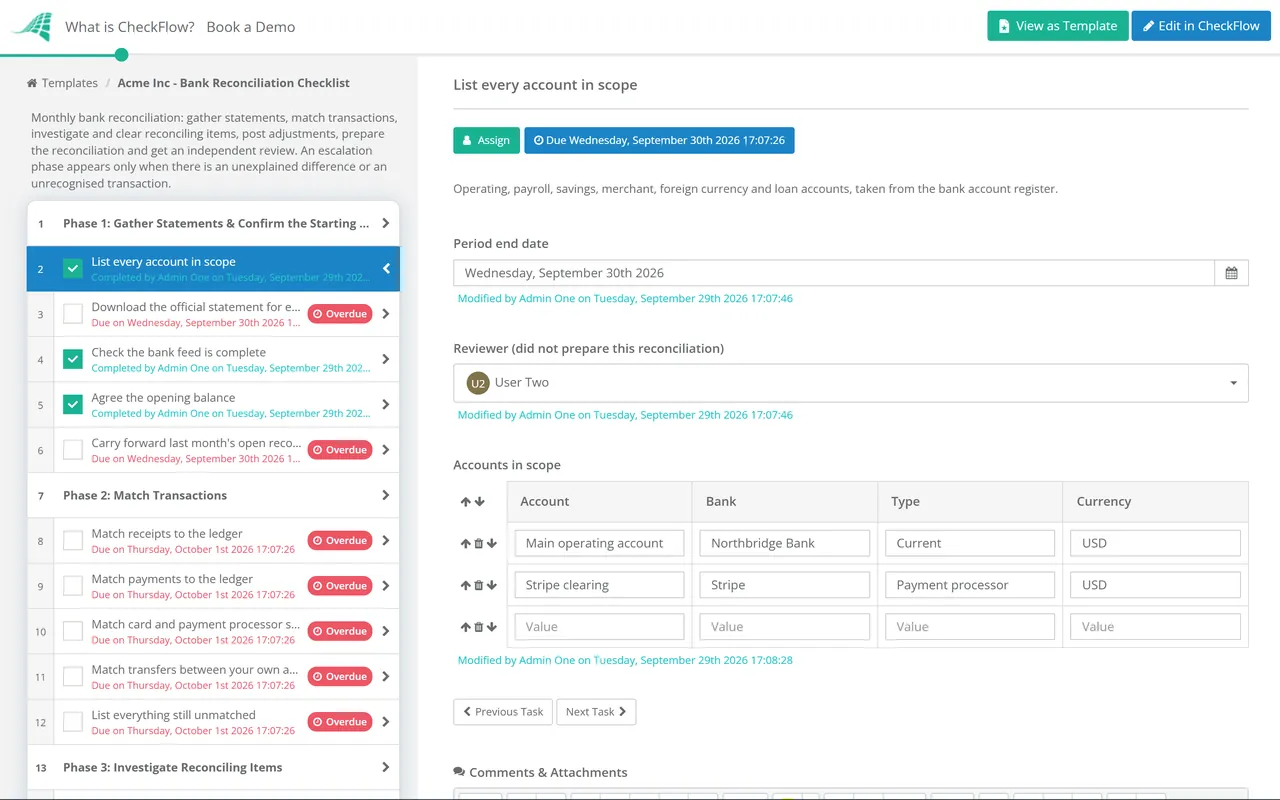
  • List every account in scope — operating, payroll, savings, merchant, foreign currency and loan accounts, taken from the bank account register
  • Download the official statement for each account — the statement to the period-end date, not a live balance or a screenshot of the bank feed
  • Check the bank feed is complete — no missing days and no duplicated imports between the last statement and this one
  • Agree the opening balance — the opening bank balance equals last month’s reconciled closing balance, and last month’s reconciliation was signed off
  • Carry forward last month’s open reconciling items — each one listed with its original date so its age is visible
Phase 2

Phase 2: Match Transactions

  • Match receipts to the ledger — customer payments, card settlements and transfers in, by amount, date and reference
  • Match payments to the ledger — supplier payment runs, payroll, direct debits and cleared cheques
  • Match card and payment processor settlements gross — record processor fees as an expense rather than netting them off against sales
  • Match transfers between your own accounts — both sides recorded, in the same period
  • List everything still unmatched — unmatched bank lines and unmatched ledger entries, which become the reconciling items for Phase 3
Phase 3

Phase 3: Investigate Reconciling Items

  • Confirm deposits in transit — each one should clear in the first few days of the next period; anything older needs an explanation
  • Review outstanding cheques and payments — list them with dates, follow up anything past its normal clearing time and flag cheques more than six months old as stale
  • Identify bank-only items — fees, interest, returned (NSF) customer payments and direct debits not yet recorded in the ledger
  • Identify errors on either side — transposed amounts, postings to the wrong bank account and duplicate entries
  • Escalate any debit nobody recognises the same day — do not wait for the month-end review; report it to the finance manager and the bank
  • Record the cause, owner and expected clearing date for every item — so next month’s preparer knows exactly what should have happened
Phase 4

Phase 4: Post Adjusting Entries

  • Record bank fees, charges and interest — coded to the correct expense or income account
  • Reverse returned customer payments — reopen the invoice and tell whoever is collecting it
  • Correct ledger errors with a journal — referenced to this reconciliation, never a plug to suspense
  • Get approval for adjustments over the threshold — a second person approves any adjustment above the authority limit before it is posted
Phase 5

Phase 5: Prepare the Reconciliation

  • Calculate the adjusted bank balance — statement balance, plus deposits in transit, less outstanding payments, plus or minus bank errors
  • Calculate the adjusted book balance — ledger balance, plus or minus bank-only items and ledger errors not yet corrected
  • Confirm the unexplained difference is zero — an unexplained difference is not immaterial, it is unknown
  • Age the open reconciling items — flag anything older than 30, 60 or 90 days
  • Attach the statement, the matching report and the reconciliation — so the reviewer can check the figures without asking for them
Phase 6

Phase 6: Independent Review & Sign-Off

Assign this phase to someone who did not prepare the reconciliation and who cannot initiate or approve payments from the account.

  • Agree the balances yourself — tie the statement balance to the bank statement and the book balance to the trial balance
  • Challenge old and round-sum reconciling items — ask why each one has not cleared and whether it ever will
  • Scan the statement for unusual payments — new payees, payments outside the normal payment runs and amounts just under approval limits
  • Approve the reconciliation or return it with questions — the approval records who reviewed it and when
  • Confirm the period is locked in the accounting system — so nobody can post back into a reconciled month without authority
Phase 7 — Only If Needed

Phase 7: Unexplained Differences & Suspected Fraud

Shown only when Phase 5 records an unexplained difference or a transaction nobody recognises. In a normal month this phase stays empty.

  • Escalate to the controller or finance manager — with the amount, the date and what has been checked so far
  • Report unauthorised transactions to the bank immediately — request a recall where possible; notification windows are limited by law and often shortened further by your bank agreement
  • Preserve the evidence — statements, payment files, approvals and any emails that requested the payment
  • Check the payment controls around the account — who could have initiated the payment, and whether any supplier bank details were changed recently
  • Record the outcome and any loss — then update the reconciliation and the issues log once the item is resolved

Accounts to Reconcile, and What to Watch For in Each

Most businesses hold more accounts than the main operating account, and each type produces its own kind of reconciling item. Use the table to build your account list in Phase 1 and to brief whoever prepares each reconciliation. The frequency column is a starting point; businesses with high volumes or a history of errors reconcile their busiest accounts weekly or even daily.

Account Typical frequency Common reconciling items Watch for
Main operating accountMonthly; weekly or daily at high volumeDeposits in transit, outstanding payments, bank feesDebits nobody recognises; duplicate supplier payments
Payroll accountEvery pay run, and monthlyUncashed payroll cheques, returned paymentsPayments to people who aren’t on the payroll register
Payment processor clearing (Stripe, PayPal, Square, card acquirers)WeeklyProcessor fees, refunds, chargebacks, reserves, settlement timingSales recorded net of fees, which understates revenue and expenses
Business credit cardsMonthly, to the card statementUnposted transactions, statement cut-off datesPersonal spend and missing receipts
Foreign currency accountsMonthlyRevaluation at the closing exchange rateExchange differences being written off as “errors”
Loans and credit linesMonthly, to the lender statementInterest charged, drawdowns, repaymentsBalances that feed covenant calculations
Petty cashMonthly, with a physical countVouchers not yet postedTop-ups without receipts

Why reconciling promptly matters. The time you have to dispute a transaction with your bank is limited. In the US, the Uniform Commercial Code requires a customer to examine statements with reasonable promptness (UCC §4-406(c)), and a customer who doesn’t report an unauthorised signature or alteration within one year of the statement being made available can’t assert it against the bank (§4-406(f)). Your deposit agreement may set a shorter period, so check it. In the UK, the Payment Services Regulations 2017 require an unauthorised or incorrectly executed payment to be reported without undue delay, and no later than 13 months after the debit date. In both cases the practical window is shorter than the legal one: the sooner a fraudulent payment is reported, the better the chance of recalling it.

Old, uncashed cheques. A cheque that has not been presented after six months is generally treated as stale. In the US a bank has no obligation to pay one (UCC §4-404), although it may still do so in good faith. In the UK most banks treat cheques as out of date after six months, but that is banking practice rather than law, and the only sure way to cancel a cheque is to stop it. Don’t simply write an old cheque back to income. In the US, uncashed payroll and supplier cheques usually become unclaimed property that must be reported to the state after a dormancy period set by that state, often one year for wages and three to five years for supplier payments. Some states exempt business-to-business payments, so check the rules in each state before you reverse one.

Why Run Bank Reconciliations in CheckFlow?

1

Every account, every month, without a reminder

A recurring schedule creates the reconciliation on the first working day of the month, one checklist per account or per entity, and assigns it to the preparer. A reconciliation that hasn’t been started shows as overdue, so a missed account is visible the same week rather than at the year-end audit.

2

Preparer and reviewer are different people

The review phase is assigned to a named reviewer and ends in an approval, so the person who matched the transactions cannot sign off their own work. Each task records who completed it and when, and the statement and reconciliation are attached to the task they support.

3

Unexplained items can’t quietly roll forward

When the preparer records an unexplained difference, the escalation phase appears with its own owner and due dates. Auditors can see every month’s reconciliation, the reviewer’s sign-off and how each exception was resolved, without anyone rebuilding the file.

The bank reconciliation is one step in the wider close. The Month-End Close Checklist puts it in sequence with the other balance sheet reconciliations, and our guide to the month-end close explains how bank, subledger and intercompany reconciliations fit together.

If you run reconciliations for several entities or clients, CheckFlow’s recurring checklist software shows how one template can generate a separate checklist for each account on its own schedule, with a single view of which are complete, in review or overdue.

Frequently Asked Questions

What is a bank reconciliation checklist?

+

It is a step-by-step list for proving that the cash balance in your accounting records agrees to the bank statement at a given date. It covers collecting the statements, matching transactions, investigating and clearing the differences, posting adjustments, preparing the reconciliation and having it reviewed by someone independent. A checklist makes sure the same steps happen for every account, every month, whoever is preparing it.

How often should bank accounts be reconciled?

+

At least monthly, as part of the month-end close. Accounts with high volumes, such as a main operating account or a payment processor clearing account, are often reconciled weekly or daily. Frequent reconciliation keeps each exercise small and means unauthorised transactions are spotted well inside the time your bank allows for reporting them.

What are the most common reconciling items?

+

Deposits in transit and outstanding cheques or payments are the most common, and both are timing differences that clear on their own. Bank fees, interest, returned customer payments and direct debits not yet recorded are items the bank knows about before you do. Errors, such as transposed figures or duplicate postings, can occur on either side. Anything that doesn’t fit one of those categories should be investigated straight away.

Who should review a bank reconciliation?

+

Someone who did not prepare it, and ideally someone who cannot initiate or approve payments from the account. That separation is what makes the reconciliation a control rather than a formality. In a small business the reviewer is often the owner or an external accountant; in a larger finance team it is usually the financial controller or a senior accountant.

What should I do with an unexplained difference?

+

Don’t post it to suspense and move on. Check the obvious causes first: an opening balance that doesn’t agree to last month, a transaction posted to the wrong bank account, a duplicated bank-feed import or a transposed figure. If the difference still can’t be explained, or a debit on the statement isn’t recognised, escalate it the same day and contact the bank. The conditional phase in this template exists for exactly that case.

Doesn’t bank-feed matching in Xero or QuickBooks already do this?

+

It does the matching, which is Phase 2 of this checklist. It doesn’t confirm that the feed is complete, investigate old reconciling items, get adjustments approved or give an independent reviewer a reason to look at the statement. Clicking “reconcile” on a bank feed and reviewing a reconciliation are different things. Use the software for the matching and the checklist for everything around it.

Is CheckFlow free for this template?

+

14-day free trial, no card required. The Business plan is $10 per user per month after the trial. Full details at checkflow.io/pricing.

Every Account Reconciled, Reviewed and Signed Off. Every Month.

Free trial — no credit card required.