Bank reconciliation
- Bank statement balance agreed to the cash ledger
- Timing differences and unrecorded items
- Run with the Bank Reconciliation Checklist
Last reviewed: October 2026
No Credit Card Required
Printed from checkflow.io/templates/finance-accounting/credit-card-reconciliation-checklist
Corporate cards move spending decisions out to dozens of cardholders, and the monthly reconciliation is where finance gets them back under control. This free credit card reconciliation checklist is for finance managers, AP leads and card programme administrators running corporate, travel and purchasing (P-card) programmes. It covers statement cut-off, cardholder coding and receipts, manager review, disputes and personal charges, the reconciliation of the statement to the card liability account in the general ledger, and the monthly housekeeping of leavers’ and inactive cards. Scope questions at the start show the tasks for company-billed or individually billed cards, a purchasing card phase and a UK VAT phase only when they apply.
A credit card reconciliation does two jobs. It accounts for every transaction on the statement: each one coded, supported by a receipt, explained and reviewed by someone other than the cardholder. And it proves that the balance the card issuer says you owe agrees to the card liability or clearing account in your ledger, so the month-end balance sheet is right and the statement is paid in full and on time.
It is not a bank reconciliation, which proves cash, and it is not an audit. The reconciliation looks at every transaction once, within weeks of the statement, through the eyes of the cardholder and their manager. An expense audit comes later, tests a sample in depth and looks for patterns across people and months that a monthly review cannot see.
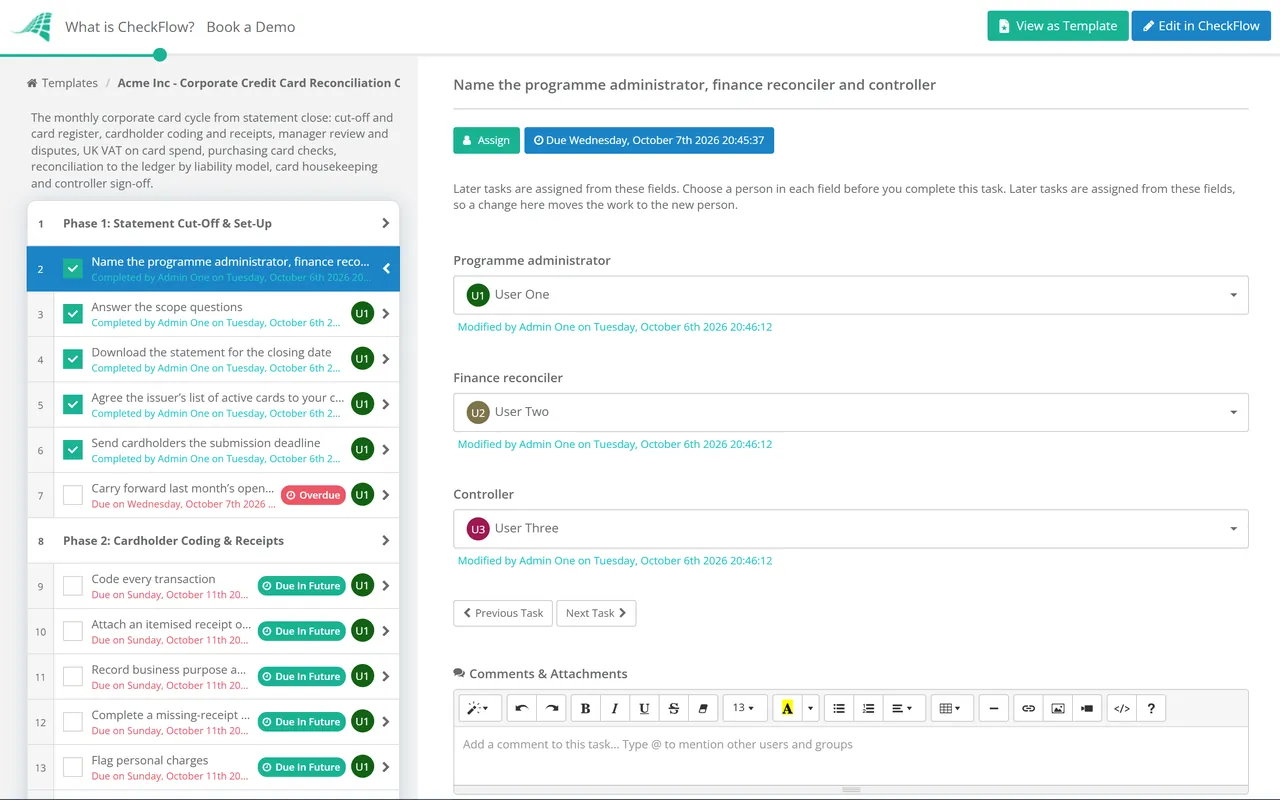
Seven phases run from statement cut-off to sign-off. Phase 4 appears only for UK VAT-registered companies and Phase 5 only when the programme includes purchasing cards. In Phase 6, the liability answer shows the company-billed tasks, the individually billed tasks or both.
Owned by the card programme administrator. Answer the three scope questions first.
Shown only when the company is UK VAT-registered.
Shown only when the programme includes purchasing cards.
Tasks marked company-billed or individually billed appear according to the liability answer in Phase 1.
Who the issuer bills decides what finance reconciles. Check your card agreement: names vary by issuer, and many programmes mix models, with company-billed travel accounts alongside individually billed employee cards.
| Model | Who pays the issuer | What finance reconciles | Main risk |
|---|---|---|---|
| Company-billed (central or corporate liability) | The company pays the whole statement | Every transaction, and the statement balance to the card liability account | Personal or unsupported spend paid before anyone has reviewed it |
| Individually billed (individual liability) | The cardholder pays and claims business charges back through expenses | The expense claims, plus the issuer’s past-due report | Business charges claimed twice, or a cardholder falling behind on payments |
| Joint and several | Usually the cardholder, with the company liable if they do not pay | As individually billed, with closer attention to arrears | The company ends up paying for a leaver’s unpaid balance |
| Purchasing card (P-card) | The company, normally on a central statement | Every transaction, receipt of goods, and the statement balance | Purchases that bypass purchase orders and goods-received checks |
Where the differences usually come from. When the card platform or expense tool does not agree to the statement, the cause is rarely mysterious: transactions that were still pending authorisations at the closing date, refunds and dispute credits posted on a different date from the original charge, foreign transaction fees the issuer adds as separate lines, and cards issued or cancelled mid-cycle that one system knows about and the other does not. List each difference with its cause in Phase 6 and expect it to clear next month. A difference with no cause is a finding, not a rounding item.
A typical month, counted from the statement closing date. These are suggested offsets for the template; set your own around the issuer’s payment due date.
The checklist is created, the statement downloaded and cardholders told what is still missing.
Every transaction coded, receipted and explained, with personal charges and unrecognised items flagged.
Disputes raised, personal charges agreed, late cardholders chased.
Statement posted, liability account reconciled, controller approval recorded, payment scheduled before the due date.
Dispute rights are thinner on company cards. In the US, most of the Truth in Lending Act’s Regulation Z does not apply to credit extended for business purposes. The exception is the rules on card issuance and liability for unauthorised use, and where an issuer provides 10 or more cards to one organisation’s employees, the organisation and issuer may agree different liability terms, though an employee’s own liability stays capped by the regulation. In the UK, Section 75 of the Consumer Credit Act 1974 protects consumers, not business cardholders. Either way, disputes on company cards run through the card scheme’s chargeback rules and your card agreement. Visa and Mastercard give up to 120 days from the transaction for most dispute types, but the deadline that binds you is the one in your issuer’s agreement, which may be shorter, so put it on the dispute task as a due date.
A monthly schedule starts the checklist on the statement closing date, with the cardholder deadline, manager review and reconciliation each due a set number of days later.
Keep cardholders, managers, cost centres and limits in a data set that feeds the dropdowns. When someone leaves, the card cancellation task names the card and the person who must cancel it.
Disputes, missing receipts and unpaid personal charges are recorded on the tasks with their evidence. The Tasks grid shows what each cardholder still owes, and the activity trail shows who approved what and when.
The card reconciliation is one of the inputs to a clean close. The Month-End Close Checklist picks up the reconciled card liability, the Expense Reimbursement Checklist handles out-of-pocket claims, and the Expense Audit Checklist tests a sample of both each quarter.
CheckFlow is not a card platform or an expense management tool: it does not issue cards, import transactions or match receipts. Your issuer’s portal and expense software do that. CheckFlow runs the monthly routine around them, with every step assigned, dated and signed off. See how recurring checklists work.
Describe the process in a sentence and the AI checklist generator drafts the phases and tasks for you.
Download the statement at its closing date, get each cardholder to code every transaction and attach a receipt, have their manager review it, deal with disputes and personal charges, then agree the statement total to your card platform and to the card liability account in the ledger. The controller signs off and the balance is paid by the due date.
With company liability, the issuer bills the company, which pays the whole statement and reconciles every transaction. With individual liability, the cardholder is billed, pays the issuer and claims business charges back through expenses. Joint and several arrangements bill the cardholder but make the company liable if they do not pay.
Ask for a duplicate from the merchant first. Failing that, the cardholder signs a missing-receipt declaration with the date, merchant, amount and business purpose, and the policy should limit how often that is allowed. In the UK, no VAT can be reclaimed without a valid VAT invoice. In the US, IRS rules require documentary evidence for all lodging and for other expenses of $75 or more.
No. A card statement shows that you paid, not what the supplier charged VAT on, so you need the supplier’s VAT invoice. The exception is purchasing card programmes that provide VAT invoices on suppliers’ behalf under the arrangements in HMRC’s VAT Notice 701/48. If an invoice arrives late, claim the VAT in the period you receive it.
Check your card agreement, because the issuer’s deadline is the one that binds you. Visa and Mastercard allow up to 120 days from the transaction for most dispute types, but an issuer can require notice sooner, and consumer protections such as Section 75 in the UK do not cover business cards. Raise disputes as soon as a cardholder flags a charge.
If the employee repays them promptly, there is usually nothing to report. In the UK, personal spend the employer pays and does not recover is reported on the P11D, with Class 1 National Insurance through payroll. In the US, personal charges that are not repaid are taxable wages.
14-day free trial, no card required. The Business plan is $10 per user per month after the trial. Full details at checkflow.io/pricing.
14-day free trial, no credit cardFull refund in your first 30 daysUS hosting, EU on request