PCI DSS 4.0 Compliance Checklist Template

A PCI DSS assessment can be lost long before fieldwork starts: a quarterly scan that slipped, a targeted risk analysis nobody reviewed, a scope last confirmed before the new checkout went live.

PCI DSS applies to every merchant and service provider that stores, processes or transmits cardholder data, or could affect its security. This free PCI DSS compliance checklist runs the annual assessment cycle for either: scope and validation type, third-party responsibilities, targeted risk analyses, a year of scan and penetration test evidence, and the SAQ or ROC with its Attestation of Compliance. Answers on the first task switch on the service provider, segmentation and payment page tasks only where they apply. The result is one dated, signed record of the year that your acquirer and assessor can follow.

Use This Template Free See Live Example
No Credit Card Required

Last reviewed: September 2026

The Assessment Is Annual. The Evidence Is Not.

The PCI Security Standards Council writes PCI DSS, but the card brands’ compliance programmes and, for merchants, the acquiring bank decide who validates and how. Visa, for example, sets a merchant’s level from its total Visa transaction volume over 12 months, and the acquirer says which report to submit.

The current standard is v4.0.1, published in June 2024. Version 4.0 was retired on 31 December 2024, and its future-dated requirements became mandatory on 31 March 2025. The report is annual, but the controls are not: daily log reviews (10.4.1), weekly file comparisons (11.5.2), scans every three months (11.3.1, 11.3.2), and six-monthly reviews of network security controls and user access (1.2.7, 7.2.4). Section 7 of the standard defines “every three months” as at least once every 90 to 92 days, and expects you to show how any missed activity was noticed and caught up.

Self-Assessment Questionnaire (SAQ)

Completed by the entity itself

Who: merchants their acquirer allows to self-assess; eligible service providers use SAQ D.

Scope: only the requirements for the SAQ type, from SAQ A up to SAQ D.

Output: the SAQ and an AOC signed by an executive officer, plus ASV scan reports where required.

Approach: the customized approach is not available.
Report on Compliance (ROC)

Completed by a QSA or ISA

Who: typically the largest merchants and service providers, at thresholds the brands set.

Scope: every applicable requirement, tested by sampling, interviews and observation.

Output: the ROC and an AOC signed by the entity and the assessor.

Approach: defined or customized, the latter backed by a risk analysis (12.3.2).

SAQ A changed in January 2025

E-commerce merchants with an embedded payment form

The Council removed Requirements 6.4.3 and 11.6.1, and the related risk analysis under 12.3.1, from SAQ A. Instead, the merchant must confirm its site is not susceptible to attacks from scripts that could affect its e-commerce systems. FAQ 1588 applies this to pages that embed a provider’s payment form, such as an iframe, and accepts either the merchant’s own script controls or written confirmation from its PCI DSS compliant provider. The requirements themselves did not change.

What the PCI DSS Compliance Checklist Covers

Six phases take the cycle from scoping to a submitted AOC. A seventh appears only for service providers. Requirement numbers are from PCI DSS v4.0.1.

Phase 1

Phase 1: Confirm Scope & Validation Type

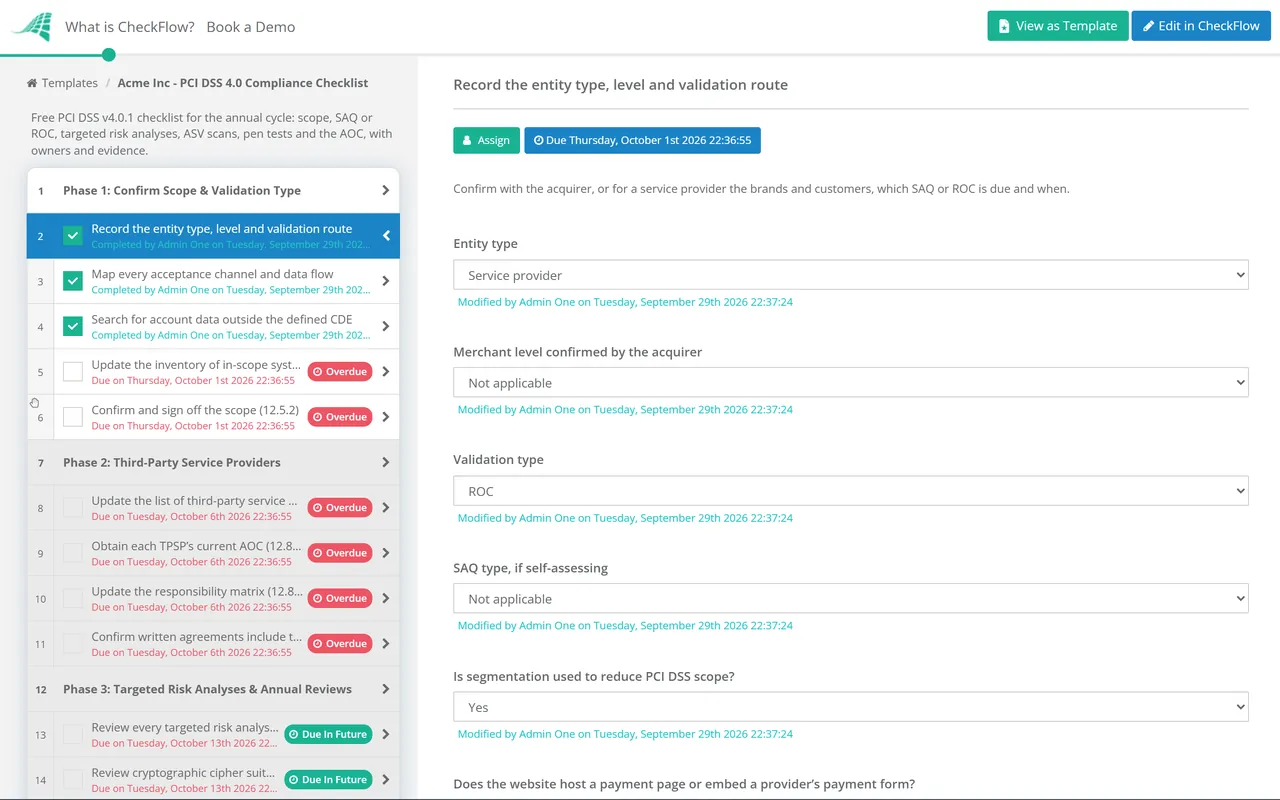
The answers on the first task drive the conditional tasks in Phases 2, 4 and 6, and whether Phase 7 appears.

  • Record the entity type, level and validation route — confirm with the acquirer, or for a service provider the brands and customers, which SAQ or ROC is due and when
  • Map every acceptance channel and data flow — authorisation, capture, settlement, chargebacks and refunds, with updated data-flow diagrams (1.2.4)
  • Search for account data outside the defined CDE — file shares, tickets, call recordings and backups; any PAN found starts the 12.10.7 procedure
  • Update the inventory of in-scope system components (12.5.1) — including connected and security-impacting systems
  • Confirm and sign off the scope (12.5.2) — record what changed and who approved it; repeat after any significant change
Phase 2

Phase 2: Third-Party Service Providers

  • Update the list of third-party service providers (12.8.1) — every TPSP that handles account data or could affect its security, with its service
  • Obtain each TPSP’s current AOC (12.8.4) — check it covers the services you use, and record the review date
  • Update the responsibility matrix (12.8.5) — which requirements each TPSP manages, which you manage and which are shared
  • Confirm written agreements include the TPSP’s acknowledgement (12.8.2) — that it is responsible for the security of the account data it handles or could affect
  • File the provider’s script-protection confirmation — only when an embedded payment form is used and SAQ A eligibility relies on it (FAQ 1588)
Phase 3

Phase 3: Targeted Risk Analyses & Annual Reviews

Where PCI DSS lets you set a frequency, 12.3.1 requires a documented risk analysis: for example 5.2.3.1, 7.2.5.1, 8.6.3, 9.5.1.2.1, 10.4.2.1 and 11.3.1.1.

  • Review every targeted risk analysis (12.3.1) — at least every 12 months, and add one for any new frequency the entity sets
  • Review cryptographic cipher suites and protocols (12.3.3) — with the trusted keys and certificates inventory (4.2.1.1)
  • Review hardware and software technologies (12.3.4) — end-of-life plans approved by senior management
  • Review the information security policy (12.1.2) — updated for changes in business objectives or risks
  • Review and test the incident response plan (12.10.2) — confirming it includes the 12.10.7 procedure
Phase 4

Phase 4: Scans, Penetration Tests & Segmentation

The segmentation task appears only when segmentation reduces scope; the payment page task only when the website hosts or embeds a payment page.

  • Collect four quarterly internal vulnerability scans (11.3.1) — high-risk and critical findings resolved and rescanned
  • Collect four quarterly ASV scans (11.3.2) — a passing result each quarter, including rescans
  • Match scans to significant changes (11.3.1.3, 11.3.2.1) — every significant change has a scan behind it
  • Run internal and external penetration tests (11.4.2, 11.4.3) — at least every 12 months by an independent tester, with exploitable findings retested (11.4.4)
  • Test segmentation controls (11.4.5) — at least every 12 months and after changes, confirming the CDE is isolated
  • Evidence payment page script controls (6.4.3, 11.6.1) — script inventory and authorisation, and tamper detection at least weekly or as risk-analysed
Phase 5

Phase 5: Periodic Control Evidence

Controls an assessor samples across the year. Run each on its own recurring checklist and attach the completed runs here.

  • Collect two network security control reviews (1.2.7) — each rule checked against a current business justification
  • Collect two user access reviews (7.2.4) — including vendor accounts, with management acknowledgement
  • Sample daily log reviews and weekly file comparisons (10.4.1, 11.5.2) — with each alert investigated and closed
  • Confirm MFA for all non-console access into the CDE (8.4.2) — not only remote access
  • Confirm security awareness training (12.6.3, 12.6.3.1) — on hire and annually, covering phishing and social engineering
  • Record any scheduled activity that ran late — the cause, catch-up date and revised schedule, as Section 7 of the standard expects
Phase 6

Phase 6: Assess, Attest & Submit

The first task appears for an SAQ, the second for a ROC, following the validation type recorded in Phase 1.

  • Complete the SAQ for the confirmed type — answer every requirement from the evidence in Phases 1–5
  • Agree the assessment plan with the QSA or ISA — scope, sampling, interviews and any customized approach controls
  • Resolve findings before the report is final — a control scheduled for a future date is not in place
  • Complete the Attestation of Compliance — the official PCI SSC form, signed by the executive officer and any assessor
  • Submit the AOC, report and ASV scans — to the acquirer or requesting organisation, recording the date and recipient
Phase 7 — Service Providers Only

Phase 7: Service Provider Requirements

Shown only when the entity type is service provider.

  • Confirm executive responsibility for the PCI DSS compliance programme (12.4.1) — accountability and a charter
  • Confirm scope every six months (12.5.2.1) — and review the scope impact of organisational changes (12.5.3)
  • Run quarterly reviews that personnel follow security procedures (12.4.2) — by someone other than the task owner
  • Test segmentation every six months (11.4.6) — where segmentation is used, and after changes to it
  • Answer customer requests for compliance information (12.9.2) — AOC status and the split of responsibilities

The 12 PCI DSS Requirements and the Evidence Each Needs

The table lists recurring evidence for each of the 12 principal requirements in v4.0.1, and the phase that collects it. Your SAQ type decides which rows apply, so treat the table as a starting point, not legal advice.

Principal requirement Recurring evidence Evidenced in
1. Install and Maintain Network Security ControlsSix-monthly NSC reviews (1.2.7); data-flow diagrams (1.2.4)Phases 1 and 5
2. Apply Secure Configurations to All System ComponentsIn-scope component inventory (12.5.1)Phase 1
3. Protect Stored Account DataSearch for PAN outside the CDE; response procedure (12.10.7)Phases 1 and 3
4. Protect Cardholder Data with Strong Cryptography During Transmission Over Open, Public NetworksKeys and certificates inventory (4.2.1.1); cipher suite review (12.3.3)Phase 3
5. Protect All Systems and Networks from Malicious SoftwareRisk analysis for 5.2.3.1Phase 3
6. Develop and Maintain Secure Systems and SoftwarePayment page script inventory (6.4.3)Phase 4
7. Restrict Access to System Components and Cardholder Data by Business Need to KnowSix-monthly user access reviews (7.2.4); risk analysis for 7.2.5.1Phases 3 and 5
8. Identify Users and Authenticate Access to System ComponentsMFA into the CDE (8.4.2); risk analysis for 8.6.3Phases 3 and 5
9. Restrict Physical Access to Cardholder DataRisk analysis for POI device inspections (9.5.1.2.1)Phase 3
10. Log and Monitor All Access to System Components and Cardholder DataDaily log reviews (10.4.1); risk analysis for 10.4.2.1Phases 3 and 5
11. Test Security of Systems and Networks RegularlyScans (11.3); penetration and segmentation tests (11.4); file comparisons (11.5.2); tamper detection (11.6.1)Phases 4 and 5
12. Support Information Security with Organizational Policies and ProgramsPolicy review, risk analyses, scope, training, TPSPs and incident response (12.1–12.10)Phases 1–3, 5 and 7

From 3 June to 20 July 2026 the Council ran a request for comments on v4.0.1, the first step towards the next version. At the time of review no draft or publication date had been announced, and v4.0.1 remains the version to assess against. The Council’s June 2026 guidance on compensating controls and the customized approach clarifies both but changes no requirement.

Why Run Your PCI DSS Cycle in CheckFlow?

1

Quarterly means 90 to 92 days

A recurring schedule starts the scan checklist every three months, the access and NSC reviews every six, and this checklist once a year, with dynamic due dates. A missed quarter shows up as an overdue checklist with a name on it.

2

Scope answers shape the checklist

Conditional logic reads the Phase 1 answers and shows the service provider phase, segmentation test, payment page tasks and the SAQ or ROC task only where they apply. A redirect-only merchant never sees tasks it does not need, and a service provider cannot skip the ones it does.

3

Evidence an assessor can sample

Scan reports, test reports, risk analyses and provider AOCs sit on the task they support. The activity trail records who completed each step and when, scope sign-off runs as an approval, and template versioning keeps each year’s record tied to the checklist it used.

CheckFlow is not an Approved Scanning Vendor, a QSA, a scanner or a GRC platform. It runs the scheduled work and sign-offs around your scanning, testing and assessment providers. Attach reports with card numbers masked, so the checklist never becomes part of your CDE. CheckFlow’s compliance checklist software shows how the same schedules, evidence and approvals work across your whole compliance calendar.

If you also need a SOC 2 report, much of this evidence carries over to the SOC 2 Readiness Checklist. For due diligence on the Phase 2 providers beyond their AOC, use the Vendor Risk Assessment Checklist. The Council mapped PCI DSS v4.0.1 to NIST CSF 2.0 in July 2026, and the NIST CSF 2.0 Checklist runs that wider assessment.

Frequently Asked Questions

What is the difference between PCI DSS 4.0 and 4.0.1?

+

Version 4.0.1, published in June 2024, is a limited revision. It corrects formatting and typographical errors and clarifies the intent of some requirements, but adds or deletes none. Version 4.0 was retired on 31 December 2024, so assessments today are against v4.0.1, although many people still say “PCI DSS 4.0”.

Which PCI DSS requirements became mandatory on 31 March 2025?

+

The requirements v4.0 introduced as best practices until that date. They include targeted risk analyses (12.3.1), MFA for all non-console access into the CDE (8.4.2), payment page script controls (6.4.3, 11.6.1), automated log reviews (10.4.1.1), anti-phishing mechanisms (5.4.1), 12-character passwords (8.3.6) and a procedure for unexpected PAN (12.10.7).

How do I know whether I need an SAQ or a ROC?

+

Ask your acquirer. The card brands’ programmes and the acquirer decide, not the PCI SSC. Your level comes from your annual transaction volume with each brand, and the SAQ type from how you accept cards. A merchant with fully outsourced e-commerce payments may qualify for SAQ A, and anyone using the customized approach needs a ROC. Record the answer on the first task.

How often are PCI DSS vulnerability scans and penetration tests required?

+

Internal and ASV scans at least every three months and after significant change (11.3.1, 11.3.2). Internal and external penetration tests at least every 12 months and after significant change (11.4.2, 11.4.3). Segmentation tests every 12 months, or six for service providers (11.4.5, 11.4.6). For a first assessment, four passing ASV scans are not required if the latest passed, policy requires quarterly scans and findings were corrected.

What is a targeted risk analysis in PCI DSS?

+

A documented analysis that justifies a choice PCI DSS leaves to you, usually how often a control runs. Under 12.3.1 it identifies the assets, the threats, the factors affecting likelihood and impact, and how the chosen frequency addresses the risk. Each is reviewed at least every 12 months. The customized approach needs a separate analysis under 12.3.2, approved by senior management.

Is a new version of PCI DSS coming?

+

The Council ran a request for comments on v4.0.1 from 3 June to 20 July 2026. At the time of review no draft or date had been announced, and the standard lists v4.0.1’s retirement date as to be determined. For comparison, v4.0 and v3.2.1 ran side by side from March 2022 until 31 March 2024.

Is CheckFlow free for this template?

+

14-day free trial, no card required. The Business plan is $10 per user per month after the trial. Full details at checkflow.io/pricing.

Every Quarter Evidenced Before the Assessor Asks

Free trial — no credit card required.