Ledger against an outside record
- One entity, one account, one statement
- The bank’s record is the reference point
- Differences are timing, errors or fraud
Last reviewed: October 2026
No Credit Card Required
Printed from checkflow.io/templates/finance-accounting/intercompany-reconciliation-checklist
This free intercompany reconciliation checklist is for group controllers, entity accountants and finance managers in groups of two or more companies that trade with, lend to or charge each other. It runs the monthly cycle from the cut-off calendar and the recharges through balance confirmation by counterparty pair, dispute resolution and eliminations to a signed-off reconciliation, with transfer pricing and withholding tax checks built in. Two scope questions decide whether the foreign exchange phase and the netting and settlement phase appear, so a single-currency month without a settlement stays short.
Most reconciliations compare your ledger with something outside the business: a bank statement, a supplier statement, a subledger. An intercompany reconciliation compares two ledgers inside the same group, each kept by a different team, often on a different system and in a different currency. Neither side is automatically right, so the process needs rules agreed in advance: who raises the charge, when both sides must book it, which rate converts it, how big a difference can be cleared without argument, and who decides when the two teams disagree.
The result also matters twice. Each entity’s own accounts and tax return depend on its side of the balance, and the consolidated accounts depend on the two sides cancelling exactly. Where the entities are in different countries, tax authorities on both sides expect the price to be at arm’s length and documented. This checklist sits alongside the Month-End Close Checklist, which each entity runs for its own books, and feeds the group close.
Seven phases run from the cut-off calendar to the group controller’s sign-off. Phase 4 appears only when a counterparty pair holds balances in more than one currency, and Phase 6 only in a settlement month.
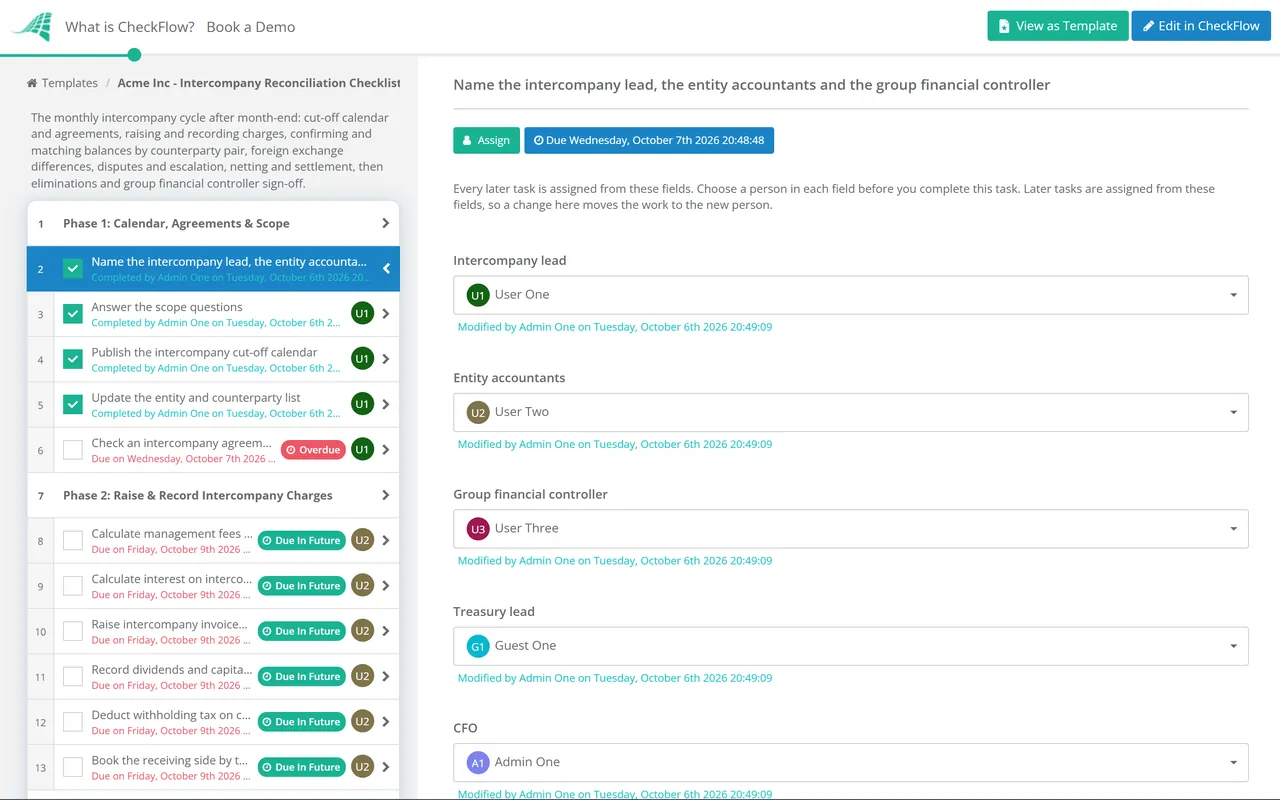
Owned by the group intercompany lead. The two scope questions decide which later phases this month’s checklist shows.
Shown only when a counterparty pair holds balances in more than one currency.
Shown only in a settlement month, for example the quarterly netting run.
The checklist is a process, but most of its tasks exist because a standard or a tax rule requires something. The table shows the main US and UK or IFRS references. Rates, thresholds and treaties change, so confirm the current position with your advisers.
| Topic | United States | UK and IFRS |
|---|---|---|
| Eliminations (Phase 7) | ASC 810-10-45-1: intra-entity balances and transactions are eliminated, and intra-entity profit on assets still in the group is eliminated in full even where there is a noncontrolling interest | IFRS 10 paragraph B86: intragroup assets, liabilities, equity, income, expenses and cash flows are eliminated in full, including profit recognised in inventory and fixed assets. FRS 102 Section 9 sets the same rule |
| Exchange differences (Phase 4) | ASC 830-20-35-3: gains and losses on intra-entity balances of a long-term investment nature go to the cumulative translation adjustment on consolidation; others stay in earnings | IAS 21 paragraph 45: an intragroup monetary item cannot be eliminated without showing the exchange difference, which stays in consolidated profit or loss unless the item forms part of a net investment in a foreign operation |
| Arm’s length pricing (Phases 1, 2, 7) | Internal Revenue Code section 482 and its regulations | UK transfer pricing legislation, read in line with the OECD Transfer Pricing Guidelines; small and medium-sized enterprises are generally exempt |
| Documentation (Phase 7) | Penalty protection under section 6662(e) depends on documentation existing when the return is filed; the penalty is 20% of the underpayment, or 40% for a gross misstatement | Groups with consolidated revenue of €750 million or more keep a master file and local file in the OECD format, plus a summary audit trail, for periods beginning on or after 1 April 2023, and provide them within 30 days of an HMRC request |
| Country-by-country reporting | Form 8975 for US-parented groups with revenue of $850 million or more in the preceding year | Groups with consolidated revenue of €750 million or more, following OECD BEPS Action 13 |
| Low value-adding services (Phase 2) | The services cost method in the section 482 regulations allows certain routine services to be charged at cost | The OECD simplified approach allows a 5% mark-up on the cost of qualifying services without a benchmarking study, where the jurisdiction accepts it |
| Withholding tax (Phases 2, 6) | 30% on US-source interest, royalties and other fixed or periodic income paid to foreign persons, unless reduced by a treaty | 20% on UK-source yearly interest and on royalties paid abroad, unless reduced by a treaty; the rate on interest rises to 22% from 6 April 2027 |
Disclosure in each entity’s own accounts. Under FRS 102 paragraph 33.1A, a UK company need not disclose transactions with other group members where every subsidiary involved is wholly owned. Partly owned subsidiaries lose that exemption, so keep the counterparty list in Phase 1 clear about ownership.
What is changing. For UK chargeable periods beginning on or after 1 January 2026, Finance Act 2026 exempts many UK-to-UK transactions from transfer pricing where there is no risk of UK tax loss. Banks, REITs and some other regimes are carved out, and companies can elect out. The government dropped its proposal to remove the medium-sized enterprise exemption, and it plans a new International Controlled Transactions Schedule for reporting cross-border related-party transactions, expected to apply from accounting periods beginning on or after 1 January 2027 once secondary legislation is made. The OECD published proposed revisions to Chapter VII of its guidelines, on intra-group services, on 1 June 2026, with comments closing on 22 July 2026; they are not yet final. And IFRS 18, which replaces IAS 1 for periods beginning on or after 1 January 2027, prompted an April 2026 IFRS Interpretations Committee agenda decision on which category of the income statement holds exchange differences on intragroup loans.
A monthly schedule creates the checklist after each month-end, with every entity accountant assigned and each due date counted back from the group reporting date.
Each difference over tolerance has an owner, comments from both sides and the evidence attached. The group controller’s decision is recorded on the task, and the approval halts the checklist until it is given.
Keep your entities, entity codes, functional currencies and ownership in a data set, so counterparty dropdowns stay current. The Tasks grid shows every open item by person, and analytics show which entities finish late.
Intercompany is one reconciliation among many in the close. The Bank Reconciliation Checklist covers cash, the Journal Entry Review & Approval Checklist controls the correcting entries this process produces, and the Year-End Close Checklist picks up the final transfer pricing true-up. Our month-end close guide shows where intercompany fits in the timetable.
CheckFlow is not a consolidation tool or an accounting system, and it does not match transactions or post eliminations. It runs the workflow around those tools: who books what by when, who confirmed, which differences are open, who decided and who approved, with a timestamped trail you can export for your auditors.
Describe the process in a sentence and the AI checklist generator drafts the phases and tasks for you.
It is the process of agreeing the balances and transactions that companies in the same group record with each other, so that a receivable in one entity equals the payable in the other, interest income equals interest expense, and so on. Once each counterparty pair agrees, the balances can be eliminated on consolidation without an unexplained difference.
The usual causes are timing (one side booked the charge this month, the other next month), charges never booked by the receiver, the wrong counterparty code, disagreement over the amount or the pricing, goods or cash in transit, and exchange rates. Matching in transaction currency first, then retranslating, separates the exchange effect from the real differences.
Monthly, as part of the close, is common practice for any group that produces monthly consolidated accounts. Cash settlement is often less frequent, for example quarterly through a netting run, which is why the settlement phase in this template is switched on only in a settlement month.
Under IAS 21 they stay in consolidated profit or loss even though the loan itself is eliminated, because the group is genuinely exposed to the currency. The exception is a loan that forms part of the net investment in a foreign operation, where settlement is neither planned nor likely in the foreseeable future: then the differences go to other comprehensive income on consolidation. US GAAP reaches a similar answer under ASC 830 for balances of a long-term investment nature.
Cross-border charges between related companies must be priced at arm’s length in most countries. In the UK, groups with consolidated revenue of €750 million or more must keep a master file and local file, and smaller groups still need enough evidence to support their returns. In the US, documentation in place when the return is filed is what protects against the section 6662(e) penalties. Since 2026 many UK-to-UK transactions are exempt.
14-day free trial, no card required. The Business plan is $10 per user per month after the trial. Full details at checkflow.io/pricing.
14-day free trial, no credit cardFull refund in your first 30 daysUS hosting, EU on request