
Quarterly review, annual count, one template
A recurring quarterly schedule starts the desk review, and marking the fourth-quarter review as the annual one adds the physical verification phase. Nobody has to remember which quarter needs the count.
The fixed asset register usually holds some of the largest numbers on the balance sheet, and it is one of the least reviewed. Depreciation runs automatically every month, so the register looks as if it is working. Meanwhile it collects assets that were scrapped years ago, misses equipment bought on a credit card, and keeps depreciating assets that are already fully written down but still in daily use. This free fixed asset register review checklist gives controllers, finance managers and asset accountants a structured periodic review. It reconciles the register to the general ledger, reviews additions against your capitalisation policy, clears disposals and transfers, tests depreciation, records an impairment indicator assessment and ends with a controller sign-off. An annual physical verification phase appears only when the review is marked as the annual one.
A fixed asset register can be wrong in two directions. It can contain ghost assets: items that are still on the books but no longer exist, because they were scrapped, lost or sold without anyone telling finance. Ghost assets overstate the balance sheet and keep generating depreciation. It can also miss assets that exist, such as equipment expensed by mistake or bought outside the purchasing process. Both problems grow quietly, and both usually come to light during an audit or an insurance claim.
If the register hasn’t been reviewed for a while, expect the first review to take longer than the rest. Start by agreeing the register total to the ledger by asset class and explaining the differences, even if some can only be written off. Then write down the capitalisation threshold, the useful life for each asset class and who authorises disposals, if those policies don’t already exist. Every later review tests the register against those policies, so they need to be clear before the checklist can do its job.
The desk review catches accounting errors: additions coded wrongly, disposals not recorded, depreciation that doesn’t make sense. Only a physical check catches ghost assets and unrecorded ones. Most businesses run the desk review quarterly and a physical verification once a year, focusing on high-value and portable assets.
Checks: register-to-ledger reconciliation, additions, disposals, transfers, depreciation, impairment indicators.
Finds: coding errors, missed disposals, wrong useful lives, depreciation on land or unfinished projects.

Checks: existence, tag, location, condition and custodian of each asset in the sample.
Finds: ghost assets, unrecorded assets, idle or damaged equipment that may be impaired.
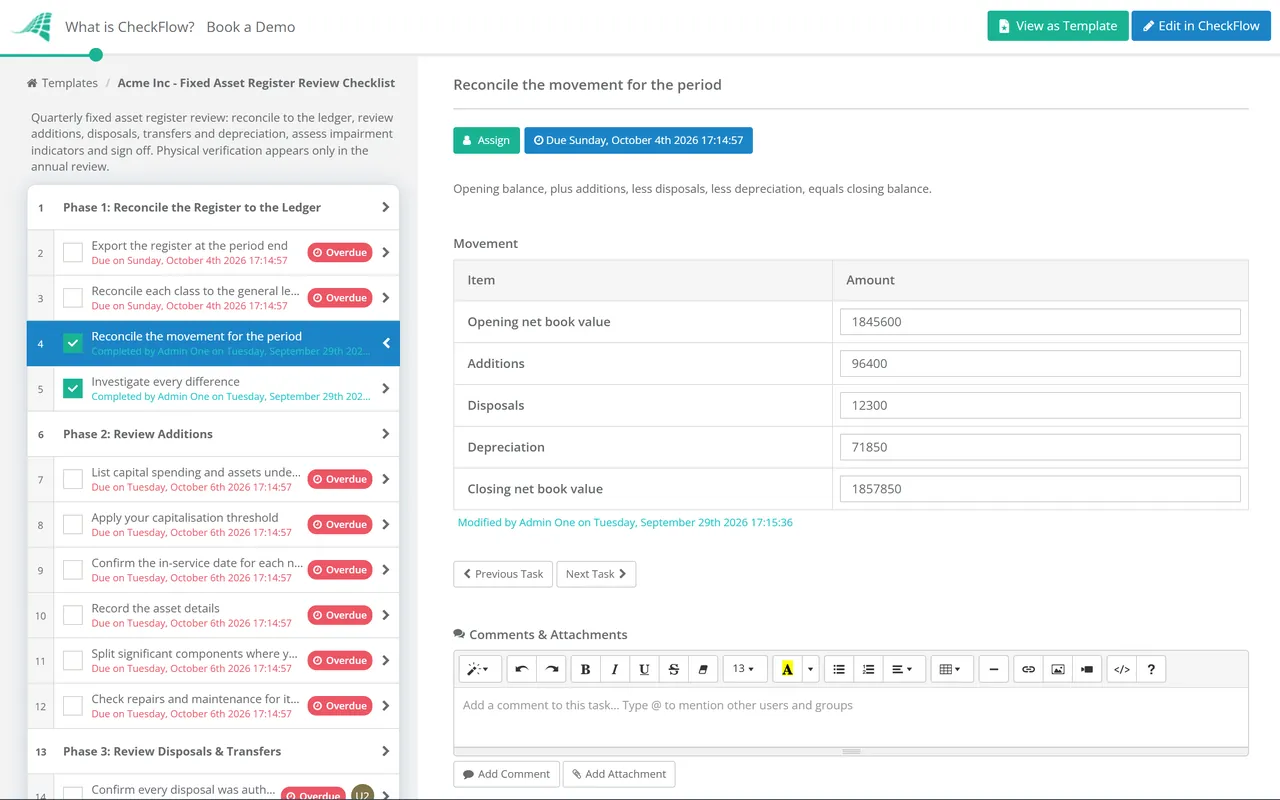
Six phases make up the quarterly desk review. A seventh phase, physical verification, appears only when the review is marked as the annual one.
Shown only when the review is marked as the annual review. Assign each location to its site or department manager.
The review steps are the same under every framework, but several of the rules behind them differ. The table compares US GAAP, IFRS (IAS 16 and IAS 36) and UK FRS 102 (Sections 17 and 27) on the points this checklist touches. It is a summary for planning the review, not a substitute for the standards or your auditors’ view.
| Topic | US GAAP | IFRS | UK FRS 102 |
|---|---|---|---|
| Component depreciation | Permitted, not required | Required for each part with a significant cost | Required for major components with different patterns of use |
| Revaluation above cost | Not permitted | Permitted, by class of asset | Permitted, by class of asset |
| Review of useful life and residual value | When events or circumstances indicate a change | At least at each financial year end | When there is an indication of change since the last reporting date |
| Impairment trigger | Test when events or changes in circumstances indicate the carrying amount may not be recoverable | Assess for indicators at the end of each reporting period | Assess for indicators at each reporting date |
| Impairment test | Recoverability test on undiscounted cash flows, then measure the loss at fair value | Compare with recoverable amount: the higher of fair value less costs of disposal and value in use | Compare with recoverable amount, as under IFRS |
| Reversal of an impairment | Prohibited for assets held and used | Permitted, except for goodwill | Permitted, except for goodwill |
Tax depreciation is a separate register. Capitalisation and depreciation for tax follow their own rules, so the tax figures rarely match the books. In the US, businesses depreciate assets under MACRS, can elect the de minimis safe harbor to expense items up to $2,500 per invoice or item ($5,000 with an applicable financial statement), and since 2025 can claim 100% bonus depreciation on qualifying property acquired after 19 January 2025. In the UK, companies claim capital allowances instead of depreciation: the Annual Investment Allowance covers up to £1 million a year, full expensing applies to new main-rate plant and machinery, and from April 2026 the main-pool writing-down allowance fell from 18% to 14%. Keep the tax register alongside the book register and reconcile the two for the deferred tax calculation.
A recurring quarterly schedule starts the desk review, and marking the fourth-quarter review as the annual one adds the physical verification phase. Nobody has to remember which quarter needs the count.
Verification tasks are assigned to the manager of each location, who confirms existence and condition and attaches photos from the floor. Finance sees which locations are complete without chasing spreadsheets.
Disposals, missing-asset write-offs and correcting journals are approval steps, and the controller signs off the review at the end. Auditors get the reconciliation, the impairment assessment and the evidence in one place.
Asset reviews are recurring work with a different scope each quarter. CheckFlow’s recurring checklist software shows how conditional phases keep the quarterly review short and add the annual verification only when it is due.
The register feeds the year-end. The Year-End Close Checklist relies on this review for its asset verification step, and the Capital Project Checklist covers the projects that turn into new assets under construction.
It is a periodic check that the fixed asset register is complete and accurate, and that it agrees to the general ledger. The review covers additions, disposals, transfers, depreciation and impairment indicators, and at least once a year it includes a physical check that the assets on the register actually exist and are where the register says they are.
Most businesses reconcile the register to the ledger monthly or quarterly as part of the close, run a fuller desk review quarterly, and carry out a physical verification once a year. Businesses with many portable or high-value assets, such as IT equipment, tools or vehicles, often verify those more frequently.
It is the minimum cost at which an item is recorded as a fixed asset rather than expensed. It is an accounting policy, not a rule set by the standards, so each business chooses a level that is immaterial to its accounts. Tax rules can set different limits, such as the US de minimis safe harbor, so the book and tax treatment of the same purchase may differ.
Ghost assets are items that are still recorded on the fixed asset register but no longer exist or are no longer in use, usually because they were scrapped, lost or sold without the disposal being recorded. They overstate the balance sheet and keep attracting depreciation, and in some cases insurance premiums or property taxes. Only a physical verification finds them reliably.
It depends on your framework. IFRS requires useful lives and residual values to be reviewed at least at each financial year end. UK FRS 102 and US GAAP require a review when there is an indication that they have changed. In practice, the list of fully depreciated assets still in use is the clearest sign that useful lives need revisiting.
When there is an indication that an asset may be impaired, such as physical damage, idleness, obsolescence, a restructuring or a fall in the performance or market value of the assets. IFRS and FRS 102 require you to assess for indicators at every reporting date, and US GAAP requires a test when events or changes in circumstances suggest the carrying amount may not be recoverable. The measurement of the loss also differs between frameworks.
14-day free trial, no card required. The Business plan is $10 per user per month after the trial. Full details at checkflow.io/pricing.