Teacher Observation Checklist Template

An observation helps a teacher when they know why it is happening, chose part of what is looked at, and hear feedback while the lesson is still fresh. This checklist builds in all three.

Last reviewed: October 2026

This free teacher observation checklist runs one lesson observation, from agreeing why it is happening to the review of targets. The observer and the teacher agree the purpose and the type of observation, the teacher gets notice, and a pre-observation meeting covers the class, the lesson plan, what the teacher wants feedback on and the criteria. On the day the observer notes what was seen and heard, not judgements. The teacher reflects first, then a private feedback conversation agrees the strengths, one or two development points and targets with support. The observer and the teacher both confirm the written record before the follow-up starts. Peer, induction and focus-area observations, a second observer and a remote or recorded lesson each add their own steps. For a teacher who is new to the school, start with the Teacher Onboarding Workflow Checklist.

One Lesson Observation, From the Agreed Focus to the Follow-Up

This checklist is built so the teacher knows why the observation is happening, has a say in what is looked at, and gets feedback they can act on. It runs one observation of one lesson: the purpose and type agreed first, a pre-observation meeting, evidence notes against criteria you agree together, the teacher’s own reflection, a feedback conversation, a written record that both of you confirm, and the follow-up.

It does not grade the lesson. The seven areas it looks at are examples for your school to replace with its own criteria, and how observation links to anything else, such as appraisal, is for your school’s policy to set. Two other checklists sit next to it.

This checklist

One lesson observation

Covers: the purpose, notice, the pre-observation meeting, evidence against the agreed criteria, the teacher’s reflection, feedback, the agreed record, support and the review of targets.

Who: an observer, the teacher and whoever arranges support, with a second observer or a mentor when they take part.

Output: a record the teacher has agreed, with one or two targets and the support for each.
For new staff

The Teacher Onboarding Workflow Checklist

Covers: a new teacher’s start: employment checks, safeguarding, systems, curriculum induction, a mentor and a first-term review.

Use it: when someone joins. Each observation during their induction runs here, one checklist per lesson. Teacher Onboarding Workflow Checklist.

Once a year

The Employee Performance Review Checklist

Covers: the yearly review cycle: self-assessment, evidence, the conversation and a development plan.

Use it: for appraisal. Whether observation records feed into it is a matter for your school’s policy, agreed with the teacher at the start of each observation. Employee Performance Review Checklist.

What the Teacher Observation Checklist Covers

Nine phases follow one lesson observation, from the agreed purpose to the review of targets. The type of observation on the first task adds the tasks for a peer, induction or focus-area observation, and a second observer and a remote or recorded lesson add their own. A development point that needs support adds Phase 8, and a teacher who does not agree with the record adds a written response before it is confirmed. The observer and the teacher confirming the record is the gate: nothing after it can be completed until it is done.

  1. Phase 1

    Phase 1: Purpose & Type of Observation

    6 tasks

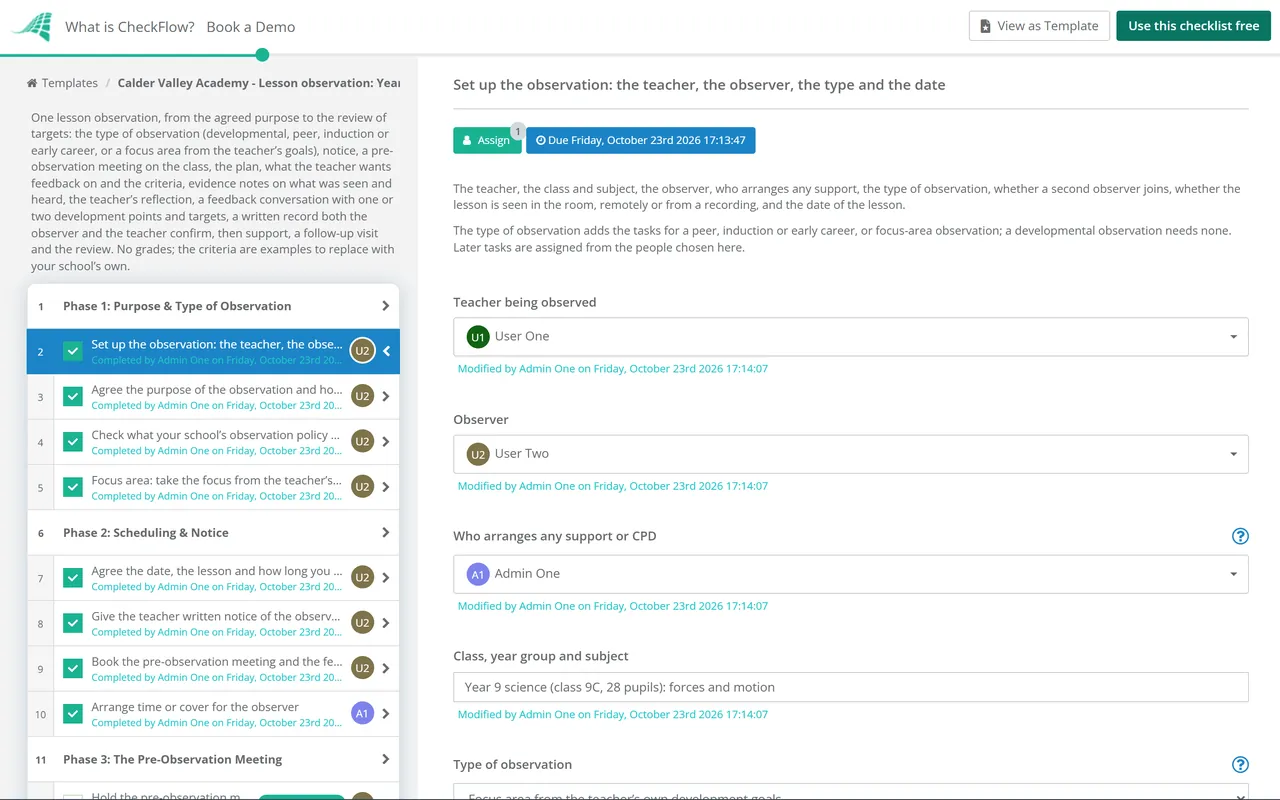
    Start this checklist when an observation is planned. Enter the observation date on the first task: every later due date counts from it in business days, the preparation back from it and the feedback, the record and the follow-up forward from it. The type of observation, a second observer and a remote or recorded lesson each add their own tasks.

    • Set up the observation: the teacher, the observer, the type and the date — the teacher, the class and subject, the observer, who arranges any support, the type of observation, whether a second observer joins, whether the lesson is seen in the room, remotely or from a recording, and the date of the lesson
    • Agree the purpose of the observation and how the record will be used — why this observation is happening, that its aim is to support the teacher’s practice, who will see the written record, and whether it links to anything else; any link to formal performance management is for your school’s policy to set, and is said plainly to the teacher at the start
    • Check what your school’s observation policy says — how much notice to give, how long and how often observations can be, who may observe, what is written down and who sees it, how the teacher can respond, and how long records are kept; schools usually set these arrangements in their own policy
    • Peer: agree that the record stays with the teacher unless they choose to share it — a peer observation is for both of you to learn from; no formal record goes to leaders unless the teacher agrees, and you may agree to swap roles so the teacher observes you next
    • Induction: link the observation to the mentor and the induction record — the mentor told about the observation and its focus, the focus taken from the teacher’s induction or early career targets, and where the record will go in the induction record under your school’s arrangements
    • Focus area: take the focus from the teacher’s own development goals — the goal or area the teacher has chosen, such as questioning or adapting a task for a group of pupils, so the observation looks only at that and gives the feedback the teacher asked for
  2. Phase 2

    Phase 2: Scheduling & Notice

    6 tasks

    Agree the lesson and the date with the teacher rather than for them, and give notice as your policy says. A second observer and a remote or recorded lesson each add a task here.

    • Agree the date, the lesson and how long you will observe — a lesson the teacher is happy to have observed, the start and end times, and whether you watch the whole lesson or part of it
    • Give the teacher written notice of the observation — the date, the time, the class, the purpose, who will observe, and when the pre-observation and feedback meetings will be, sent in writing so there is no doubt
    • Book the pre-observation meeting and the feedback meeting — the pre-observation meeting a few days before the lesson and the feedback meeting a couple of working days after it, both in a private space and in both diaries
    • Joint: agree the second observer’s role and how you will compare notes — why there are two observers, such as moderating judgements across a team or training a new observer, who leads the feedback, and that each of you writes evidence notes on your own before comparing them
    • Remote or recorded: agree consent, who can watch and how any recording is kept — the teacher’s agreement, whether pupils and parents need to be told or asked under your school’s policy, who may watch, where any recording is stored and who can open it, and when it will be deleted under your data protection policy
    • Arrange time or cover for the observer — the observer’s own lessons covered or the time kept free, so the observation is not cut short or cancelled at the last minute
  3. Phase 3

    Phase 3: The Pre-Observation Meeting

    6 tasks

    A short meeting a few days before the lesson. The teacher describes the class and the lesson, says what they want feedback on, and you agree the focus and the criteria together. These tasks count back from the observation date.

    • Hold the pre-observation meeting — a short, private conversation with the teacher a few days before the lesson, with time for the teacher to say what they want from the observation
    • Hear about the class and where the lesson fits — the pupils, any with additional needs and the support in place, what the class did in earlier lessons and what comes next, and anything the observer should know about the room or the day
    • Look at the lesson plan or outline together — the teacher’s usual plan or outline, not a special one written for the observation, with what pupils should learn and how the teacher will check it
    • Ask what the teacher wants feedback on — one or two things the teacher would like you to look at closely, taken from their own goals or something new they are trying in the lesson
    • Agree the focus and the criteria for this observation — the focus in a sentence and the criteria you will use, taken from your school’s own list; the seven areas in this template are examples to replace with yours
    • Agree where you will sit, when you arrive and leave, and whether you talk to pupils — so the lesson runs as normal: where the observer sits, whether they look at books or talk to pupils, and that they will not step in unless the teacher asks
  4. Phase 4

    Phase 4: The Lesson Observation

    9 tasks

    On the day, observe against the agreed criteria and write down what you see and hear, not judgements. Mark any area outside the agreed focus as not applicable. In a joint observation the second observer writes their own notes.

    • Arrive as agreed and observe the lesson — at the agreed time and place, for the agreed length, without taking over the lesson or interrupting the teacher
    • Note evidence on planning and structure — how the lesson starts, how it is sequenced and paced, whether pupils know what they are learning, and how it ends
    • Note evidence on subject knowledge — how accurately and clearly the content is explained, the examples and models used, and how misconceptions are spotted and dealt with
    • Note evidence on questioning and checking understanding — the questions asked and who answers them, how the teacher finds out what pupils have understood, and what they do with what they find
    • Note evidence on adaptation for different learners — how the lesson works for pupils who need more support or more challenge, including pupils with special educational needs or who are learning English, so every pupil takes part in the same learning
    • Note evidence on behaviour and the classroom climate — the routines and how pupils respond to them, how the teacher keeps attention, and how pupils speak to the teacher and to each other
    • Note evidence on the use of time and resources — how time is shared between explanation, practice and discussion, how smooth the transitions are, and how resources, technology and other adults in the room are used
    • Note evidence on pupils’ learning and progress — what pupils produce in the lesson, what their books or work show over time if you agreed to look, and what they say about their learning if you agreed to ask
    • Joint: second observer writes their own evidence notes — notes made independently during the lesson, against the same criteria, before comparing them with the observer’s
  5. Phase 5

    Phase 5: Evidence Notes & the Teacher’s Reflection

    5 tasks

    Write the notes up while the lesson is fresh, then give the teacher time to reflect before the feedback. A joint observation adds a moderation step, and a recorded lesson lets the teacher watch it first.

    • Write up the evidence notes the same day — what was seen and heard against each criterion, with times and the words used where they help, kept free of grades and labels so the teacher can recognise the lesson in them
    • Joint: compare notes with the second observer and agree what the evidence shows — where your notes agree and differ, what each of you would draw out, and one agreed view of the strengths and development points before the feedback, with a note of how you settled any difference
    • Recorded: the teacher watches the recording before the feedback — the teacher sees the lesson as the observer saw it, on the agreed system, without downloading or sharing the recording
    • Teacher reflects on the lesson before the feedback — what went well, what they would change, and what they noticed about the pupils’ learning, written down or brought to the meeting
    • Pick the strengths and one or two development points from the evidence — two or three strengths with the evidence for each, and no more than one or two development points, each linked to the agreed focus and something the teacher can act on
  6. Phase 6

    Phase 6: The Feedback Conversation

    5 tasks

    A private conversation a couple of working days after the lesson that starts with the teacher’s reflection. Agree one or two development points, and targets with the support for each. If a development point needs support, Phase 8 is added.

    • Hold the feedback meeting in private — in a quiet room with enough time, led by the observer, or in a joint observation by the observer you agreed would lead
    • Start with the teacher’s own reflection — ask how they felt the lesson went and what they noticed, and listen before giving your view
    • Talk through the strengths, with evidence — what worked and why, with what you saw and heard, so the teacher knows what to keep doing
    • Agree one or two development points — discussed rather than announced, each tied to the evidence and the agreed focus, with the teacher’s own ideas for what to try
    • Agree targets and the support for each — each target written so you will both know when it is met, with the support, who provides it and a date to review it
  7. Phase 7

    Phase 7: The Agreed Written Record

    5 tasks

    The observer writes a short record and the teacher reads it. If the teacher does not agree with all of it, their response is added and discussed before anyone confirms it. The observer and the teacher both confirm the record: that is the gate, and nothing in Phases 8 and 9 can be completed until it is done.

    • Write the record and share it with the teacher — the focus, the evidence, the strengths, the development points and the agreed targets, in plain language and with no grade, shared with the teacher first
    • Teacher reads the record and says whether they agree — the teacher checks the record against the lesson and the feedback meeting, and says whether it is fair and accurate
    • Disagreement: teacher adds a written response to the record — what the teacher sees differently and why, in their own words, attached to the record so it goes wherever the record goes
    • Disagreement: observer and teacher discuss the response and correct any factual errors — a short conversation about each point, factual errors corrected in the record, and differences of view left in the teacher’s response rather than removed; if you still cannot agree, follow your policy, for example by asking the CPD lead to help
    • Observer and teacher both confirm the written record — both confirm the record is the agreed account of the observation, with any response from the teacher attached, and say who will see it; nothing after this task can be completed until it is done
  8. Phase 8

    Phase 8: Support & a Follow-Up Visit (Only If Support Is Needed)

    5 tasks

    This phase applies only when a development point needs support. Arrange the CPD or coaching, check in halfway, and visit again to see the development point in practice. These tasks count from the observation date.

    • Support: arrange the CPD, coaching or training agreed — the course, coaching sessions, reading or in-school training agreed at the feedback meeting, booked with dates and the time to do it
    • Support: arrange for the teacher to watch or plan with a colleague — a colleague whose practice shows the development point, and a time to watch them teach or to plan a lesson together, with cover if needed
    • Support: check in on progress halfway to the follow-up visit — a short conversation about what the teacher has tried, what is working and whether the support is happening
    • Support: hold the follow-up visit on the development point — a shorter visit, agreed with the teacher and with notice, that looks only at the development point and the target, with evidence notes and feedback as before
    • Support: record what changed after the follow-up visit — what the teacher now does differently, whether the target is met, and any further support agreed with the teacher
  9. Phase 9

    Phase 9: Follow-Up & Review of Targets

    8 tasks

    Whatever the outcome, the targets go where the teacher plans their development and are reviewed with them. The record is kept only where it was agreed. These tasks count from the observation date.

    • Shared: send the agreed record to the CPD lead or line manager — the agreed record and any response from the teacher, sent only to the person agreed and filed where your policy says
    • Induction: add the record to the induction record and agree next steps with the mentor — the record filed with the teacher’s induction or early career evidence under your school’s arrangements, and the targets built into the next mentor meetings
    • Recorded: store or delete the recording as agreed — the recording kept only where and for as long as agreed, then deleted, with no copies left on personal devices
    • Add the targets to the teacher’s development plan or CPD record — the targets and the support agreed, where the teacher plans their own development, so they come up again at the next one-to-one or review
    • Review progress against the targets with the teacher — what the teacher has tried, what the evidence shows, and whether each target is met, partly met or still open
    • Record the outcome of the review and any new targets — the outcome for each target, shared with the teacher, and any new target or further support they ask for
    • Pass on themes for whole-school CPD, without names — development points that come up across several observations, passed to whoever plans training so CPD answers what is seen in classrooms, with no teacher named and nothing from a peer observation unless the teacher agrees
    • Agree when the next observation will be, if one is planned — the next date, its type and its focus, or a note that none is planned; a new run of this checklist covers it

What to Look For and What to Write Down

Example criteria, and the evidence to write down

The seven areas in the template, with what an observer might look for and the kind of evidence worth noting. They are examples: replace them in the template with your school’s own list, and agree before each lesson which of them this observation will cover.

Area (an example) What you might look for Evidence worth writing down
Planning and structureA clear start, a sequence that builds, pace that suits the task, a clear endWhat pupils were told they would learn, what each part of the lesson asked them to do, the timings
Subject knowledgeAccurate explanations, well-chosen examples, misconceptions spotted and dealt withThe explanation or model used, a misconception that came up and what the teacher did about it
Questioning and checking understandingQuestions that make pupils think, many pupils answering, the teacher acting on what they findQuestions asked, word for word where you can, who answered, how the teacher checked the whole class
Adaptation for different learnersSupport and challenge that let every pupil take part in the same learningWhat a pupil needing support did, what a pupil needing more challenge did
Behaviour and classroom climateRoutines pupils know, attention kept, respectful talkRoutines seen, how pupils responded, what happened when a pupil lost focus
Use of time and resourcesTime spent on the learning, smooth transitions, resources and other adults that helpMinutes spent on each part, any time lost and why, how resources and other adults were used
Pupils’ learning and progressWork that shows the intended learning, pupils able to say what they are learningWhat pupils wrote or said, and what their books showed over time if you agreed to look

Types of observation

The type on the first task decides which tasks appear. Who sees the record is agreed at the start and confirmed with the record.

Type Who might observe Who sees the record What the checklist adds
DevelopmentalA leader, a coach or an experienced colleague, agreed with the teacherThe teacher and the observer, and others only as your policy saysThe core steps, with nothing extra
PeerA colleague, perhaps taking turnsThe teacher; leaders only if the teacher agreesA task to agree that the record stays with the teacher
Induction or early career supportThe mentor, the induction tutor or another colleagueAs your induction arrangements sayThe mentor, a task to link the observation to the induction record and one to add the record to it
Focus areaA colleague the teacher agrees toThe teacher and the observer, and others only as your policy saysA task to take the focus from the teacher’s own development goals

Two more answers on the first task. A second observer adds tasks to agree their role, write their own notes during the lesson and compare them before the feedback, so the two of you give one view. A remote or recorded lesson adds a task to agree consent, access, storage and deletion under your school’s policies; a recording also gives the teacher a chance to watch it before the feedback, and a task to store or delete it as agreed.

Write what was seen and heard. “Six pupils answered; the teacher asked the rest to write their answer on a whiteboard” is evidence. “Questioning was weak” is a judgement. A record a teacher can recognise is one they can act on.

Why Run Teacher Observations in CheckFlow?

1

Every step while the lesson is fresh

Enter the observation date on the first task and every later task gets a due date in business days: the notice and the pre-observation meeting before it, the evidence notes on the day, the feedback two working days after, the record soon after that and the review of targets about six weeks on. Overdue alerts go to the people assigned, so feedback does not drift for weeks.

2

The right steps for each observation

The type of observation adds the tasks for a peer, induction or focus-area observation. A second observer adds a moderation step, a remote or recorded lesson adds consent and storage, a development point that needs support adds CPD and a follow-up visit, and a teacher who does not agree with the record adds a written response before anyone confirms it.

3

A record both of you agree

The observer and the teacher both confirm the written record, and that confirmation is a gate: the targets, the support and the review cannot be ticked off until it is done. The Reports Grid lists every observation with its answers, with filters and export, and Analytics shows completion rates and overdue work. See how approval steps work.

CheckFlow does not judge lessons or teachers. The observer and the teacher do, under your school’s policy. CheckFlow makes sure each step happens on time, every task has an owner, and the record that is kept is the one the teacher agreed. Each observation is its own checklist, so a term of observations can run from one template.

Welcome a new teacher with the Teacher Onboarding Workflow Checklist, and turn themes from many observations into a training plan with the Training Needs Analysis Checklist. Targets from an observation fit the Employee Development Plan Checklist, and the One-on-One Meeting Checklist keeps them on the agenda between observations. When observations point to a problem with what is taught rather than how, the Curriculum Review Process Checklist covers it.

AI generator

Didn’t find what you need? Describe it.

Describe the process in a sentence and the AI checklist generator drafts the phases and tasks for you.

Frequently Asked Questions

What should a teacher observation checklist include?

Every step of one observation: agreeing its purpose and type, notice to the teacher, a pre-observation meeting on the class, the lesson plan and what the teacher wants feedback on, the agreed focus and criteria, evidence notes on what was seen and heard, the teacher’s own reflection, a feedback conversation with strengths, one or two development points and targets, a written record that the observer and the teacher both confirm, and the follow-up. This template adds steps for peer and induction observations, a second observer and a recorded lesson.

What should you look for in a lesson observation?

What you agreed to look for with the teacher. This template uses seven example areas: planning and structure, subject knowledge, questioning and checking understanding, adaptation for different learners, behaviour and classroom climate, use of time and resources, and pupils’ learning and progress. Replace them with your school’s own criteria, choose the ones that fit the agreed focus before each lesson, and mark the rest not applicable.

Does this template grade lessons?

No. It records evidence, strengths, development points and targets, and it does not use or cite any grading scheme. Leaving out a grade keeps the feedback on what the teacher should keep doing and what to try next. If your policy does use a grade or a rating, add a field for it to the template in the template designer.

How much notice should a teacher get before an observation?

Your school’s observation policy may set it, along with how long and how often observations can be. In this template the written notice task falls eight business days before the observation date and the pre-observation meeting three days before, and you can change both offsets in the template to match your policy.

What is the difference between a peer observation and a developmental observation?

In a developmental observation a leader, coach or experienced colleague observes to support the teacher’s practice, and the record goes where your policy says. In a peer observation a colleague observes so both can learn, and you may agree to take turns, and no formal record goes to leaders unless the teacher agrees. Choosing peer on the first task adds a task to agree that, and the record’s audience is confirmed again at the end.

How do you give feedback after a lesson observation?

Soon and in private. Start with the teacher’s own reflection and listen before giving your view. Talk through two or three strengths with the evidence for each, then agree one or two development points rather than a long list, with the teacher’s ideas for what to try. Finish with targets that say how you will both know they are met, the support for each and a date to review them. This template puts the feedback meeting two working days after the lesson.

What if the teacher disagrees with the observation record?

The teacher says so when they read the record, and two tasks appear before it can be confirmed: the teacher adds a written response in their own words, and the observer and the teacher discuss it and correct any factual errors. Differences of view stay in the response rather than being edited out. Both then confirm the record with the response attached, and your policy says what happens if you still cannot agree.

Can you observe a remote or recorded lesson?

Yes, if your school’s policies allow it. Choose remote or recorded on the first task and a task asks you to agree the teacher’s consent, whether pupils and parents need to be told or asked, who can watch, where any recording is stored and when it is deleted. For a recording, the teacher watches it before the feedback, and a final task stores or deletes it as agreed.

Is CheckFlow free for this template?

14-day free trial, no card required. The Business plan is $10 per user per month after the trial. Full details at checkflow.io/pricing.

Give Every Observation a Purpose, Feedback and a Follow-Up

Free trial — no credit card required.

14-day free trial, no credit cardFull refund in your first 30 daysUS hosting, EU on request