IEP Meeting Checklist Template

An annual IEP review runs on steps the school has to take: notice early enough for the parents to attend, a review of progress on every goal, a copy of the IEP for the parents, and the IEP made accessible to every teacher and provider who must put it in place. This checklist puts each step, and who owns it, in one place.

Last reviewed: November 2026

Printed from checkflow.io/templates/education-training/iep-meeting-checklist

This free IEP meeting checklist is for special education case managers, teachers and district staff in US public schools. One run covers one student’s annual review of their individualized education program (IEP) under Part B of the Individuals with Disabilities Education Act (IDEA): the review date and the team, the written notice to the parents, progress data on each annual goal, the parents’ concerns and the student’s views, draft proposals, the meeting itself, the finalised IEP and prior written notice, the IEP shared with every teacher and provider who must put it in place, and the first progress report. Answers on the first task add the tasks for transition planning, the age of majority, an interpreter and state consent, and a later answer adds the reevaluation tasks when one is due. Each step the federal regulations require cites the section of 34 CFR Part 300 it follows; the rest are this template’s practice. Your state adds its own rules and timelines, and the IEP team decides what services a student needs: this checklist runs the process around those decisions.

An IEP Meeting, Student Enrolment or a Lesson Observation?

An IEP meeting, in this template, is the school’s process for one student’s annual IEP review: who is invited and told, what data the team brings, what is decided at the meeting, and the notices, copies and progress reports that follow. It follows the federal IDEA Part B regulations and leaves every decision about the student’s needs and services to the IEP team.

Two other education checklists touch the same students. The Student Enrolment Process Checklist runs an intake, including the records a new student brings with them. The Teacher Observation Checklist looks at how a lesson works for every pupil, including those who need more support. For an employee who asks for an adjustment at work, use the Reasonable Accommodation Request Checklist instead.

This checklist

One student’s annual IEP review

Covers: the review date and team, notice to the parents, progress data and input, draft proposals, the meeting, prior written notice, putting the IEP in place and progress reports.

When: about five school weeks before the meeting until the first progress report.

Output: a dated record of each step, the notices sent and the district representative’s confirmation of the finalised IEP.

Student enrolment

A new student’s intake

Covers: enquiry, records, placement and the first day for each intake.

When: each admission cycle, in the Student Enrolment Process Checklist.

Output: a student set up in the school’s systems.

Lesson observation

How one lesson works for every pupil

Covers: the focus agreed with the teacher, the observation and the feedback.

When: through the year, in the Teacher Observation Checklist.

Output: feedback and next steps for the teacher.

What the IEP Meeting Checklist Covers

Nine phases take one student from setting the review date to the first progress report under the new IEP. Phases 1 to 5 prepare: the review date and team, the notice to the parents, progress data and input, draft proposals and the final arrangements. Phase 6 is the meeting, Phase 7 finalises the IEP and sends prior written notice, and Phases 8 and 9 put the IEP in place and report progress. Every due date counts in school days from the meeting date. Tasks for a reevaluation, transition planning, the transfer of rights, an interpreter, an excused member, parents the school could not reach, a disagreement and state consent appear only when they apply.

  1. Phase 1

    Phase 1: Set-Up & the Review Date

    6 tasks

    Record the student, the meeting date and the team, check when the review is due and whether a reevaluation is due with it, and agree the date with the parents. Every due date counts from the meeting date, in school days.

    • Record the student, the meeting date and the IEP team — the student by initials or ID, the school and grade, the date of the annual IEP meeting, the case manager, the general education teacher and the district representative, and the answers that add tasks for transition, the age of majority, an interpreter and state consent
    • Check the review deadline, the current IEP and the reevaluation date — the date the current IEP was developed, the date this review is due by, the goals, services, accommodations and placement in the current IEP, and when the last evaluation was done
    • Agree the meeting date, time and place with the parents — a date, time and place agreed with the parents, and whether anyone joins by phone or video
    • List the IEP team and anyone else invited — each member the regulations name, who fills each role, and anyone the parents or the school invite for their knowledge of the student
    • Review existing evaluation data for the reevaluation — the team and other qualified professionals review existing data and decide what more, if anything, is needed
    • Ask for consent to reevaluate, or tell the parents no more data is needed — the parents’ informed consent before any new assessment, or written notice that no more data is needed and of their right to ask for an assessment
  2. Phase 2

    Phase 2: Meeting Notice & Invitations

    5 tasks

    Send the parents a written notice early enough for them to attend, with the purpose, time, place and who will be there. Offsets in this template are its own choice: follow your state’s notice period where it sets one.

    • Arrange an interpreter for the parents — an interpreter booked for the meeting, and notices given in the parents’ language or mode of communication
    • Invite the student and any transition agency — the student invited, and, with the parents’ consent, a representative of any agency likely to provide or pay for transition services
    • Send the meeting notice to the parents — the purpose, time and location of the meeting and who will attend, sent early enough for the parents to attend, and their right to bring others with knowledge of their child
    • Give the procedural safeguards notice if not yet given this school year — a copy of the procedural safeguards given to the parents once a school year, and whenever they ask for one
    • Invite related service providers and anyone else the school asks — invitations to the providers whose services will be discussed and to anyone the school invites for their knowledge of the student
  3. Phase 3

    Phase 3: Progress Data & Input

    7 tasks

    Gather what the team needs to review the IEP: progress on each annual goal measured as the IEP says, classroom and assessment results, providers’ reports, the parents’ concerns and the student’s views. Then draft the present levels.

    • Collect progress data on each annual goal — for each goal in the current IEP, how progress was measured, the latest result and whether the goal was met or is on track
    • Gather classroom work, assessment results and teacher input — work samples, classroom-based, district and state assessment results, and the general education teacher’s observations of how the student is doing
    • Get reports from related service providers — a short report from each provider on progress, the service delivered and what they suggest the team discusses
    • Ask the parents for their concerns and priorities — what the parents want the team to know, their concerns for their child’s education and anything they would like discussed
    • Carry out age-appropriate transition assessments — assessments of the student’s interests, preferences and skills related to training, education, employment and, where appropriate, independent living
    • Ask the student for their views where appropriate — what the student says about what helps, what is hard and what they want to work on, in a way that suits their age
    • Draft the present levels of performance — a draft statement of the student’s present levels of academic achievement and functional performance, including how the disability affects involvement and progress in the general education curriculum
  4. Phase 4

    Phase 4: Draft Proposals for the Meeting

    10 tasks

    Prepare proposals for each part of the IEP for the team to discuss. Drafting proposals before the meeting is preparation, not the meeting itself; the IEP is developed at the meeting with the parents.

    • Check the special factors the team must consider — behaviour, English language needs, Braille, communication and assistive technology, each considered for this student
    • Draft measurable annual goals — proposed academic and functional goals that meet the needs arising from the disability, written so progress can be measured
    • Propose how progress will be measured and reported — how progress on each goal will be measured and when the parents will get progress reports, for example with report cards
    • Draft postsecondary goals and transition services — proposed measurable postsecondary goals and the transition services, including courses of study, needed to reach them
    • Prepare the statement on rights that transfer at the age of majority — the statement that the student has been informed of the rights under Part B that will transfer to them at the age of majority, and when they were told
    • Draft the services, aids, modifications and supports — proposed special education, related services and supplementary aids and services, program modifications or supports for staff, with the start date, frequency, location and duration of each
    • Draft accommodations for state and district assessments — the individual accommodations needed on state and districtwide assessments, or why an alternate assessment is appropriate
    • Draft participation with nondisabled peers and placement options — the extent, if any, to which the student will not take part with nondisabled children in the regular class and activities, and the placement options to discuss
    • Consider extended school year services — whether the team needs to discuss extended school year services for this student, with the data that bears on it
    • Share the drafts with the parents before the meeting — the draft present levels, goals and proposals sent to the parents, marked as drafts for discussion, so they can come with questions
  5. Phase 5

    Phase 5: Final Arrangements

    4 tasks

    Confirm who will attend and how. If a parent cannot attend, use other ways for them to take part; if the school cannot reach them, keep the record of its attempts. A member is excused only with the parents’ written agreement.

    • Confirm who will attend and how — the parents’ attendance confirmed, each team member’s attendance, and any member whose attendance is not needed or who asks to be excused
    • Get the written agreement or excusal for an absent member — the parents’ and the school’s written agreement, and, where the member’s area will be discussed, their written input sent to the parents and the team before the meeting
    • Keep the record of attempts to arrange the meeting — detailed records of calls, letters, emails and visits made to arrange a mutually agreed time and place, and their results
    • Prepare the room or link, the agenda and the papers — the room or video link, a short agenda, copies of the drafts and the progress data, and the procedural safeguards notice on hand
  6. Phase 6

    Phase 6: The IEP Meeting

    5 tasks

    Hold the meeting with the parents as members of the team. Review progress, develop the IEP together and record the parents’ response. This checklist records what the team decided; it does not decide anything.

    • Open the meeting: purpose, introductions and the parents’ rights — introductions and roles, the purpose of the meeting, how decisions will be made, and an offer of the procedural safeguards notice
    • Review progress and the present levels with the team — progress on each goal, the present levels, the parents’ concerns and any evaluation results, discussed by the whole team
    • Agree the goals, services, accommodations and placement as a team — the annual goals, how progress is measured and reported, services with their start date, frequency, location and duration, accommodations and the placement, as the team develops them
    • Record the parents’ response to the proposed IEP — whether the parents agree, agree in part or disagree, in their words, and anything they asked for that the school refused
    • Respond to the parents’ disagreement — the parents’ points recorded, a copy of the procedural safeguards notice offered, and where they can get help understanding their rights
  7. Phase 7

    Phase 7: Finalise the IEP & Prior Written Notice

    5 tasks

    The district representative confirms the finalised IEP; nothing after that step can be completed until they do. Then the parents get prior written notice of what the school proposes or refuses, and a copy of the IEP.

    • Arrange a further meeting to finish the IEP — a new date agreed with the parents to finish what the team could not, with the notice sent again
    • Confirm the finalised IEP — the district representative checks the written IEP matches what the team agreed and confirms it, before prior written notice goes out
    • Send prior written notice to the parents — written notice of what the school proposes or refuses, a reasonable time before it acts on it, with every part the regulations list
    • Get the parents’ written consent where the state requires it — the parents’ written consent on your state’s form, or what your state says to do if they do not give it
    • Give the parents a copy of the IEP — a copy of the IEP given to the parents at no cost, in a form they can read
  8. Phase 8

    Phase 8: Put the IEP in Place

    5 tasks

    Make the IEP accessible to everyone responsible for it, tell each of them what they must do, and start the services on the date the IEP states.

    • Give each teacher and provider access to the IEP and their responsibilities — each regular and special education teacher, related service provider and other provider responsible for the IEP told their responsibilities and the accommodations, modifications and supports they must provide
    • Schedule the services from the projected start date — each service timetabled at the frequency, location and duration the IEP states, starting on its projected date
    • Put the classroom and testing accommodations in place — the accommodations and modifications in the IEP in use in class, and the assessment accommodations recorded for the next state or district test
    • Update the student’s records and the IEP system — the finalised IEP, the notices and the dates of the next progress report, the next annual review and the next reevaluation recorded in the district’s systems
    • Check the services and accommodations have started — a check with each provider and teacher that services started on time and the accommodations are being used, and what to do about any gap
  9. Phase 9

    Phase 9: Progress Reports & the Next Review

    3 tasks

    Send progress reports when the IEP says, and act if progress is not as expected. The first report’s due date is this template’s choice, about nine school weeks after the meeting: move it to the date your IEP states.

    • Send the first progress report to the parents — a report on progress toward each annual goal, sent when the IEP says, for example with the report card
    • Decide whether progress needs an earlier review — whether progress is as expected, and if not, whether to propose an IEP meeting before the annual review or an amendment the parents agree to
    • Plan next year’s annual review and close this run — the window for next year’s review set before the anniversary of this IEP, and this checklist completed

What the Federal Regulations Require, Step by Step

Requirements and where they sit

What 34 CFR Part 300 says the school (the “public agency”) must do around an annual IEP review, and where each step sits in this checklist.

Requirement Regulation In this checklist
Review the IEP periodically, but not less than annually, and revise it as appropriate34 CFR 300.324(b)(1)Phase 1 checks the date; Phase 6 is the review
Reevaluate at least once every 3 years unless the parents and the school agree it is unnecessary; consent before a reevaluation34 CFR 300.303(b), 300.300(c)Phase 1, when a reevaluation is due
Schedule the meeting at a mutually agreed time and place; video or conference calls if both agree34 CFR 300.322(a)(2), 300.328Phase 1
Notify the parents early enough to attend: purpose, time, location and who will attend34 CFR 300.322(a)(1) and (b)Phase 2
Procedural safeguards notice once a school year, and on request34 CFR 300.504(a)Phase 2, and Phase 6 on a disagreement
Invite the student, and with consent any transition agency, when transition is discussed34 CFR 300.321(b), 300.322(b)(2)Phase 2, when transition is planned
An interpreter where the parents need one34 CFR 300.322(e)Phase 2, when needed
Consider the student’s strengths, the parents’ concerns, the latest evaluation and the student’s needs, and the special factors34 CFR 300.324(a)(1) and (2)Phases 3 and 4
The contents of the IEP: present levels, measurable annual goals, how progress is measured and reported, services, participation with nondisabled children, assessment accommodations, start date, frequency, location and duration34 CFR 300.320(a)Phases 3, 4 and 6
Postsecondary goals and transition services from the IEP in effect at 16, or younger34 CFR 300.320(b)Phase 4, when transition is planned
Written agreement or excusal when a required member does not attend34 CFR 300.321(e)Phase 5, when it applies
Other ways to take part if neither parent can attend; a record of attempts if the meeting goes ahead without them34 CFR 300.322(c) and (d)Phase 5
Prior written notice a reasonable time before the school proposes or refuses to initiate or change the identification, evaluation, placement, or the provision of a free appropriate public education34 CFR 300.503Phase 7
A copy of the IEP for the parents at no cost34 CFR 300.322(f)Phase 7
The IEP accessible to every teacher and provider responsible for it, each told their responsibilities34 CFR 300.323(d)Phase 8
Progress reports when the IEP says34 CFR 300.320(a)(3)(ii)Phase 9

The IEP team

The members 34 CFR 300.321(a) lists. One person may fill more than one role where the regulation allows it.

Member Who
The parentsOne or both parents of the student
Regular education teacherAt least one, if the student is, or may be, in the regular education environment
Special education teacherAt least one special education teacher of the student or, where appropriate, a special education provider
District representativeQualified to provide or supervise specially designed instruction, and knowledgeable about the general education curriculum and the district’s resources
Interprets evaluation resultsSomeone who can interpret the instructional implications of evaluation results; may be one of the members above
Others with knowledge or special expertiseAt the parents’ or the school’s discretion, including related services staff
The studentWhenever appropriate, and invited when transition is discussed

US federal rules only. This checklist follows the federal regulations for IDEA Part B. States add their own rules and timelines, such as how many days’ notice parents get before a meeting, how soon prior written notice goes out, which forms to use and whether parents must consent to an annual IEP; a state may require consent for more than the federal rules do (34 CFR 300.300(d)(2)). Follow your state’s rules and your district’s procedures where they say more. This page is not legal advice.

One date. Every due date counts in school days (Monday to Friday) from the meeting date entered on the first task: preparation from about five school weeks before, the follow-up after. These offsets are this template’s choice. They do not skip school holidays, and they do not shrink for a shorter run: if your state’s notice period is longer or your meeting is sooner, start the run earlier or change the meeting date, which moves every due date.

Decisions stay with the team. Whether a student is eligible, which goals, services, accommodations and placement they get, and whether extended school year services are needed are decisions for the IEP team under the regulations. The checklist records the drafts and what the team agreed; the IEP itself stays in your district’s IEP system.

Where this comes from. Read on 24 November 2026 on the eCFR (issue of 16 November 2026; Title 34 up to date as of 20 November 2026) and Cornell’s Legal Information Institute: 34 CFR 300.320, 300.321, 300.322, 300.323, 300.324 (last amended 30 June 2017), 300.503 and 300.504, with 300.106, 300.116, 300.300, 300.303, 300.305, 300.328, 300.501 and 300.520. The regulations are at 34 CFR Part 300 on the eCFR.

Why Run IEP Meetings in CheckFlow?

1

Every notice on time

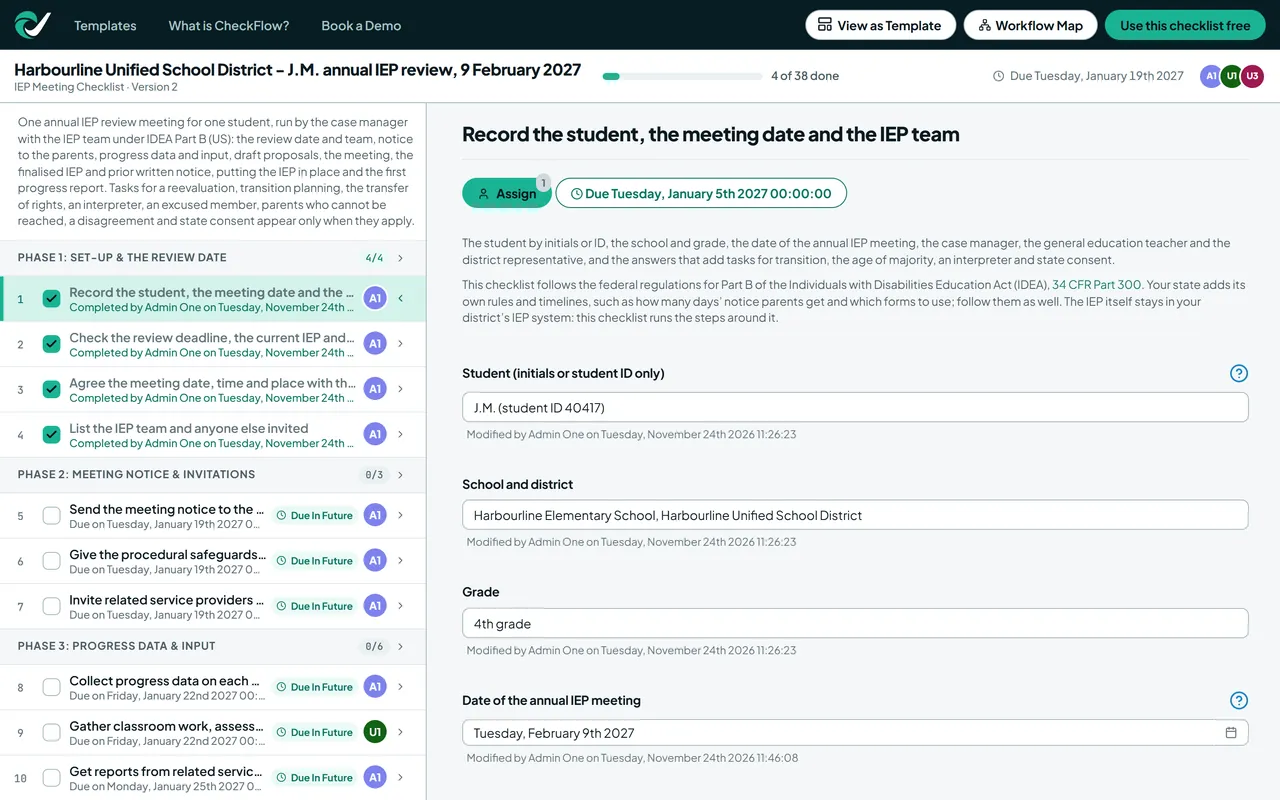
The meeting date sets every due date, so the notice to the parents, the drafts, prior written notice and the copy of the IEP each fall due in turn. Move the meeting and they all move with it. Tasks for an interpreter, an excused member or a reevaluation appear only when the answers call for them.

2

Nothing goes out unconfirmed

Prior written notice waits for the district representative to confirm the finalised IEP, and nothing after that approval step can be completed until they do. If the team could not finish, a task to arrange a further meeting appears and the step stays open.

3

Every annual review in one place

Run one checklist per student, and the Reports Grid lists every review with its meeting date, progress and answers, with filters and export. Analytics shows overdue and late tasks by person and step, so a case manager with many reviews can see what is due this week.

CheckFlow does not decide whether a student is eligible, or what goals, services or placement they need. Those decisions belong to the IEP team, including the parents. CheckFlow runs the steps around them: who does what, by when, and what was sent. Keep the IEP, evaluations and other student records in your district’s IEP system; this checklist names the student by initials or ID.

Run a new student’s intake with the Student Enrolment Process Checklist, plan trips that include every pupil with the School Trip Planning Checklist and review what is taught with the Curriculum Review Process Checklist.

AI generator

Didn’t find what you need? Describe it.

Describe the process in a sentence and the AI checklist generator drafts the phases and tasks for you.

Frequently Asked Questions

What should an IEP meeting checklist include?

The review date and the team, written notice to the parents, progress data on each annual goal, the parents’ concerns and the student’s views, draft present levels, goals and services, and the arrangements for the day. Then the meeting, the parents’ response, prior written notice, a copy of the IEP for the parents, the IEP shared with each teacher and provider, and progress reports. This checklist covers each of those in order, citing 34 CFR Part 300.

How often must an IEP be reviewed?

The IEP team must review a student’s IEP periodically, but not less than annually, to see whether the annual goals are being achieved, and revise it as appropriate (34 CFR 300.324(b)). A reevaluation must happen at least once every 3 years unless the parents and the school agree it is unnecessary, and not more than once a year unless they agree otherwise (34 CFR 300.303(b)). The team can meet more often than once a year.

Who must attend an IEP meeting?

The team includes the parents, at least one regular education teacher if the student is or may be in the regular classroom, at least one special education teacher or provider, a district representative, someone who can interpret evaluation results, others with knowledge of the student invited by the parents or the school, and the student whenever appropriate (34 CFR 300.321(a)). A member may be excused only with the parents’ written agreement.

How much notice do parents get before an IEP meeting?

The federal rule is that the school must notify the parents “early enough to ensure that they will have an opportunity to attend” and schedule the meeting at a mutually agreed time and place (34 CFR 300.322(a)). The notice gives the purpose, time and location and who will attend. Your state may set a number of days, so check its rules. This template sends the notice 15 school days before the meeting.

Can an IEP meeting go ahead without the parents?

If neither parent can attend, the school must use other ways for them to take part, such as individual or conference calls (34 CFR 300.322(c)), and the parents and the school may agree to meet by video (34 CFR 300.328). A meeting may be held without a parent only if the school cannot convince them to attend, and it must keep records of its attempts, such as calls, letters and visits (34 CFR 300.322(d)).

Can an IEP team member be excused from the meeting?

Yes, in two cases (34 CFR 300.321(e)). If the member’s area is not being changed or discussed, the parents and the school can agree in writing that they need not attend. If it is being discussed, the member can be excused only if the parents consent in writing, the school agrees, and the member gives written input to the parents and the team before the meeting.

What is prior written notice after an IEP meeting?

It is the written notice the school must give the parents a reasonable time before it proposes or refuses to initiate or change the student’s identification, evaluation or educational placement, or the provision of a free appropriate public education (34 CFR 300.503(a)). It describes the action and why, the evaluations and records used, the other options considered and why they were rejected, other relevant factors, the parents’ procedural safeguards and where to get help, in language the parents understand.

When does transition planning start in an IEP?

Not later than the first IEP to be in effect when the student turns 16, or younger if the IEP team decides, the IEP must include measurable postsecondary goals based on age-appropriate transition assessments, and the transition services needed to reach them (34 CFR 300.320(b)). The school must invite the student and, to the extent appropriate and with consent, any agency likely to provide or pay for transition services. Your state may set a younger age.

Do parents have to consent to an annual IEP?

The federal regulations require the parents’ informed consent before the first provision of special education services and before a reevaluation (34 CFR 300.300(b) and (c)). They let a state require consent for other services and activities (34 CFR 300.300(d)(2)), so the answer depends on your state. Parents who disagree have the options set out in the procedural safeguards notice. This page is not legal advice.

Is CheckFlow free for this template?

14-day free trial, no card required. The Business plan is $10 per user per month after the trial. Full details at checkflow.io/pricing.

Run Every Annual IEP Review on Time

Free trial — no credit card required.

14-day free trial, no credit cardFull refund in your first 30 daysUS hosting, EU on request