
Teacher Onboarding Workflow Checklist Template

A structured onboarding process that gets new teachers classroom-ready, compliant, and genuinely supported — from offer accepted to first-term review.

Teacher turnover costs schools billions every year — and the evidence consistently shows that structured, well-supported onboarding is one of the most effective interventions for improving retention. A new teacher who arrives on their first day without system access, without a clear sense of the curriculum, without a named mentor, and without confidence in the school’s safeguarding and behaviour management procedures is a teacher who will take months longer to become effective — and is significantly more likely to leave within two years. A structured teacher onboarding workflow coordinates every aspect of the process — employment compliance, safeguarding checks, IT setup, classroom preparation, curriculum induction, and professional mentoring — so that every new teacher receives the same quality of start, regardless of which term they join or how busy the school is when they arrive. This free teacher onboarding workflow checklist covers the full onboarding cycle for schools, colleges, universities, and training organisations.

Use This Template Free See Live Example
No Credit Card Required

Why the First 90 Days Determine Whether a New Teacher Stays

The first 90 days of a new teacher’s employment are the most formative — and the most vulnerable. New teachers consistently cite the same reasons for leaving early: feeling unsupported in managing behaviour, not receiving adequate curriculum guidance, lacking access to the right resources and systems, and feeling isolated rather than welcomed into a professional community. None of these are inevitable. All of them are preventable with a structured onboarding process that proactively addresses each one from day one.

The compliance dimension adds a further layer of urgency. A new teacher who begins teaching before their safeguarding checks are completed, whose teaching qualification has not been verified, or who has not received mandatory safeguarding training represents real legal and reputational risk for the institution. A structured onboarding workflow with enforced compliance phases ensures no new teacher enters a classroom before every required check and training is completed and documented.

What the Teacher Onboarding Workflow Checklist Covers

This checklist covers eight phases of the teacher onboarding workflow — from pre-arrival preparation through to first-term review and ongoing induction support. It combines employment compliance, safeguarding, IT setup, curriculum induction, and professional mentoring into a single, coordinated process.

Phase 1

Pre-Arrival Preparation (Before Day One)

The quality of a new teacher’s first day is determined entirely by what happens before it. A new teacher who arrives to find their room set up, their login ready, and a colleague waiting to welcome them starts differently from one who spends the first morning finding a working computer.

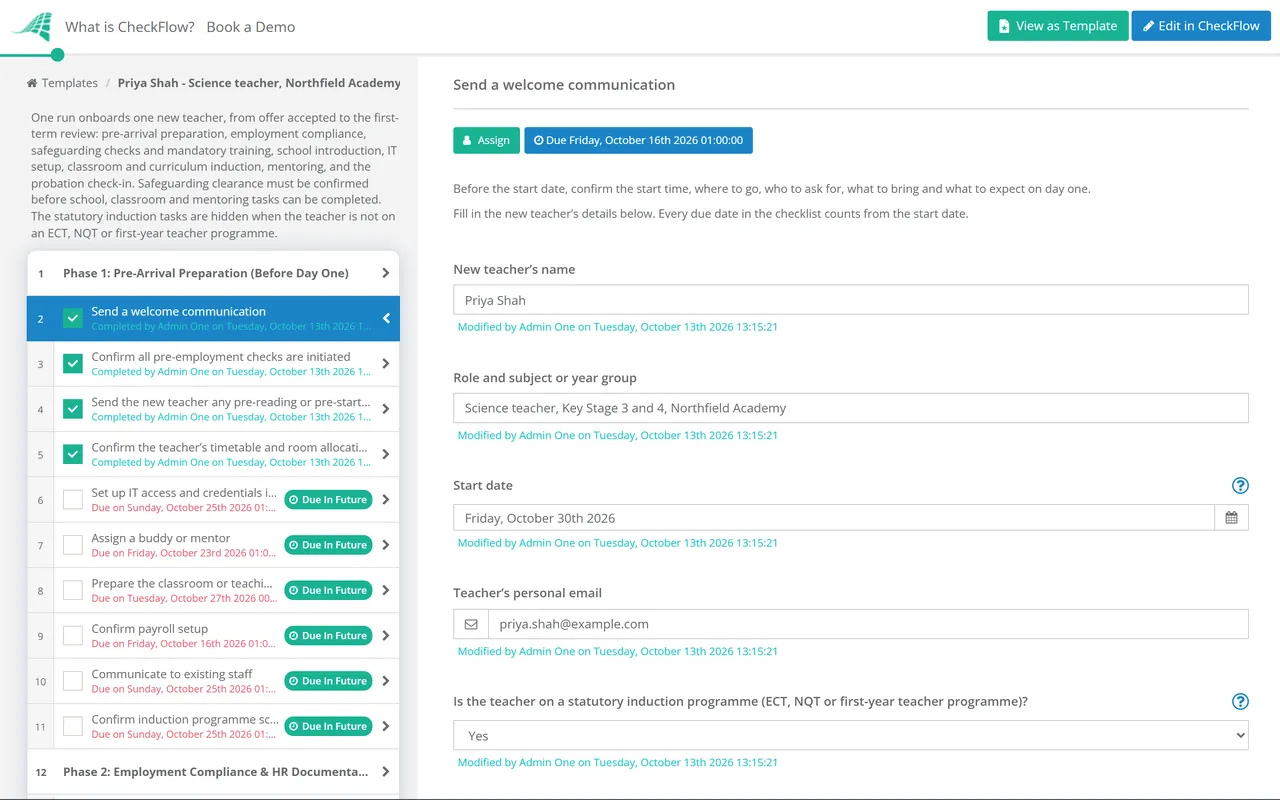
  • Send a welcome communication — before the start date; confirm the start time, where to go, who to ask for, what to bring, and what to expect on day one
  • Confirm all pre-employment checks are initiated — do not wait until the start date to begin safeguarding, qualification, or reference checks
  • Send the new teacher any pre-reading or pre-start materials — staff handbook, safeguarding policy, behaviour management policy, and timetable so they can prepare before arriving
  • Confirm the teacher’s timetable and room allocation — communicate clearly before the first day to reduce first-day anxiety
  • Set up IT access and credentials in advance — school email, MIS/SIS login, LMS access, and any other required systems; confirm all accounts are working before day one
  • Assign a buddy or mentor — confirm before arrival who the new teacher’s day-one contact is, introduce them by email, and brief the mentor on their role
  • Prepare the classroom or teaching space — confirm the space is accessible, cleaned, and equipped with the basic resources needed for the teacher’s first lessons
  • Confirm payroll setup — bank details, tax information, and payroll registration completed in advance so the first pay is correct
  • Communicate to existing staff — brief colleagues on who is joining, when, in what role, and ask them to make the new teacher feel welcome
  • Confirm induction programme schedule — the new teacher has a clear agenda for their first week before they arrive
Phase 2

Employment Compliance & HR Documentation

  • Complete the employment contract — signed by both parties before the start date; confirm the teacher has received and read their contract
  • Complete right to work verification — I-9 (US), right to work check (UK), or equivalent for the jurisdiction; document the verification outcome and retain copies as required
  • Complete payroll registration — P46 or starter declaration (UK), W-4 (US), or equivalent; confirm tax code and pension enrolment
  • Process benefits enrolment — pension scheme, health insurance, or other benefits applicable; provide information and allow adequate time for decisions
  • Obtain signed policy acknowledgements — code of conduct, safeguarding policy, data protection policy, IT acceptable use policy, and any other mandatory policy acknowledgements
  • Confirm professional body registration — General Teaching Council (UK), state teaching certification (US), or equivalent professional registration requirement is confirmed and documented
  • Update personnel file — all employment documents filed securely and the personnel record created in the HR system; confirm GDPR or FERPA compliance for data storage
  • Confirm probationary period terms — duration, review process, and any specific expectations are clearly communicated and understood
  • Confirm emergency contact details and health and safety information are recorded — including any medical conditions relevant to the work environment
  • Issue the staff ID card or access credentials — physical or electronic access to the building and any required restricted areas
Phase 3

Safeguarding, Background Checks & Mandatory Training

Safeguarding checks are a legal requirement, not an administrative option. No new teacher should be in unsupervised contact with students until all required checks are complete and documented. CheckFlow’s enforced task order ensures classroom contact tasks cannot begin before this phase is marked complete.

  • Complete enhanced criminal background check — DBS enhanced disclosure (UK), state background check (US), Working with Children check (Australia), or equivalent; confirm result is satisfactory before unsupervised classroom contact
  • Obtain and verify references — minimum two professional references; confirm at least one is from the most recent employer; references must be obtained and checked before the teacher is confirmed in post
  • Add the new teacher to the Single Central Record (SCR) or equivalent safeguarding register — UK schools are legally required to maintain an SCR; ensure all checks are recorded with dates and outcomes
  • Deliver safeguarding induction training — Keeping Children Safe in Education (UK), Mandated Reporter training (US), or applicable jurisdictional safeguarding training; document completion and date
  • Deliver child protection policy briefing — confirm the teacher understands the institution’s safeguarding policy, reporting procedures, and the role of the Designated Safeguarding Lead (DSL)
  • Complete health and safety induction — fire evacuation procedures, first aid arrangements, accident reporting, and any specific hazards relevant to the teaching environment
  • Complete any mandatory equality and diversity training — including any jurisdiction-specific requirements such as Title IX training (US) or Prevent duty training (UK)
  • Confirm any statutory induction programme registration — Early Career Teacher (ECT) induction in England, NQT equivalent programmes, or state-level first-year teacher support programmes
  • Deliver data protection training — GDPR (UK/EU) or FERPA (US) obligations relevant to handling student data; document completion
  • Confirm all mandatory training is completed and documented — create an auditable record of completion dates and methods for each required training item
Phase 4

School Introduction, Culture & Community

  • Welcome and introduce to the school community — staff meeting introduction, walkthrough of the building, and an opportunity to meet key colleagues in a relaxed setting
  • Brief on the school’s mission, vision, and values — not just the published statement but what they mean in practice; how they guide decisions and daily culture
  • Introduce key staff — headteacher/principal, head of department, SENDCo, DSL, form tutor colleagues, and support staff the teacher will work with regularly
  • Explain the organisational structure — reporting lines, team meetings, communication channels, and decision-making processes
  • Brief on behaviour management policy and practice — specific procedures used in this school, not just the policy document; what actually happens when behaviour is escalated
  • Brief on student welfare and inclusion — SEND provision, Pupil Premium or Title I students, EAL/ELL learners, and any other student population considerations relevant to the teacher’s classes
  • Explain administrative procedures — attendance marking, lesson cover procedures, report writing cycles, parents evening process, and other key administrative routines
  • Introduce professional development culture — CPD expectations, observation and feedback practices, appraisal process, and the school’s approach to teacher growth
  • Provide the staff handbook and confirm understanding — key policies, procedures, and expectations in the handbook are discussed
  • Answer questions and confirm the teacher knows who to contact for different types of queries
Phase 5

IT & Systems Setup

  • Confirm all system access is working — institutional email, management information system (MIS/SIS), virtual learning environment (VLE/LMS), and any other required platforms
  • Walk through the MIS/SIS — attendance registration, reporting, grade recording, SEND records access, and any other functions the teacher will use regularly
  • Walk through the VLE/LMS — confirm the teacher can access their classes, upload resources, set and mark assignments, and communicate with students
  • Set up classroom technology — interactive whiteboard, projector, or display screen; confirm the teacher knows how to use the equipment in their classroom
  • Provide any required devices — laptop, tablet, or other equipment; confirm school device policy and acceptable use requirements are communicated
  • Confirm printing access and reprographics arrangements — how to print, photocopy, and prepare physical materials; any budgets or authorisation required
  • Confirm communication platform access — staff messaging system, email distribution lists, and any parent communication platform (e.g. Class Dojo, Seesaw, ParentPay)
  • Set up online safeguarding and filtering tools where applicable — confirm the teacher understands internet filtering policies and any reporting obligations for online safety concerns
  • Confirm IT support procedures — who to contact for technical issues, how to log a support request, and expected response times
  • Confirm data protection obligations specific to IT use — password security, device handling, student data storage, and personal device policies
Phase 6

Classroom Setup & Curriculum Induction

  • Orient the teacher to their classroom(s) — layout, resources available, storage, display expectations, and any room-specific arrangements (shared spaces, specialist rooms)
  • Provide the scheme of work and curriculum plan — what is being taught when, in what order, and with what resources; confirm where the teacher is expected to start
  • Walk through the assessment framework — how student progress is assessed, recorded, and reported; marking and feedback policies; grade descriptors
  • Introduce subject or department team — head of department meeting, team planning sessions, and any collaborative planning arrangements
  • Provide student information for classes — class lists, SEND information, relevant medical or pastoral information, and any specific student needs the teacher should be aware of from day one
  • Review the homework or independent study policy — expectations, how it is set and marked, and communication with parents/guardians
  • Confirm textbooks, physical resources, and consumables are available — sufficient for the classes being taught from the first lesson
  • Brief on differentiation and inclusion expectations — how teaching should be adapted for students with SEND, EAL, or other specific learning needs
  • Conduct a lesson observation of an experienced colleague — new teachers should observe at least one experienced practitioner in their subject area before teaching independently
  • Confirm the teacher has lesson plans ready for their first week of teaching
Phase 7

Mentor Assignment & Professional Development Support

Mentoring is not an optional add-on — it is the onboarding intervention with the strongest evidence base for improving teacher retention and effectiveness. A mentor who is properly briefed, given dedicated time, and follows a structured programme makes a measurable difference.

  • Assign a formal mentor — an experienced teacher in the same or a related subject; confirm the mentor has been briefed, has protected time, and understands their role
  • Schedule the first mentor meeting — in the first week; set a regular meeting cadence for the rest of the term
  • Introduce the statutory induction programme requirements where applicable — ECT induction (England), NQT equivalent, or state-level first-year teacher programme; confirm the induction tutor is assigned and the programme is explained
  • Establish professional development goals — an initial conversation about the teacher’s development priorities, strengths, and areas for growth
  • Schedule a lesson observation in the first month — a structured observation with written feedback and a follow-up conversation; framed as supportive, not evaluative
  • Confirm access to CPD opportunities — internal training, subject association events, and any statutory ECT or early career professional development entitlements
  • Introduce the appraisal or performance review process — timeline, who leads it, what it covers, and how it connects to professional development
  • Confirm the teacher has adequate planning, preparation, and assessment (PPA) time protected in their timetable
  • Set expectations for workload and wellbeing — communicate the school’s approach to staff wellbeing and provide signposting to any available support
  • Confirm the teacher knows how to raise concerns or access additional support — who to speak to about workload, student behaviour, or professional challenges
Phase 8

First Term Review, Probation Check-In & Ongoing Induction

  • Conduct a first half-term check-in — an informal conversation between the new teacher and their line manager or mentor; how is it going, what support is needed?
  • Conduct the end-of-term formal review — structured review of progress against probationary period expectations, professional development goals, and any statutory induction requirements
  • Gather feedback from the teacher on the onboarding experience — what was helpful, what was missing, what would have made the start easier?
  • Confirm all mandatory training is complete and documented — any training that remains outstanding should be scheduled and completed before the end of the first term
  • Confirm any statutory induction programme milestones — ECT formal assessment, progress review, or equivalent is documented and submitted to the relevant body
  • Identify any support needs for term two — additional coaching, observations, curriculum support, or behaviour management assistance; confirm these are arranged before the term ends
  • Confirm the teacher’s probationary period decision — confirmed in post, extended with support plan, or other outcome as appropriate; communicated clearly and documented
  • Update the personnel file — all onboarding documentation, training records, and review outcomes filed securely
  • Review and improve the onboarding process — document lessons learned from this onboarding; update the checklist for the next new teacher
  • Set the next review date — mid-year progress review and end-of-year appraisal scheduled and communicated

This checklist is available as a free, runnable template in CheckFlow — with tasks assigned across HR, IT, the head of department, and the assigned mentor, safeguarding phases enforced before classroom contact begins, and a complete compliance record for every new teacher.

Use This Template Free

Teacher Onboarding Across Different Educational Contexts

The eight-phase onboarding framework applies across educational contexts — adapted in regulatory requirements and emphasis, but identical in structure.

Primary & Secondary Schools (K-12)

Enhanced DBS or background check before any unsupervised contact; Single Central Record (SCR) compliance; Keeping Children Safe in Education or equivalent safeguarding training; behaviour management policy induction; statutory ECT or NQT induction programme; form group or pastoral responsibility briefing.

Further Education & Sixth Form Colleges

Professional teaching qualification verification (or development plan); vocational subject area induction; SEND and additional learning support policy briefing; safeguarding and Prevent duty training; exam board and assessment requirements; student welfare and mental health support awareness.

Higher Education

Academic credential and research background verification; department and faculty introduction; university teaching qualification or commitment (e.g. PGCertHE, Fellowship of the HEA); module leadership and assessment responsibilities; research ethics and governance briefing; student mental health and wellbeing signposting.

Corporate Training Organisations

Trainer qualification and subject expertise verification; L&D platform and LMS access; client-specific confidentiality and conduct requirements; health and safety for training venues; quality assurance and course delivery standards; CPD and accreditation obligations.

Independent & Private Schools

All safeguarding requirements as state schools plus ISI or equivalent inspection compliance; school-specific ethos and co-curricular expectations; boarding duty obligations where applicable; parental communication standards.

SEND & Specialist Educational Settings

Specialist qualification and experience verification; enhanced safeguarding induction; manual handling and physical intervention training where required; student risk assessment familiarisation; multi-disciplinary team introduction.

Why Run Teacher Onboarding in CheckFlow?

1

Enforce safeguarding before classroom contact

CheckFlow’s enforced task sequence means classroom induction and teaching tasks cannot begin while the safeguarding phase is incomplete. Enhanced background checks, reference verification, and safeguarding training must all be marked complete before the checklist advances to classroom and curriculum phases. The compliance that matters most cannot be bypassed under deadline pressure or administrative convenience.


2

Coordinate HR, IT, the department, and the mentor in one process

Teacher onboarding involves HR (contracts, payroll, checks), IT (system access, device setup), the head of department (curriculum, timetable, observation), and the assigned mentor (professional support, development goals) — all in the first two weeks. CheckFlow assigns each phase to the right person, sends reminders as tasks come due, and gives the headteacher or HR manager a live view of every new teacher’s onboarding status simultaneously.

3

An auditable compliance record for every new hire

Every completed task is timestamped and attributed to a named person. The complete onboarding record — safeguarding check outcomes, training completion dates, policy acknowledgements, SCR entries, and review notes — is archived in CheckFlow. When an Ofsted inspection, ISI review, or regulatory audit asks for evidence of how new staff are inducted and checked, the record is complete and immediately accessible.

Teacher onboarding covers the systems setup and IT access side alongside the education-specific requirements. For IT teams managing system access for all new staff — including new teachers — CheckFlow’s IT Onboarding Checklist provides a parallel detailed framework for the technical setup workstream. See the IT Onboarding Checklist →

When teachers leave, the same rigour applies in reverse — system access revoked, devices returned, and student data handling confirmed. CheckFlow’s IT Offboarding Checklist ensures every departure is handled consistently and compliance is maintained. See the IT Offboarding Checklist →

Frequently Asked Questions

What should a teacher onboarding checklist include?

+

A comprehensive teacher onboarding checklist covers eight phases: pre-arrival preparation (welcome communication, system setup, room preparation, mentor assignment), employment compliance and HR documentation (contract, right to work, payroll, policy acknowledgements), safeguarding and mandatory training (background checks, safeguarding induction, mandated reporter or Keeping Children Safe training, health and safety), school introduction and culture (mission, key staff, behaviour management, administrative procedures), IT and systems setup (MIS/SIS access, VLE, classroom technology), classroom and curriculum induction (scheme of work, assessment framework, student information), mentor assignment and professional development (formal mentor, development goals, lesson observation, CPD entitlements), and first-term review (probation check-in, statutory induction milestones, documentation). Safeguarding checks must be completed before any unsupervised contact with students and documented in the Single Central Record or equivalent.

What are the safeguarding requirements for new teachers?

+

Safeguarding requirements for new teachers vary by jurisdiction but follow a consistent pattern. In England, schools must complete an enhanced DBS check, verify teaching qualifications and prohibition orders, obtain references, and record all checks on the Single Central Record (SCR) before a teacher has unsupervised contact with students — as required by Keeping Children Safe in Education (KCSIE). In the US, state background checks (including sex offender registry checks) are mandatory, and most states require Mandated Reporter training so that teachers understand their legal obligation to report suspected abuse or neglect. In Australia, Working with Children checks are required in all states and territories. In every jurisdiction, the safeguarding induction must include the institution’s child protection policy, the reporting procedure, and the role of the Designated Safeguarding Lead or equivalent.

What is the Single Central Record (SCR) and why is it important?

+

The Single Central Record (SCR) is a legally required document maintained by all schools in England that records the pre-employment checks completed for every member of staff who works at the school. It must include the date each check was completed, who verified it, and the outcome for every required check — identity, right to work, DBS clearance, teaching qualification, prohibition order check, and Childcare Disqualification check where applicable. The SCR is one of the first documents inspected by Ofsted at any school inspection — schools that cannot produce a complete and accurate SCR are judged as failing their safeguarding obligations regardless of all other evidence. Equivalent registers exist in other jurisdictions; the principle — that all safeguarding checks must be documented and auditable — is universal.

What is the ECT or NQT induction programme and how should onboarding support it?

+

In England, the Early Career Teacher (ECT) induction programme is a statutory two-year programme of structured support and assessment for newly qualified teachers. It includes a reduced timetable, an assigned mentor, regular formal observations, professional development activities, and termly formal progress reviews leading to a pass or fail decision at the end of year two. Schools must register ECTs with an appropriate body and ensure the programme requirements are met. The teacher onboarding checklist should include ECT programme setup as a distinct phase for newly qualified teachers — identifying the induction tutor, explaining the programme, registering with the appropriate body, and scheduling the protected time and first formal review. Other jurisdictions have equivalent programmes: state-level beginning teacher support programmes in the US, and probationary year requirements in various forms globally.

How does teacher onboarding affect teacher retention?

+

Research consistently shows that structured, well-supported onboarding is one of the most effective interventions for reducing early teacher turnover. New teachers who feel unsupported, underprepared, or isolated in their first year leave at significantly higher rates than those who receive structured mentoring, adequate curriculum guidance, and proactive wellbeing support. The cost of teacher turnover is significant — estimates place the average cost of replacing a teacher in the US at $9,000–$21,000 when recruitment, training, and productivity loss are combined. A structured onboarding checklist that assigns a mentor, delivers professional development, monitors first-term progress, and creates a clear pathway to support addresses the most common reasons new teachers give for leaving — and does so in a consistent, documented, and scalable way.

Is CheckFlow free to use for this template?

+

You can start a free 14-day trial with no credit card required, giving you full access to all features including this template. The Business plan is $10 per user per month after the trial. Full details at checkflow.io/pricing.

Give Every New Teacher the Start They Deserve

Free trial — no credit card required.