Training Needs Analysis Checklist Template

Training budgets go on the courses people ask for most often, while the gap behind last quarter’s errors goes untrained and nobody can say what the money was meant to change.

Last reviewed: October 2026

This free training needs analysis checklist is for L&D and HR teams, training managers and the line managers who work with them. One run is one analysis for a team, department or organisation, worked back from the date the sponsor signs off the plan. It starts with the business goals and scope, lists the roles and the skills each needs in a skills matrix, then gathers evidence from performance reviews, operational data, incidents, training records, a skills survey, interviews and observation. The gap analysis separates training gaps from other causes and ranks the rest by impact and urgency. Each priority gets a recommended solution, a cost and a measure of success, and the sponsor approves the plan and budget before the handoff to delivery. A mandatory and compliance training phase appears when you say it is in scope, with a check of training records against what each role must have.

Decide What Training Is Needed Before Anyone Books It

A training needs analysis answers three questions before any money is spent: what the business needs people to be able to do, what they can do now, and which of the gaps training will actually close. Its output is a short list of priorities, each with a solution, a cost and a measure of success, that a sponsor has approved. Without one, next year’s training plan tends to be this year’s plan plus whatever was asked for most often.

This checklist comes before the delivery templates. The training program rollout checklist takes an approved programme to its audience, and the new course development checklist builds one course when nothing suitable exists. Individual needs come in from the employee performance review checklist, and the critical roles in your succession plan are a good place to look for gaps that matter.

This checklist

Decide what training is needed

Covers: business goals, a skills matrix, evidence, gaps and priorities, solutions, costs and the sponsor’s approval.

Owned by: an L&D or HR lead, with a sponsor and the line managers.

Output: an approved, costed training plan for a team, department or organisation.

Feeds into it

Reviews and development plans

Covers: one person’s performance, goals and development.

Owned by: the line manager and the employee.

Output: individual development needs, which the analysis reads by role and team.

Follows it

Build and deliver the training

Covers: developing or buying each approved programme and rolling it out.

Owned by: L&D and the delivery owner named at handoff.

Output: training delivered to the people who need it, checked against its measure.

What the Training Needs Analysis Checklist Covers

Eight phases take one analysis from the sponsor’s goals to the handoff to delivery, with due dates counted back from the sign-off date. Phase 4 appears only when mandatory or compliance training is in scope, and nothing in the handoff can be completed until the sponsor has approved the plan and budget.

  1. Phase 1

    Phase 1: Scope & Business Goals

    5 tasks

    A training needs analysis starts from what the business is trying to achieve, not from a list of courses. Agree the goals and the scope with the sponsor first, so every finding can be traced back to a reason the sponsor already accepts.

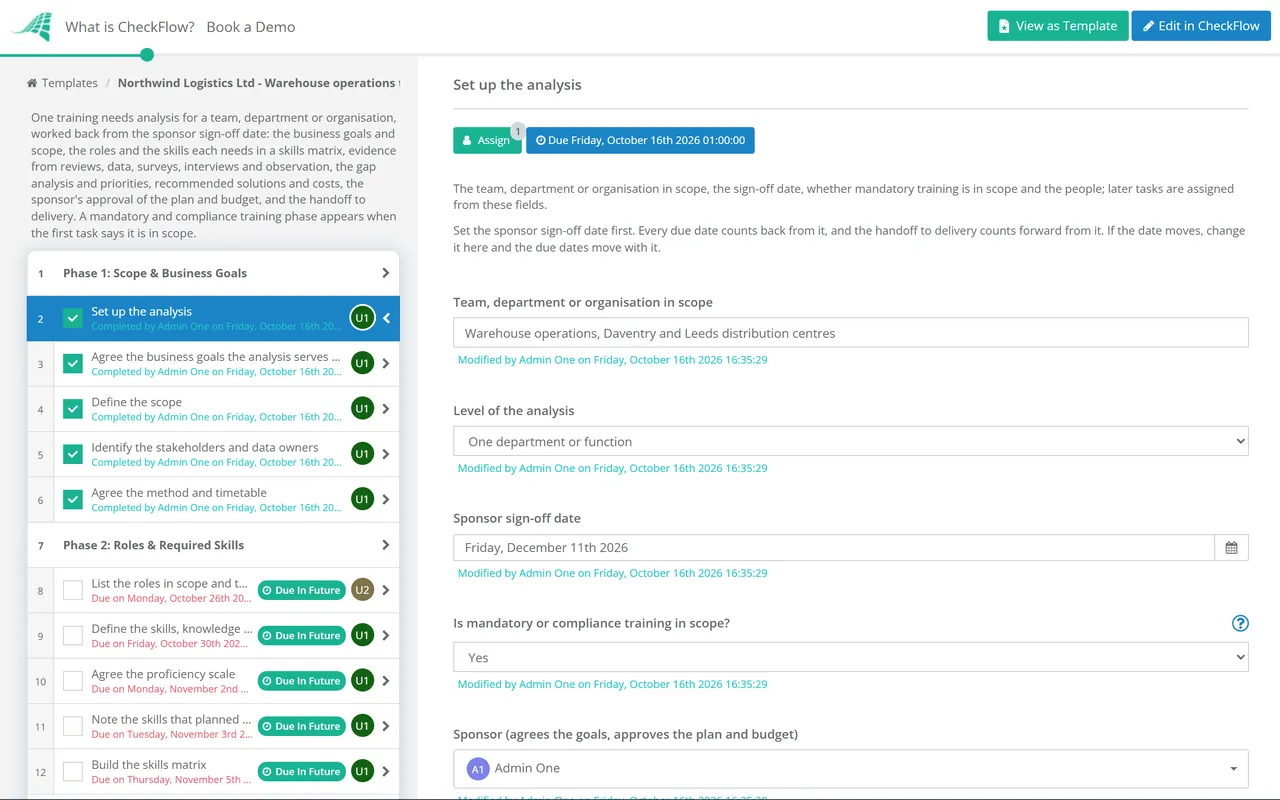
    • Set up the analysis — the team, department or organisation in scope, the sign-off date, whether mandatory training is in scope and the people; later tasks are assigned from these fields
    • Agree the business goals the analysis serves with the sponsor — the results, changes and risks that training should support, taken from the business plan or strategy
    • Define the scope — which teams, roles and locations are in and which are out, and whether you are looking at the organisation, a team or individual roles
    • Identify the stakeholders and data owners — line managers, HR, health and safety, quality and anyone who holds the records the analysis needs
    • Agree the method and timetable — which evidence sources you will use, who will be surveyed or interviewed, and the dates for each stage
  2. Phase 2

    Phase 2: Roles & Required Skills

    5 tasks

    You cannot measure a gap until you have written down what good looks like. This phase builds the required side of the skills matrix: every role in scope, the skills it needs and the level it needs them at.

    • List the roles in scope and the headcount in each — from the HR system, including vacancies and roles the business plan will add
    • Define the skills, knowledge and behaviours each role needs — from job descriptions, competency frameworks, procedures and the business goals agreed in Phase 1
    • Agree the proficiency scale — one scale for every role and skill, with a plain definition of each level, so managers and staff rate the same way
    • Note the skills that planned changes will need — new systems, products, processes, regulations or roles in the business plan that people will need to be ready for
    • Build the skills matrix — each role against the skills it needs, with the required level and the goal or risk that makes it matter
  3. Phase 3

    Phase 3: Gather the Evidence

    7 tasks

    Evidence decides the priorities, not the loudest request. Use the sources agreed in Phase 1, and report people data in aggregate: the analysis is about roles and teams, not about marking individuals.

    • Review performance review and objective data — development needs and ratings that recur across a role or team, reported in aggregate
    • Analyse operational and quality data — errors, rework, complaints, productivity and customer measures that point to a skills gap
    • Review incidents, near misses and audit findings — where a lack of training or competence was a cause, and which roles were involved
    • Review current training records — what each role has completed, what is booked and what is out of date
    • Run the skills survey or self-assessment — people rate their current level against the skills matrix, and managers rate their teams on the same scale
    • Interview managers and a sample of staff — what gets in the way of good performance, what has changed and what they think would help
    • Observe the work where the gap is practical — watch the task done against the procedure or standard, with the person’s agreement
  4. Phase 4 — If mandatory training is in scope

    Phase 4: Mandatory & Compliance Training

    4 tasks

    Applies only when the first task says mandatory training is in scope. Some training is required by law, a regulator, a licence, a contract or your own policy. Gaps in it are not ranked against other needs; they are scheduled before their deadline.

    • List the mandatory training each role needs — from law, regulators, licences, contracts, customers and your own policies, with the source of each requirement
    • Confirm the refresher interval for each course — from the source where it sets one, otherwise from your own policy, and record which
    • Check training records against the list — person by person: training missing, expired, or due to expire before the next analysis
    • Record each mandatory gap with its deadline — these go to the top of the priority list, whatever else the analysis finds
  5. Phase 5

    Phase 5: Gap Analysis & Priorities

    5 tasks

    A gap is the difference between the level a role needs and the level people have. Not every gap is a training need, and not every training need is worth funding this year. This phase sorts them.

    • Compare current levels with required levels — role by role and skill by skill, using the survey, the data and what managers and observation showed
    • Separate training gaps from other causes — a gap caused by tools, processes, workload, recruitment or motivation will not be closed by a course
    • Score each training gap for impact and urgency — the effect on the business goals, the number of people affected and how soon it matters
    • Agree the priority list with the managers — highest impact and risk first, with legal and mandatory gaps at the top
    • Count the people who need each priority — by role and location, so solutions and costs are sized for the real audience
  6. Phase 6

    Phase 6: Recommended Solutions & Costs

    7 tasks

    For each priority, recommend the simplest solution that will close the gap, and say how you will know it worked. Then cost the plan and set it against the budget before the sponsor sees it.

    • Choose a solution for each priority gap — a course, e-learning, coaching on the job, mentoring, a job aid or a qualification, whichever fits the gap and the audience
    • Check what already exists before buying or building — internal courses, the learning platform’s library, supplier agreements and people who could coach
    • Recommend actions for the gaps training will not close — process, tool, workload, recruitment or job design changes, each with an owner
    • Estimate the cost of each solution — fees, licences, materials, travel, the trainer’s time and the time people spend away from work
    • Compare the total with the budget — and say which priorities wait if the budget is short
    • Set a measure of success for each priority — what should change in the work, the measure that will show it, the baseline and when it will be checked
    • Write the training needs analysis report — the goals, the method, the findings, the priorities, the recommended solutions, the costs and the measures
  7. Phase 7

    Phase 7: Sponsor Sign-Off

    3 tasks

    The plan is not a plan until the sponsor approves it and the budget. Nothing in the handoff to delivery can be completed until the sponsor has decided.

    • Present the findings and the plan to the sponsor — with the evidence behind each priority and the cost of each recommendation
    • Sponsor approves the training plan and budget — approved, approved with conditions, or not approved with the reasons
    • Tell managers and staff what was decided — what will be delivered and when, what will not, and what happens to the gaps that wait
  8. Phase 8

    Phase 8: Handoff to Delivery

    5 tasks

    The analysis ends when every approved priority has someone delivering it and a date to check it worked. Delivery itself runs in its own project.

    • Hand each approved priority to a delivery owner — with the audience, the budget, the deadline and the measure of success
    • Start the delivery project for each programme — a rollout for an existing programme, course development where nothing suitable exists, or a booking with a supplier
    • Hand the non-training actions to their owners — each owner confirms the action and its date
    • Store the analysis and its evidence — with restricted access to individual survey, interview and observation data, and a retention period
    • Schedule the results review and the next analysis — check the measures of success on their dates, and repeat the analysis when the business plan changes or at least once a year

How to Prioritise Training Gaps

Most analyses find more gaps than any budget can close. Score each training gap for its impact on the business goals and how soon it matters, then sort it into one of four priorities. A gap with a cause other than skills or knowledge goes in the last row, however much it matters, because a course will not fix it.

Priority Typical gap Evidence that supports it What the plan does
1. Must doMandatory training missing or expired, or a gap that has caused or could cause harmTraining records checked against the mandatory list; incidents, near misses and audit findingsSchedules it before its deadline, ahead of everything else
2. HighA skill central to a business goal, missing in many people or in a critical roleOperational data and manager interviews that agree with a wide gap in the skills matrixFunds it in this plan, with a measure of success
3. MediumA gap with a workaround, or one that affects few peopleSurvey and review themes not yet backed by operational dataFunds it if the budget allows, or uses a low-cost option such as coaching or a job aid
4. LowUseful, but not needed for this year’s goalsRequests and self-ratings with no link to a goal or riskRecords it and looks again at the next analysis
Not trainingThe cause is a tool, process, workload, recruitment or motivation problemObservation and interviews showing people can do the task when conditions allowHands it to the owner of the cause as a non-training action

Rate on one scale. The skills matrix only works if a 3 means the same in every team. A five-point scale is common: 0 none, 1 aware (knows what the task involves), 2 working (does it with help), 3 skilled (does it alone, to the standard), 4 expert (handles the unusual case and can coach others). Put the definitions at the top of the survey, and ask managers to rate their teams on the same scale so the two can be compared.

Mandatory training has its own sources. In England, Wales and Scotland, regulation 13 of the Management of Health and Safety at Work Regulations 1999 requires health and safety training when people are recruited and when they are exposed to new or increased risks, repeated periodically where appropriate. In the US, OSHA collects the training requirements in its standards in the booklet Training Requirements in OSHA Standards (OSHA 2254). Contracts, licences, customers and your own policies add more. Record the source of each requirement, so the next analysis can check whether it has changed.

Why Run Training Needs Analysis in CheckFlow?

1

The sponsor signs off before anything is booked

The sponsor’s approval of the plan and budget is assigned to them alone, and the checklist halts there. The handoff to delivery cannot be completed until the decision is recorded, with any conditions beside it. See how approvals that halt a checklist work.

2

The evidence stays with the finding

The skills matrix, the gap register, survey results, interview notes and costings sit in tables and files on the tasks they belong to, so the report and its evidence stay together. Due dates count back from the sign-off date, and the Reports Grid shows where every analysis has reached.

3

The next analysis starts on time

Put the template on a recurring schedule and the next analysis starts each year with its due dates set. Say that mandatory training is in scope and Phase 4 appears, with a check of training records against what each role must have.

CheckFlow is not a learning management system and does not hold your training records. It runs the analysis in the same order every time, with a record of who did what and when, and keeps the evidence on the tasks it belongs to.

This template decides what training is needed. Deliver an approved programme with the Training Program Rollout Checklist, build a new course with the New Course Development Checklist and turn one person’s gaps into a plan with the Employee Development Plan Checklist. The Employee Performance Review Checklist and the Succession Planning Checklist give it evidence about individuals and critical roles.

AI generator

Didn’t find what you need? Describe it.

Describe the process in a sentence and the AI checklist generator drafts the phases and tasks for you.

Frequently Asked Questions

What is a training needs analysis?

A training needs analysis, or TNA, is a structured way of working out what training an organisation, team or role needs. It compares the skills and knowledge the work requires with the skills people have now, using evidence such as performance data, surveys, interviews, observation and training records. It then separates the gaps training can close from those with other causes, ranks them by impact and urgency, and recommends solutions with costs. The output is a prioritised training plan that a sponsor approves before anything is booked.

What are the three levels of training needs analysis?

Analyses are usually described at three levels. Organisational analysis asks where the business is going and which capabilities its goals and risks depend on. Task or role analysis asks what each role needs to be able to do, and to what standard; this is where the skills matrix comes from. Individual analysis asks who already meets that standard and who does not. Work through all three in that order, so individual gaps are judged against what the roles and the business actually need.

How do you carry out a training needs analysis?

Agree the business goals and scope with a sponsor. List the roles in scope and define the skills and levels each needs in a skills matrix. Gather evidence from performance reviews, operational data, incidents, training records, a skills survey, interviews and observation. Compare current and required levels, set aside gaps with other causes and score the rest for impact and urgency. Recommend a solution, a cost and a measure for each priority, get the plan and budget approved, then hand each priority to someone who will deliver it.

What is the difference between a training needs analysis and a skills gap analysis?

A skills gap analysis measures the difference between the skills a role needs and the skills people have. It is one part of a training needs analysis. The TNA starts earlier, with the business goals that make some skills matter more than others, and goes further: it asks whether each gap is really a training problem, ranks the gaps, recommends solutions, costs them and gets a budget approved. A skills gap analysis shows where people fall short; a TNA decides what to do about it, and in what order.

What methods are used to identify training needs?

The common ones are performance review data, operational and quality measures, incidents and audit findings, training records, skills surveys or self-assessments, interviews and focus groups, and observation of the work. Each has limits. Self-assessments show what people think they need, records show what was completed rather than what was learned, and operational data shows a problem without its cause. Use at least two sources for every finding you fund, and report people data by role and team rather than by name.

How often should you carry out a training needs analysis?

There is no fixed rule. Many organisations run one a year, timed so the findings are ready for the budget round, and a smaller one for a team when something changes: a new system, process, product, regulation or role, a reorganisation, or a run of errors or incidents. Mandatory training also has refresher intervals set by the law, regulator, contract or policy behind it, and those should be checked at every analysis, whenever it runs.

Is mandatory training the same as training required by law?

Not always. Mandatory usually means the organisation requires it, and the reason may be the law, a regulator, a licence, a contract, a customer or internal policy. Some of it is legal: in Great Britain the Management of Health and Safety at Work Regulations 1999 require health and safety training on recruitment and when people are exposed to new or increased risks, and in the US many OSHA standards set their own training requirements. Record the source of each mandatory course, because it decides the deadline and the refresher interval.

Is CheckFlow free for this template?

14-day free trial, no card required. The Business plan is $10 per user per month after the trial. Full details at checkflow.io/pricing.

Know What Training Your Teams Need Before You Book It

Free trial — no credit card required.

14-day free trial, no credit cardFull refund in your first 30 daysUS or EU hosting