The technical skills an employee has today have a half-life of 2.5 years. The development plan you build now determines whether they outgrow the role — or leave for one that will grow them.
Employees who cannot see a clear development path leave. Not immediately — first they disengage, become less proactive, and eventually accept the offer from the organisation that appeared to care about their growth. The pattern is consistent and costly, and almost entirely avoidable with one thing most managers acknowledge matters but few do systematically: a structured, documented, collaboratively built Employee Development Plan. An EDP is not a list of training courses. It is a framework for understanding where an employee is now, where they want to go, what skills and experiences they need to get there, and how the manager and organisation will support that journey. This free employee development plan checklist gives managers and HR teams a structured process for creating, implementing, and reviewing development plans that are genuinely useful — specific, measurable, collaborative, and connected to both the employee’s career goals and the organisation’s strategic needs.
Why Employee Development Is a Retention Strategy, Not a Training Budget Line
Research from Mercer’s 2024–25 Skills Snapshot Survey found that 62% of organisations plan to rebuild their job architectures around skills within two years. High-maturity development organisations — those with structured, continuous development programmes — achieve 2.1 times higher employee engagement and 1.6 times stronger retention than peers. The cost of not investing in development is not a training budget saved. It is the cost of replacing the employees who leave because they could not see a future with you.
The most effective development programmes are also not primarily about formal training. Research consistently shows that roughly 70% of meaningful professional development comes from on-the-job experience — stretch assignments, new responsibilities, cross-functional projects. 20% comes from others — coaching, mentoring, peer feedback. Only 10% comes from formal training events. An employee development plan that consists only of a list of courses to attend misses 90% of the development opportunity. A structured EDP that deliberately designs on-the-job growth and coaching relationships alongside formal learning is the approach that actually develops people.
What the Employee Development Plan Checklist Covers
This checklist covers seven phases of the employee development planning process — from initial assessment and goal-setting through learning pathway design, implementation, and regular review. Run it collaboratively with the employee — it is a shared planning process, not a manager-to-employee download.
Phase 1
Phase 1: The Development Conversation & Needs Assessment
The development conversation is the foundation of the plan. It works when it is a genuine two-way conversation about aspirations and honest about current gaps — not a manager presenting a predetermined development agenda to an employee.
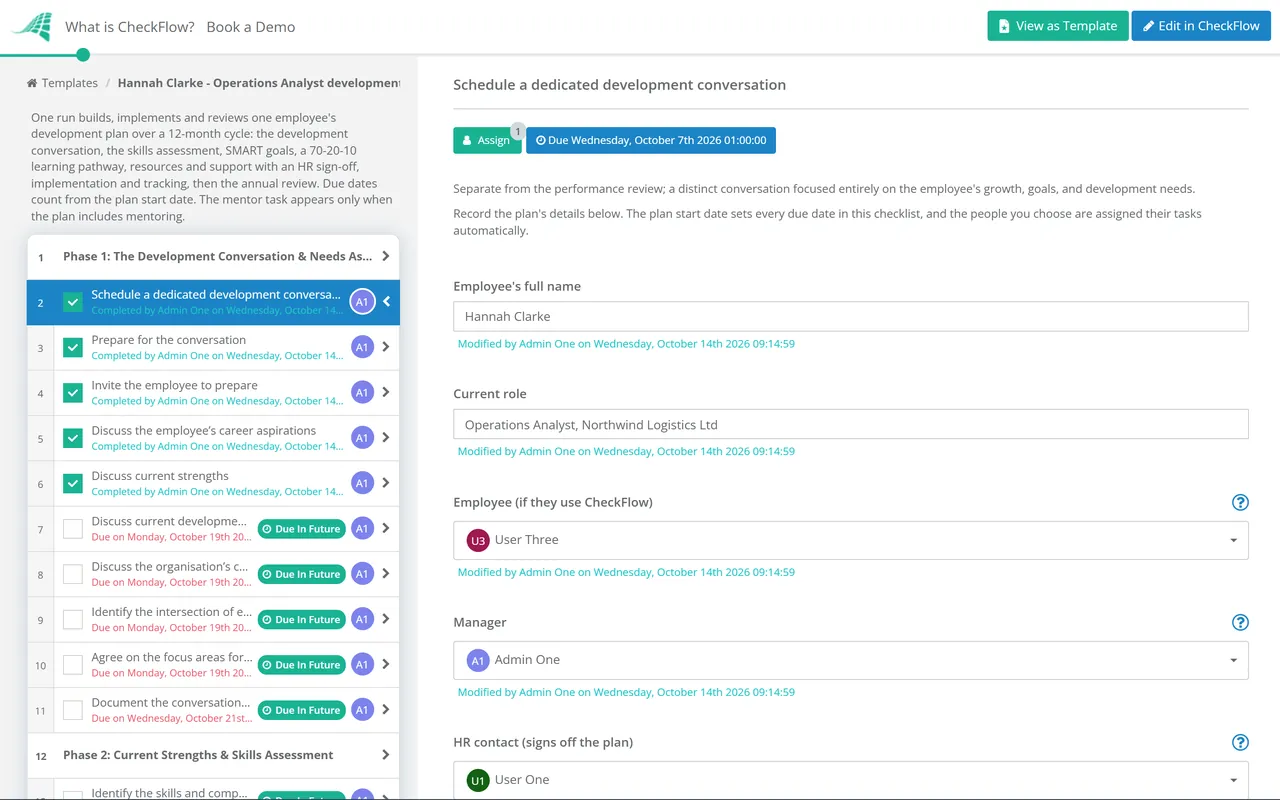
Schedule a dedicated development conversation — separate from the performance review; a distinct conversation focused entirely on the employee’s growth, goals, and development needs
Prepare for the conversation — the manager reviews the employee’s recent performance, their current role scope, and the team’s upcoming capability needs before the conversation
Invite the employee to prepare — ask them to reflect on their strengths, development areas, career interests, and what kind of support they are looking for; share guiding questions in advance
Discuss the employee’s career aspirations — where do they want to be in 2–3 years? What kind of work energises them? What do they want to be known for professionally?
Discuss current strengths — what does the employee do well? What feedback have they received that affirms their strengths? What comes naturally?
Discuss current development areas — where do they feel least confident? Where has feedback identified gaps? What do they find most challenging in the current role?
Discuss the organisation’s capability needs — what skills will the team and business need over the next 12–24 months that the employee could contribute to?
Identify the intersection of employee aspiration and organisational need — the most effective development plans address both; development that serves only the organisation without serving the employee’s goals produces compliance, not commitment
Agree on the focus areas for the development plan — not all development areas at once; typically two or three priority areas for the next 6–12 months
Document the conversation outcomes — key themes, agreed focus areas, and any immediate actions identified
Phase 2
Phase 2: Current Strengths & Skills Assessment
Identify the skills and competencies required for the current role — confirm what is needed now, at a high-performance level
Identify the skills and competencies required for the employee’s next career stage — what would a more senior version of this role, or the next role the employee aspires to, require?
Assess current skills against both sets — where is the employee strong in the current role? Where are the gaps between current skills and the next stage?
Use multiple data sources for the assessment — manager observation, self-assessment, peer feedback, performance review data, and any relevant skills assessments or tests
Distinguish between development areas and performance issues — a development plan addresses growth opportunities and aspirational skills; persistent performance gaps require a different conversation and process
Identify transferable strengths — skills and experiences the employee has from previous roles or experiences that could be more fully leveraged
Assess digital and AI literacy given the 2.5-year half-life of technical skills — confirm current skill levels are adequate and identify any upskilling needs in rapidly evolving areas
Identify strength overdevelopment risks — skills used too heavily that become limiting or create blind spots; confirm the employee has appropriate breadth alongside their strengths
Confirm the skills assessment is shared and agreed — not a manager verdict delivered to the employee; a shared view of where the employee currently stands
Document the skills assessment findings — confirmed strengths, identified gaps, and prioritised development areas
Phase 3
Phase 3: SMART Development Goal-Setting
A development goal that says “improve communication skills” is not a goal — it is a wish. A development goal that says “lead the Q3 client presentation independently by September” is specific enough to work towards and measure.
Set SMART development goals — Specific, Measurable, Achievable, Relevant, and Time-bound; confirm each goal meets all five criteria before it is finalised
Align goals to the employee’s career aspirations — confirm each goal moves the employee towards something they genuinely want, not just something the organisation needs
Align goals to organisational capability needs — confirm the development plan also serves the team and business; development that has no connection to organisational need is harder to resource
Set a realistic number of goals — two or three focused goals are more achievable than six broad ones; prioritise depth over breadth
Define milestones for each goal — how will progress be measured at 30, 60, and 90 days or at quarterly reviews?
Define what success looks like for each goal — be specific about the evidence that will demonstrate achievement
Confirm the goals are challenging but realistic — development goals should stretch; they should not be set up to fail; confirm adequate support is available
Agree on the review frequency for each goal — more frequent check-ins for goals that require active coaching; lighter check-ins for self-directed goals
Confirm both manager and employee are genuinely committed to the goals — development plans that the employee does not own produce compliance, not growth
Document all development goals — written record shared with the employee; retained in the HR system for reference at performance reviews
Phase 4
Phase 4: Learning Pathway Design — the 70-20-10 Approach
Most development budgets go to formal training. Most development happens on the job and through relationships. Design the plan to reflect how development actually works — not how it is easiest to budget for.
Apply the 70-20-10 framework — for each development goal, identify how on-the-job experience (70%), relationships and feedback (20%), and formal training (10%) will each contribute
Identify on-the-job development opportunities — stretch assignments the employee could take on, projects they could lead, responsibilities they could expand; these deliver 70% of development
Identify coaching and mentoring opportunities — a mentor who has walked the path the employee wants to follow; a coach for specific skill development; regular structured feedback conversations
Identify peer learning opportunities — shadowing colleagues with skills the employee wants to develop, cross-functional projects, and communities of practice; this is part of the 20%
Identify formal training options — courses, certifications, workshops, conferences; confirm they are relevant, high quality, and value for money compared to on-the-job alternatives
Prioritise on-the-job learning where possible — a stretch assignment that develops the skill in context is more effective and longer-lasting than most equivalent training courses
Consider secondments or rotations — working in another team, department, or even organisation for a defined period; a powerful development tool that is rarely used as actively as it should be
Confirm self-directed learning resources — books, podcasts, online courses, professional bodies, industry events; confirm the employee has the time and budget to pursue them
Sequence the learning pathway — what should be done first to build the foundation for later activities?
Document the learning pathway — written record of all planned development activities, the goal each addresses, and the expected timeline
Phase 5
Phase 5: Resources, Budget & Manager Support
Confirm the development budget available — the organisation’s learning and development budget per employee; any additional budget that can be accessed for this specific plan
Confirm the time available for development — development activities require time; confirm how much is protected in the employee’s schedule for development versus business-as-usual
Identify the manager’s support commitments — coaching conversations, stretch assignment briefings, feedback sessions, and advocacy for the employee’s development opportunities; confirm these are genuine commitments, not aspirational statements
Identify any organisational advocacy needed — access to projects, senior introductions, or departmental exposure that requires manager advocacy rather than just permission
Confirm access to a mentor — where mentoring is part of the plan, confirm the mentor is approached, has agreed, and understands what is being asked of them
Identify any barriers to development — workload, team dynamics, resource constraints, or organisational limitations that could prevent the plan from being executed; address these before the plan is finalised
Confirm support from HR — any HR-provided resources, coaching budget, or structured programmes the employee can access
Confirm the employee has the autonomy to pursue self-directed learning — time, approval to attend events, and access to online learning resources
Agree on what happens if development activities fall behind schedule — how will the manager support re-engagement rather than quietly abandoning the plan?
Document all resource and support commitments — both the organisation’s commitments to the employee and the employee’s commitments to their own development
Phase 6
Phase 6: Implementation & Progress Tracking
Initiate the first development activity — the first step should happen within two weeks of the plan being agreed; momentum matters
Schedule regular development check-ins — at least quarterly; separate from the performance review conversation; focused entirely on development progress and what support is needed
Track development activity completion — confirm each planned activity is completed and logged; update the plan when activities are completed or substituted
Capture learning from development activities — what did the employee learn? How are they applying it? This reflection step significantly improves the transfer of development activity into actual capability change
Address barriers proactively — if development activities are falling behind, investigate why and address the cause; do not wait for the annual review to note that the plan was not completed
Celebrate milestone achievements — development progress that is noticed and acknowledged reinforces the behaviour; do not wait for the full goal to be complete
Adjust the plan as circumstances change — if the employee’s role changes, if business priorities shift, or if an unexpected development opportunity arises; the plan should be a living document, not a fixed contract
Gather feedback on the development activities — was the training useful? Is the stretch assignment well-calibrated? Is the mentor relationship working? Act on the feedback
Maintain the development log — a running record of activities completed, skills developed, and progress against each goal
Share progress updates with HR where required — particularly for programmes that involve organisational investment or mandatory development
Phase 7
Phase 7: Development Plan Review & Continuous Growth
Conduct the formal annual development review — assess progress against all goals; celebrate achievements; analyse what was not achieved and why
Review whether development goals are still relevant — the business, the role, and the employee’s aspirations may have changed; update goals accordingly
Assess the impact of development activities on performance — has the employee’s capability grown in the areas identified? Is it visible in their work?
Update the development plan for the next 12 months — new goals, revised learning pathway, updated resource commitments
Discuss progression and career direction — has the plan brought the employee closer to their career goals? Are the goals still what they want?
Identify any emerging skill gaps — particularly relevant given the 2.5-year half-life of technical skills; confirm the plan addresses rapidly evolving areas of the role
Link development outcomes to performance review and compensation — where development goals are met, confirm this is reflected in the performance assessment and any related rewards
Identify opportunities for the employee to contribute to others’ development — mentoring junior colleagues, leading internal knowledge sessions, or representing the team externally; developing others is itself a development activity
Confirm the development plan continues after the initial period — development does not stop at 12 months; confirm ongoing commitment from both sides
Archive the completed development plan — a full record of goals set, activities completed, and outcomes achieved; retained in the HR record for reference in future performance management and succession planning
This checklist is available as a free, runnable template in CheckFlow — with development plan tasks shared between manager and employee, progress tracked against each goal, and quarterly review conversations scheduled automatically as a recurring checklist.
Why Development Is Mostly Not About Training — The 70-20-10 Model
Most organisations spend their development budget almost entirely on formal training — courses, workshops, certifications. Research consistently shows this delivers roughly 10% of meaningful professional development. The rest comes from experience and relationships.
70%
On-the-job experience
What it looks like: Stretch assignments above the employee’s current comfort level. Leading a project they have not led before. Taking on a new area of responsibility. Cross-functional work. Secondments to another team or department. Representing the team externally for the first time.
Why it works: Development embedded in real work is immediately applicable, contextually relevant, and produces results alongside the development — unlike training, which must be transferred back into the real world.
Manager’s role: Deliberately design stretch into the employee’s work. Brief well. Debrief after. Create safety to fail and recover.
20%
Learning from others
What it looks like: A mentor who has navigated the career path the employee aspires to. Regular structured coaching conversations with the manager. Peer feedback from colleagues. Shadowing more experienced colleagues. Participating in professional networks and communities of practice.
Why it works: Relationships accelerate development by providing specific, contextualised guidance that formal training cannot. A mentor who has made the mistakes saves the mentee from making them.
Manager’s role: Identify and introduce appropriate mentors. Hold regular coaching conversations — not just performance updates. Give specific, actionable feedback regularly.
10%
Formal training
What it looks like: Courses, certifications, workshops, conferences, e-learning programmes, and structured training events.
Why it works: Formal training is most effective for foundational knowledge and frameworks that create the conceptual structure for on-the-job application. It is least effective when used as a substitute for on-the-job development or when it is not applied to real work immediately afterwards.
Manager’s role: Select formal training that is directly applicable to current work. Brief the employee before and debrief after. Confirm there is an immediate opportunity to apply the learning.
An employee development plan built only on formal training misses 90% of the development opportunity. CheckFlow’s development plan template explicitly structures all three elements — on-the-job, relationships, and formal learning — so nothing is left to chance.
Why Use CheckFlow for Employee Development Plans?
1
A shared plan the employee genuinely owns
Development plans that only exist in the manager’s system are manager plans, not employee plans. CheckFlow’s shared checklist gives both the manager and the employee visibility into the development plan — goals, activities, progress, and upcoming milestones. The employee can update their progress, add learning reflections, and track their own development journey. Ownership shifts from the manager to the employee — where it belongs.
2
Quarterly reviews that actually happen
Development plans drafted at the annual review and revisited twelve months later are development plans in name only. CheckFlow’s recurring checklist feature schedules quarterly development check-ins automatically — creating a new review task for the manager and employee at the right cadence, sending reminders when the check-in is due, and ensuring development conversations happen regularly rather than annually.
3
A development record that informs succession and promotion
Every development goal set, every activity completed, and every milestone achieved is logged in CheckFlow with a timestamp. When a promotion decision, a succession planning review, or a talent assessment requires evidence of an employee’s development trajectory, the complete record is immediately available — not reconstructed from memory or scattered across email threads and annual review documents.
Employee development plans work best when they build on a clear foundation of expectations. CheckFlow’s Employee Expectations Checklist covers the structured expectations-setting conversation that precedes the development plan — ensuring both manager and employee have agreed what is expected now before planning what comes next. See the Employee Expectations Checklist →
For organisations developing new training programmes to support employee development goals, CheckFlow’s New Course Development Checklist covers the full ADDIE process for building effective training — from needs analysis through to evaluation of learning outcomes. See the New Course Development Checklist →
A comprehensive employee development plan covers seven areas: a development conversation and needs assessment (the collaborative discussion that identifies aspirations, strengths, and development areas); a current skills assessment (mapping current capabilities against role requirements and career aspirations); SMART development goal-setting (specific, measurable, achievable, relevant, and time-bound goals that serve both employee and organisational needs); a learning pathway design using the 70-20-10 model (70% on-the-job, 20% from others, 10% formal training); resource and support identification (budget, time, manager commitments, mentor access); plan implementation and progress tracking; and regular review and plan update. The plan should be co-created by the employee and manager, documented in writing, and reviewed at least quarterly.
What is the 70-20-10 development model?
+
The 70-20-10 model is an empirically-derived framework for how effective professional development actually happens. It proposes that roughly 70% of meaningful professional development comes from on-the-job experience — challenging assignments, new responsibilities, leading projects outside the employee’s comfort zone, and cross-functional exposure. 20% comes from learning from others — mentoring, coaching, peer feedback, and professional networks. 10% comes from formal training events such as courses, certifications, and workshops. The practical implication is that development plans built primarily around training courses miss 90% of the development opportunity. Effective development plans deliberately design stretch experiences and coaching relationships alongside formal learning — using training to build the conceptual framework and on-the-job experience to develop genuine capability.
How often should an employee development plan be reviewed?
+
Development plans should be reviewed at least quarterly — more frequently for employees in their first 90 days, new to a development area, or working towards a time-sensitive goal. Quarterly reviews confirm progress is on track, identify any barriers that have emerged, adjust activities that are not working, and maintain momentum. Annual reviews update the plan for the next year — setting new goals, assessing the impact of completed development on actual capability, and confirming whether the employee’s career aspirations have evolved. A development plan that is only reviewed annually is not a development plan — it is an annual administrative requirement that produces minimal development. CheckFlow’s recurring checklist feature schedules quarterly review conversations automatically.
What is the difference between a performance review and a development review?
+
A performance review assesses how well the employee is performing against their current role’s expectations and KPIs — looking backward at what was achieved and rating performance against agreed standards. A development review focuses on growth — looking forward at where the employee wants to go, what skills they are developing, what support they need, and whether the development plan is on track. Both conversations are important, but they serve different purposes and require different mindsets. Combining them in a single meeting tends to mean performance dominates and development is addressed briefly at the end. Treating them as separate conversations gives development the dedicated attention that produces genuine growth.
How do you create a development plan for an employee who is not sure what they want?
+
The development conversation is the right starting point. Employees who are uncertain about their career direction benefit from structured reflection rather than a plan that assumes a clear destination. Useful questions include: what kind of work energises you most? What problems do you most enjoy solving? What do colleagues consistently come to you for? What would you want to be doing in five years if you knew you could not fail? Development goals for employees who are uncertain about direction can focus on exploration — deliberately taking on a variety of stretch assignments to discover what resonates, having conversations with people in roles they might aspire to, and building breadth before committing to a specific direction.
Is CheckFlow free to use for this template?
+
You can start a free 14-day trial with no credit card required, giving you full access to all features including this template. The Business plan is $10 per user per month after the trial. Full details at checkflow.io/pricing.
Build Development Plans That Actually Develop People
Free trial — no credit card required.
Do you like cookies? 🍪 We use cookies to ensure you get the best experience on our website. Learn more