Curriculum Review Process Checklist Template

A structured, repeatable framework for reviewing curriculum — from data gathering to implementation and ongoing evaluation.

Curriculum that is not regularly and systematically reviewed drifts — from current standards, from learner needs, from evidence of what actually works in practice. A structured curriculum review process ensures that every subject or programme is evaluated against learning outcomes, student or learner performance data, stakeholder feedback, and current best practices on a defined cycle — and that the findings translate into concrete improvements rather than sitting in a report nobody acts on. This free curriculum review process checklist gives curriculum coordinators, instructional designers, department heads, and L&D managers a structured framework for every phase of the review cycle — from initial data gathering and standards alignment through learning outcome design, materials review, implementation planning, and ongoing monitoring.

Use This Template Free See Live Example
No Credit Card Required

Why Curriculum Review Without a Structured Process Rarely Produces Change

Most educational institutions and training departments acknowledge that curriculum review should happen regularly. Fewer have a structured process that ensures it actually does — and that the review produces documented, actionable findings rather than informal discussions that do not translate into improvements. Without a defined process, review cycles slip, different teams review differently, data is gathered inconsistently, and the link between review findings and curriculum changes is difficult to trace. The review happens in name but not in practice.

A structured curriculum review process changes this: each phase has defined inputs, activities, and outputs; each stakeholder group knows their role and when they are needed; review findings are documented and tracked through to action; and the cycle repeats consistently, creating an institutional discipline rather than a periodic good intention. Whether the context is a K-12 school district reviewing a core subject area, a university reviewing a degree programme, or a corporate L&D team reviewing a professional development curriculum, the same structured phases apply.

What the Curriculum Review Process Checklist Covers

This checklist covers six phases of the curriculum review cycle — from initial data gathering through standards alignment, learning outcome design, instructional materials review, implementation planning, and ongoing monitoring and evaluation.

Phase 1

Scope Definition & Stakeholder Engagement

Before data is gathered or analysis begins, the review needs a clear scope, a named team, and a realistic timeline. A curriculum review that lacks these from the start consistently loses momentum before it produces recommendations.

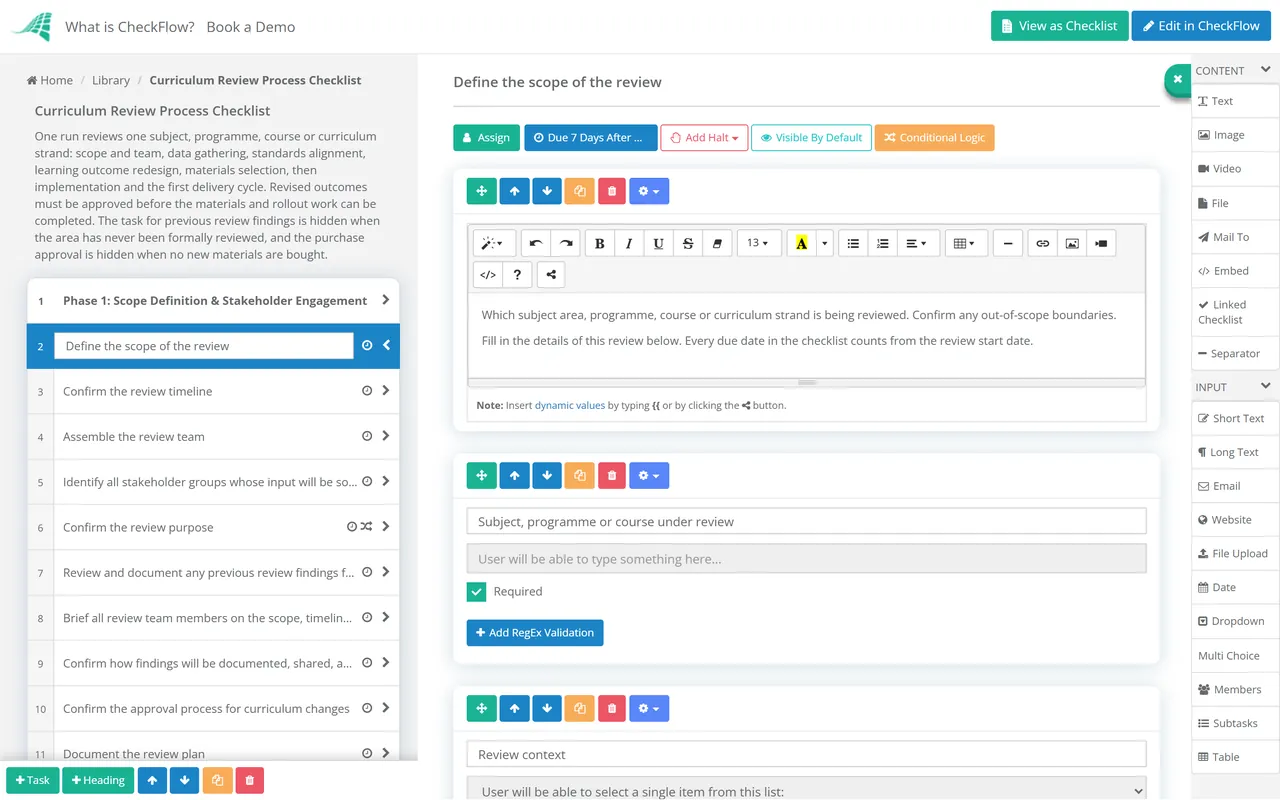
  • Define the scope of the review — which subject area, programme, course, or curriculum strand is being reviewed; confirm any out-of-scope boundaries
  • Confirm the review timeline — start date, key phase milestones, and target date for implementing approved changes
  • Assemble the review team — curriculum coordinator or review lead, subject teachers or instructors, department head or programme director, and any specialist advisors or external reviewers
  • Identify all stakeholder groups whose input will be sought — teachers, learners (students or employees), parents or line managers, external experts, and accreditation bodies where applicable
  • Confirm the review purpose — is this a routine cycle review, a response to performance data, a standards update, an accreditation requirement, or a programme redesign?
  • Review and document any previous review findings for this curriculum area — what was recommended last time and what was implemented?
  • Brief all review team members on the scope, timeline, their roles, and the intended outputs
  • Confirm how findings will be documented, shared, and actioned — who receives the review report and who approves recommended changes?
  • Confirm the approval process for curriculum changes — who has sign-off authority for revisions at each level?
  • Document the review plan — a written summary of scope, team, timeline, and process shared with all stakeholders before work begins
Phase 2

Data Gathering & Current State Evaluation

  • Collect and review all current curriculum documentation — course outlines, unit plans, learning objectives, assessment designs, and any supporting materials or resources
  • Gather learner performance data — assessment results, grades, completion rates, progression data, and any standardised test results relevant to the curriculum area
  • Review assessment results against intended learning outcomes — are learners achieving what the curriculum intends? Where are the gaps?
  • Collect teacher or instructor feedback — structured surveys or interviews covering what is working well, what is difficult to teach effectively, and where the curriculum needs strengthening
  • Collect learner feedback — structured surveys or focus groups covering engagement, perceived relevance, difficulty, and suggestions for improvement
  • Collect stakeholder feedback — parents, employers, line managers, or other external parties whose perspective on curriculum outcomes is relevant
  • Review course completion and engagement data — attendance, dropout rates, time-on-task, and any other engagement indicators available
  • Review any previous external evaluation or inspection findings — Ofsted, accreditation body, or employer feedback that has addressed this curriculum area
  • Identify patterns and themes in the data — where does performance consistently underdeliver? Where is there evidence of strong learning outcomes?
  • Document the current state assessment — a written summary of findings from data gathering that will inform the standards alignment phase
Phase 3

Standards Alignment & Best Practice Review

  • Review applicable curriculum standards or frameworks — national or state curriculum standards (for K-12), programme specifications (for higher education), occupational or competency frameworks (for corporate training), or accreditation body requirements
  • Confirm the current curriculum is aligned to applicable standards — identify any areas where coverage is missing, insufficient, or misaligned
  • Review recent updates to standards or frameworks — have standards changed since the last curriculum review? What changes are required?
  • Research current best practices in this curriculum area — review academic literature, professional body guidance, industry publications, and comparable programmes at peer institutions
  • Review emerging trends and skills requirements — particularly relevant for professional and vocational programmes; are there new skills or knowledge areas the curriculum should be incorporating?
  • Assess the currency of content — are the topics, examples, and references in the curriculum current? Have significant developments in the field made any content outdated?
  • Review comparable curricula at peer institutions or competitor organisations — benchmarking against comparable programmes identifies gaps and opportunities
  • Identify any equity and inclusion considerations — does the curriculum represent diverse perspectives? Are there barriers to access for any learner groups?
  • Consult external subject matter experts or advisory boards where available — external input provides independent validation of content currency and relevance
  • Document standards alignment findings — gaps identified, standards updates required, and best practice recommendations
Phase 4

Learning Outcome Design & Curriculum Revision

Learning outcomes should be written first — before content, materials, or assessment are designed. Outcomes define what learners will be able to know, understand, or do; everything else is in service of those outcomes.

  • Review and revise learning outcomes for the curriculum area — confirm outcomes are clear, measurable, appropriately levelled, and aligned to standards
  • Apply a backward design approach — start with the desired outcomes, then design assessments that evidence those outcomes, then design learning experiences that prepare learners for those assessments
  • Confirm the scope and sequence — are learning outcomes ordered logically? Does earlier content build the foundation for later content? Is there coherent vertical progression across year groups or levels?
  • Review assessment design — do current assessments validly measure the intended learning outcomes? Are they appropriately challenging and varied?
  • Revise unit or module plans — update content, learning activities, and teacher or facilitator guidance to reflect revised outcomes and best practices
  • Review and update teaching and learning strategies — are the instructional approaches specified in the curriculum evidence-based and appropriate for the learner group?
  • Address identified equity and inclusion gaps — confirm revised curriculum is accessible and representative
  • Map curriculum progression — confirm the revised curriculum connects logically to prerequisite and subsequent learning at the appropriate levels
  • Obtain peer review of revised curriculum documentation — from other teachers, instructional designers, or external reviewers before finalising
  • Obtain approval for revised learning outcomes and curriculum structure from the relevant authority — department head, academic board, L&D director, or equivalent
Phase 5

Instructional Materials Review & Selection

  • Audit existing instructional materials — textbooks, online resources, learning management system (LMS) content, workbooks, videos, and any other materials currently in use
  • Assess the currency and quality of existing materials — are they up to date? Are they aligned to the revised learning outcomes? Are they engaging and appropriate for the learner group?
  • Identify materials that should be retired — outdated, misaligned, or low-quality materials that should no longer be used
  • Research and evaluate new or alternative materials — review against evaluation criteria covering alignment, quality, accessibility, and practicality
  • Apply a structured materials evaluation process — define evaluation criteria before reviewing materials; involve teachers or instructors in the evaluation; pilot materials with learners where possible
  • Confirm accessibility of all selected materials — digital accessibility (WCAG compliance for online resources), physical accessibility, and language accessibility for all learner groups
  • Consider cost and procurement — budget for new materials; licensing requirements for digital resources; procurement lead times
  • Confirm LMS or training system compatibility — for digital materials, confirm compatibility with the organisation’s learning management or delivery platform
  • Document materials selection decisions — what was selected, what was retired, and the rationale for each decision
  • Obtain approval for materials purchases and procurement — confirm budget authorisation and procurement timeline before finalising the materials list
Phase 6

Implementation Planning, Professional Development & Ongoing Evaluation

  • Develop the implementation plan — rollout timeline, phased introduction where applicable, and a clear schedule for when revised curriculum and materials will be in use
  • Identify professional development needs — what training or support do teachers or facilitators need to deliver the revised curriculum effectively?
  • Plan and schedule professional development — confirm training is delivered before the curriculum is implemented, not after
  • Communicate the changes to all stakeholders — teachers, learners, parents, and any other stakeholders affected by the curriculum revision
  • Monitor implementation in the first cycle — gather early feedback from teachers and learners about how the revised curriculum is working in practice
  • Collect and review performance data from the first full delivery cycle — assess whether learning outcomes are being achieved at the expected level
  • Review any implementation issues and address them promptly — confirm a process for flagging and resolving issues during the first year of delivery
  • Document lessons learned from implementation — what worked well, what needs adjustment, and what should be done differently in the next review cycle
  • Set the next review date — confirm when this curriculum area will next be formally reviewed; schedule the next cycle before this one is complete
  • Archive the complete review record — all data gathered, findings, decisions, approved revisions, and implementation notes; available for the next review cycle and any accreditation or inspection processes

This checklist is available as a free, runnable template in CheckFlow — with tasks assigned across curriculum teams, review phases managed as structured stages, annual review cycles scheduled automatically, and a complete documented record for each review cycle.

Use This Template Free

The Curriculum Review Process Across Different Contexts

The same six-phase review process applies across different educational and training contexts — adapted in scope and terminology but identical in structure.

K-12 Schools & School Districts

Subject curriculum review cycles aligned to national or state standards. Typically covers one core subject per year on a multi-year rotation. Review data includes student assessment results, teacher feedback, and standardised test performance. Output: revised curriculum guides, updated unit plans, and materials selection decisions.

Higher Education

Programme and course review cycles driven by accreditation requirements, graduate outcomes data, and employer feedback. Involves faculty, programme directors, external examiners, and student representatives. Output: updated programme specifications, learning outcomes, and module content.

Corporate L&D & Training Departments

Review of professional development programmes, onboarding curricula, technical training, and leadership development. Driven by skills gap data, manager feedback, and business performance outcomes. Output: revised course designs, updated materials, and adjusted delivery methods.

Vocational & Professional Training Providers

Review of vocational qualifications and professional development programmes against occupational standards and employer needs. Involves awarding body requirements, employer advisory boards, and learner outcome data.

eLearning & Online Course Providers

Review and update of online course content against current knowledge, learner completion and satisfaction data, and platform capabilities. Particularly important for rapidly evolving subject areas where content becomes outdated quickly.

Regulatory & Compliance Training

Review of mandatory compliance training programmes against current regulatory requirements, incident data, and audit findings. Driven by regulatory change, incident patterns, or audit recommendations. Output: updated training content and evidence of curriculum currency for regulatory inspection.

Why Run Curriculum Review in CheckFlow?

1

Coordinate across every stakeholder in the review

Curriculum review involves teachers, curriculum coordinators, department heads, external reviewers, and sometimes learners and parents — all contributing at different phases of the process. CheckFlow assigns each review task to the right person at the right phase, notifies them when their input is needed, and gives the review lead a live view of what has been completed and what is outstanding across every stakeholder simultaneously.

2

Keep multi-year review cycles on track

Curriculum review cycles span months or years — and without a structured tracking system, phases slip, assignments get forgotten, and the review arrives at implementation without completing all its preceding work. CheckFlow’s dashboard shows exactly which phase every subject or programme is in, what is outstanding in the current phase, and which review cycles are approaching their next milestone. Nothing drifts unnoticed.

3

Build the review record for accreditation and inspection

Every completed review task is logged with a timestamp and the name of the responsible reviewer. The full review record — data gathered, standards alignment findings, decisions made, approvals given, and implementation notes — is archived in CheckFlow. When an accreditation body, Ofsted inspection, or senior leadership review asks for evidence of how curriculum review is conducted, the record is complete and immediately accessible.

Curriculum review cycles are an excellent candidate for CheckFlow’s recurring checklist feature — the same structured process, run for a different subject or programme, on a defined annual or multi-year cycle. Set it up once and CheckFlow schedules each new cycle automatically. Learn more about recurring checklists in CheckFlow →

For corporate L&D teams, curriculum review is one of several structured operational processes that benefit from a checklist approach. CheckFlow’s SOP software lets L&D teams document and run any repeatable training and development process consistently — from curriculum review to new hire onboarding programmes. Learn more about SOP software in CheckFlow →

Frequently Asked Questions

What is a curriculum review process and why is it important?

+

A curriculum review process is a structured, cyclical evaluation of educational programmes, courses, or training curricula to ensure they remain current, aligned to applicable standards, effective at producing intended learning outcomes, and responsive to learner needs. It involves gathering data on current performance, reviewing alignment with standards and best practices, revising learning outcomes and content, selecting and updating instructional materials, planning implementation, and monitoring outcomes after changes are made. Regular curriculum review is required by accreditation bodies, regulatory frameworks, and quality assurance systems in most educational contexts — and is a professional obligation for L&D teams ensuring training remains relevant to business needs.

How often should curriculum be reviewed?

+

Most structured curriculum review frameworks operate on a three to six year cycle per subject area or programme — reviewing one or two areas per year on a rolling basis rather than attempting to review everything at once. Annual reviews of assessment data, student performance, and teacher feedback should happen within every cycle, even when a full curriculum review is not scheduled. Trigger events — significant standards updates, poor performance data, accreditation requirements, or major changes in the subject field — may require an out-of-cycle review regardless of where a curriculum area sits in the regular rotation. CheckFlow’s recurring checklist feature can schedule both annual check-ins and full review cycles automatically.

Who should be involved in a curriculum review?

+

Effective curriculum review involves multiple stakeholder groups at different phases. The core review team typically includes the curriculum coordinator or review lead, subject teachers or instructors (who deliver the curriculum and have first-hand knowledge of what works), and a department head or programme director who can authorise changes. Input should also be gathered from learners (student or employee surveys and focus groups), external stakeholders (employers, parents, professional bodies, or accreditation advisors), and subject matter experts for content currency and standards alignment. The breadth of stakeholder engagement is what distinguishes a robust curriculum review from an internal desk exercise.

What is backward design and why is it used in curriculum review?

+

Backward design (also called Understanding by Design, developed by Wiggins and McTighe) is an approach to curriculum design that begins with the desired learning outcomes — what learners should know, understand, or be able to do — and works backwards to design assessments that evidence those outcomes, then learning experiences that prepare learners for those assessments. It is widely used in curriculum review because it ensures content and activities serve the intended outcomes rather than existing because they always have. When reviewing curriculum, applying a backward design lens frequently reveals content that is taught because it is familiar rather than because it advances the learning outcomes — and outcomes that are stated but never actually assessed.

How does curriculum review differ between schools and corporate training teams?

+

The structure of the review process is the same — data gathering, standards alignment, learning outcome design, materials review, implementation, and evaluation. The drivers, standards, and metrics differ. School curriculum review is driven by national or state curriculum standards, student assessment data, and Ofsted or accreditation requirements. Corporate L&D curriculum review is driven by skills gap analysis, business performance data, manager feedback, and competency frameworks. The inputs are different; the questions being asked — is this curriculum producing the intended learning outcomes, and does it reflect current best practice? — are the same in both contexts.

Is CheckFlow free to use for this template?

+

You can start a free 14-day trial with no credit card required, giving you full access to all features including this template. The Business plan is $10 per user per month after the trial. Full details at checkflow.io/pricing.

Run Consistent, Documented Curriculum Reviews Every Cycle

Free trial — no credit card required.