Most organisations find out how deep their bench is on the day someone important hands in their notice. A succession plan answers the question earlier, while there is still time to do something about the answer.
This free succession planning checklist runs one complete review cycle. It starts by deciding which roles are genuinely critical, scores each one for the impact of losing its holder and the risk that it will happen, builds a pool of possible successors, rates how ready they are and turns the gaps into development plans. Every critical role also gets a named interim cover for the day the seat empties without warning. The plan is signed off, stored with restricted access and scheduled for its next review. If a departure is already known, an extra phase runs the handover itself.
The list stops at the top. Many plans cover the chief executive and the directors and nothing else. Yet the role that halts operations is often further down: the only engineer who understands the billing system, the account manager who holds your largest client relationship, the payroll lead nobody has ever covered for. Critical means hard to replace and costly to lose, whatever the job title.
One name becomes the plan. When a single successor is picked early and everyone knows it, the “crown prince” stops being stretched, colleagues who were passed over start looking elsewhere, and if the heir leaves first the plan is empty. A pool of two or three people for each critical role, at different stages of readiness, survives a resignation.
Successors look like the incumbent. Leaders tend to nominate people whose careers resemble their own. Without a deliberate check on how the slate was built, the same profile is promoted for a decade and capable people in other teams are never considered.
Nothing happens after the meeting. A talent review that produces a grid of names but no development actions, no owner and no next date has documented the risk without reducing it. The value is in what changes for each successor over the following year.
United Kingdom
Talent data is personal data
Access: ratings and succession notes are personal data under UK GDPR, so a subject access request can reach them. The Data Protection Act 2018 has a management forecasting exemption, but the ICO says it is not a blanket one: apply it case by case, only where disclosure would be likely to prejudice the business, and release everything else.
Fairness: age is a protected characteristic under the Equality Act 2010, so do not assume someone is about to retire because of their age. Where a group is under-represented, positive action is allowed within limits: encouraging and developing its members, and a tie-break in promotion between two equally qualified candidates, but never a blanket policy of preference.

United States
Promotion decisions are covered
Discrimination: Title VII covers promotion, and the EEOC’s 2025 technical assistance on DEI-related discrimination names placement on or exclusion from a candidate slate, and access to leadership development programmes. Widen who is considered; do not reserve places by race or sex.
Age and privacy: the Age Discrimination in Employment Act protects people aged 40 or over at employers with 20 or more employees, so treat retirement as something the person tells you. There is no general federal access right, but since 1 January 2023 California’s CCPA has applied to employee data held by covered businesses. Other state privacy laws vary.
The template is a management process, not legal advice. If you plan positive action, are handling an access request for talent data or are planning around a named person’s retirement, a short conversation with an employment lawyer is worth having first.
What the Succession Planning Checklist Covers
Seven phases, from setting the scope to scheduling the next review. The external pipeline tasks appear only for roles with no viable internal successor, the data tasks follow the jurisdiction you choose, and the transition phase runs only when a departure is already known.
Phase 1
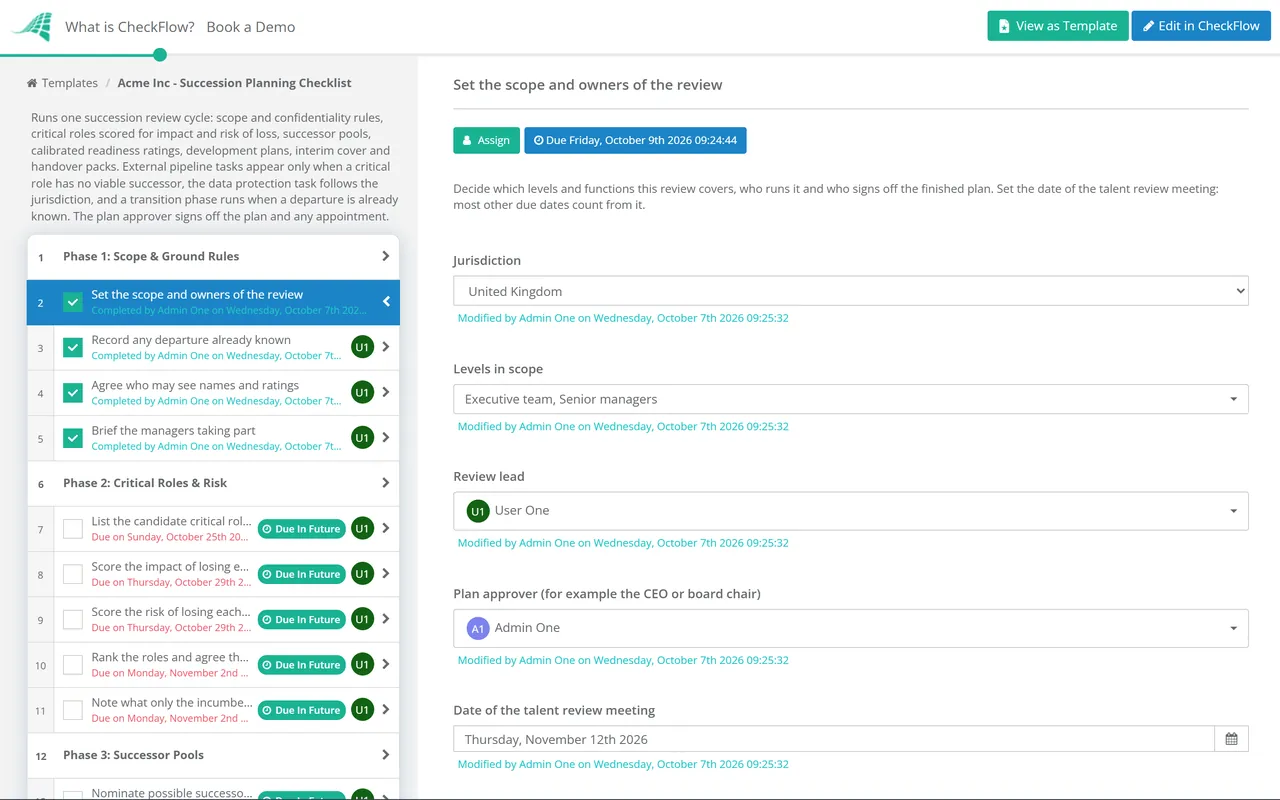
Phase 1: Scope & Ground Rules
Set the scope and owners of the review — roles in scope, review lead, plan approver and jurisdiction
Record any departure already known — resignation, announced retirement or long absence, with the date
Agree who may see names and ratings — a short list, one storage location and a retention period
Brief the managers taking part — the rating definitions, the evidence expected and common biases
Phase 2
Phase 2: Critical Roles & Risk
List the candidate critical roles — leadership posts plus rare skills, key relationships and single points of failure
Score the impact of losing each role — what stops, slips or costs money if the seat is empty
Score the risk of losing each incumbent — from known facts, never from age or health assumptions
Rank the roles and agree the priority list — high impact and high risk first
Note what only the incumbent knows — relationships, decisions and undocumented work
Phase 3
Phase 3: Successor Pools
Nominate possible successors for each priority role — from more than one manager and more than one team
Check how the slate was built — breadth of background, lateral moves and people outside the obvious line
Ask each candidate about their career goals — directly, and without promising the role
Gather evidence on experience and gaps — results, scope handled and what the role would demand
Phase 4
Phase 4: Readiness & Calibration
Rate each successor’s readiness — ready now, ready in 1–2 years or ready in 3+ years
Calibrate the ratings in a talent review meeting — one standard across managers, with each rating challenged
Use the 9-box grid only as a discussion aid — never as a label that follows someone
Check that no role rests on a single heir — aim for two or more names at different stages
Record whether any critical role has no viable successor
Phase 5
Phase 5: Development & Interim Cover
The two external pipeline tasks show only when a critical role has no viable internal successor.
Agree a development plan with each successor — stretch work, exposure, mentoring and a review date
Name interim cover for every critical role — who steps in tomorrow, and with what authority
Build a handover pack for each critical role — contacts, recurring decisions, systems and open commitments
Map external talent for roles with no successor — where the skills exist and how you would reach them
Decide whether to hire ahead or redesign the role
Phase 6
Phase 6: Sign-Off, Data & Review
The access request task is shown for the United Kingdom and the state privacy task for the United States.
Approve the succession plan — by the plan approver picked at the start
Store the plan with restricted access — and diary its deletion date
Prepare for access requests about talent data (UK)
Check state privacy law for talent data (US)
Schedule development check-ins and the next review — at least once a year
Phase 7 — If a Departure Is Known
Phase 7: Transition
Shown when a departure is already known at the start of the review.
Approve the interim or permanent appointment
Run the handover with the outgoing holder — the handover pack, introductions and a shadowing period
Announce the change to the team and key contacts
Start the successor’s onboarding into the role — goals, support and a 90-day check-in
Backfill the successor’s previous role — and add it to the next review
A readiness rating is a judgement about one person and one role, not about the person in general. Someone can be ready now for one director post and years away from another. Write the definitions into the template so that every manager means the same thing, and ask for evidence behind each rating rather than a feeling.
Rating
What it means
Evidence to look for
Typical development
Ready now
Could take the role today with normal onboarding support
Has covered the role, or done work of the same scope and complexity
Keep them close to the role: deputising, key meetings, decision rights
Ready in 1–2 years
One or two clear gaps that experience can close
Strong results in the current role; the gaps can be named
A stretch assignment or project that closes the named gap
Ready in 3+ years
Right direction, but needs a bigger role first
Growing scope, learning quickly, has said they want this path
Can hold the role safely for a few weeks or months, not permanently
Knows the work and the people; has deputised before
A written handover pack and agreed limits on authority
Score the risk side in the same plain way. Rate the impact of losing each role as high, medium or low by asking what would stop, what would slip and what it would cost. Rate the risk of losing its holder from what you actually know: an announced retirement, a stated wish to move on, an external approach they have mentioned. Roles that are high on both get successors and interim cover first. A role that is high impact but low risk still needs interim cover, because nobody can plan for illness or an accident.
Where it helps
The 9-box as a conversation
Puts performance and potential on one page, so the group talks about both
Exposes disagreement between managers about the same person
Shows where the organisation has strong performers and few people with room to grow
Gives a starting point for each development conversation
Where it misleads
The 9-box as a verdict
“Potential” is a prediction, and often a guess about who resembles today’s leaders
Last year’s performance rating drags the potential score with it
A box placement can stick to someone long after it stops being true
People in part-time roles or on leave are easily rated down for being less visible
It says nothing about readiness for a specific role
Why Run Succession Planning in CheckFlow?
1
A review that comes round again
Put the template on a recurring schedule and the next cycle starts on its own, with due dates set from the start date. Development check-ins are tasks with owners, so the plan does not wait twelve months for its next look.
2
Steps that fit the situation
Answer that a departure is known and the transition phase appears. Record a role with no successor and the external pipeline tasks follow. The plan itself is an approval task for the approver chosen at the start, and the checklist halts until it is signed off.
3
Progress you can see
Handover packs and development plans are uploaded to the task they belong to, with comments alongside. The audit trail shows who completed each step and when, and reports show which development actions are overdue across every review.
Succession planning is the regular process of identifying the roles an organisation cannot afford to leave empty, finding people who could fill them and developing those people before they are needed. It also covers what happens on the day a critical role empties unexpectedly. Done well, it reduces the cost and disruption of senior departures and gives capable employees a visible route to bigger roles.
Which roles need a succession plan?
+
Start with roles where losing the holder would hurt most and where a replacement would be hardest to find. That includes the senior team, but also specialist and relationship roles at any level, and any job one person has always done alone. Score each role for impact of loss and for risk of loss, then plan for the ones that score high on both. Every critical role needs interim cover, even if the risk of losing its holder looks low.
How many successors should each critical role have?
+
There is no fixed rule, but more than one. Two or three names at different stages of readiness, for example one ready now and one ready in a year or two, mean the plan survives if a successor leaves or changes direction. A single anointed heir tends to stop developing, discourages everyone else and leaves the role uncovered if they go.
Should employees be told they are on a succession plan?
+
Tell them about their development, not about their place on a list. Explaining that the organisation sees them growing into bigger roles, and agreeing a plan to get there, motivates people without promising a job that may not exist when the time comes. Keep the full plan, with names and ratings, to the few people who need it. In the UK and in California, employees may be able to request their own data, so write every note as if the person could read it.
Is the 9-box grid a good tool for succession planning?
+
It is a useful prompt for discussion and a poor basis for decisions. Plotting performance against potential helps a group compare views, but potential is hard to judge fairly, and placements tend to stick. Use it to start the conversation, then rate readiness for a specific role with evidence, and never pass a box placement on as a label.
How often should a succession plan be reviewed?
+
Run a full review at least once a year, and check progress on development plans more often, for example every quarter. Review a role straight away when something changes: a holder announces they are leaving, a successor moves or leaves, or a reorganisation changes which roles are critical.
Is CheckFlow free for this template?
+
14-day free trial, no card required. The Business plan is $10 per user per month after the trial. Full details at checkflow.io/pricing.
Know Who Steps In Before Anyone Steps Out
Free trial — no credit card required.
Do you like cookies? 🍪 We use cookies to ensure you get the best experience on our website. Learn more