Operational Due Diligence (ODD) Checklist Template

Review a fund manager’s operations before you commit: the DDQ, governance, valuation, cash controls, compliance, cyber and the service providers, confirmed directly, then an ODD rating and a monitoring date.

Last reviewed: November 2026

Printed from checkflow.io/templates/due-diligence/operational-due-diligence-checklist

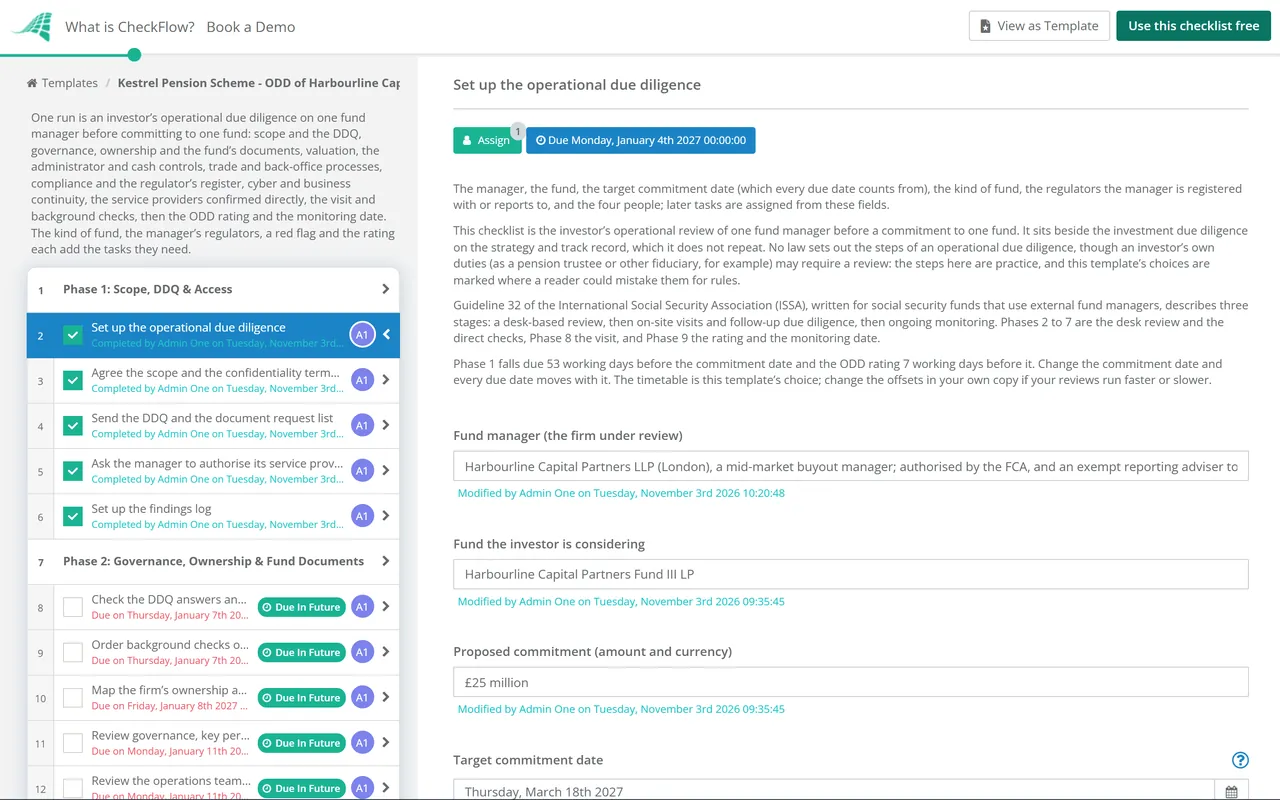
This free operational due diligence checklist is for investors, such as pension funds, endowments, family offices, funds of funds and their advisers, reviewing one fund manager before committing to one fund. One run covers one manager, with every due date counted back from the target commitment date. It sends the DDQ, reviews governance, ownership and the fund’s documents, the valuation policy, the administrator and cash controls, trade and back-office processes, compliance and the regulator’s register, cyber and business continuity, then confirms the service providers directly, holds the onsite or virtual visit and reviews the background checks. It ends with the ODD rating (approve, approve with conditions or reject) and the date of the next review. The kind of fund and the manager’s regulators add the tasks they need, and so do a red flag and the rating.

The Fund Manager’s Operations, Not a Company’s

Operational due diligence, or ODD, is the investor’s review of how a fund manager runs its business: who owns and controls it, how the fund’s assets are valued and its cash is moved, which service providers hold and check them, and whether the controls the manager describes work. It sits beside the investment due diligence on the strategy and the track record, and its rating can stop a commitment that the investment case supports.

Buyers of a company also use the phrase for their review of a target’s operations. That is a different job, with a company as the subject: the Private Equity Due Diligence Checklist and the M&A Due Diligence Checklist run it as one phase of the deal. The Management Due Diligence Checklist assesses a company’s own leadership team, not the firm that manages a fund.

A company’s leaders

Management due diligence

Covers: the executives of a business you are buying or backing: their track record, references, background checks, incentives and key-person risk, in the Management Due Diligence Checklist.

Ends: with a view on the team and a people plan for after the deal.

This checklist

Operational due diligence

Covers: one fund manager’s governance, fund terms, valuation, administrator and cash controls, trade and back office, compliance and its regulators, cyber and continuity, and its service providers, confirmed directly.

Ends: with an ODD rating before the commitment and the date of the next review.

What the Operational Due Diligence Checklist Covers

Nine phases take one fund manager from the DDQ, about ten weeks before the commitment, to the ODD rating and the monitoring date. The checklist halts at the rating in Phase 9. The first task’s answers add tasks for a private markets fund or a hedge fund and a register check for each regulator, and a red flag and the rating add their own.

  1. Phase 1 — about ten weeks before the commitment

    Phase 1: Scope, DDQ & Access

    5 tasks

    Start about ten weeks before the target commitment date. The first task names the four people and asks two questions: what kind of fund this is, and which regulators the manager is registered with or reports to. Every due date counts back from the commitment date, in working days.

    • Set up the operational due diligence — the manager, the fund, the target commitment date (which every due date counts from), the kind of fund, the regulators the manager is registered with or reports to, and the four people; later tasks are assigned from these fields
    • Agree the scope and the confidentiality terms with the investment lead — the firm and the fund in scope, any affiliated or sub-advisers, what the investment due diligence covers instead, whether an outside ODD provider does the work and its mandate in writing, the date the rating is needed, and the non-disclosure terms with the manager
    • Send the DDQ and the document request list — the due diligence questionnaire the investor uses, the list of documents wanted with the answers, and a date for the replies
    • Ask the manager to authorise its service providers to talk to you — a letter or email from the manager telling the administrator, the auditor, the custodian or prime broker and the fund’s counsel that they may answer the investor’s questions, with a named contact at each
    • Set up the findings log — one log of every finding with its area, rating, the manager’s answer and what is still needed, kept up to date until the ODD rating
  2. Phase 2 — weeks 1 and 2

    Phase 2: Governance, Ownership & Fund Documents

    8 tasks

    Read the DDQ answers, order the background checks early, then work out who owns and runs the firm, how decisions and conflicts are handled, and what the fund’s documents say about fees, expenses and investors’ rights.

    • Check the DDQ answers and the documents received — every question answered or explained, the documents that arrived, the ones still missing, and answers that differ from the manager’s presentation or earlier funds
    • Order background checks on the firm and its key people — the firm, its owners and the key people named in the fund’s documents: company records, court and regulatory records, media and sanctions searches, and the education and past employers in their biographies
    • Map the firm’s ownership and legal structure — who owns the management company and the general partner, any outside or minority owner and what rights it has, and each entity in the structure (management company, general partner, fund vehicles, feeder funds) with where it is set up
    • Review governance, key persons and succession — the management committee and other committees, who decides what, independent directors on the fund’s board where there is one, the key persons named in the fund’s documents and what happens if one leaves, and the succession plan
    • Review the operations team and the separation of duties — the chief operating officer, finance and operations staff, their backgrounds and how many there are for the size of the business, and who can trade or make investments, record them, value them and approve payments
    • Review conflicts of interest and how deals and costs are shared — the conflicts policy, how investment opportunities and co-investments are allocated between funds and accounts, how shared costs are split, transactions with related parties, and the conflicts the manager has disclosed
    • Review the fund’s terms and documents — the limited partnership agreement or offering documents and the subscription agreement: fees, carried interest or performance fee, the expenses the fund pays, the manager’s own commitment, key-person and removal terms, the advisory committee, reporting and transfer terms, and the side letters the manager says exist
    • Check the fund’s expenses against its documents — which costs the fund pays and which the manager pays, how shared costs are allocated, and a sample of recent fund expenses traced to what the documents allow
  3. Phase 3 — weeks 2 and 3

    Phase 3: Valuation, Administrator & Cash Controls

    5 tasks

    How the fund’s assets are valued and by whom, what the administrator does and does not do, who can move the fund’s money, and what the audited accounts say.

    • Review the valuation policy and who applies it — the written valuation policy, the valuation committee and its members, the methods for each type of asset, the part played by the administrator or an outside valuation firm, and how overrides are approved and recorded
    • Test the valuation of a sample of positions — for a few positions, the value reported to investors against the policy, the inputs and evidence behind it, and who approved it
    • Review the fund administrator’s role — whether the administrator is independent of the manager, what it does (the books, the net asset value or capital accounts, investor statements, checks on investors, payments), what the manager keeps in house, and the administrator’s independent controls report where it has one
    • Review cash controls and how payments are authorised — bank accounts held in the fund’s name, who can open accounts and move money, how many people must authorise a payment, call-back checks on new or changed bank details, the administrator’s part in releasing payments, and how money in and out from investors is handled
    • Review the books, the audited financial statements and the auditor’s opinion — the fund’s latest audited financial statements, the auditor’s opinion and any qualification, any recent change of auditor, and how long after the year end the accounts reached investors
  4. Phase 4 — week 4

    Phase 4: Trade & Back-Office Processes

    8 tasks

    How the fund’s investments are made, recorded, settled and reported. The kind of fund on the first task decides which tasks show: deal closing, capital calls and borrowing for a private markets fund, or trading, reconciliations, counterparties and redemptions for a hedge fund. Investor reporting applies to both.

    • Walk through how a deal is closed and funded — the approvals needed before a deal closes, who instructs the payment, how money moves from the fund to the seller or an escrow account, and how the fund’s ownership of the investment is recorded
    • Review the capital call and distribution process — how calls and distributions are calculated, checked, approved and sent, who checks the administrator’s figures, and how investors are told the bank details for a call
    • Review the fund’s credit facilities and borrowing — any subscription line or other borrowing by the fund, who may draw on it, what it is used for, and how its use is shown to investors
    • Walk through the trade lifecycle — how orders are placed, executed, allocated between funds and accounts, confirmed and settled, and who can change a trade after it is booked
    • Review the reconciliations of positions and cash — how often positions and cash are reconciled between the manager, the administrator and the prime brokers or custodians, who reviews the breaks, and how old the open ones are
    • Review counterparties, margin and trade errors — how prime brokers and trading counterparties are approved and monitored, who authorises margin and collateral moves, the trade error policy, and the recent errors and who paid for them
    • Review the redemption terms and liquidity management — notice periods, lock-ups, gates, side pockets and the power to suspend redemptions, how the manager matches the portfolio’s liquidity to them, and any time these terms were used
    • Review investor reporting — what investors receive and when (quarterly reports, capital account or account statements, the audited accounts), who prepares them, and how the figures are checked before they go out
  5. Phase 5 — week 5

    Phase 5: Compliance & the Regulator’s Register

    7 tasks

    Check the compliance programme, look the manager up on the public register of each regulator ticked on the first task, and ask about exams, lawsuits, anti-money laundering checks and insurance.

    • Review the compliance programme — the compliance officer, their reporting line and other roles, the compliance manual, the code of ethics, personal trading, gifts, inside information, the testing plan and the latest annual review
    • Check the manager’s Form ADV on the SEC’s adviser search — on the SEC’s Investment Adviser Public Disclosure site: whether the firm is registered or an exempt reporting adviser, its owners, its disciplinary disclosures, the private fund section with the service providers it lists, and, for a registered adviser, its brochure (Part 2A). An exempt reporting adviser completes only some items of Part 1A and no brochure
    • Check the manager and its people on the FCA register — on the FCA’s Financial Services Register: the firm’s status and permissions, the individuals shown for it, any disciplinary history, and that the details match the firm you are dealing with
    • Check the manager on its other regulators’ registers — the regulator named in the DDQ, the firm’s entry on its public register, the licence or registration type, and any public enforcement action
    • Review regulatory exams, lawsuits and investigations — the latest examination or inspection by each regulator and what it found, what the firm fixed, and past or pending lawsuits, investigations and regulatory actions against the firm and its people
    • Review anti-money laundering checks on the fund’s investors — who carries out the know-your-customer and anti-money laundering checks on the fund’s investors (the manager or the administrator), sanctions screening, and the anti-money laundering rules the firm and the fund fall under
    • Review the firm’s insurance cover — the types of cover the firm holds (the ILPA DDQ’s examples are fidelity bond, errors and omissions, directors’ and officers’ and cyber), the limits, who is covered and whether the fund or the manager pays the premiums
  6. Phase 6 — week 6

    Phase 6: Cyber, Technology & Business Continuity

    4 tasks

    How the firm protects its systems and data, what has gone wrong before, which systems and providers it depends on, and how it would keep running if its office or main systems were unavailable.

    • Review the cyber and information security policy — the policy and the standard it follows, who approved it and when it was last reviewed, independent testing of it, multi-factor sign-in and access controls, and the checks that stop a fraudulent payment request by email
    • Review cyber incidents and data breaches — incidents and breaches at the firm in recent years, what happened, who was told, and what changed afterwards
    • Review the main systems and technology providers — the portfolio, accounting and investor systems, spreadsheets that hold key figures, outsourced IT and cloud providers, and how the manager checks the providers it depends on
    • Review the business continuity and disaster recovery plan — the plan, the latest test and its results, cover for key people, and how the firm would keep investing, paying, valuing and reporting if its office or main systems were unavailable
  7. Phase 7 — weeks 7 and 8

    Phase 7: Service Providers Confirmed Directly

    5 tasks

    Hear from each service provider yourself, using contact details you have checked, and compare what they say with the DDQ, the fund’s documents and the regulator’s records.

    • Confirm the administrator’s role directly — that it is appointed to the fund, the services it provides, whether it releases or approves payments, whether it sends statements to investors, and anything it raises about the manager
    • Confirm the auditor’s appointment directly — the firm and office that audits the fund, the years it has audited, the opinion on the latest accounts, and its registration where the rules need one
    • Confirm the custodian or prime broker directly — which custodians or prime brokers hold the fund’s assets, that the accounts are in the fund’s name, and where a private fund’s ownership of its investments is recorded
    • Confirm the fund’s legal counsel — the law firms acting for the fund and the manager, what they advised on, and whether any of them also acts for investors in the fund
    • Compare the confirmations with the DDQ and the public records — every service provider named in the DDQ, the fund’s documents, the regulator’s records and the confirmations; a provider that differs or does not confirm goes in the findings log
  8. Phase 8 — weeks 8 and 9

    Phase 8: Onsite or Virtual Visit & Background Checks

    5 tasks

    Meet the people who run operations, finance, compliance and technology, see the controls work, review the background checks and references, send the follow-up questions, and record whether there is a red flag.

    • Plan the onsite or virtual visit — the date, whether it is in person or by video, who you meet (operations, finance, compliance, technology), the walkthroughs and samples you want to see, and the questions held back from the DDQ
    • Hold the visit and walk through the controls — meet the operations, finance, compliance and technology leads, see the main systems working, follow one payment, one valuation and one trade or capital call from start to finish, and check what you hear against the DDQ
    • Review the background check results — each result against what the firm and its people disclosed in the DDQ and the regulator’s records; anything not disclosed goes in the findings log
    • Take references on the manager — other investors in the manager’s funds, former colleagues and service providers, including at least one reference the manager did not name
    • Write up the visit and send the follow-up questions — the visit notes, the differences from the DDQ, the follow-up questions sent to the manager with a date for answers, the answers added to the findings log, and whether the review has found a red flag
  9. Phase 9 — weeks 9 to 12

    Phase 9: Findings, ODD Rating & Monitoring

    8 tasks

    Deal with any red flag, write the ODD report, get the rating before the commitment, and set the date and the triggers for the next review. Nothing after the rating task can be completed until it is done.

    • Escalate each red flag to the investment lead — what was found, where, why it matters, what the manager has been asked, and whether the commitment date needs to move
    • Ask the manager to fix or explain each red flag — the manager’s answer, the fix it offers and by when, the evidence that the fix is made, and whether the answer changes the rating of the finding
    • Write the ODD report — each finding by area with its rating and the manager’s answer, what is still open, the conditions proposed, the date of the information reviewed, and the recommended rating
    • ODD approver records the ODD rating — the approver reads the report and records approve, approve with conditions, or reject before the commitment; nothing after this task can be completed until it is done
    • Record the rejection and close the review — the reasons, the investment lead and the committee told, the manager told as agreed, the manager’s documents returned or destroyed under the non-disclosure terms, and the tasks that no longer apply marked not applicable
    • Agree the conditions with the manager — each condition the rating named, how it is met (a side letter term, a fix before the commitment, a report the manager will send), who checks it, and the manager’s agreement
    • Give the ODD rating to the investment committee — the rating, the conditions and how far each is met, the findings still open, and the report, with the investment team’s recommendation
    • Set the monitoring date and what to watch — the date of the next operational review, the events that bring it forward (a key person leaving, a change of administrator or auditor, a regulatory action, a breach, a qualified audit opinion), and the open conditions to follow up

What to Ask For and What to Confirm Yourself, Area by Area

The DDQ and the documents tell you what the manager says. The checklist then tests the main points against a sample, a public record or a third party. The table gives this template’s choices for each area; they are not a standard, and your own policy decides what matters.

Area What to ask the manager for What to confirm yourself Phase
Ownership and governanceThe structure chart, owners, committees, key persons and the succession planOwners and executive officers in the regulator’s records (Form ADV Schedule A for an SEC adviser)Phase 2
Fund terms and expensesThe partnership agreement or offering documents, the side letters, the expense allocation policyA sample of the last year’s fund expenses against what the documents allowPhase 2
ValuationThe valuation policy, the committee and its minutes, any outside valuation reportsA sample of positions: the value reported against the method and the evidencePhase 3
Administrator and cashThe administration agreement, its controls report, the bank mandates and signatoriesThe administrator’s role, in its own words; one payment followed at the visitPhases 3, 7, 8
Trading (hedge funds)The trade and reconciliation procedures, the trade error policy, the redemption termsA recent reconciliation and its open breaks; one trade followed at the visitPhase 4
Deals and capital calls (private markets)The funding approvals, sample call and distribution notices, credit facility termsOne deal funding and one capital call followed at the visitPhase 4
Compliance and regulatorsThe compliance manual, the annual review, the latest exam findings, lawsuitsThe manager’s entry on each regulator’s public registerPhase 5
Cyber and continuityThe security policy, the latest independent test, the incident list, the continuity planThe systems seen working at the visit; the test results and their datePhase 6
Service providersThe names of the administrator, auditor, custodian or prime broker and counselEach provider directly, using contact details you have checkedPhase 7
PeopleBiographies of the key people and a list of referencesBackground checks and at least one reference the manager did not namePhases 2, 8

Where the template cites a source. Read on the official sites on 3 November 2026. The ILPA Due Diligence Questionnaire 2.0 (November 2021) is free; its user guide says it was developed with private equity managers and strategies as its reference point and that the industry is not required to use it. AIMA publishes DDQs for its members, first written for hedge fund managers. Guideline 32 of the International Social Security Association (ISSA), written for social security funds that use external fund managers, describes three stages: a desk-based review, on-site visits and follow-up, then ongoing monitoring. For US advisers, investor.gov says both parts of Form ADV are public on the SEC’s Investment Adviser Public Disclosure site, and Form ADV Part 1A asks about each private fund’s auditors, prime brokers, custodians, administrators and marketers. For the UK, the FCA says its Financial Services Register is a public record of firms, individuals and other bodies that are, or have been, authorised by the FCA or the PRA. Elsewhere, use the register of the manager’s own regulator.

Private markets fund or hedge fund? The questions are mostly the same, but the back office is not. A closed-ended private markets fund calls capital, funds a few large deals and may borrow against investors’ commitments, so the checklist follows a deal and a capital call. A hedge fund trades every day and lets investors redeem, so it follows a trade, the reconciliations, the counterparties and the redemption terms. The first task’s answer adds the right tasks.

Why Run Operational Due Diligence in CheckFlow?

1

The rating is recorded before the commitment

The ODD approver named on the first task is the only person who can complete the rating, and the checklist halts there: nothing after it can be completed until they record approve, approve with conditions or reject. Conditions add a task to agree them with the manager, and a reject adds a task to close the review. See how approvals that halt a checklist work.

2

The fund sets the checklist

A private markets fund adds deal funding, capital calls and borrowing; a hedge fund adds trading, reconciliations, counterparties and redemptions; each regulator the manager is registered with or reports to adds its register check; a red flag adds the escalation. Conditional logic keeps the rest out of the way.

3

Timed from the commitment date, owned by name

Enter the commitment date and every task falls due a set number of working days before or after it. Tasks go to the ODD lead, the investment lead and the legal and compliance reviewer named on the first task, and each sees their work in the Tasks Grid. Every review sits in the Reports Grid with its progress, and the monitoring date starts the next one.

CheckFlow runs the review: who does what and by when, the DDQ, the findings, the confirmations and the rating. It does not search registers, run background checks or contact service providers itself. Your team and advisers do that, and the checklist records what they found.

For due diligence in general, see the glossary. A manager setting up a new fund can use the Venture Capital Fund Formation Checklist; a buyer of a company uses the Private Equity Due Diligence Checklist, the M&A Due Diligence Checklist, the Venture Capital Due Diligence Checklist or the Purchase of a Business Checklist. For the ongoing review of a provider your own firm outsources to, see the Vendor Oversight Checklist, and for your own continuity plan the Business Continuity Plan Checklist.

AI generator

Didn’t find what you need? Describe it.

Describe the process in a sentence and the AI checklist generator drafts the phases and tasks for you.

Frequently Asked Questions

What is operational due diligence (ODD)?

It is an investor’s review of how a fund manager runs its business, as opposed to how it invests. It covers ownership and governance, the fund’s terms and expenses, valuation, the administrator and cash controls, trading or deal processes, compliance, cyber security, business continuity and the service providers. The aim is to find operational weaknesses that could cause a loss, whatever the strategy, and to rate the manager before the investor commits.

What should an operational due diligence checklist include?

This template has nine stages: scope, the DDQ and access to service providers; governance, ownership and the fund’s documents; valuation, the administrator and cash controls; trade and back-office processes; compliance and the regulator’s register; cyber and business continuity; the service providers confirmed directly; the visit and background checks; then the findings, the ODD rating and the monitoring date. The first task’s answers add tasks for the kind of fund and each regulator.

How is operational due diligence different from investment due diligence?

Investment due diligence asks whether the manager’s strategy, team and track record make the fund a good investment. Operational due diligence asks whether the business behind it is run safely: whether the assets are valued fairly, the cash is controlled, the service providers are real and independent, and the firm complies with its regulators. In this template ODD has its own rating, so a poor operational review can stop a commitment the investment team supports.

Does operational due diligence also mean the operational review in an M&A deal?

Yes, the phrase is used both ways. In a company acquisition, operational due diligence is the buyer’s review of the target’s processes, systems, suppliers and people. This template is the fund investor’s sense: one fund manager reviewed before a commitment. For a buyer reviewing a company, the Private Equity Due Diligence Checklist and the M&A Due Diligence Checklist include an operational phase on the target.

What is a DDQ in fund due diligence?

A due diligence questionnaire is the set of written questions an investor sends a fund manager, with a list of documents to provide. The ILPA DDQ 2.0, free from the Institutional Limited Partners Association, is built around private equity managers and covers 20 topics. AIMA publishes DDQs for its members, first written for hedge fund managers. Investors can add their own questions, and this template records which questionnaire was used.

Why confirm a fund’s service providers directly?

The administrator, auditor, custodian or prime broker and counsel are the independent parties who hold, record and check the fund’s assets and accounts. Hearing from each one yourself, using contact details you have checked, shows they are appointed, what they really do and whether they release payments or send investor statements. This template compares their answers with the DDQ, the fund’s documents and the regulator’s records.

How do you check a fund manager’s regulatory record?

For a US adviser, read its Form ADV on the SEC’s Investment Adviser Public Disclosure site: ownership, disciplinary disclosures, the private fund section that lists service providers and, for a registered adviser, the brochure (an exempt reporting adviser files no brochure). For a UK firm, look it up on the FCA’s Financial Services Register for its status, permissions and individuals, and watch for clone firms. Elsewhere, use the manager’s own regulator’s register. This template adds a task for each regulator ticked on the first task.

What counts as a red flag in operational due diligence?

This template’s examples include a service provider that will not confirm its role, one person who can both commit the fund and approve the payment, fund expenses the documents do not allow, a qualified audit opinion or an unexplained change of auditor, valuations the policy does not support, and a lawsuit, regulatory action or background finding the manager did not disclose. A red flag recorded at the Phase 8 write-up adds an escalation and a request to the manager.

How often should operational due diligence be repeated?

ISSA guideline 32 (written for social security funds) makes ongoing monitoring the third stage of operational due diligence, after the desk review and the visit, but the timing is each investor’s choice. This template ends by setting the date of the next review and the events that bring it forward, such as a key person leaving, a change of administrator or auditor, a regulatory action, a breach or a qualified audit opinion.

Is CheckFlow free for this template?

14-day free trial, no card required. The Business plan is $10 per user per month after the trial. Full details at checkflow.io/pricing.

Rate the Manager’s Operations Before You Commit

Free trial — no credit card required.

14-day free trial, no credit cardFull refund in your first 30 daysUS hosting, EU on request