
A senior leader is judged by the board, investors and their own team within weeks of arriving. If the introductions, the governance paperwork and the first-100-days plan are left to the executive’s own diary, the early impressions form before the plan does.
This free executive onboarding checklist is for chairs, CEOs, company secretaries and people leads bringing in a chief officer, managing director or other senior leader who reports to the CEO or the board. It treats the first hundred days as a stakeholder programme: a briefing pack before the start date, early time with the chair and committee chairs, structured interviews with investors, key customers, regulators and staff, a written authority to act, and a 100-day plan the CEO or chair approves. When the executive will be a statutory director or a public company officer, a formalities phase adds the filings, identity checks and dealing rules. Contracts and pre-start checks belong in the Preboarding Checklist. For a team leader or department head taking on direct reports for the first time, the New Manager Onboarding Checklist is the better fit.
Most of what an executive needs to learn in the first months sits outside the organisation chart. The board has views on why the previous person left. A major customer has a complaint that never reached the leadership meeting. An investor expects a strategy update at the next results. A regulator has an open action with the executive’s name now attached. None of this arrives through a standard induction, and much of it is only shared in a conversation that someone has to arrange.
So the checklist is built around four groups of people, each with an owner who makes the introduction and a set of questions that stays the same from one interview to the next. Consistent questions make the answers comparable, which turns forty conversations into a diagnosis the executive can test with the board. The sponsor, usually the CEO for a chief officer or the chair for a CEO, owns the programme and approves the plan that comes out of it.
Board
Chair & directors
Why this role, why now
How the board likes to be informed
What would count as success in a year
Inside
Peers & leaders
Where decisions really get made
What the previous holder left unfinished
Which teams are stretched
Capital
Investors & lenders
What they were promised
Which numbers they watch
Their concerns about the plan
Outside
Customers & regulators
Why they stay and what nearly made them leave
Open commitments and actions
Who they deal with today
What the Executive Onboarding Checklist Covers
Seven phases from the briefing pack to a day-100 review. The director and officer formalities, and the regulator approval task, are added only when the Phase 1 answers say the executive needs them.
Phase 1
Phase 1: Appointment & Pre-Start Briefing
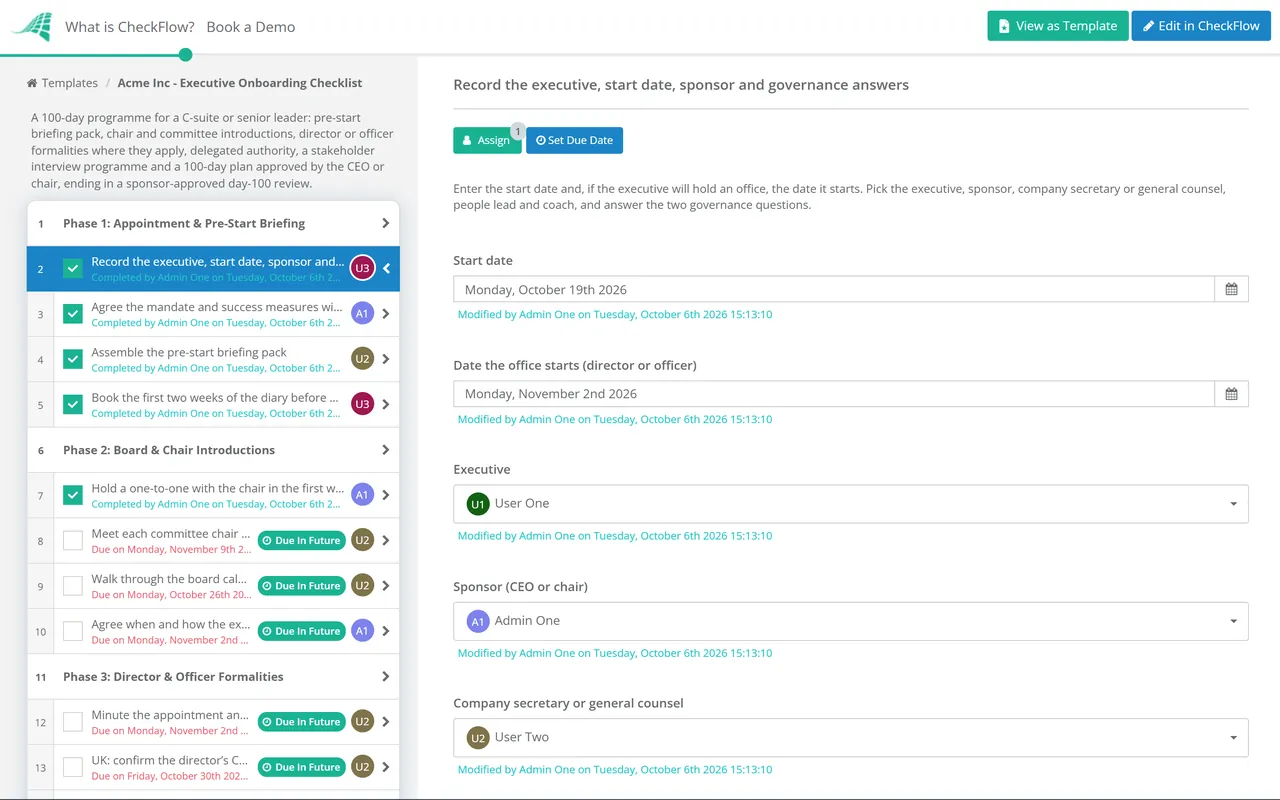
Record the executive, start date, sponsor and governance answers — plus the company secretary or general counsel, people lead and coach; whether the role is a statutory director or officer, and whether it needs regulator approval
Agree the mandate and success measures with the sponsor — what the board hired them to change and what must not break
Assemble the pre-start briefing pack — strategy, a year of board papers and minutes, financials, risk register and recent audit findings
Book the first two weeks of the diary before day one — chair, CEO, direct reports and the largest customer first
Apply for FCA or PRA approval before the start date — for a senior management function in a regulated firm, allowing time for the criminal record check and regulatory references
Phase 2
Phase 2: Board & Chair Introductions
Hold a one-to-one with the chair in the first week — expectations, how the board works and how the two will communicate
Meet each committee chair one to one — audit, remuneration, risk or their equivalents
Walk through the board calendar, reporting cycle and paper deadlines — including who drafts the executive’s papers in the first quarter
Agree when and how the executive first presents to the board
Phase 3 — If Director or Officer
Phase 3: Director & Officer Formalities
Shown when the executive will be a statutory director or a US public company officer. Process steps, not legal advice; the company secretary or general counsel owns them.
Minute the appointment and the executive’s consent to act — with the date the office starts, which can differ from the employment start date
UK: confirm the director’s Companies House identity verification — their personal code is needed on the appointment filing
UK: notify Companies House of the appointment within 14 days
UK: brief the director on the general duties and declare interests — Companies Act 2006 sections 171 to 177, including conflicts
US: file Form 3 within 10 days of becoming an officer — after setting up EDGAR access; it is due even if they own no shares
Add the executive to the dealing code, insider list and blackouts — for listed companies
Phase 4
Phase 4: Governance & Delegated Authority
Issue the delegated authority letter with financial limits — spend, contracts, hiring and settlements, and what goes back to the board
Confirm committee roles and the matters reserved for the board
Confirm D&O insurance cover and any indemnity in writing
Update bank mandates and contract signing authority
Hand over open risks, audit actions and regulatory commitments — each with an owner and a date
Phase 5
Phase 5: Stakeholder Interviews & Listening Tour
Agree the interview list with the sponsor — board, peers, investors, key customers, partners and regulators
Use one set of questions in every stakeholder interview — five or six, sent in advance
Brief the executive on disclosure rules before meeting investors — what counts as inside information and who from investor relations attends
Meet key customers, investors and regulators with their owner — the person who holds each relationship makes the introduction and attends
Visit sites and hold listening sessions with front-line teams
Write up the themes and share them with the people interviewed
Phase 6
Phase 6: First-100-Days Plan
The plan approval halts the checklist until the CEO or chair signs it off.
Draft the 100-day plan from the interview themes — diagnosis, priorities, early wins and what will not change
CEO or chair approves the 100-day plan
Present the plan to the board or executive committee
Assess the inherited leadership team before changing it — and agree the timing of any structural decision with the sponsor
Tell the organisation the priorities and what will not change
Phase 7
Phase 7: Coach, Sponsor & Day-100 Review
Support runs alongside the whole programme and ends in a second approval, from the sponsor.
Start the executive coaching programme — or agree how the sponsor will fill that role
Hold sponsor check-ins at days 30 and 60 — progress against the mandate and anything the sponsor should hear early
Collect structured feedback from the board, peers and reports — around day 90, with the same questions for each group
Most of the extra paperwork for a senior hire comes from holding an office rather than from being employed. A UK company director is a legal office with public filings and statutory duties. A US public company officer reports their shareholdings to the SEC within days of taking up the role. Several deadlines run from the appointment date, not the employment start date, so Phase 3 dates its tasks from the appointment. It describes the process; it is not legal advice.
Step
United Kingdom
United States
Recording the appointment
Board minute, then notice to Companies House within 14 days of the person becoming a director, including a statement that their identity is verified
Board resolution under the bylaws; a public company generally files a Form 8-K within four business days when it appoints a principal executive, financial, accounting or operating officer, or a director between shareholder meetings (Items 5.02(c) and (d))
Identity
Since 18 November 2025, a new director verifies their identity through GOV.UK One Login or an authorised corporate service provider and receives a Companies House personal code
Anyone filing on EDGAR has signed in with individual Login.gov credentials and multi-factor authentication since 15 September 2025
Duties
Seven general duties in the Companies Act 2006, sections 171 to 177, from acting within powers to declaring interests in proposed transactions
Fiduciary duties set by the law of the state of incorporation
Dealing in shares
At a company within UK market abuse rules, managers’ dealings are notified within three working days, with a 30-day closed period before results
Form 3 within 10 days of becoming an officer or director, even with no holdings; later changes on Form 4; listed companies disclose their insider trading policy
Regulator approval
In FCA- or PRA-regulated firms, senior managers need approval before starting, plus a Statement of Responsibilities
Depends on the sector; take advice for banks, insurers and other regulated firms
Liability protection
A company may buy insurance for its directors; most indemnities against liability to the company itself are void
Indemnification and insurance under state law, the bylaws and an indemnification agreement
Three of these rules have changed recently. Identity verification became a legal requirement on 18 November 2025, with existing directors verifying at their next confirmation statement during a 12-month transition. The FCA and PRA reforms of April 2026 changed the 12-week rule, which lets a firm cover an unforeseen or temporary senior manager vacancy, and further changes that need legislation are planned. UK market abuse law is also listed for revocation under the Financial Services and Markets Act 2023, as retained EU law is replaced by UK rules, so check the current text before a first dealing. Verify each point against its source before you act on it: Companies House identity verification, the FCA Senior Managers Regime and the SEC Form 3 instructions.
Why Run Executive Onboarding in CheckFlow?
1
Filings only where they apply
Two answers in Phase 1 decide what appears. A UK director gets the identity check and the Companies House notice, a US officer gets Form 3, and a senior hire who holds no office sees neither. Regulator approval appears only for a regulated senior management role.
2
Each introduction has an owner
The sponsor, company secretary, people lead and coach are picked once on the first task, and each introduction is assigned to the person who holds the relationship. Every due date counts from the start date, so the chair meeting lands in week one and the plan by day 60.
3
Two approvals and a record
The 100-day plan and the day-100 review are approval tasks, so the checklist pauses until the CEO, chair or sponsor signs each one. Filings, the authority letter and interview themes sit on the same record, with names and timestamps for the auditors and the board.
CheckFlow’s onboarding software runs the executive programme, the preboarding and the company induction as separate checklists, each with its own owner and record.
How is executive onboarding different from onboarding a manager?
+
A manager mainly needs to take over a team and learn the people admin that comes with it. An executive has to build relationships with the board, investors, major customers and sometimes regulators, often holds a legal office with filings and duties attached, and is expected to produce a plan for the business rather than for one team. The programme is longer and has a sponsor at board level.
How long should executive onboarding last?
+
Plan for about 100 days of structured activity, starting before the first day with the briefing pack. The listening work usually fills the first six to eight weeks, the plan is agreed after that, and the day-100 review decides whether anything needs more time. Board relationships take longer than that, so keep the sponsor check-ins going into the second quarter.
Who should a new executive meet in the first 100 days?
+
The chair and each committee chair, every peer on the leadership team, their own direct reports and the level below, the largest customers and partners, the main investors or lenders, and any regulator the role deals with. Add front-line visits so the picture is not built only from senior views. Agree the list with the sponsor so nobody important is left out.
What does a new UK director need to do at Companies House?
+
Since 18 November 2025 a new director has to verify their identity, through GOV.UK One Login or an authorised corporate service provider, and give the company their Companies House personal code. The company then notifies Companies House within 14 days of the appointment, with a statement that the director’s identity is verified. Directors appointed earlier verify when the company files its next confirmation statement.
When must a new US public company officer file Form 3?
+
The SEC’s Form 3 instructions say it must be filed within 10 days after the person becomes an officer or director, and that a person with no holdings still files and says so. Filing is on EDGAR, which now requires individual Login.gov credentials, so set up access as soon as the appointment is agreed. Later changes in holdings are reported on Form 4.
Should a new executive have a coach?
+
A coach often helps in the first months, because a senior leader has few people inside the business they can think aloud with. A coach is not a substitute for the sponsor, who still owns the programme and the approvals. If there is no budget for a coach, ask an experienced non-executive director or a peer from outside the reporting line to play that part.
Is CheckFlow free for this template?
+
14-day free trial, no card required. The Business plan is $10 per user per month after the trial. Full details at checkflow.io/pricing.
Bring Senior Leaders In With a Plan the Board Has Seen
Free trial — no credit card required.
Do you like cookies? 🍪 We use cookies to ensure you get the best experience on our website. Learn more