
Venture Capital Due Diligence Checklist Template

A structured framework for evaluating every material aspect of a potential investment — from founding team to exit pathway.

In venture capital, a compelling pitch deck is the opening act. The real work — and the difference between a successful investment and a costly mistake — is what happens in due diligence. With global VC funding reaching $120 billion across 4,000 deals in late 2024, the volume of opportunities requiring rigorous evaluation has never been higher. A structured due diligence process ensures that team quality, market dynamics, product robustness, financial health, legal exposure, and commercial traction are all systematically assessed — and that nothing material is missed because a work stream was not assigned, a document was not requested, or a deadline was allowed to slip. This free VC due diligence checklist gives investment teams a structured framework for every stage of the diligence process, from initial screening through to investment committee and term sheet.

Use This Template Free See Live Example
No Credit Card Required

Why Structure Is the Most Important Variable in Due Diligence Quality

Most due diligence failures are not failures of expertise — they are failures of process. The legal team did not see the employment contracts before the term sheet was signed. The cap table discrepancy was in the data room but nobody was assigned to review it. The technical debt in the core product was flagged by the engineer but not documented in the investment memo. These are not failures of intelligence or diligence — they are the predictable consequences of a process run without a structured checklist across coordinated work streams.

For founders, the same principle applies from the other side. A startup that has prepared systematically for due diligence — with all material documents organised, all known issues proactively disclosed, and all team members briefed on their responsibilities — will close rounds faster, at better terms, and with greater investor confidence than one that treats diligence as an adversarial process to survive. A due diligence checklist is as valuable as a preparation framework as it is as an investigation framework.

What the VC Due Diligence Checklist Covers

This checklist covers eight work streams that together constitute a comprehensive VC due diligence process. Work streams may run sequentially or in parallel depending on deal timeline and team structure. Each work stream should have a named owner within the deal team.

Phase 1

Initial Screening & Deal Setup

Initial screening filters the pipeline against investment thesis fit before full diligence resources are committed. Rigorously applied, it saves significant time and preserves deal team capacity for the highest-potential opportunities.

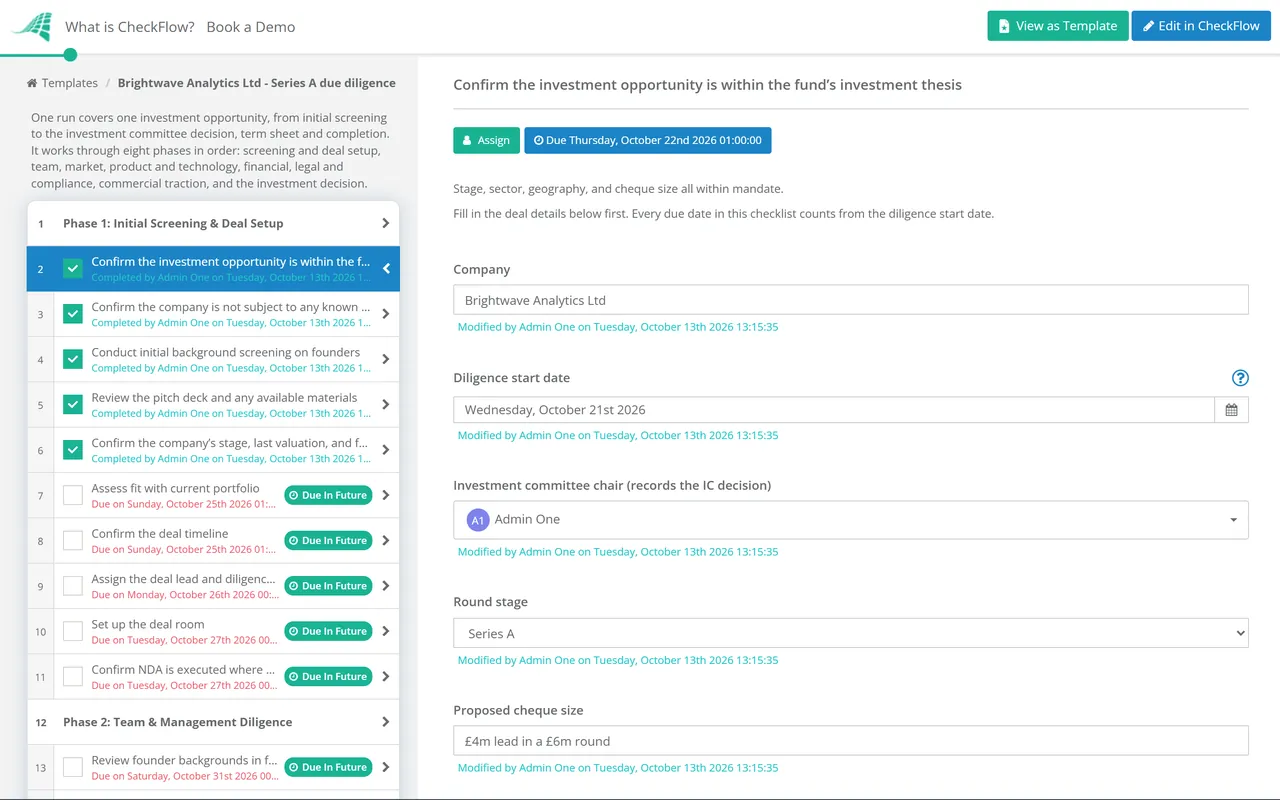
  • Confirm the investment opportunity is within the fund’s investment thesis — stage, sector, geography, and cheque size all within mandate
  • Confirm the company is not subject to any known conflicts of interest — existing portfolio companies, personal relationships, or other considerations
  • Conduct initial background screening on founders — confirm no immediately disqualifying factors in public records, prior company history, or reference network
  • Review the pitch deck and any available materials — assess market opportunity, product concept, team composition, and traction at a preliminary level
  • Confirm the company’s stage, last valuation, and funding history — obtain cap table summary or last round term sheet
  • Assess fit with current portfolio — synergy opportunities and any potential conflicts or cannibalisation
  • Confirm the deal timeline — is there a round deadline, competing term sheets, or other timing considerations that affect the diligence schedule?
  • Assign the deal lead and diligence team — confirm roles for each work stream
  • Set up the deal room — CRM entry, diligence tracker, data room access, and document organisation
  • Confirm NDA is executed where required before accessing confidential materials
Phase 2

Team & Management Diligence

At early stage, team quality is frequently the primary investment thesis. At all stages, management execution risk is the most common cause of value loss. Assess with commensurate rigour.

  • Review founder backgrounds in full — education, prior employment, previous companies founded (successes and failures), and relevant domain expertise
  • Conduct reference checks on key founders and senior management — minimum three references per founder from former colleagues, investors, or customers; at least one back-channel reference not provided by the candidate
  • Assess founder motivations and commitment — confirm full-time dedication; identify any side commitments, advisory roles, or competing interests
  • Assess co-founder relationship dynamics — how long have they worked together? Have they been through adversity together? Are equity splits agreed and documented?
  • Review management team completeness — identify key missing roles for the company’s current stage and growth plan
  • Assess team depth below the founding layer — is the company over-dependent on one or two individuals?
  • Conduct background checks — confirm no adverse legal history, regulatory sanctions, or undisclosed material information
  • Review employment agreements for key personnel — confirm vesting schedules, non-compete and non-solicit provisions, and IP assignment clauses
  • Assess board composition and governance — is the board currently functional? Are there any governance risks?
  • Document team diligence findings — strengths, gaps, risks, and any conditions to be addressed in the term sheet
Phase 3

Market & Competitive Analysis

  • Validate the Total Addressable Market (TAM) — review the company’s methodology and sources; independently size the market using bottom-up and top-down approaches
  • Define and assess the Serviceable Addressable Market (SAM) — the portion of TAM the company can realistically serve given its model, geography, and go-to-market
  • Assess market growth rate — confirm the market is growing, the growth rate is credible, and the drivers of growth are structural rather than cyclical
  • Map the competitive landscape — direct competitors, indirect competitors, and potential substitutes; confirm the company’s competitive positioning is accurately characterised
  • Assess the company’s competitive moat — network effects, switching costs, proprietary data, brand, technology differentiation, or regulatory advantage; confirm it is durable and defensible
  • Evaluate market timing — is the company entering a market at the right time? Are there tailwinds or headwinds?
  • Assess regulatory environment — are there existing or anticipated regulations that affect the market or business model?
  • Identify the most credible competitive threats — large incumbents with adjacent capabilities, well-funded direct competitors, or structural changes that could erode the opportunity
  • Confirm the company’s go-to-market strategy is appropriate for the market structure and buyer behaviour
  • Document market diligence findings — opportunity size assessment, competitive position, key risks, and conviction level
Phase 4

Product & Technology Diligence

  • Review the product or service in detail — use the product; understand the core workflow and value proposition from a user perspective
  • Assess product-market fit evidence — retention data, NPS scores, qualitative customer feedback, and the strength of evidence that the product solves a real, recurring problem
  • Review the technology architecture — engage a technical advisor or specialist for deep technical diligence where the fund does not have in-house capability
  • Assess technology scalability — can the current architecture support 10x or 100x current usage? What is the estimated cost to scale?
  • Review the product roadmap — assess feasibility, prioritisation rationale, and resourcing against current team capacity
  • Identify technical debt — quantify and assess materiality; is it manageable within existing resources or a significant capital requirement?
  • Review intellectual property — patents filed or granted, trade secrets, copyright ownership; confirm all IP is fully owned by or assigned to the company
  • Assess third-party technology dependencies — key vendors, open-source components with licence implications, and single points of failure
  • Review cybersecurity and data practices — data storage, access controls, incident history, and compliance with applicable privacy regulations
  • Document technical diligence findings — architecture assessment, IP status, key risks, and any recommended conditions
Phase 5

Financial Diligence

Financial diligence at early stage is as much about the quality of financial thinking as the historical numbers. Assess the founders’ financial literacy and the robustness of assumptions, not just the outputs.

  • Review historical financial statements — income statements, balance sheets, and cash flow statements for all available periods; confirm they are prepared by a credible accountant and audited where applicable
  • Review management accounts and board packs — assess reporting quality and the frequency and depth of financial monitoring
  • Analyse key unit economics — customer acquisition cost (CAC), lifetime value (LTV), LTV:CAC ratio, payback period, gross margin, and contribution margin per product or customer segment
  • Review revenue composition and quality — recurring vs non-recurring, customer concentration, contract lengths, and renewal rates
  • Review the financial model — assess assumptions for revenue growth, cost structure, hiring plan, and capital requirements; stress test key assumptions
  • Confirm cash runway — current cash position, monthly burn rate, and months of runway at current burn
  • Review the cap table in detail — confirm ownership percentages, option pool size and refresh, any convertible instruments, SAFEs, or outstanding warrants; confirm it is clean and consistent with prior round documentation
  • Review all prior funding rounds — confirm terms, valuations, investor rights, liquidation preferences, and anti-dilution provisions
  • Confirm tax position — any outstanding liabilities, R&D tax credit claims, transfer pricing issues, or deferred tax considerations
  • Document financial diligence findings — unit economics assessment, model quality, cap table summary, and key financial risks
Phase 6

Legal & Compliance Diligence

  • Engage legal counsel to conduct formal legal due diligence — confirm scope of legal review before work begins
  • Review corporate structure and governance documents — articles of association, shareholder agreements, board minutes, and any unanimous written consents
  • Review all material contracts — customer contracts, supplier agreements, partnership agreements, and any contracts with change of control clauses
  • Confirm all IP is properly assigned to the company — including IP created by founders prior to incorporation, freelancer or contractor contributions, and any open-source licence obligations
  • Review employment and contractor agreements — IP assignment, non-compete, non-solicit, and confidentiality provisions for all material employees
  • Confirm there are no outstanding or threatened legal proceedings — litigation history, regulatory investigations, or outstanding claims from former employees or partners
  • Review data protection compliance — GDPR, CCPA, or applicable local privacy regulations; confirm privacy policy, consent mechanisms, and data processing agreements are in place
  • Review regulatory status — any licences, permits, or regulatory approvals required to operate; confirm all are current and transferable
  • Confirm no material undisclosed liabilities — contingent liabilities, deferred revenue obligations, or off-balance sheet exposures
  • Document legal diligence findings — issues identified, conditions to be resolved, and any required representations and warranties
Phase 7

Commercial Traction & Customer Diligence

  • Review commercial metrics in detail — ARR or MRR, growth rate, net revenue retention (NRR), gross revenue retention (GRR), and monthly churn
  • Conduct customer reference calls — minimum three to five independent customer conversations; at least one back-channel reference not provided by the company
  • Assess customer concentration risk — what percentage of revenue comes from the top three to five customers?
  • Review the sales process and pipeline — pipeline size, conversion rates, average sales cycle, and win/loss rates
  • Assess go-to-market efficiency — sales and marketing spend relative to revenue growth; confirm the company is acquiring customers at a sustainable cost
  • Review channel strategy and partner relationships — are there material dependencies on a single channel or partner?
  • Conduct industry expert calls — engage independent sector specialists to validate market assumptions and competitive positioning
  • Review marketing content and positioning — confirm claims made to customers are supportable and no regulatory issues with marketing materials
  • Assess pricing strategy and sustainability — is pricing appropriate for the value delivered? Is there pricing power?
  • Document commercial diligence findings — revenue quality assessment, customer reference summary, growth efficiency, and key risks
Phase 8

Investment Decision, IC Preparation & Term Sheet

  • Compile the investment memo — synthesising all diligence work streams into a structured IC presentation covering thesis, opportunity, team, risks, and proposed terms
  • Prepare the diligence summary — key findings, open items, and any conditions to be addressed before closing
  • Confirm all material diligence items are resolved or documented as accepted risk before IC presentation
  • Present to the investment committee — structured presentation with diligence evidence; confirm IC questions and concerns are addressed
  • Confirm investment decision and any conditions — document IC outcome formally
  • Negotiate and issue term sheet — valuation, investment amount, liquidation preference, anti-dilution, board seats, pro-rata rights, information rights, and any conditions precedent
  • Confirm term sheet is signed before proceeding to legal documentation
  • Conduct final confirmatory diligence — any outstanding items from the diligence process that were deferred to post-term-sheet
  • Oversee legal documentation — shareholders’ agreement, subscription agreement, and any ancillary documents
  • Confirm completion — all conditions precedent satisfied, funds transferred, and new board composition confirmed

This checklist is available as a free, runnable template in CheckFlow — with tasks assigned across the deal team’s diligence work streams, progress tracked in real time from a single dashboard, and a complete documented record of every finding for the investment file.

Use This Template Free

The Checklist From Both Sides

VC due diligence is experienced very differently depending on which side of the table you are on. Both perspectives are addressed below.

For VC investment teams

The Investment Investigation Framework

The checklist is an investigation framework — ensuring that every material aspect of the investment opportunity is systematically assessed before capital is committed. A structured process protects the firm from investment losses caused by missed risk factors, incomplete information, or poorly documented decisions. It also creates an evidence trail for LPs and for post-investment accountability.

CheckFlow use: Assign each work stream to the relevant deal team member, track progress across all parallel workstreams in real time, and maintain a timestamped record of every finding and decision.

For founders preparing for VC diligence

The Preparation Framework

The same checklist is a preparation framework — a roadmap of exactly what an investor will examine and what they will want to see. Founders who have worked through this list proactively — clean data room, organised cap table, referenced employment agreements, customer contacts ready for reference calls — close rounds faster and with greater investor confidence than those who encounter these requests for the first time during the process.

CheckFlow use: Assign data room preparation tasks across the founding team, track which items are complete and which are outstanding, and share a progress view with the lead investor to demonstrate preparation quality.

Key Red Flags a Structured Diligence Process Is Designed to Surface

Not all red flags disqualify an investment — but all should be identified, documented, and either resolved or explicitly accepted before capital is committed.

Team

Founder reference checks that reveal material character or competence concerns. Undisclosed prior company failures or regulatory issues. Equity splits that were never formally agreed. Key technical or commercial roles vacant with no credible hire plan.

Market

TAM significantly smaller than the company represents. Market growth dependent on assumptions that are not structurally supported. Competitive moat that erodes on close inspection. A market that is being entered by a well-capitalised incumbent at the same time.

Product & Technology

Core IP not properly assigned to the company. Significant technical debt that would absorb a disproportionate share of the round. Architecture that cannot scale to the revenue model’s requirements without a major rebuild. Key person dependency in the engineering team.

Financial

Unit economics that do not improve with scale. Revenue that is inflated by one-off or non-recurring items. A financial model built on assumptions the founders cannot explain or defend. Cap table errors or inconsistencies between documents.

Legal

Litigation, regulatory investigations, or material claims that were not proactively disclosed. IP ownership that is unclear or disputed. Employee or contractor agreements that do not contain IP assignment clauses. Change of control provisions in material customer contracts.

Commercial

Customer reference calls that reveal significant product or service dissatisfaction. Revenue concentrated in one or two customers who are not committed long-term. NRR below 100% indicating net customer value is declining. Sales pipeline that is inflated or poorly qualified.

Why Run VC Due Diligence in CheckFlow?

CheckFlow manages the due diligence process — task coordination, tracking, and documentation across the deal team. It complements, but does not replace, specialist legal, financial, and technical advisors.

1

Coordinate parallel work streams without losing track

VC diligence runs multiple work streams simultaneously — legal, financial, technical, commercial, and team assessments all in progress at once, often with different advisors, across different timelines. CheckFlow assigns every task to the right deal team member or advisor, notifies them of their responsibilities, and gives the deal lead a real-time view of what has been completed and what is outstanding across every work stream simultaneously.


2

Nothing material is missed under timeline pressure

The most common due diligence failures happen when deal timelines compress and work streams are de-prioritised under pressure. CheckFlow’s enforced task structure and automatic reminders ensure that every item on the checklist is completed or explicitly documented as deferred and accepted risk — not silently skipped because the deal was moving fast.

3

A complete investment file for every deal

Every completed diligence task is logged with a timestamp and the name of the responsible analyst or advisor. The investment file — findings, open items, IC decisions, and conditions — builds automatically as the process runs. When LP reporting, portfolio reviews, or follow-on investment decisions require evidence of the original diligence rationale, the record is already there.

VC firms conducting diligence across multiple active deals simultaneously use CheckFlow to manage each deal as a separate checklist instance — all visible in the same grid dashboard, each at a different stage, each assigned to the relevant deal team. The same capability that helps MSPs manage multiple client processes applies directly to a multi-deal pipeline. See how CheckFlow handles multi-process visibility →

Venture capital due diligence is one of several structured due diligence processes in the CheckFlow template library. As additional due diligence templates are added to this series, they will appear in the related templates section below. View all due diligence templates →

Frequently Asked Questions

What is venture capital due diligence and what does it cover?

+

Venture capital due diligence is the systematic process by which a VC firm investigates a potential investment opportunity before committing capital. It covers eight primary work streams: team and management assessment (founder quality, reference checks, key person risk), market and competitive analysis (TAM validation, competitive moat, market timing), product and technology review (architecture, scalability, IP ownership, technical debt), financial diligence (unit economics, revenue quality, cap table, and financial model), legal and compliance review (corporate structure, IP assignment, contracts, regulatory status), commercial and customer diligence (traction metrics, customer reference calls, go-to-market efficiency), and investment decision preparation (investment memo, IC presentation, term sheet negotiation). The depth of each work stream is calibrated to the investment stage — seed diligence is lighter in financial and legal depth, heavier in team and market assessment; growth-stage diligence reverses this balance.

How long does VC due diligence typically take?

+

The timeline varies significantly by investment stage and firm process. Seed and pre-seed diligence often completes in two to four weeks for straightforward deals. Series A diligence typically takes four to eight weeks. Growth-stage and later-stage diligence — involving formal financial audits, extensive legal review, and multiple advisor work streams — can take eight to twelve weeks or longer. Competitive deal dynamics frequently compress these timelines, which is precisely why a structured diligence checklist with pre-assigned work streams is valuable — when the clock is running, having a defined process prevents important items from being skipped under time pressure.

What documents should founders prepare for VC due diligence?

+

Founders should prepare a comprehensive data room before approaching investors. Key documents include: corporate records (articles of incorporation, shareholder agreement, cap table, board minutes), financial statements and management accounts, detailed financial model with assumptions, all material contracts (customer, supplier, partner, employment), IP documentation (patents, assignment agreements, third-party licences), team information (CVs, employment agreements, equity vesting schedules), product and technology documentation (architecture overview, roadmap, technical debt assessment), and commercial metrics (ARR/MRR, retention rates, unit economics, customer list). Founders who maintain a well-organised, current data room throughout their company’s life — not just when a round opens — consistently complete diligence faster and with greater investor confidence.

What are the most common reasons deals fail in due diligence?

+

The most common deal-breakers in VC due diligence fall into five categories. First, team issues — reference checks that reveal material concerns about character, judgement, or competence that were not apparent in the pitch process. Second, IP ownership gaps — core intellectual property that was not properly assigned to the company, particularly IP created by founders before incorporation or by contractors without assignment agreements. Third, financial discrepancies — metrics presented in the pitch that do not hold up to detailed financial review, or a cap table that is inconsistent with prior round documents. Fourth, customer reference call findings — significant product or service dissatisfaction that was not reflected in the company’s NPS or churn figures. Fifth, undisclosed material issues — litigation, regulatory problems, or significant liabilities that were not proactively disclosed at the outset of the process.

What is the difference between VC due diligence and M&A due diligence?

+

Both processes share a common structure — financial, legal, commercial, and operational review — but differ significantly in depth, focus, and objective. VC due diligence is primarily a forward-looking assessment: evaluating the potential for the company to grow into its valuation and return the fund’s capital. It tolerates more uncertainty and incomplete information, particularly at early stage. M&A due diligence is more comprehensive and backward-looking: confirming the accuracy of everything represented in the purchase price, identifying all liabilities that transfer with the business, and ensuring the acquirer understands exactly what it is buying. M&A diligence involves more extensive legal and financial review, typically requires formal audited accounts, and is usually conducted with more advisors over a longer timeline.

Is CheckFlow free to use for this template?

+

You can start a free 14-day trial with no credit card required, giving you full access to all features including this template. The Business plan is $10 per user per month after the trial. Full details at checkflow.io/pricing.

Run Every Deal Through a Consistent, Documented Process

Free trial — no credit card required.