
M&A due diligence
Covers: commercial, financial, legal, tax, operational, people and ESG workstreams on one target, in the M&A Due Diligence Checklist.
Ends: with the decision on the deal and the integration plan.
Last reviewed: November 2026
No Credit Card Required
Printed from checkflow.io/templates/due-diligence/hr-due-diligence-checklist
This free HR due diligence checklist is for buyers of a company or a business, and the HR leads and employment counsel who review its people for them. One run covers one acquisition, with every due date counted back from the target signing date. It agrees the scope and how employee data is shared, checks the employee census against payroll, reviews contracts, restrictive covenants, pay, bonus and equity plans, benefits and pensions, contractors and worker status, claims, unions and HR compliance, and rates the key people and the culture. It ends with a costed findings log, the points for the price and the purchase agreement, the deal lead’s sign-off and the actions handed to integration. Where the target employs people (the UK, the US or both) and how the deal is structured add the tasks those rules need, and a defined benefit pension adds two more.
HR due diligence is the buyer’s review of the target’s workforce: who works there and on what terms, what they cost, what the buyer would inherit (claims, underpaid wages, pension deficits, misclassified contractors, missing right to work checks), and what keeping the right people and integrating the rest will take. Its findings go into the price, the warranties and indemnities, and the integration plan.
The M&A Due Diligence Checklist runs the whole deal, with people as one of its nine phases; this checklist is that phase in full. The Management Due Diligence Checklist assesses the leadership team, and the Legal Due Diligence Checklist the target’s contracts and disputes as a whole. After completion, the people actions move to the Post-Merger Integration Checklist, and a UK business transfer runs its statutory steps in the TUPE Transfer Checklist. To review your own company’s HR rather than a target’s, use the Human Resources Audit Checklist.
Covers: commercial, financial, legal, tax, operational, people and ESG workstreams on one target, in the M&A Due Diligence Checklist.
Ends: with the decision on the deal and the integration plan.
Covers: the target’s whole workforce: census, contracts, pay and incentives, benefits and pensions, contractors and right to work, claims, unions and compliance, key people and culture, for UK and US employees.
Ends: with costed findings, the HR points for the purchase agreement, a sign-off and a handover to integration.
Covers: the executives: track record, interviews, references, background checks, their contracts and key-person risk, in the Management Due Diligence Checklist.
Ends: with a view on the team and a 100-day people plan.
Nine phases take one target from the data request, about nine weeks before signing, to the sign-off and the handover to integration. The checklist halts at the deal lead’s sign-off in Phase 8. The first task’s answers add the UK or US tasks and a review for each other country, a defined benefit pension adds two tasks, and the sign-off decides what follows.
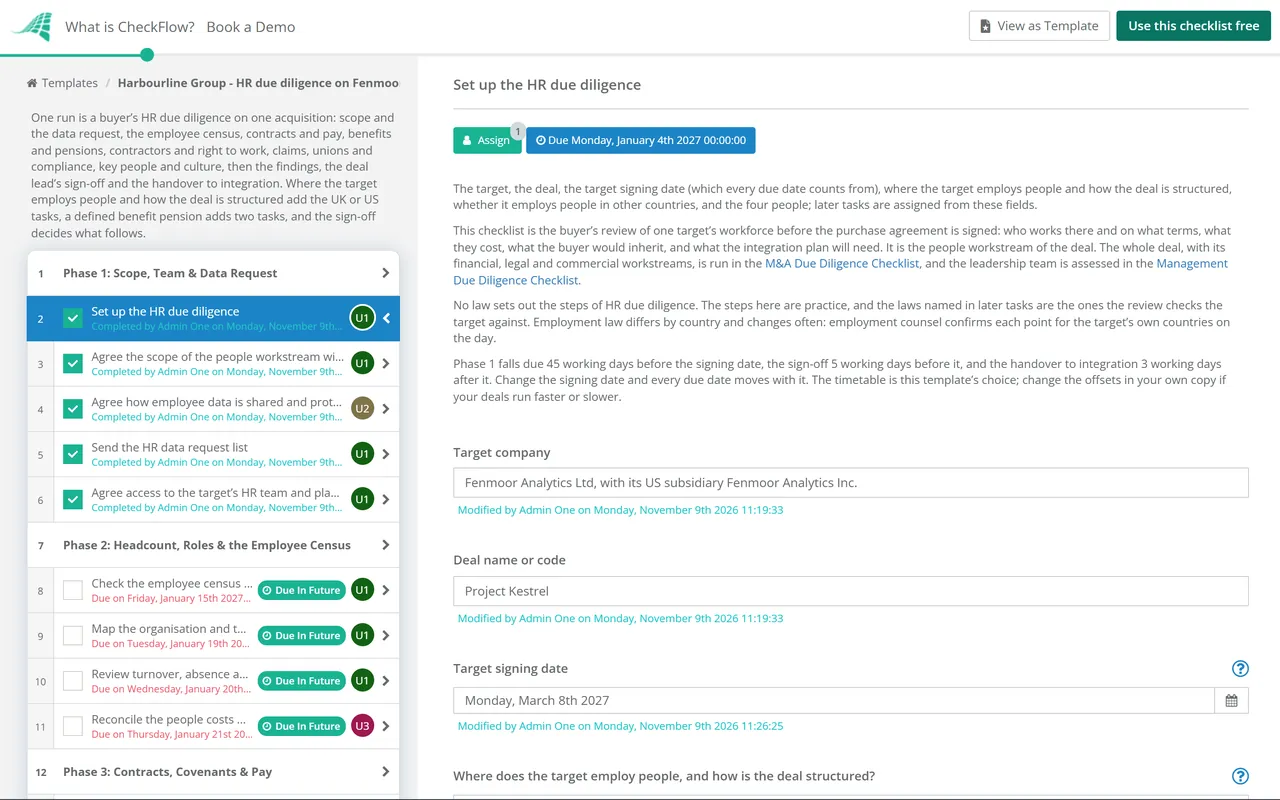
Start about nine weeks before the target signing date. The first task names the target, the signing date and the four people, and asks where the target employs people and how the deal is structured. Every due date counts back from the signing date, in working days.
Know who works for the target before you judge their terms: one census that matches payroll and the accounts, the organisation and the roles the deal depends on, and how the workforce has changed.
What each person is entitled to, what the deal itself triggers, and whether the target has paid people correctly. Employment counsel reads the contracts; the reward reviewer reads the plans.
Benefits and pensions can carry costs that last for decades. A defined benefit pension adds an actuarial view and a task on how the deal deals with it; the UK and US tasks follow where the target employs people.
People who are not on the payroll can still be the buyer’s liability, and people who are on it must be allowed to work. The UK and US tasks follow where the target employs people.
What could cost money or stop a plan: claims, complaints and investigations, the unions and agreements in place, the consultation and notice the buyer’s plans would need, and how well HR runs.
The people the deal depends on, how likely they are to stay, what it would take to keep them, and how the two workforces compare. The leadership team itself is assessed in management due diligence.
Turn the review into decisions: a rated findings log, a cost for each material finding, the points for the price and the purchase agreement, the report, and the deal lead’s sign-off. Nothing after the sign-off can be completed until it is done.
Check the HR terms in the final agreement, give the announcement plan its people facts, hand the actions to the integration team, and close the review data.
Most of the review is the same in any country. These are the points where the law differs, as the official sources put them on 9 November 2026. The first task’s answer adds the matching tasks.
| Area | UK | US | Phase |
|---|---|---|---|
| Who employs the staff after the deal | Share purchase: the target stays the employer. Asset purchase or business transfer: TUPE moves the staff to the buyer; run it in the TUPE Transfer Checklist | Stock purchase: the target stays the employer. Asset purchase or merger into the buyer: the staff move to a new employer | 1 |
| Right to work and sponsorship | A sponsor licence cannot be transferred: a new direct owner (by a sale of the controlling shares or a going-concern sale) needs its own licence. After a TUPE transfer, a fresh right to work check is advised within 60 calendar days. Since 1 October 2026 the checks also cover workers’ contracts and individual sub-contractors | Stock purchase: the forms stay with the target. Asset purchase or merger: keep the target’s Forms I-9 (with any errors on them) or complete new ones as for new hires | 5 |
| Defined benefit pensions | The Pensions Regulator’s contribution notices and financial support directions; voluntary clearance for type A events | Withdrawal liability for an employer that leaves a multiemployer plan | 4 |
| Pension and benefit plan duties | Automatic enrolment: the declaration of compliance, re-enrolment and re-declaration every three years | ERISA retirement and health plans and their yearly Form 5500 filings | 4 |
| Contractors and worker status | Employment status can differ in employment and tax law; the off-payroll working rules (IR35) for workers using their own company | The IRS common-law tests and Form SS-8; the Department of Labor’s rule has changed more than once | 5 |
| Restructuring after the deal | In Great Britain, consultation for 20 or more redundancies at one establishment within 90 days (30 or 45 days); an organisation-wide threshold from April 2027 | WARN Act: 60 days’ notice of a plant closing or mass layoff by an employer of 100 or more; on a sale, the seller gives notice up to the sale date and the purchaser after it | 6 |
| Recent changes | Employment Rights Act 2025 (Great Britain; Northern Ireland has its own law): six-month tribunal time limits (1 October 2026), the harassment prevention duty (30 October 2026), a six-month unfair dismissal qualifying period and no cap on the compensatory award (1 January 2027) | Check federal and state rules in force on the day | 6 |
The sources are the Home Office’s sponsor guidance and employer’s guide to right to work checks, the Pensions Regulator’s guidance, the government’s Employment Rights Act timeline, USCIS, the IRS, the Department of Labor, PBGC and the WARN Act itself. Employment law changes often and differs by state: employment counsel confirms each point for the target on the day. Employees in other countries get a local counsel review task.
The deal lead named on the first task is the only person who can complete the HR sign-off, and the checklist halts there: nothing after it can be completed until they record proceed, proceed with conditions or do not proceed on these terms. Conditions add a task to agree them, and a stop hides the signing and handover tasks. See how approvals that halt a checklist work.
UK employees add right to work and sponsorship, automatic enrolment and the Employment Rights Act 2025; a UK asset purchase adds TUPE; US employees add Form I-9, the WARN Act and benefit plan filings; other countries add a local counsel review, and a defined benefit pension adds two tasks. Conditional logic keeps the rest out of the way.
Enter the signing date and every task falls due a set number of working days before or after it. Tasks go to the HR lead, employment counsel, the reward reviewer and the deal lead named on the first task, and each sees their work in the Tasks Grid. Every deal’s review sits in the Reports Grid with its progress.
CheckFlow runs the review: who does what and by when, the census checks, the findings and the sign-off. It does not give legal advice, value pensions or run right to work checks. Your HR team, counsel and actuaries do that, and the checklist records what they found.
For due diligence in general, see the glossary. For the checks on one new hire, see the Right to Work Check Checklist; for a restructuring the plan needs after completion, the Redundancy & Layoff Process Checklist.
Describe the process in a sentence and the AI checklist generator drafts the phases and tasks for you.
It is the buyer’s review of a target’s workforce before an acquisition: headcount and roles, contracts and covenants, pay, incentives, benefits and pensions, contractors, claims, unions and HR compliance, and the people the deal depends on. The aim is to find the costs and risks the buyer would inherit, put a figure on them for the price and the purchase agreement, and give the integration plan what it needs.
This template has nine stages: scope and the data request; the employee census and organisation; contracts, covenants and pay; benefits and pensions; contractors, worker status and right to work; claims, unions and compliance; key people, retention and culture; the findings, deal points and sign-off; then signing and the handover to integration. The first task’s answers add the UK or US tasks.
In the UK, the ICO’s guidance says information shared for a prospective acquisition should be anonymised wherever possible, and that before a final decision the seller should only hand over workers’ personal information once assured the buyer will use it solely to evaluate the deal, keep it confidential and return or destroy it. This template starts with anonymised or pseudonymised data and records the terms.
In a share or stock purchase the target stays the employer, so its claims, records and liabilities stay with the company and the buyer takes them on by owning it. In an asset purchase the staff move to a new employer: in the UK under TUPE (see the TUPE Transfer Checklist), and in the US with new or continuing Forms I-9 and the WARN Act’s sale rule. The first task asks for the structure and adds the matching tasks.
A defined benefit scheme promises a level of pension, so a deficit can be one of the largest people costs a buyer takes on. In the UK the Pensions Regulator can issue contribution notices and financial support directions to employers and those connected with them, and offers voluntary clearance for events materially detrimental to a scheme. In the US, leaving a multiemployer plan can create withdrawal liability. This template adds an actuarial view and a task on how the deal deals with the scheme.
List every contractor, agency worker and consultant, then test the long-serving and full-time ones against how they really work. In the UK, employment status and the off-payroll working rules (IR35) decide rights and tax. In the US, the IRS weighs behavioural control, financial control and the relationship, and the Department of Labor has its own test. Record the exposure and the fix for each.
In the UK a sponsor licence cannot be transferred: the Home Office says a new direct owner, through a sale of the controlling shares or a going-concern sale, needs its own licence, with changes reported within 20 working days. After a TUPE transfer it advises a fresh right to work check within 60 calendar days. In the US, a stock purchase leaves the Forms I-9 with the target; after an asset purchase or merger, the new employer keeps the previous forms, with any errors, or completes new ones.
The WARN Act requires 60 days’ written notice of a plant closing or mass layoff by an employer of 100 or more employees, not counting part-time staff. On a sale of part or all of a business, the seller gives any notice due up to and including the sale date and the purchaser after it, and the seller’s employees (other than part-time employees) count as the purchaser’s immediately after the sale. Check state notice laws too.
Each material finding gets a cost and a treatment: a price change, a specific indemnity for a known matter such as a claim or a misclassified contractor, an HR warranty, a condition before signing or completion, or an action for integration. This template records them in a findings log, agrees the points with counsel and the deal lead, and checks them in the final agreement.
14-day free trial, no card required. The Business plan is $10 per user per month after the trial. Full details at checkflow.io/pricing.
14-day free trial, no credit cardFull refund in your first 30 daysUS hosting, EU on request