Human Resources Audit Checklist Template

A structured review of your HR policies, compliance, and processes — from documentation to employee relations.

An HR audit is how HR teams ensure their own house is in order. It evaluates whether your organisation’s HR policies are documented and current, whether employee records meet compliance requirements, whether your recruitment and onboarding processes are consistent, and whether your compensation, performance, and employee relations practices are both effective and legally sound. This free HR audit checklist template gives HR managers a structured way to run that evaluation consistently — as an annual internal review or a targeted compliance check. Use it as a reference or run it as a live, trackable checklist in CheckFlow — with tasks assigned to team members, every finding documented, and nothing overlooked.

Use This Template Free See Live Example
No Credit Card Required

What Is a Human Resources Audit Checklist?

A human resources audit checklist is a structured evaluation tool used by HR managers and HR directors to systematically assess whether their organisation’s HR policies, practices, records, and processes are compliant, consistent, and effective.

Unlike external compliance audits conducted by regulators or third parties, an HR audit is typically an internal exercise — an objective, structured review of how the HR function is operating, where gaps exist, and what needs to improve. According to SHRM, an HR audit involves “taking an intensely objective look at the organisation’s HR policies, practices, procedures, and strategies to protect the organisation, establish best practices, and identify opportunities for improvement.”

A well-conducted HR audit covers six core areas: HR compliance and documentation, recruitment and hiring practices, compensation and benefits, performance management, employee relations and culture, and health and safety. Each area has specific legal requirements — including FLSA, COBRA, ADA, FMLA, and applicable state and local employment laws — and operational best practices that the audit evaluates against.

For HR teams managing these reviews annually, a structured checklist ensures consistent coverage across audit cycles and produces a documented record of findings and remediation actions.

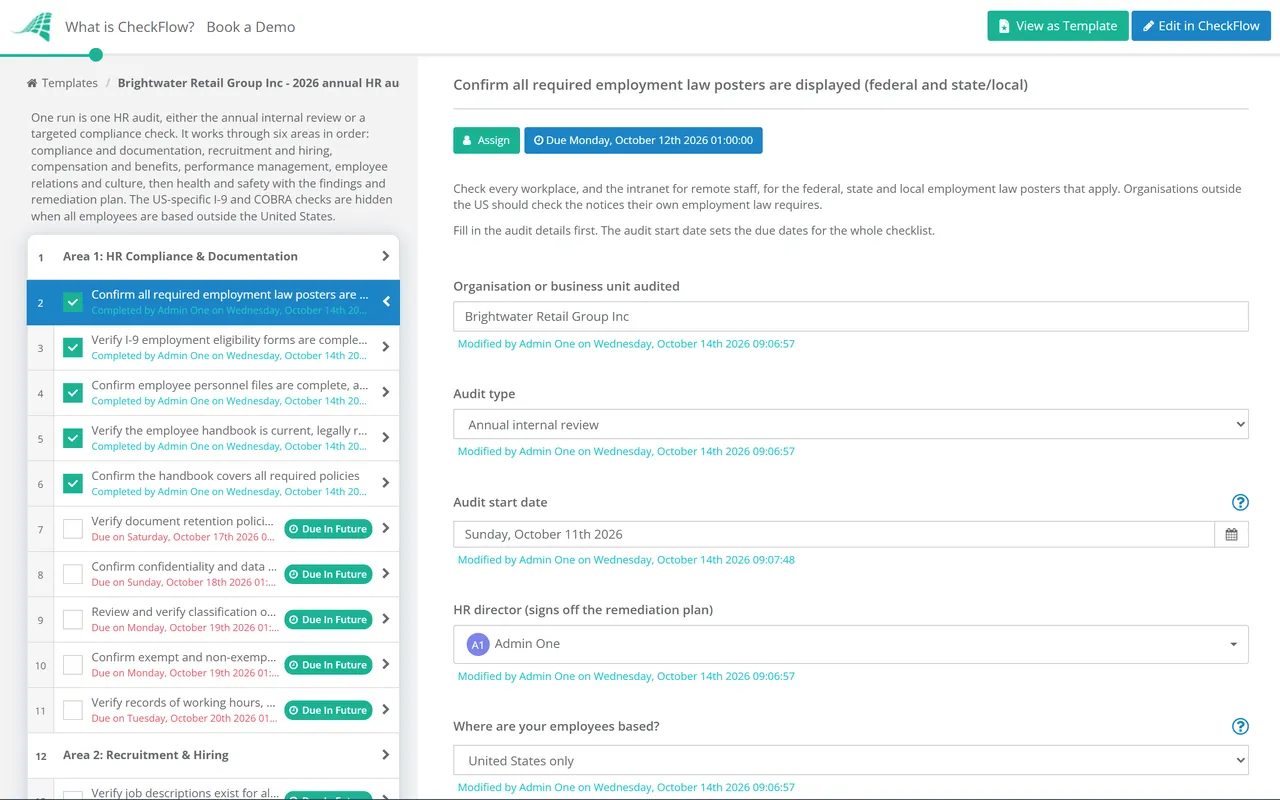
What the HR Audit Checklist Covers

This checklist is organised into six areas that together cover the full scope of a human resources audit. Each area can be reviewed independently or as part of a comprehensive annual HR audit.

Area 1

HR Compliance & Documentation

  • Confirm all required employment law posters are displayed (federal and state/local)
  • Verify I-9 employment eligibility forms are complete and correctly filed for all employees
  • Confirm employee personnel files are complete, accurate, and securely stored
  • Verify the employee handbook is current, legally reviewed, and distributed to all staff
  • Confirm the handbook covers all required policies — anti-discrimination, harassment, FMLA, ADA accommodations, social media, and code of conduct
  • Verify document retention policies are in place and being followed
  • Confirm confidentiality and data protection practices for employee records meet applicable requirements (GDPR, CCPA, or other)
  • Review and verify classification of employees vs. independent contractors
  • Confirm exempt and non-exempt employee classifications are correct under FLSA
  • Verify records of working hours, overtime, and paid time off are accurate and accessible
Area 2

Recruitment & Hiring

  • Verify job descriptions exist for all roles and are accurate, up to date, and ADA compliant
  • Confirm application forms do not include prohibited questions (age, national origin, disability, etc.)
  • Review interview process for consistency and compliance — confirm interviewers are trained on lawful interviewing practices
  • Verify background check and reference check procedures are documented and consistently applied
  • Confirm offer letter templates are legally reviewed and include all required terms
  • Assess onboarding process — are new hires receiving a consistent, structured experience?
  • Verify IT and HR onboarding checklists are in place and being run for every new hire
  • Confirm probation period policies and procedures are documented
  • Review time-to-hire data and identify bottlenecks in the recruitment process
  • Verify diversity and inclusion considerations are built into the hiring process
Area 3

Compensation & Benefits

  • Confirm all employees are paid at or above minimum wage requirements (federal, state, and local)
  • Verify overtime is calculated and paid correctly for non-exempt employees
  • Review pay equity across roles — identify any unexplained gaps by gender, ethnicity, or other protected characteristics
  • Confirm salary ranges for all roles are documented and consistently applied
  • Verify payroll processes are accurate and compliant with applicable tax requirements
  • Confirm benefits packages are documented and communicated clearly to all eligible employees
  • Verify COBRA notification procedures are in place and being followed when employees leave
  • Review leave policies — FMLA, sick leave, parental leave, and PTO — for compliance and consistency
  • Confirm employees are informed of their benefits entitlements during onboarding and at annual review
  • Verify workers’ compensation coverage is current and claims procedures are documented
Area 4

Performance Management

  • Confirm a formal performance review process exists and is consistently applied across the organisation
  • Verify performance review criteria are objective, role-specific, and documented
  • Review frequency of performance reviews — confirm reviews are being conducted on schedule
  • Confirm underperformance management procedures are documented and being followed consistently
  • Verify that performance improvement plans (PIPs) are documented, fairly applied, and legally reviewed
  • Confirm managers are trained on performance management and feedback best practices
  • Review goal-setting and OKR/KPI processes — are employee goals aligned with business objectives?
  • Verify records of performance reviews, PIPs, and disciplinary actions are retained in personnel files
  • Confirm the process for managing promotions and pay increases is documented and applied consistently
  • Review any outstanding or unresolved performance issues and confirm they have active management plans
Area 5

Employee Relations & Culture

  • Confirm a formal grievance and disciplinary procedure is documented and accessible to all employees
  • Verify all employees are aware of how to raise a grievance and what to expect
  • Review any open or recent grievance cases — confirm they have been handled correctly and documented appropriately
  • Confirm anti-harassment and anti-discrimination policies are current, communicated, and enforced
  • Verify managers are trained on handling workplace complaints and misconduct
  • Review exit interview data — identify any recurring themes around turnover reasons
  • Confirm a formal offboarding process is in place and consistently applied for all leavers
  • Review employee engagement data (survey results, eNPS) and identify action areas
  • Assess management effectiveness — are employees receiving regular feedback and support?
  • Confirm succession planning is in place for key roles
Area 6

Health, Safety & Remediation Planning

  • Verify health and safety policies are documented, current, and accessible to all employees
  • Confirm safety training has been completed for all roles with relevant health and safety requirements
  • Review accident and incident reporting procedures — confirm records are maintained correctly
  • Verify OSHA compliance requirements are met (or equivalent local regulatory requirements)
  • Confirm workplace risk assessments have been conducted and documented
  • Compile all audit findings across all six areas with severity ratings
  • Identify highest-priority compliance gaps requiring immediate remediation
  • Assign owners and target completion dates to each remediation item
  • Present findings to HR leadership and senior management
  • Document audit completion and schedule next annual review

This checklist is available as a free, runnable template in CheckFlow — with tasks assigned to HR team members and managers, findings tracked to remediation, and a complete record for every audit cycle.

Use This Template Free

Why Run Your HR Audit in CheckFlow?

1

Consistent coverage every audit cycle

Build the checklist once as a reusable template. Run a new instance for every annual HR audit — with the scope, assigned reviewers, and audit date pre-filled at launch. Every area is evaluated the same way, every year, regardless of who leads the review. Nothing gets skipped because it felt less urgent this cycle.

Template Designer
2

Assign areas to the right people

Each area of the audit can be assigned to the right HR team member — the HR manager handles compliance and documentation, the recruitment lead reviews hiring practices, the compensation specialist reviews pay equity. Everyone works through their section in parallel, with the HR director tracking overall progress from a single dashboard.

Auto-Assignments
3

Findings tracked from identification to remediation

Document each finding directly in the checklist, assign it an owner and a due date, and track it through to completion. Every remediation action is logged with a timestamp. When your next audit cycle begins, you have a complete record of what was found last time and what was done about it.

Audit Trail

The recruitment and onboarding area of your HR audit is a good moment to review whether your employee onboarding process is structured and trackable. CheckFlow’s onboarding templates give IT and HR teams a consistent, automated way to run onboarding for every new hire. Learn more about CheckFlow for IT onboarding →

Frequently Asked Questions

What is the purpose of an HR audit?

+

An HR audit is an internal review that evaluates whether your organisation’s HR policies, practices, records, and processes are compliant with applicable employment law, consistent across the organisation, and effective in supporting business objectives. According to SHRM, an HR audit involves taking an objective look at HR policies, practices, procedures, and strategies to protect the organisation, establish best practices, and identify opportunities for improvement. Regular HR audits help organisations identify compliance gaps before they become legal liabilities, standardise HR practices across departments, and improve the overall employee experience.

How often should an HR audit be conducted?

+

Most organisations conduct a comprehensive HR audit annually. Some HR teams take a phased approach — auditing HR compliance in year one, compensation and benefits in year two, and HR strategy in year three — to allow for more depth in each area. Targeted audits should also be conducted after significant organisational changes such as rapid growth, a merger or acquisition, or a change in employment law that affects existing policies. CheckFlow’s recurring checklist feature can schedule your HR audit automatically so it is never deferred.

Who should conduct an HR audit?

+

An HR audit can be conducted internally by the HR manager or HR director, or externally by an HR consultant or employment law specialist. Internal audits are more cost-effective and draw on existing institutional knowledge; external audits provide an independent perspective and may be preferable when the HR team lacks the time or expertise to audit objectively. For organisations conducting an internal audit, assigning different areas of the checklist to different HR team members — rather than having one person review everything — improves both efficiency and objectivity.

What employment laws does an HR audit typically check compliance with?

+

In the US context, a thorough HR compliance audit typically checks against the Fair Labor Standards Act (FLSA) for wage and hour compliance, the Family and Medical Leave Act (FMLA), the Americans with Disabilities Act (ADA), COBRA continuation coverage requirements, OSHA health and safety standards, Title VII and other anti-discrimination laws, and applicable state and local employment laws. Organisations in other jurisdictions should check against their own applicable employment law framework. CheckFlow’s template can be customised to add or remove tasks based on your specific compliance requirements.

Can I customise this HR audit checklist for my organisation?

+

Yes. CheckFlow’s drag-and-drop template designer lets you add, remove, reorder, or modify any task in the checklist. You can adapt the template to your organisation’s size, industry, and applicable legal requirements — adding jurisdiction-specific compliance checks, incorporating your existing HR policies by reference, or splitting the audit into focused sub-audits for different HR areas. Once customised, the template runs consistently for every future audit cycle.

Is CheckFlow free to use for this template?

+

You can start a free 14-day trial with no credit card required, giving you full access to all features including this template. The Business plan is $10 per user per month after the trial. Full details at checkflow.io/pricing.

Start Running Consistent HR Audits Today

Free trial — no credit card required.