FDA Inspection Readiness Checklist Template

The investigators are at reception, nobody is sure who should meet them, a routine record takes an hour to find, and the Form FDA 483 response misses the 15 business days FDA described at close-out.

Last reviewed: October 2026

This free FDA inspection readiness checklist is for heads of quality, regulatory affairs managers and site leaders at FDA-regulated sites that make drugs, biologics, medical devices or food. One run covers one inspection, from the readiness review to the closed inspection file. It starts with the site’s inspection history and open commitments, runs a mock inspection and closes the gaps it finds, then sets up the inspection team, the front and back rooms and the document request procedure. On the day, it covers credentials and the Form FDA 482, the opening meeting, escorts, the request log, daily meetings and the close-out. When a Form FDA 483 is issued, a response phase appears with the site head’s approval and the 15-business-day response. Choosing the product type and the type of inspection adds the matching steps, such as the device pre-announcement call or the application check for a pre-approval inspection.

Readiness, Hosting and the 483 Response Are One Process

Section 704 of the Federal Food, Drug, and Cosmetic Act lets FDA investigators enter and inspect a site that makes, processes, packs or holds food, drugs or devices, at reasonable times and within reasonable limits, once they have shown their credentials and given written notice. That notice is the Form FDA 482. FDA runs surveillance inspections to monitor compliance, pre-approval inspections as part of an application review, for-cause inspections when it has reason to believe there is a problem, and follow-up inspections after earlier violations. At the end, the investigators discuss what they found with management, and any significant objectionable conditions are written on a Form FDA 483.

A 483 is not a final agency decision. FDA weighs it with the Establishment Inspection Report, the evidence collected and the company’s response before it classifies the inspection and decides whether to act. That is why the work after close-out matters as much as the days on site.

This checklist covers one inspection by FDA, from readiness to the closed file. Your own internal audits test the quality system on your schedule; the ISO 9001 internal audit checklist shows that pattern. The CAPA checklist and the root cause analysis checklist run the corrective actions a 483 leads to. Hospitals preparing for an accreditation survey or a CQC inspection in England have their own regulators and methods, covered by the Joint Commission survey readiness checklist and the CQC inspection readiness checklist.

Before FDA arrives

Be ready on any working day

Covers: the inspection history, open commitments, a mock inspection, gap closure, the team, the front and back rooms and the request procedure.

Owned by: the inspection lead and the head of quality.

Output: a site that can find any record quickly and people who can explain their work.
On site

Host the investigators

Covers: credentials and the Form FDA 482, the opening meeting, escorts, the walk-through, every request logged and reviewed, daily meetings and the close-out.

Owned by: the inspection lead, the back room lead and the site head.

Output: a full record of what FDA asked for, was given and was told.

After close-out

Respond and close

Covers: the written response to any Form FDA 483 within 15 business days, corrective actions, the classification and the EIR.

Owned by: the head of quality, with the site head’s approval.

Output: commitments kept and a closed inspection file.

What the FDA Inspection Readiness Checklist Covers

Eight phases take one inspection from the readiness review to the closed file. The product type and the inspection type chosen on the first task add the matching steps. The annotation task and Phase 7 appear only when a Form FDA 483 is issued, and nothing after the site head’s approval of the response can be completed until it is given.

  1. Phase 1 — Readiness

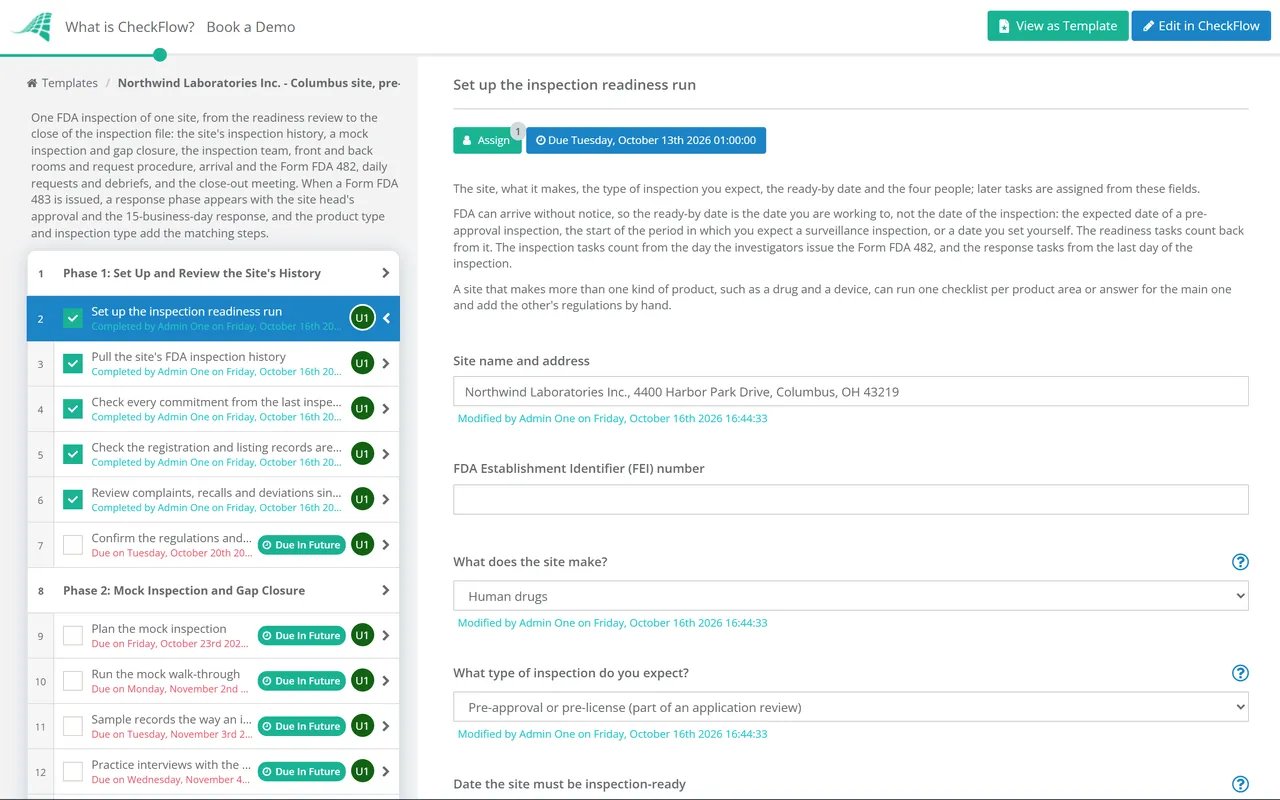
    Phase 1: Set Up and Review the Site’s History

    6 tasks

    Investigators read a site’s inspection history, complaints, recalls, registration and listing before they arrive. Read the same file first, and answer the two setup questions, because they decide which tasks appear.

    • Set up the inspection readiness run — the site, what it makes, the type of inspection you expect, the ready-by date and the four people; later tasks are assigned from these fields
    • Pull the site’s FDA inspection history — previous Establishment Inspection Reports, Form FDA 483s, your responses, any warning letters and the classification of each inspection
    • Check every commitment from the last inspection is complete — each correction promised in your last Form 483 response is done, still in place and backed by evidence
    • Check the registration and listing records are current — the establishment registration and product listings FDA holds match what the site makes, the operations it carries out and its address today
    • Review complaints, recalls and deviations since the last inspection — the trends, the open investigations and what was done about each one, because investigators review complaints and recalls before they arrive
    • Confirm the regulations and compliance program that apply — the CGMP or quality management system rules for your products and the FDA compliance program investigators will work from
  2. Phase 2 — Readiness

    Phase 2: Mock Inspection and Gap Closure

    8 tasks

    A mock inspection only helps if it is run the way FDA runs one: a walk-through first, then records, then the people who do the work, by someone who does not work in the area. The application check and the trigger account appear only for the inspection types that need them.

    • Plan the mock inspection — its scope, dates and the systems it covers, from the compliance program and the areas FDA cites most often for your product type, with mock investigators from outside the areas they inspect
    • Run the mock walk-through — the way investigators begin: housekeeping, the state of processes and equipment, staff practices, and the failure investigation, sampling, rework, returned goods and quarantine areas
    • Sample records the way an investigator would — pick batches or lots and follow each one through its production, testing, deviation, complaint and training records
    • Practice interviews with the people who do the work — operators, analysts and supervisors explain what they do and why, from their own procedures and records, not from a script
    • Log every gap with an owner and a due date — rank each one by its risk to the product, as investigators rank observations by significance
    • Check the application against the site — the facilities, processes, methods and data in the application match what the site does and the records it holds
    • Prepare your account of what triggered the inspection — the complaint, recall or earlier violations behind it, what you found, what you corrected and the evidence for each
    • Close or contain the high-risk gaps before the ready-by date — with evidence of each fix, and a dated plan for any gap that is still open
  3. Phase 3 — Readiness

    Phase 3: Inspection Team, Rooms and Procedures

    7 tasks

    On the day there is no time to decide who does what. Agree the roles, the rooms and the request procedure now and rehearse them once. The pre-announcement task appears for medical devices, and the advance records task for drugs, biologics and devices.

    • Name the inspection team and a deputy for each role — host, front room scribe, back room lead, runners, subject matter experts and the most responsible individual on site, on every shift
    • Set up the front room and the back room — a quiet room for the investigators with nothing else stored in it, and a back room near the records where requests are found, reviewed and copied
    • Write the arrival procedure for reception and security — who reception calls, where investigators wait, and the sign-in and safety rules they will be asked to follow
    • Set up the document request procedure — every request numbered and logged, each record reviewed before release, a duplicate of everything given kept, and confidential material marked
    • Brief staff on what to expect — answer the question asked, truthfully, from your own procedures; never delay, limit or refuse what FDA is entitled to see
    • Prepare for the pre-announcement call — FDA pre-announces domestic device surveillance and premarket inspections at least five calendar days ahead, with the start date, type, expected length and team size
    • Answer any records request FDA sends in advance — for drugs and devices, FDA can ask for records in advance of or instead of an inspection; send them within a reasonable time and keep a copy of what was sent
  4. Phase 4 — Day 1

    Phase 4: Arrival and Opening Meeting

    5 tasks

    The inspection starts when the investigators show their credentials and issue the Form FDA 482 to the most responsible individual on site. The date on the 482 drives the due dates in Phases 4 and 5.

    • Greet the investigators and call the inspection team — reception follows the arrival procedure, takes them to the front room and calls the host, the site head and senior management
    • Check credentials and receive the Form FDA 482 — the investigators show their credentials to the most responsible individual and issue a signed Notice of Inspection; record names and credential numbers, but do not photocopy or photograph the credentials
    • Hold the opening meeting — confirm the purpose, scope and type of the inspection, its expected length, working hours, the daily meeting and the contacts on both sides
    • Assign an escort to each investigator — someone who knows the area, stays with them, fetches the right expert and tells the back room what was asked
    • Lead the walk-through — investigators usually walk through early to plan the inspection; take the planned route, but go where they ask to go
  5. Phase 5 — Each Day

    Phase 5: Hosting the Inspection

    7 tasks

    Most of an inspection runs through requests: a question in the front room becomes a record found, reviewed and copied in the back room. Log every one, so the response team and the next inspection can see exactly what FDA was given.

    • Log every request and what was provided — request number, time, who asked, what was asked, what was given and when
    • Review each document before it goes to the front room — the right version, complete and legible, with a duplicate kept and confidential pages marked; never alter or create a record for the inspection
    • Scribe every question, answer and commitment — in the front room, word for word where it matters, so the back room and the response team know exactly what was said
    • Record the photographs and samples FDA takes — what was photographed or sampled, where and when, with your own matching photograph
    • Attend the daily meeting with the investigators — FDA discusses findings that may become observations at least once each inspection day; ask questions, ask for clarification and say what has been corrected
    • Hold the internal debrief at the end of each day — the day’s findings and requests, the corrections started, the requests still open and the plan for the next day
    • Correct what you can during the inspection — and show the investigator the evidence; a significant condition corrected during the inspection still stays on the Form FDA 483
  6. Phase 6 — Last Day

    Phase 6: Close-Out Meeting and Form FDA 483

    5 tasks

    At the close-out meeting the investigators read and discuss each observation with management and issue the signed Form FDA 483 before they leave. The close-out date drives the due dates from here, and the annotation task and Phase 7 appear only when a 483 is issued.

    • Prepare management for the close-out meeting — who attends, who speaks for the site, and the facts behind each finding discussed so far
    • Attend the close-out meeting and hear each observation — listen, ask for clarification of anything unclear and do not argue; the investigators explain the significance of each observation
    • Decide whether to annotate each observation — where FDA offers it, annotation is voluntary and records the status of each item on the 483, such as corrected and verified, or promised to correct by a date
    • Check the Form FDA 484 against the samples taken — investigators issue a Receipt for Samples at the end of the inspection for any physical sample removed; check it lists every one
    • Debrief the team and management the same day — what was said, every commitment made to FDA and who owns each one
  7. Phase 7 — If a 483 Is Issued

    Phase 7: Written Response to the Form FDA 483

    6 tasks

    Applies only when a Form FDA 483 is issued. At close-out the investigators tell management that an adequate response FDA receives within 15 business days of the end of the inspection may affect its decision on further action. Nothing after the site head’s approval can be completed until it is given.

    • Assign an owner to each observation — with the observation copied word for word from the 483
    • Investigate the root cause and scope of each observation — including related conditions FDA did not cite and other products, lines or sites that could be affected
    • Write the corrective and preventive actions with dates — for each observation: what was fixed, the change to the system, how effectiveness will be checked and a completion date
    • Draft the written response — one section per observation: what you understand it to mean, what you have done with evidence, what you will do and by when, and how you will check it worked
    • Site head approves the response — every action, date and commitment in it, before it is sent
    • Send the response within 15 business days of the last day — to the address on the Form FDA 483, with the evidence attached, and record the date it was sent
  8. Phase 8 — Follow-Up

    Phase 8: Commitments, Classification and Close

    6 tasks

    An inspection is not over until FDA classifies it and every commitment is closed. FDA classifies each inspection as NAI, VAI or OAI, taking into account the response to the Form FDA 483 and the corrective actions proposed or completed.

    • Hold a lessons-learned review — what worked in the front and back rooms, the questions you could not answer quickly, and the changes to procedures and training
    • Complete every commitment by its promised date — the actions in the response and anything promised at close-out, with evidence filed against each one and any updates the response promised sent to FDA
    • Check each corrective action is effective — re-sample records produced after the fix, and reopen the action if the problem comes back
    • Record the classification when FDA issues it — NAI, VAI or OAI, and any warning letter or other action that follows
    • Review the Establishment Inspection Report when FDA sends it — FDA sends the narrative part once it considers the inspection closed; note anything that differs from your own records
    • Site head closes the inspection file — commitments complete, the classification and EIR filed with the 482, 483, 484, request log and copies, and the readiness program updated for the next inspection

The Forms and Records of One FDA Inspection

Every FDA inspection produces the same short set of forms and records. The table shows when each one arrives and what to do with it. It is drawn from FDA’s Investigations Operations Manual 2026, section 704 of the FD&C Act, Field Management Directive 145 and FDA’s page on inspection classifications. Foreign inspections differ: no Form FDA 482 is issued outside the United States, although credentials are still shown.

Form or record When you get it What to do with it
Form FDA 482, Notice of InspectionOn arrival, after the investigators show their credentials, issued to the most responsible individual on site. One notice covers the whole inspection, not each day.Record the date, because the inspection starts there. Check that every investigator present has signed it; anyone who joins later issues a new one.
Records request in advance (drugs and devices)Before an inspection, or instead of one, under section 704(a)(4) of the FD&C Act. The request describes the records and the reason for asking.Send the records within a reasonable time, in electronic or physical form, and keep a copy. FDA confirms receipt.
Form FDA 483, Inspectional ObservationsAt the close-out meeting, signed, before the investigators leave. Each observation is read and discussed with management.Decide on annotation where FDA offers it. Send a written response with your corrective action plan; FDA tells management that an adequate response received within 15 business days may affect its decision on further action.
Form FDA 484, Receipt for SamplesAt the end of the inspection, for any physical sample removed from the site.Check it lists every sample. Records, labeling and photographs get no receipt, so log them yourself.
Establishment Inspection Report (EIR)Written by the investigators. FDA sends the redacted narrative to the site within 45 calendar days of deciding the inspection is closed.Compare it with your own notes and keep it with the inspection file.
Classification: NAI, VAI or OAIAfter FDA has weighed the findings, the EIR and your response.NAI: no objectionable conditions found. VAI: objectionable conditions found, but no action recommended. OAI: regulatory or administrative action recommended.

What FDA can see. For prescription and nonprescription human drugs and for devices, an inspection extends to everything bearing on whether products are adulterated or misbranded, including records, files, processes, controls and facilities. It does not extend to financial data, sales data other than shipment data, pricing data, personnel data other than the qualifications of technical and professional staff, or research data outside what the law requires to be reported (21 U.S.C. 374(a)(1)). Turning down a request for information the law does not require is not a refusal of inspection.

Delays count. For drugs and devices, delaying, denying, limiting or refusing an inspection, including delaying records without a reasonable explanation, can cause the product to be deemed adulterated under section 501(j). Plan the back room so records arrive quickly, and ask for time only for a reason you can explain, such as compiling a large volume of records or translating them.

Why Run FDA Inspection Readiness in CheckFlow?

1

No response leaves without the site head

The site head’s approval of the 483 response is assigned to them alone, and the checklist halts there. The response cannot be marked sent until every action, date and commitment in it has been approved. See how approvals that halt a checklist work.

2

Every request and commitment is on record

The request log, the scribe notes, the findings from each daily meeting and every commitment made to FDA sit on the tasks they belong to, with the 482, 483 and 484 attached. The Reports Grid shows each site’s inspection as tasks are completed, so senior management can follow it without calling the back room.

3

Dates that follow the inspection, not a guess

Readiness tasks count back from your ready-by date, the hosting tasks from the date on the Form FDA 482, and the response from the close-out date, so the 15 business days start on the right day. Choosing drugs, biologics, devices or food adds the matching steps. Change the offsets or add your own SOP steps in the template designer.

CheckFlow does not tell you whether your site complies with FDA regulations, and it is not legal advice or a document control system. It runs the readiness, hosting and response steps in the same order for every inspection, with a record of who did what and when.

This template covers one inspection by FDA. Run the corrective actions a 483 leads to with the CAPA Checklist and the Root Cause Analysis (8D) Checklist, audit your own quality system with the ISO 9001 Internal Audit Checklist and your suppliers with the Supplier Audit Checklist. Food sites can keep their HACCP plan current with the HACCP Food Safety Checklist, and the Annual Compliance Calendar Checklist keeps readiness reviews on a schedule. Running inspections across several sites? CheckFlow’s compliance checklist software keeps owners, evidence and sign-offs in one place.

AI generator

Didn’t find what you need? Describe it.

Describe the process in a sentence and the AI checklist generator drafts the phases and tasks for you.

Frequently Asked Questions

What is an FDA Form 483?

A Form FDA 483, Inspectional Observations, is issued to a company’s management at the end of an inspection when the investigators have seen conditions that, in their judgment, may violate the FD&C Act and related laws. Each observation is read and discussed at the close-out meeting. It is not a final agency determination and not a complete list of every problem: FDA weighs it with the Establishment Inspection Report, the evidence collected and the company’s response before deciding what to do. Companies are expected to correct both the cited conditions and related ones that were not cited.

How long do you have to respond to an FDA 483?

FDA’s Investigations Operations Manual tells investigators to advise management at close-out that an adequate response received within 15 business days of the end date of the inspection may affect FDA’s decision on further action. Count the days from the last day of the inspection, leaving out weekends and federal holidays. FDA encourages a written response with a corrective action plan that is then put in place quickly. A response that explains the root cause, the fix, the systemic change and how you will check it worked, with evidence, is more useful than a list of promises.

How do you prepare for an FDA inspection?

Start with what FDA already knows: your inspection history, open commitments, complaints, recalls and registration. Then run a mock inspection the way FDA runs one, starting with a walk-through, then sampling records and interviewing the people who do the work, and close the high-risk gaps it finds. Before the ready-by date, name the inspection team, set up a front room and a back room, write the arrival and document request procedures, and brief staff to answer truthfully from their own procedures.

What happens when FDA investigators arrive?

They ask for the owner, operator or agent in charge, show their credentials and issue a signed Form FDA 482, Notice of Inspection, to the most responsible individual on site. They explain the purpose of the visit and usually walk through the site early to plan the inspection. Management may examine the credentials and record their numbers but may not photocopy them. Investigators can sign in and follow your security rules, but are not authorized to sign waivers or confidentiality letters.

Does FDA announce inspections in advance?

Sometimes. Domestic medical device surveillance and premarket inspections are pre-announced at least five calendar days ahead, with the start date, type, expected length and team size, and foreign inspections are usually announced because of travel and access. Drug inspections may be pre-announced at the program division’s discretion, while FDA’s manual says it may generally be inappropriate to pre-announce inspections of food establishments. A pre-announcement is not an appointment, and FDA keeps its authority to inspect for cause without notice.

What do NAI, VAI and OAI mean?

They are FDA’s three inspection classifications. No action indicated (NAI) means no objectionable conditions or practices were found. Voluntary action indicated (VAI) means objectionable conditions or practices were found, but FDA is not prepared to take or recommend administrative or regulatory action. Official action indicated (OAI) means regulatory or administrative action is recommended. FDA decides the classification from the inspection findings and the information the facility provides afterwards, including its response to the Form FDA 483.

Can a company refuse an FDA inspection or a records request?

Refusing entry or access to records FDA is entitled to see is a prohibited act under the FD&C Act. For drugs and devices, delaying, denying, limiting or refusing an inspection can also cause the products to be deemed adulterated under section 501(j). The inspection does not extend to financial, pricing and most sales, personnel and research data, and declining to give information the law does not require is not a refusal. Ask for time only for a reason you can explain.

Is CheckFlow free for this template?

14-day free trial, no card required. The Business plan is $10 per user per month after the trial. Full details at checkflow.io/pricing.

Be Ready Before the Investigators Reach Reception

Free trial — no credit card required.

14-day free trial, no credit cardFull refund in your first 30 daysUS or EU hosting