
ISO 13485 Internal Audit Checklist Template

The internal audit reads the procedures back to their owners, nobody opens a complaint file, and the missed reportable event is found first by an FDA investigator, who can now read the internal audit report too.

Last reviewed: October 2026

This free ISO 13485 internal audit checklist is for quality managers, internal auditors and regulatory affairs teams at medical device manufacturers. One run covers one internal audit from the audit programme: the scope and criteria, independent and competent auditors, the document and medical device file review, the opening meeting, fieldwork by clause from the QMS to CAPA, graded findings, the closing meeting and the report. When the audit raises a nonconformity, the corrective action plan needs the quality manager’s approval before the actions and their verification can be completed. Choosing the US, Great Britain or the EU adds that market’s rules to the tasks they affect, and the device types and design scope add the matching tasks.

An ISO 13485 Internal Audit Tests the Device QMS, Not One Process

ISO 13485:2016 sets out quality management system requirements for organisations involved in the design, production, installation and servicing of medical devices. It is the third edition, published in March 2016, and ISO last reviewed and confirmed it in 2025. Compared with ISO 9001 it puts more weight on regulatory requirements, risk management and process validation, and it asks for things a general quality system does not have, such as a medical device file for each device type or family, complaint handling and reporting to regulatory authorities.

Regulators now build on it directly. In the United States, the Quality Management System Regulation (21 CFR part 820), effective 2 February 2026, incorporates ISO 13485:2016 by reference, and FDA investigators may now read internal audit reports, which the old regulation kept out of inspections. Article 10(9) of the EU Medical Devices Regulation requires a quality management system covering a list of aspects from regulatory strategy to CAPA, and the MHRA regulates the Great Britain market under the UK Medical Devices Regulations 2002.

This checklist covers one internal audit of a medical device QMS, by clause, with notes for the markets you supply. The ISO 9001 internal audit checklist audits one process of a general quality management system; use this one where the devices, their files and their regulators are in scope. Preparing for an FDA visit itself is covered by the FDA inspection readiness checklist, and the CAPA checklist runs larger corrective actions on their own.

Before fieldwork

Plan from the programme

Covers: the reason for the audit, objectives, scope and criteria, independent and competent auditors, earlier findings, the procedures and the medical device files to sample.

Owned by: the quality manager and the lead auditor.

Output: an audit plan the auditee manager has agreed.
Fieldwork

Audit clauses 4 to 8

Covers: the QMS and documentation, management responsibility, resources, product realisation from design to servicing, and measurement, analysis and improvement, with sterile, implantable and design tasks when they apply.

Owned by: the lead auditor, with regulatory affairs for anything reportable.

Output: objective evidence for every clause sampled.

After the audit

Report, approve, verify

Covers: graded findings, the closing meeting, the report, the corrective action plan, the quality manager’s approval and verification of effectiveness.

Owned by: the auditee manager, with the quality manager’s approval.

Output: closed findings and a complete audit record.

What the ISO 13485 Internal Audit Checklist Covers

Eight phases take one audit from its slot in the programme to verified corrective action. The market, the device types and design scope chosen on the first task add the matching notes and tasks. Phases 7 and 8 appear only when the audit raises a nonconformity, and nothing after the quality manager’s approval of the corrective action plan can be completed until it is given.

  1. Phase 1 — Plan

    Phase 1: Plan the Audit from the Programme

    6 tasks

    Each internal audit is one entry in your audit programme. Answer the setup questions first: the market, whether design and development is in scope and the device types decide which notes and tasks appear.

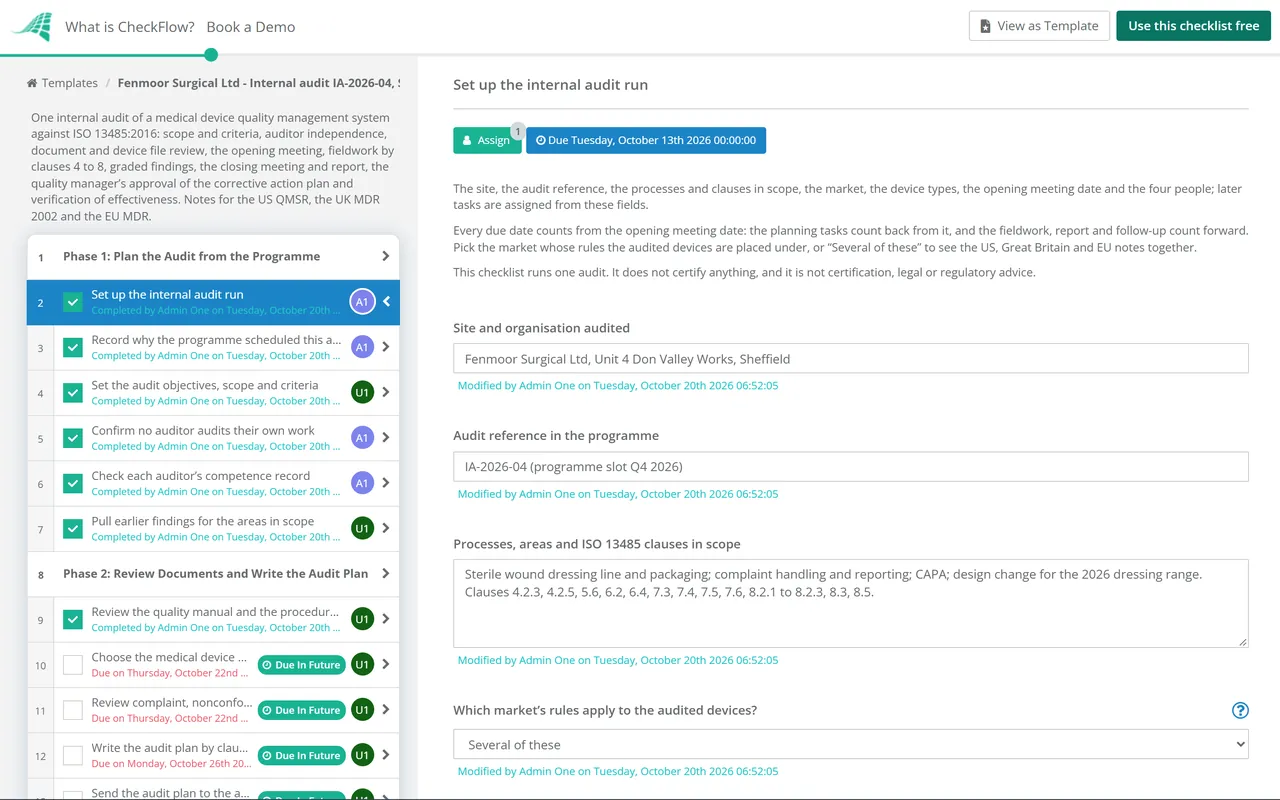
    • Set up the internal audit run — the site, the audit reference, the processes and clauses in scope, the market, the device types, the opening meeting date and the four people; later tasks are assigned from these fields
    • Record why the programme scheduled this audit now — the status and importance of the processes, the results of earlier audits, and any changes, complaints or nonconformities that brought it forward
    • Set the audit objectives, scope and criteria — ISO 13485:2016, the regulations of each market the devices are supplied to, your own procedures and any customer requirements
    • Confirm no auditor audits their own work — each auditor is independent of the processes they audit, and the record says how that was checked
    • Check each auditor’s competence record — training in auditing, knowledge of ISO 13485 and the regulations in scope, and enough technical knowledge of the devices and processes audited
    • Pull earlier findings for the areas in scope — the last internal audit, open corrective actions, and findings from certification body, approved or notified body, MDSAP or regulator audits and inspections
  2. Phase 2 — Prepare

    Phase 2: Review Documents and Write the Audit Plan

    5 tasks

    Read the documents before you go to the floor, so fieldwork tests what people do against what the procedures say. Choose the medical device files and the data trends to follow now.

    • Review the quality manual and the procedures in scope — check they are current, approved and cover the clauses in scope, and note what to test in fieldwork
    • Choose the medical device files to sample — one file per device type or family in scope, to compare in fieldwork with what is actually made, labelled and released
    • Review complaint, nonconformity and CAPA data since the last audit — trends, repeat problems and late actions become audit trails to follow in fieldwork
    • Write the audit plan by clause and process — who is audited when, which records are sampled and which auditor covers each clause group
    • Send the audit plan to the auditee manager — agree the times, the people who must be available and the records to have ready
  3. Phase 3 — Clauses 4 to 6

    Phase 3: Opening Meeting and Clauses 4 to 6

    9 tasks

    Clauses 4 to 6 cover the quality management system, management responsibility and resources. Sample real records and talk to the people who do the work, not only the managers.

    • Hold the opening meeting — confirm the objectives, scope, criteria and plan, how findings will be graded and when the closing meeting is
    • Audit QMS processes, outsourcing and QMS software — the processes and how they interact, the risk-based approach, control of outsourced processes and validation of software used in the QMS (clause 4.1)
    • Audit document and record control — approval and change of documents, obsolete versions, and how long records are kept and how they are protected (clauses 4.2.4 and 4.2.5)
    • Sample each medical device file against the device — the file contains or references what your procedures require for that device, and matches the current labelling, specifications and production records (clause 4.2.3)
    • Audit management commitment, quality policy and objectives — objectives are measurable, consistent with the policy and tracked, and top management’s part is evidenced (clauses 5.1 to 5.4)
    • Check responsibilities, authorities and communication — who is responsible for what is defined and known, and quality information reaches the people who need it (clause 5.5)
    • Sample the last management review — it was held at the planned interval, covered the inputs your procedure requires and its actions were completed (clause 5.6)
    • Audit training and competence records — for a sample of people in the audited areas, the competence their work needs, the training given and evidence it was effective (clause 6.2)
    • Audit infrastructure, maintenance and work environment — maintenance of equipment that affects product quality, and the controls on the work environment and contamination (clauses 6.3 and 6.4)
  4. Phase 4 — Clause 7

    Phase 4: Product Realisation (Clause 7)

    11 tasks

    Clause 7 covers how the device is planned, designed, bought, made, released and serviced. Trace real batches and real design records. The design, sterile and implantable tasks appear only when the first task puts them in scope.

    • Audit planning of product realisation and risk management — risk management is documented and applied across product realisation, and the plans match how the device is made (clause 7.1)
    • Audit customer-related processes and communication — requirements, including regulatory ones, are reviewed before you commit to supply, and communication with customers and regulators, including advisory notices, follows your procedures (clause 7.2)
    • Audit design and development — follow one design project through planning, inputs, outputs, review, verification, validation, transfer, changes and the design and development file (clause 7.3)
    • Audit purchasing and supplier controls — supplier evaluation and selection, monitoring and re-evaluation, purchasing information and verification of purchased product (clauses 4.1.5 and 7.4)
    • Trace a batch from production to release — pick a batch or lot and follow it through the production record, cleanliness, labelling and packaging checks, inspection and release (clauses 7.5.1 and 7.5.2)
    • Audit process validation — processes whose output is not fully verified afterwards are validated, revalidated after changes and run within their validated limits (clause 7.5.6)
    • Audit sterilisation and sterile barrier validation — the sterilisation process and the sterile barrier system are validated, and each batch’s sterilisation record is kept and reviewed before release (clauses 7.5.5 and 7.5.7)
    • Audit identification, traceability and UDI — product is identified and its status known through production, traceability follows your procedure, and UDI is assigned and recorded (clauses 7.5.8 and 7.5.9.1)
    • Check traceability records for implantable devices — the extra traceability records your procedure requires for implantable devices are complete for a sample of batches and shipments (clause 7.5.9.2)
    • Audit installation, servicing, customer property and preservation — installation and servicing records where you install or service devices, care of customer property, and how product is protected in storage and transit (clauses 7.5.3, 7.5.4, 7.5.10 and 7.5.11)
    • Audit control of monitoring and measuring equipment — equipment is calibrated or verified, identified and protected, and product measured with equipment later found out of calibration was assessed (clause 7.6)
  5. Phase 5 — Clause 8

    Phase 5: Measurement, Analysis and Improvement (Clause 8)

    7 tasks

    Clause 8 holds what regulators look at first: feedback, complaints, reports to regulators, nonconforming product and CAPA. Read real complaint files, not only the procedure. If the sample shows a possibly reportable event that nobody assessed, the escalation task appears.

    • Audit feedback and post-market surveillance — information from production and post-production is gathered and reviewed, and feeds risk management, product improvement and CAPA (clause 8.2.1)
    • Sample complaint files — for each complaint, whether it was recorded, assessed for reporting, investigated or the decision not to investigate justified, and closed (clause 8.2.2)
    • Check reporting to regulatory authorities — every complaint or event that met a market’s reporting criteria was reported within that market’s time limit, and advisory notices were issued where needed (clause 8.2.3)
    • Escalate a possibly reportable event now — regulatory affairs assesses it the same day and reports it if it meets the criteria; reporting time limits run from when the manufacturer becomes aware, not from the audit report
    • Audit monitoring and measurement of processes and product — process monitoring results, inspection and test records, and evidence that each release was authorised by the person named for it (clauses 8.2.5 and 8.2.6)
    • Audit control of nonconforming product — nonconforming product is identified, segregated, reviewed and dispositioned, including product found after delivery, rework and any concession (clause 8.3)
    • Audit data analysis, corrective and preventive action — data is analysed for trends, and a sample of CAPA records shows the root cause, the action, verification of effectiveness and closure (clauses 8.4, 8.5.2 and 8.5.3)
  6. Phase 6 — Report

    Phase 6: Grade the Findings and Report

    5 tasks

    Write each finding so the auditee manager can find the same evidence again. The answer to “Were any nonconformities raised?” decides whether Phases 7 and 8 appear.

    • Write and grade each finding — the requirement, the objective evidence and the gap for each finding, graded with your audit procedure’s definitions
    • Agree the facts with the auditee manager — go through each finding before the closing meeting, so the facts are agreed even when a grade is disputed
    • Hold the closing meeting — present the findings and the audit conclusion, agree dates for the corrective action plan and record who attended
    • Issue the audit report — the findings, evidence, grades and conclusion, to the quality manager and the managers of the audited areas, and as an input to management review
    • Update the audit programme — record the audit as done and adjust when these processes are audited next, based on the results
  7. Phase 7 — If Nonconformities Raised

    Phase 7: Corrective Action Plan and Approval

    4 tasks

    Appears only when the audit raised a nonconformity. A correction deals with the problem found; corrective action removes its cause. Nothing after the quality manager’s approval of the plan can be completed until it is given.

    • Correct each nonconformity and check affected product — fix what was found and decide whether any product already made, released or delivered is affected
    • Find the root cause of each nonconformity — and check whether the same cause could affect other processes, products or sites
    • Write the corrective action plan — for each nonconformity, the action, an owner, a due date and how its effectiveness will be checked
    • Quality manager approves the corrective action plan — every action, owner, date and effectiveness check, before the actions are carried out
  8. Phase 8 — Follow-Up

    Phase 8: Follow-Up and Verification of Effectiveness

    3 tasks

    A finding stays open until the auditor has seen evidence that the action worked. Leave enough time for the changed process to produce new records before you check.

    • Implement the corrective actions — by their due dates, with evidence filed against each one, and any change to procedures, training or a medical device file made through change control
    • Verify each action was effective — re-sample records made after the change, and reopen the finding if the problem comes back
    • Close the findings and file the audit record — the plan, notes, evidence, report, corrective actions and verification kept together as the record of this audit

Where Each Market Adds to ISO 13485

ISO 13485 is the same everywhere, but each market adds its own rules, and an internal audit should test them too. The table compares a few that the clause 7 and 8 tasks check. It is drawn from 21 CFR parts 803, 806 and 820 on eCFR, FDA’s QMSR pages, the UK Medical Devices Regulations 2002 on legislation.gov.uk, the MHRA’s guidance on regulating medical devices in the UK and Regulation (EU) 2017/745 on EUR-Lex. It is a summary, not legal advice: check the current text for your devices.

What the audit checks United States (QMSR) Great Britain (UK MDR 2002) EU and Northern Ireland (EU MDR)
The quality management systemSection 820.10: document a QMS that complies with ISO 13485:2016, plus the added requirements of part 820. In force since 2 February 2026.Devices must conform to the UK MDR 2002, with UKCA marking or a CE marking still accepted until 30 June 2028 or 30 June 2030, depending on the device.Article 10(9): a QMS proportionate to the risk class and type of device, addressing at least the aspects the Article lists.
Serious incidentsMedical device reports within 30 calendar days of becoming aware, or 5 work days when remedial action is needed or FDA asks (803.50, 803.53).Regulation 44ZH: no later than 15 days after becoming aware; 10 days for a death or unanticipated serious deterioration; 2 days for a serious public health threat.Article 87: the same 15, 10 and 2 days. Incidents in Northern Ireland are reported to the MHRA.
Field actionsCorrections and removals to reduce a risk to health reported within 10 working days of starting them (806.10).Regulation 44ZJ: a risk assessment, an initial report and the proposed field safety notice before the action, unless it is urgent.Article 87(1)(b): field safety corrective actions are reported, including some taken outside the EU.
Post-market informationSection 820.35(a): complaint records with set content, and a recorded justification when a complaint is not investigated.Regulation 44ZE: a post-market surveillance system for each device, used to find corrective actions and trends.Article 10(10): a post-market surveillance system kept up to date under Article 83.
Identification and registrationSection 820.10(b): a UDI system under part 830 and tracking under part 821 where it applies; the UDI recorded for each device or batch.Devices registered with the MHRA before they are placed on the market; a UK responsible person for manufacturers outside the UK.Article 10(7): UDI obligations under Article 27 and registration under Articles 29 and 31.

Certificates and inspections are separate. FDA says it will not require, or issue, certificates of conformance to ISO 13485, and a certificate does not exempt a manufacturer from inspection. FDA inspections assess compliance with FDA regulations, while third-party audits assess conformance to the standard. FDA does use reports from the Medical Device Single Audit Program (MDSAP) in place of routine surveillance inspections for manufacturers that take part.

Why Run ISO 13485 Internal Audits in CheckFlow?

1

No corrective action starts without the quality manager

The quality manager’s approval of the corrective action plan is assigned to them alone, and the checklist halts there. The actions and their verification cannot be completed until every action, owner, date and effectiveness check has been approved. See how approvals that halt a checklist work.

2

Notes for the markets you supply

Choose the US, Great Britain, the EU or several markets, and the tasks they affect show that market’s rules on records, labelling, UDI, post-market surveillance and reporting. A possibly reportable complaint found in the sample goes straight to regulatory affairs. The Reports Grid shows every audit as tasks are completed, so the quality manager can follow the programme without asking.

3

Dates that follow the opening meeting

Planning tasks count back from the opening meeting, and fieldwork, the report, the corrective action plan and verification count forward from it. Run the next audit in the programme on a recurring schedule, and change the offsets or add your own procedure’s steps in the template designer.

CheckFlow does not certify anything, and this template is not certification, legal or regulatory advice. It does not tell you whether your quality management system conforms to ISO 13485 or meets any regulation. It runs the same audit steps in the same order every time, with a record of who did what and when.

This template covers one internal audit. Run larger corrective actions with the CAPA Checklist and the Root Cause Analysis (8D) Checklist, audit your suppliers with the Supplier Audit Checklist, and prepare for an FDA visit with the FDA Inspection Readiness Checklist. The Annual Compliance Calendar Checklist keeps the audit programme on schedule. Running audits across several sites? CheckFlow’s compliance checklist software keeps owners, evidence and sign-offs in one place.

AI generator

Didn’t find what you need? Describe it.

Describe the process in a sentence and the AI checklist generator drafts the phases and tasks for you.

Frequently Asked Questions

What does an ISO 13485 internal audit cover?

It tests whether your medical device quality management system meets ISO 13485:2016, your own procedures and the regulations of the markets you supply, and whether it works in practice. Across the audit programme that means the QMS and documentation, management responsibility, resources, product realisation from design to servicing, and measurement, analysis and improvement. One audit samples part of that, chosen for the importance of the processes and the results of earlier audits.

How is an ISO 13485 internal audit different from an ISO 9001 internal audit?

ISO 9001 applies to any industry. ISO 13485 is written for medical devices and puts more weight on regulatory requirements, risk management and process validation. An ISO 13485 audit also samples things ISO 9001 does not require, such as medical device files, complaint handling, reports to regulators, sterile and implantable device controls and UDI. For a general quality system, use the ISO 9001 internal audit checklist.

Can FDA see our internal audit reports?

Yes, for inspections under the Quality Management System Regulation. FDA’s questions and answers on the QMSR say it gives FDA the authority to inspect management review, quality audit and supplier audit reports, and that the exemption in the old section 820.180(c) was not kept. FDA reasons that manufacturers already give these records to other regulators. Write internal audit reports as records an investigator may read.

Does FDA require ISO 13485 certification?

No. FDA says it will not require certificates of conformance to ISO 13485 and will not issue them, and a certificate does not exempt a manufacturer from an FDA inspection. FDA inspections assess compliance with FDA regulations. The QMSR does require a documented quality management system that complies with the applicable requirements of ISO 13485:2016, so the internal audit should test against it either way.

When did the QMSR take effect?

On 2 February 2026, two years after FDA published the final rule. The QMSR incorporates ISO 13485:2016 and clause 3 of ISO 9000:2015 by reference and adds requirements of its own, for example on UDI, complaint and servicing records, and labelling and packaging. On the same date FDA stopped using the Quality System Inspection Technique and began inspecting under Compliance Program 7382.850.

Is ISO 13485:2016 still the current edition?

Yes. ISO lists ISO 13485:2016 as the third edition, published in March 2016, and says it was last reviewed and confirmed in 2025. It replaced the 2003 edition. FDA has said it will evaluate any future revision to decide whether the QMSR should be amended, which would be done through rulemaking.

What if the audit finds a complaint that should have been reported?

Escalate it to regulatory affairs the same day rather than waiting for the audit report, because reporting time limits run from when the manufacturer becomes aware. In the US a medical device report is due within 30 calendar days, or 5 work days in some cases. In Great Britain and the EU a serious incident is reported within 15 days at most, 10 days for a death or unanticipated serious deterioration and 2 days for a serious public health threat.

Is CheckFlow free for this template?

14-day free trial, no card required. The Business plan is $10 per user per month after the trial. Full details at checkflow.io/pricing.

Find the Missed Complaint Before Your Regulator Does

Free trial — no credit card required.

14-day free trial, no credit cardFull refund in your first 30 daysUS hosting, EU on request