Anti-Bribery & Corruption Compliance Checklist Template

The gifts register stops in March, nobody has checked the agent who handles the government contracts, and when the board asks whether the bribery procedures are adequate, the evidence is in five inboxes.

Last reviewed: October 2026

This free anti-bribery and corruption compliance checklist is for compliance officers, general counsel, finance directors and company secretaries who review their organisation’s anti-bribery programme once a year. One run covers one organisation or group and ends with a report and action plan approved by the board or audit committee. It checks the board’s commitment and the compliance function, runs the bribery risk assessment across country, sector, transaction, business opportunity and business partnership risks, reviews the policy, the gifts and hospitality register, donations and facilitation payments, and checks every third party that acts on the organisation’s behalf. It then tests how high-risk payments are recorded, checks training and the speak-up channel, and assesses the programme against the six principles in the Ministry of Justice guidance for the UK Bribery Act, the hallmarks in the FCPA Resource Guide for the US, or both. Enhanced due diligence appears when a third party is rated high risk, the FCPA accounting tasks appear for a US issuer, and escalation steps appear if the review finds a suspected bribe.

What the Bribery Act and the FCPA Each Expect

The Bribery Act 2010 makes it an offence to offer, promise or give a bribe (section 1), to request, agree to receive or accept one (section 2) and to bribe a foreign public official (section 6). Section 7 adds a corporate offence: a commercial organisation is guilty if a person associated with it, such as an employee, agent or subsidiary, bribes someone to win or keep business or a business advantage for it. Its defence is to prove that it had adequate procedures designed to prevent that. Section 9 required the government to publish guidance on those procedures, and the Ministry of Justice built it on six principles.

The US Foreign Corrupt Practices Act prohibits corruptly paying, offering or promising anything of value to a foreign official to obtain or retain business. Its anti-bribery provisions reach issuers, US domestic concerns and others who act in US territory. Its accounting provisions require issuers to keep accurate books and records and a system of internal accounting controls, and they apply even where no bribe can be proved.

This checklist is the yearly review that shows the procedures exist and work. Declarations of interest run on their own cycle in the conflict of interest declaration checklist, concerns raised by staff go through the whistleblowing report handling checklist, and fraud more widely, including the UK’s failure to prevent fraud offence, is covered by the fraud risk assessment checklist.

UK

Bribery Act 2010

Covers: bribing, being bribed, bribing a foreign public official, and a commercial organisation’s failure to prevent bribery (sections 1, 2, 6 and 7).

Applies to: under section 7, UK bodies and partnerships, and any other that carries on business or part of a business in the UK, wherever the bribe is paid.

Defence: adequate procedures, which the organisation must prove. There is no exemption for facilitation payments.

US

Foreign Corrupt Practices Act

Covers: corrupt payments, offers and promises to foreign officials to obtain or retain business (15 U.S.C. 78dd-1, 78dd-2 and 78dd-3).

Applies to: issuers, domestic concerns, and other companies and people who act in US territory.

Exceptions and defences: a narrow exception for facilitating payments for routine governmental action, and defences for payments lawful under the written local law and for reasonable and bona fide expenditure.

US issuers

The accounting provisions

Covers: books, records and accounts that in reasonable detail accurately and fairly reflect transactions, and a system of internal accounting controls (15 U.S.C. 78m(b)(2)).

Applies to: companies with securities listed in the US or that report to the SEC, including subsidiaries and joint ventures they control.

Note: there is no materiality threshold, and private companies are not covered.

What the Anti-Bribery & Corruption Compliance Checklist Covers

Eight phases take one annual review from the board’s commitment to the board’s approval. The jurisdictions and the US issuer question on the first task add the UK, US, other-country and accounting tasks. Enhanced due diligence appears when a third party is rated high risk, Phase 7 appears when the review finds a suspected bribery concern, and nothing after the board’s approval can be completed until it is given.

  1. Phase 1

    Phase 1: Set Up, Scope & Top-Level Commitment

    8 tasks

    The answers on the first task decide which tasks appear: the UK tasks for the Bribery Act, the US tasks for the FCPA, notes for any other country, and the accounting tasks for a US issuer. Due dates count back from the board meeting that will approve the review.

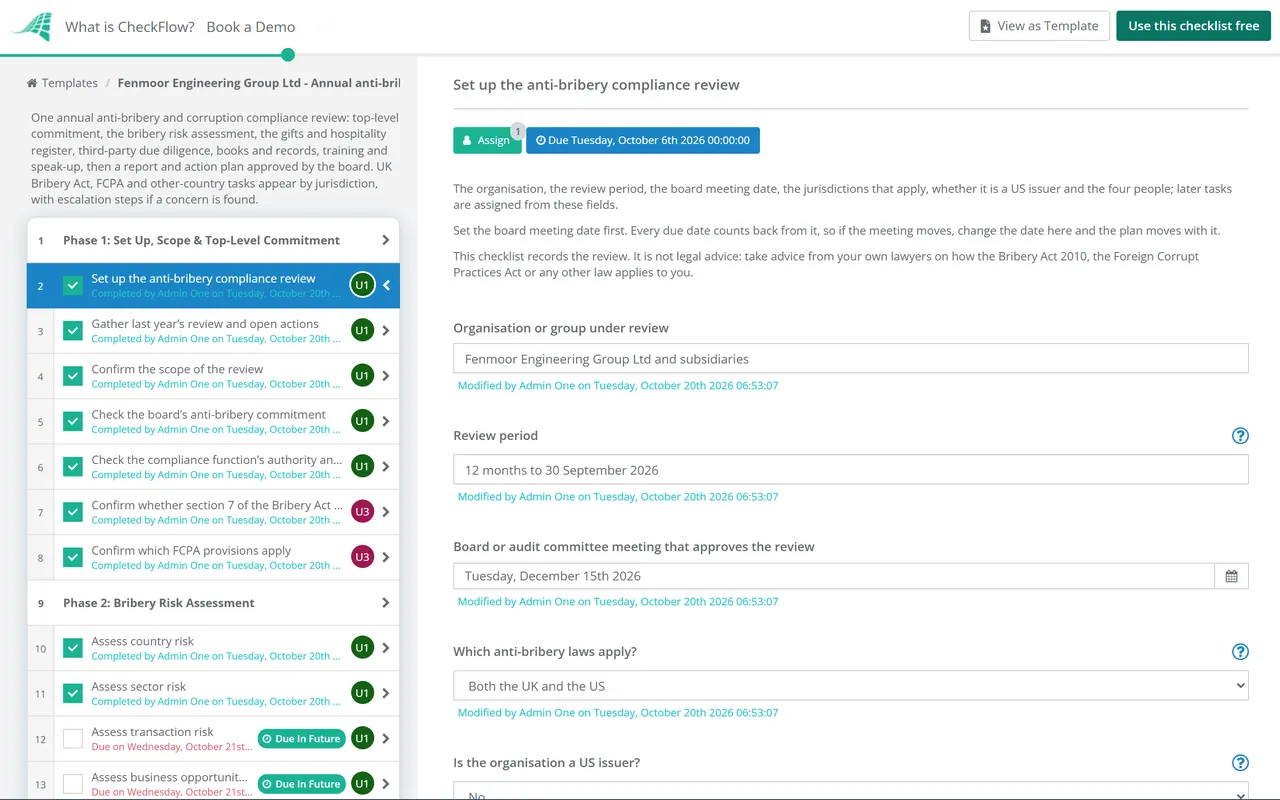
    • Set up the anti-bribery compliance review — the organisation, the review period, the board meeting date, the jurisdictions that apply, whether it is a US issuer and the four people; later tasks are assigned from these fields
    • Gather last year’s review and open actions — the previous report and action plan, what is still open, the gifts and hospitality register, third-party files, training records and any bribery concerns raised since
    • Confirm the scope of the review — entities, subsidiaries, joint ventures, countries and business lines, businesses acquired since the last review, and the people who perform services for or on behalf of the organisation
    • Check the board’s anti-bribery commitment — a current statement of zero tolerance endorsed by the board, the senior person responsible for the programme, and the board’s involvement in bribery risk decisions since the last review
    • Check the compliance function’s authority and resources — the person who runs the programme has authority, independence from management, direct access to the board or audit committee, and enough staff and budget for the risks
    • Confirm whether section 7 of the Bribery Act applies — a body or partnership formed in the UK, or one that carries on business or part of a business in the UK, is a relevant commercial organisation, and the offence applies wherever the bribery takes place
    • Confirm which FCPA provisions apply — the anti-bribery provisions cover issuers, US domestic concerns and other persons who act in US territory; the accounting provisions cover issuers only
    • Record the anti-bribery laws of other jurisdictions — for each other country in scope, the law, what it prohibits, whether it has a corporate offence or a defence for adequate procedures, and the legal advice you have
  2. Phase 2

    Phase 2: Bribery Risk Assessment

    7 tasks

    The Ministry of Justice guidance groups common external risks into five kinds: country, sector, transaction, business opportunity and business partnership. It asks for an assessment that is periodic, informed and documented, and that also looks at the organisation’s own weaknesses.

    • Assess country risk — perceived levels of corruption, how well anti-bribery law is enforced, and how transparent public procurement is in each country where you or your agents work
    • Assess sector risk — the guidance names extractive industries and large-scale infrastructure as higher-risk sectors; rate your own sector and the sectors of your main customers
    • Assess transaction risk — charitable and political contributions, licences and permits, public procurement, and any other transactions with public bodies or officials
    • Assess business opportunity risk — high-value projects, projects with many contractors or intermediaries, and deals not at market prices or without a clear legitimate objective
    • Assess business partnership risk — intermediaries who deal with foreign public officials, consortium and joint venture partners, and relationships linked to politically exposed persons
    • Assess internal risk factors — gaps in training, bonus schemes that reward excessive risk-taking, unclear rules on hospitality and donations, weak financial controls and a weak message from the top
    • Rate each bribery risk in the register — likelihood and impact on your agreed scale, the controls that address it, the residual rating and the owner, written so the board can follow the reasoning
  3. Phase 3

    Phase 3: Policy, Gifts, Hospitality & Donations

    5 tasks

    Reasonable and proportionate hospitality is a normal part of business, and the Ministry of Justice guidance says the Act is not meant to prohibit it. The register is where you show that what was given and received stayed reasonable, was approved and was recorded.

    • Review the anti-bribery policy and code of conduct — the stance on bribery, gifts, hospitality, donations, facilitation payments and intermediaries, whether it matches this year’s risks, and whether staff can read it in their own language
    • Review the gifts and hospitality register — entries against the policy limits and approvals, items in expense claims that never reached the register, and repeat or lavish items to the same people, especially public officials
    • Review charitable and political donations and sponsorships — each one approved and recorded, made to a genuine body, and not linked to a decision pending with anyone connected to it
    • Check how facilitation payments are handled — the Bribery Act has no exemption for them, while the FCPA has a narrow exception for routine governmental action; record every demand reported and how it was dealt with
    • Check recruitment, incentives and disciplinary controls — due diligence proportionate to the risk of each post, anti-bribery terms in contracts, bonus schemes that reward compliance rather than risk, and discipline applied to breaches
  4. Phase 4

    Phase 4: Third Parties & Intermediaries

    7 tasks

    Agents, consultants and distributors are a common route for bribes. The answer on the second task decides whether the enhanced due diligence tasks appear.

    • List every third party that acts on the organisation’s behalf — agents, consultants, distributors, resellers, customs and visa agents, joint venture partners and lobbyists, with the countries they work in and how they are paid
    • Rate each third party’s bribery risk — from the country, the service, contact with public officials and the way they are paid; record whether any are high risk
    • Check due diligence files are complete and current — ownership, reputation, qualifications, any link to public officials, and the business reason for using them, to a depth that matches each rating
    • Check contracts carry anti-bribery terms — services described exactly, anti-bribery commitments, audit rights and the right to end the contract for a breach
    • Test payments to third parties — commissions and fees against the work done and market rates, success fees, payments to offshore accounts, and payments to anyone other than the contracted party
    • Run enhanced due diligence on each high-risk third party — direct enquiries, independent research and reference checks, their ties to public officials, and why the business needs them
    • Decide on each high-risk third party — continue with added controls such as training, audits and an annual compliance certificate, change the terms, or end the relationship; record who decided and why
  5. Phase 5

    Phase 5: Books, Records & Financial Controls

    5 tasks

    Bribes are often hidden as legitimate payments such as commissions, consulting fees or marketing costs. The two accounting tasks appear only for a US issuer.

    • Test how high-risk payments are recorded — a sample of commissions, consulting fees, marketing, travel and entertainment, rebates, discounts, petty cash and miscellaneous expenses, looking for vague descriptions and missing support
    • Check approval controls over high-risk spending — delegated authority, separation of duties, and the approvals for gifts, hospitality, donations and third-party payments
    • Look for red flags in the ledgers — excessive commissions, large discounts to distributors, vague consulting agreements, round-sum and cash payments, and payments to offshore accounts
    • Test the FCPA books and records provision — books, records and accounts that in reasonable detail accurately and fairly reflect transactions, including those of subsidiaries and joint ventures you control; there is no materiality threshold
    • Test the FCPA internal accounting controls provision — transactions executed and access to assets allowed only with management’s authorisation, transactions recorded so financial statements can be prepared, and recorded assets compared with actual assets at reasonable intervals
  6. Phase 6

    Phase 6: Training, Speak-Up & Investigations

    6 tasks

    Training should match the risk of each role, and people need a safe way to raise concerns. The last task asks whether the review itself has found a suspected bribery concern; Yes shows Phase 7.

    • Check training completion by role — induction training for all staff, and tailored training for higher-risk roles such as purchasing, contracting, distribution, sales and people working in high-risk countries
    • Review training content and results — practical scenarios in the local language, test results and feedback, and whether people know what the policy means for their own work
    • Check external communication of the policy — the anti-bribery stance in supplier and agent onboarding, in contracts and on the public website
    • Test the speak-up channel — confidential and open to staff and outsiders, with protection from retaliation for people who raise concerns, and every report logged
    • Review bribery concerns and investigations since the last review — each one investigated, documented and closed, any discipline applied, and the lessons fed back into controls and training
    • Record whether the review has found a suspected bribery concern — anything in this review that suggests a bribe may have been offered, paid, requested or received; answer Yes as soon as it is found, whichever phase you are in
  7. Phase 7 — If a Concern Is Found

    Phase 7: Suspected Bribery Concern

    6 tasks

    Shown only when the review finds a suspected bribery concern. Its due dates count from the date the concern was identified, not from the board meeting, because a concern cannot wait for the report.

    • Escalate the concern to legal counsel the same day — what was found, where, and who may be involved, without confronting anyone or alerting the people concerned
    • Preserve the evidence — records, emails, payment files and the review’s workpapers, with routine deletion stopped for the people and systems involved
    • Brief the board approver — what is known, who has been told, and any decision that cannot wait
    • Route the concern to the investigation process — an investigator independent of the people involved, working under legal advice, with a case file of its own
    • Suspend affected payments or relationships where advised — payments to the third party or account concerned held while the investigation runs, if legal counsel advises it, with the reason recorded
    • Take legal advice on reporting to the authorities — in the UK the Serious Fraud Office and the National Crime Agency investigate international bribery; in the US the Justice Department’s FCPA Unit takes reports; record the decision and who made it
  8. Phase 8

    Phase 8: Assess, Report & Board Approval

    8 tasks

    The assessment against the six principles appears for the UK, against the FCPA Resource Guide hallmarks for the US, and against local requirements for another country. Nothing after the board’s approval of the review and action plan can be completed until it is given.

    • Assess the programme against the six principles — proportionate procedures, top-level commitment, risk assessment, due diligence, communication including training, and monitoring and review, each rated with its evidence
    • Assess the programme against the FCPA Resource Guide hallmarks — the hallmarks of an effective compliance programme that DOJ and the SEC describe, each rated with its evidence
    • Assess the programme against the other jurisdictions’ requirements — each law recorded in Phase 1, with the gaps and the legal advice behind each rating
    • Write the action plan — each gap with an action, an owner, a due date and the risk it addresses
    • Compile the report to the board — the risk profile, the register review, third-party results, books and records findings, training, speak-up and investigations, the gaps and the action plan
    • Board approves the review and action plan — the board approver records the decision and any conditions; nothing after this task can be completed until it is done
    • Share the results and track every action to closure — each risk owner gets their risks and actions, and every action is closed with evidence or escalated when it passes its due date
    • Schedule the next review and the triggers for an earlier one — a new market, an acquisition, an incident of bribery, negative press, a change in the law or a change in the countries where you operate

The Six Principles and the FCPA Hallmarks, Side by Side

The Ministry of Justice guidance and the DOJ and SEC Resource Guide to the FCPA (second edition, July 2020) describe much the same programme in different words. The table maps one onto the other and shows where the checklist covers each. It is a summary, not legal advice: whether procedures are adequate, or a programme effective, depends on the facts of each case.

MoJ principle (Bribery Act guidance) FCPA Resource Guide hallmarks Covered in
1. Proportionate procedures: matched to the bribery risks and to the nature, scale and complexity of the businessCode of conduct and compliance policies and procedures; a risk-based programme rather than one size for allPhases 2 and 3
2. Top-level commitment: the board or owners foster a culture in which bribery is never acceptableCommitment from senior management and a clearly articulated policy; oversight, autonomy and resourcesPhase 1
3. Risk assessment: periodic, informed and documented, covering external and internal risksRisk assessmentPhase 2
4. Due diligence: proportionate and risk-based, on people who perform services for the organisationThird-party due diligence and payments; mergers and acquisitionsPhases 1 and 4
5. Communication (including training): internal and external, proportionate to the risksTraining and continuing advice; confidential reportingPhase 6
6. Monitoring and review: procedures monitored, reviewed and improved where necessaryContinuous improvement: periodic testing and review; internal investigation; incentives and disciplinary measuresPhases 3, 6 and 8
Not a principle, but the guidance lists financial and commercial controls such as adequate bookkeeping, auditing and approval of expenditure among the proceduresFor issuers, the books and records and internal accounting controls provisions (15 U.S.C. 78m(b)(2))Phase 5

Penalties. Under section 11 of the Bribery Act, an individual convicted on indictment of an offence under section 1, 2 or 6 faces up to 10 years in prison, a fine or both, and an organisation convicted under section 7 faces a fine. As the Resource Guide sets out, each criminal violation of the FCPA’s anti-bribery provisions carries a fine of up to $2 million for a company and $250,000 for an individual, with up to five years in prison, and each violation of the accounting provisions up to $25 million and $5 million, with up to 20 years. The Alternative Fines Act can raise a fine to twice the benefit obtained.

US enforcement since 2025. On 9 June 2025 the Deputy Attorney General issued Guidelines for Investigations and Enforcement of the FCPA, following Executive Order 14209 of 10 February 2025. They tell prosecutors to focus on misconduct with strong signs of corrupt intent tied to particular individuals, such as substantial bribes and sophisticated efforts to conceal them, and not on routine business practices or low-value, generally accepted business courtesies. They guide which cases the Justice Department pursues; they do not amend the Act.

The other side of the bribe. Since July 2024 the Foreign Extortion Prevention Act (18 U.S.C. 1352) makes it a crime for a foreign official to demand or accept a bribe from an issuer, a domestic concern or a person in US territory. In the UK, section 2 of the Bribery Act already covers being bribed. Some organisations also certify their programme to ISO 37001:2025, Anti-bribery management systems; the Ministry of Justice guidance notes that certification may not by itself mean procedures are adequate for every section 7 case.

Why Run Your Anti-Bribery Review in CheckFlow?

1

No action plan without the board

The board approver’s decision on the review and action plan is assigned to them alone, and the checklist halts there: the results cannot be shared or the actions tracked until the board has decided. See how approvals that halt a checklist work.

2

Only the laws and branches that apply

One answer on the first task adds the Bribery Act tasks, the FCPA tasks, both, or notes for another country, and a second adds the accounting tasks for a US issuer. A high-risk third party adds enhanced due diligence, and a suspected bribe adds escalation tasks that count from the day it was found.

3

Evidence for the defence, kept as you go

Under section 7 the organisation has to prove its procedures were adequate. The risk register, the register review, third-party files, payment tests and training figures sit on the tasks they belong to, with a dated record of who did what. A recurring schedule starts next year’s review on time, and the Reports Grid shows progress and overdue tasks.

CheckFlow runs the review, the evidence and the approval. It is not a due diligence screening service, a case management system or legal advice, and it does not decide whether your procedures are adequate.

Run the yearly declarations with the Conflict of Interest Declaration Checklist and staff concerns with the Whistleblowing Report Handling Checklist; a concern that needs a formal investigation of an employee can use the Workplace Investigation Checklist. Check new agents and partners with the Vendor Risk Assessment Checklist and the Business Partnership Due Diligence Checklist, screen them with the Sanctions Screening Checklist, and cover fraud more widely with the Fraud Risk Assessment Checklist. The Annual Compliance Calendar Checklist keeps this review on the calendar. Running several compliance programmes? CheckFlow’s compliance checklist software keeps owners, evidence and sign-offs in one place.

AI generator

Didn’t find what you need? Describe it.

Describe the process in a sentence and the AI checklist generator drafts the phases and tasks for you.

Frequently Asked Questions

What is an anti-bribery and corruption compliance review?

It is a periodic check that an organisation’s anti-bribery programme still fits its risks and works in practice. A review confirms the board’s commitment, updates the bribery risk assessment, reviews the policy, the gifts and hospitality register and donations, checks due diligence on third parties, tests how payments are recorded, checks training and the speak-up channel, and ends with a report and action plan the board approves. Both the Ministry of Justice guidance and the FCPA Resource Guide expect procedures to be monitored, reviewed and improved over time.

What are adequate procedures under the Bribery Act?

Section 7(2) gives a commercial organisation a defence to failing to prevent bribery if it proves it had adequate procedures designed to prevent its associated persons from bribing. The Act does not define them. The Ministry of Justice guidance issued under section 9 says they should be informed by six principles and be proportionate to the bribery risks the organisation faces and to the nature, scale and complexity of its activities. The principles are not prescriptive, and adequacy is decided on the facts of each case.

What are the six principles of the Bribery Act guidance?

Proportionate procedures, top-level commitment, risk assessment, due diligence, communication (including training), and monitoring and review. They come from the Ministry of Justice guidance on procedures that commercial organisations can put in place to prevent bribery by people associated with them. Phases 1 to 6 of this checklist gather the evidence for each principle, and Phase 8 rates the programme against all six for an organisation subject to the Act.

How often should an anti-bribery risk assessment be done?

The Ministry of Justice guidance asks for a risk assessment that is periodic, informed and documented, but sets no fixed interval. This checklist is built for a yearly review reported to the board, and you can change that. The guidance expects the assessment to change as the business does, for example when it enters a new market, and suggests reviewing procedures after a change of government in a country where you operate, an incident of bribery or negative press reports.

Are facilitation payments legal?

Not under UK law. The Bribery Act has no exemption for small payments to speed up routine government action, and the Ministry of Justice guidance says they could trigger the section 6 or section 1 offence, and so section 7. The FCPA has a narrow exception for facilitating payments that further routine, non-discretionary governmental action, such as processing visas, but never a decision to award or continue business. A policy for an organisation subject to both laws has to meet the UK rule.

Does the FCPA apply to UK companies?

It can. The anti-bribery provisions apply to issuers, which include foreign companies with shares or American Depository Receipts listed on a US exchange, to US domestic concerns such as a US subsidiary, and to foreign companies and people who act in furtherance of a corrupt payment while in US territory. The accounting provisions apply only to issuers. A UK private company with no US listing is not an issuer, but its US subsidiary is a domestic concern. Take legal advice on your own structure.

What should a gifts and hospitality register show?

Enough to show that each gift or item of hospitality was reasonable, approved and recorded: the date, who gave and who received it, whether they are a public official, what it was and its value, the business reason and who approved it. The Ministry of Justice guidance says the Act is not meant to prohibit reasonable and proportionate hospitality, but the more lavish it is, the greater the inference that it was meant to influence. The FCPA Resource Guide describes appropriate gifts as given openly, recorded properly and permitted under local law.

Is CheckFlow free for this template?

14-day free trial, no card required. The Business plan is $10 per user per month after the trial. Full details at checkflow.io/pricing.

Every Risk Rated, Every Agent Checked, Every Action Approved

Free trial — no credit card required.

14-day free trial, no credit cardFull refund in your first 30 daysUS hosting, EU on request