
Annual Conflict of Interest Declaration Checklist Template

The forms come back with ‘nothing to declare’ ticked, nobody compares them with the supplier list, and the finance director who joined a supplier’s board in June appears in no register at all.

This free conflict of interest declaration checklist is for compliance leads, company secretaries, charity governance officers and the HR teams who run the yearly campaign. It refreshes the policy and form, defines who must declare, chases every return, reviews each disclosure against your own records, agrees a mitigation plan where one is needed, and ends with an approved register reported to the board. A campaign that only collects forms proves people were asked. This one shows what you did with the answers.

Use This Template Free See Live Example
No Credit Card Required

Last reviewed: October 2026

An Annual Snapshot and a Duty at the Moment of Decision

Most conflict rules bite when a decision is made, not once a year. A UK company director must declare an interest in a proposed transaction to the other directors before the company enters into it, under section 177 of the Companies Act 2006. The Charity Commission’s guidance CC29, updated in April 2026, asks trustees to declare conflicts at the start of each meeting and to record them in the minutes.

The annual campaign is what makes those moments work. It refreshes the register that a chair, a buyer or a grants panel checks before a decision, catches interests nobody thought to mention, and gives the board evidence the policy is applied. CC29 says a charity’s policy should list the information collected when trustees join and every year. In the US, Form 990 asks tax-exempt organisations whether their officers, directors, trustees and key employees must disclose their interests annually.

Annual declaration

Everyone in scope, once a year

Covers: outside roles, shareholdings, gifts and hospitality, family links and related parties.

Output: an updated register of interests and a decision on each disclosure.

Weak spot: it describes the position on one date and goes stale as roles change.

Decision-point declaration

One person, one decision

Covers: an interest in a specific contract, appointment, grant or purchase.

Output: a declaration in the minutes or file, and the conflicted person stepping out.

Weak spot: it relies on people recognising the conflict themselves, in the moment.

Where this template stops

The yearly campaign, not every governance process

Rewriting the policy itself belongs to the Annual Policy Review Checklist. A report that someone hid a conflict is a whistleblowing matter for the Whistleblowing Report Handling Checklist. Regulated financial firms tracking codes of ethics, licences and personal dealing alongside conflicts can use the Employee Compliance Certification Tracking Checklist.

What the Conflict of Interest Declaration Checklist Covers

Six phases, one checklist per annual campaign. Chase dates run from your return deadline, and the mitigation phase appears only when a conflict needs managing.

Phase 1

Phase 1: Refresh the Policy & Form

The first task sets the return deadline, records which rules apply to you and names the person who approves the register.

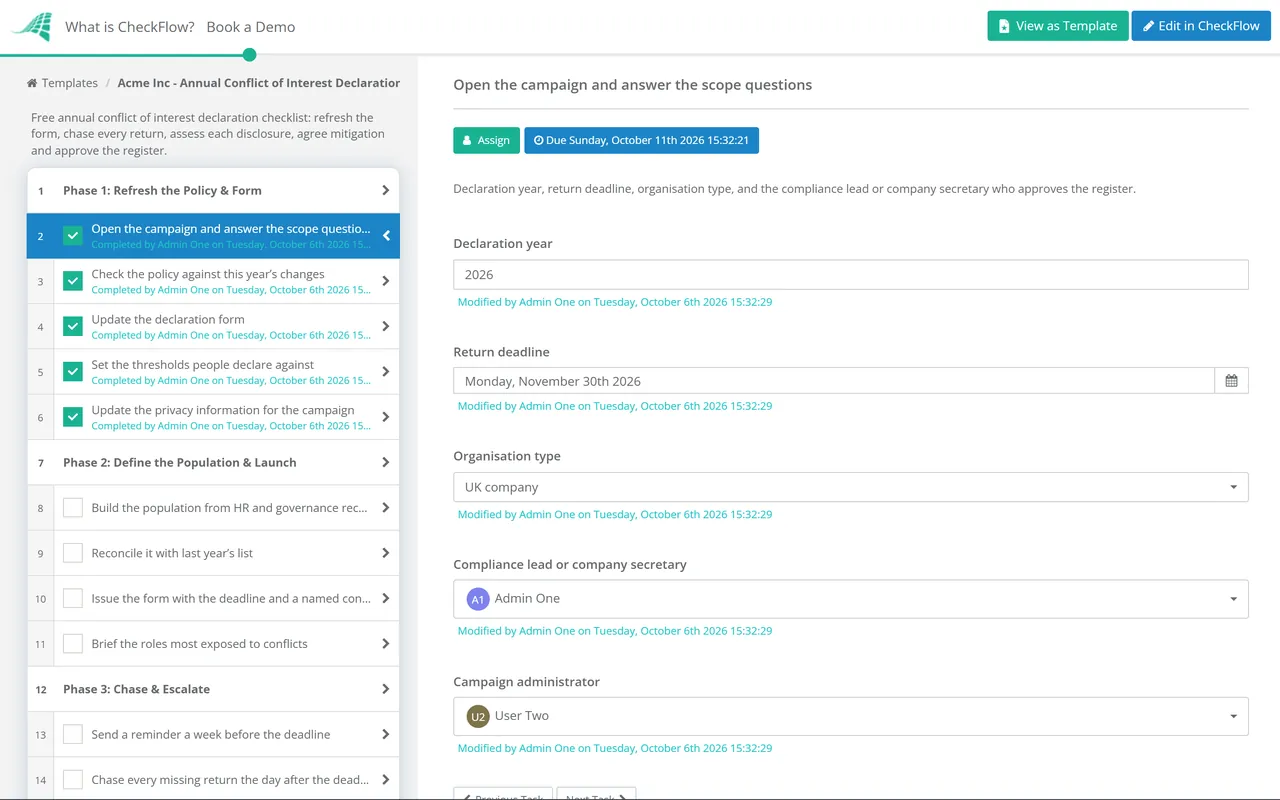
  • Open the campaign and answer the scope questions — declaration year, return deadline, organisation type, and the compliance lead or company secretary who approves the register
  • Check the policy against this year’s changes — new guidance, audit findings and last year’s cases; send substantive rewrites through your policy review
  • Update the declaration form — outside roles, shareholdings, gifts and hospitality, family and related parties, and an explicit nil return
  • Set the thresholds people declare against — gift values, shareholding levels and which relatives count, so ‘material’ means the same to everyone
  • Update the privacy information for the campaign — why the data is collected, who sees it and how long it is kept
Phase 2

Phase 2: Define the Population & Launch

  • Build the population from HR and governance records — directors, trustees, officers, key employees, and staff or contractors who buy, award or approve
  • Reconcile it with last year’s list — joiners, leavers and role changes since the previous campaign, so nobody is missed or chased in error
  • Issue the form with the deadline and a named contact — one message explaining what to declare, where to ask, and that a nil return is still required
  • Brief the roles most exposed to conflicts — procurement, grant-making and investment staff, and new board members, with real examples of what counts
Phase 3

Phase 3: Chase & Escalate

Due dates count from the return deadline set in Phase 1, so the chase runs on time without anyone remembering it.

  • Send a reminder a week before the deadline — to everyone without a return, restating the deadline and the contact
  • Chase every missing return the day after the deadline — copy the line manager or, for directors and trustees, the chair
  • Escalate returns still missing after two weeks — to the compliance lead, with names, roles and the chase history
  • Record agreed exceptions — long-term leave or a pending role change, each with a new return date
  • Confirm the completion rate before review starts — returns received against the population, with any gaps named
Phase 4

Phase 4: Review Each Declaration

Each disclosure is a row in a table on the first task. The directors’ check appears for UK companies, and the last answer decides whether Phase 5 appears.

  • Log every disclosure in the review table — person, interest, counterparty, value, and whether it is new, changed or unchanged since last year
  • Compare declarations with supplier, customer and grant records — a matching name, address or bank account nobody declared is a finding
  • Classify each disclosure — no conflict, or a potential, apparent or actual conflict, the distinction ISO 37009 draws
  • Check directors’ interests against what the board was told — the annual form does not replace a section 177 or 182 declaration to the other directors
  • Record the decision and reasoning for each disclosure — who decided, what they weighed, and any authorisation already given
  • Confirm whether any declared conflict needs mitigation — a Yes opens the mitigation phase for those disclosures
Phase 5

Phase 5: Mitigation Plans

Shown only when Phase 4 records at least one conflict that needs managing.

  • Agree a mitigation plan for each conflict — recusal, a second approver, removal from a supplier or grant decision, divestment or, in serious cases, stepping down
  • Obtain authorisation where the law requires it — board authorisation of a director’s conflict under section 175, or legal authority before any benefit to a charity trustee
  • Tell the people who must act on the plan — meeting chairs, procurement and finance, so the recusal happens at the right meeting
  • Get each person’s written acknowledgement — they confirm what they will step back from and until when
  • Set a review date for every plan — an end date or a check-in, never open-ended
Phase 6

Phase 6: Approve, Report & Retain

The register approval is assigned to the compliance lead or company secretary named in Phase 1. The filing task appears for US organisations.

  • Update the register of interests — every disclosure, decision and mitigation plan, dated and attributed
  • Compliance lead or company secretary approves the register — reviews the decisions and plans, then records Approved or Not approved
  • Report the results to the board or audit committee — completion rate, conflicts found, plans in place, late returners and process issues
  • Feed the US filings and disclosures that rely on the campaign — Form 990 Part VI line 12, Item 404 related-person disclosures, and grant disclosures
  • Retain declarations under your retention schedule — keep what the policy needs as evidence, and delete superseded forms when the period ends
  • Set the in-year triggers and next year’s campaign date — a new appointment, supplier or role prompts an update between campaigns

Conflict of Interest Rules Mapped to the Checklist

Which rules apply depends on what your organisation is. The table lists the main UK and US sources, who they bind and the phase that produces the evidence. Articles, governing documents, funder terms and sector regulators often add more, so treat the table as a starting point, not legal advice.

Source Applies to What it requires Evidenced in
Companies Act 2006, s.175UK company directorsAvoid conflicts; board authorisation possible in a private company unless the constitution prevents it, in a public company only if the articles allow; authorisation counts only if quorum and vote are met without the conflicted directorPhases 4 and 5
Companies Act 2006, s.176UK company directorsDo not accept benefits from third parties given because of the directorship, unless no conflict is reasonably likelyPhase 1
Companies Act 2006, ss.177 and 182–185UK company directorsDeclare the nature and extent of an interest in a proposed transaction before it is entered into, and in an existing one as soon as reasonably practicable; failing to declare under s.182 is an offence (s.183)Phase 4
Charity Commission CC29 (April 2026)Charity trustees in England and WalesIdentify, declare, remove or manage, and record conflicts; a policy and a register updated when trustees join and annuallyPhases 1, 4 and 6
IRS Form 990, Part VI, lines 12a–cUS tax-exempt organisations filing Form 990Report whether there is a written policy, whether annual disclosure is required, and how compliance is monitored and enforced (Schedule O)Phases 1, 3 and 6
2 CFR 200.112 and 200.318(c)(1)US federal award recipients and subrecipientsDisclose potential conflicts in writing to the agency or pass-through entity; written standards of conduct for staff involved in contractsPhases 5 and 6
Regulation S-K, Item 404SEC registrantsDisclose related-person transactions over $120,000 and the policy for reviewing themPhases 4 and 6
ISO 37009:2025Any organisation (voluntary guidance)Identify, assess, resolve and monitor conflicts, distinguishing actual, apparent and potentialPhases 4 and 5

Two sources changed recently. The Charity Commission updated CC29 on 22 April 2026 and retitled it Identifying and managing conflicts of interest in a charity, so check any policy wording that quotes the old guide. The 2024 revision of the US Uniform Guidance, which applies to federal awards made from 1 October 2024, gives section 200.112 its current wording; older awards may still carry earlier terms. Form 990 is explicit that the Part VI policies are generally not required by the tax code, though every organisation must answer the questions. Nothing on this page is legal advice.

Why Run Your Declaration Campaign in CheckFlow?

1

The chase is scheduled, not remembered

Enter the return deadline once and dynamic due dates place the reminder, the first chase and the escalation around it. An annual recurring schedule starts next year’s campaign on the same date.

2

A decision on every disclosure

A table inside the review task holds one row per disclosure, with its classification and reasoning. Keep last year’s register as a data set to spot what changed. Answer Yes to the mitigation question and the plan tasks appear.

3

A register the board can trust

The register sign-off runs as an approval, and the activity trail records who reviewed each disclosure and when. Template versioning shows which form and thresholds applied in each year.

CheckFlow is not a disclosure portal, a case-management system or a legal adviser. It runs the campaign, tracks who has returned a form and holds the review decisions; the form itself can be a file upload or arrive through Zapier or the REST API from the tool you already use. Keep declarations in a workspace with access limited to the people reviewing them.

Conflicts declared at a single meeting belong in the minutes, and the Nonprofit Board Meeting Checklist prompts for them. Where an undeclared interest sits next to a payment approval, the Segregation of Duties Review Checklist checks the access side. Wider gaps in how the legal function handles conflicts show up in the Legal Department Compliance Audit Checklist.

Frequently Asked Questions

What counts as a conflict of interest?

+

Any situation where a personal interest, or the interest of someone connected to you, could pull against your duty to the organisation. CC29 separates financial conflicts, where you or a connected person could gain, from loyalty conflicts, such as a decision affecting your employer, a relative or another charity you serve. Definitions differ: the Form 990 instructions leave out competing duties to two organisations unless a material financial interest is involved, so write yours into the policy.

What should a conflict of interest declaration form include?

+

Outside employment and directorships, shareholdings above your threshold, gifts and hospitality received, close family members working for suppliers, customers or competitors, and any other relationship that could influence a decision. Add a plain statement that the person has nothing to declare, so a blank form is never mistaken for a nil return, and a commitment to update the declaration when circumstances change.

Who should complete an annual conflict of interest declaration?

+

At a minimum, the board: directors, trustees and officers. Form 990 asks about officers, directors, trustees and key employees. Beyond that, include anyone who can steer money or decisions, such as buyers, grant assessors, investment staff and contractors in those roles. Asking everyone adds review work and few findings, so most organisations define the population by role.

Is an annual declaration enough for company directors?

+

No. Under section 177 of the Companies Act 2006 a director must declare an interest in a proposed transaction to the other directors before the company enters into it, at a meeting or by written or general notice. Section 182 covers existing transactions. A general notice under section 185 can cover dealings with a named company or person, but it takes effect only when given at a board meeting or brought up and read at the next one.

What does Form 990 ask about conflicts of interest?

+

Part VI line 12a asks whether the organisation had a written conflict of interest policy, line 12b whether officers, directors, trustees and key employees had to disclose interests annually, and line 12c whether it regularly and consistently monitored and enforced compliance. A Yes to 12c needs a Schedule O description of who is covered, who decides and what restrictions apply.

What happens after someone declares a conflict?

+

Someone independent decides whether it is a real conflict and how to handle it. For a financial conflict, CC29 sets a minimum for trustees: declare it, leave the discussion, take no part in the decision and do not count towards the quorum. Serious conflicts may need the person to step back from a role or the arrangement to be dropped. Record the decision either way.

Is CheckFlow free for this template?

+

14-day free trial, no card required. The Business plan is $10 per user per month after the trial. Full details at checkflow.io/pricing.

Every Declaration Returned, Reviewed and on the Register

Free trial — no credit card required.