Fraud Risk Assessment Checklist Template

A fraud risk assessment that only counts money going out misses half the picture. Since 1 September 2025, UK law lets a large organisation be prosecuted when an employee or agent commits fraud intended to benefit it, unless it had reasonable procedures to prevent it.

Last reviewed: October 2026

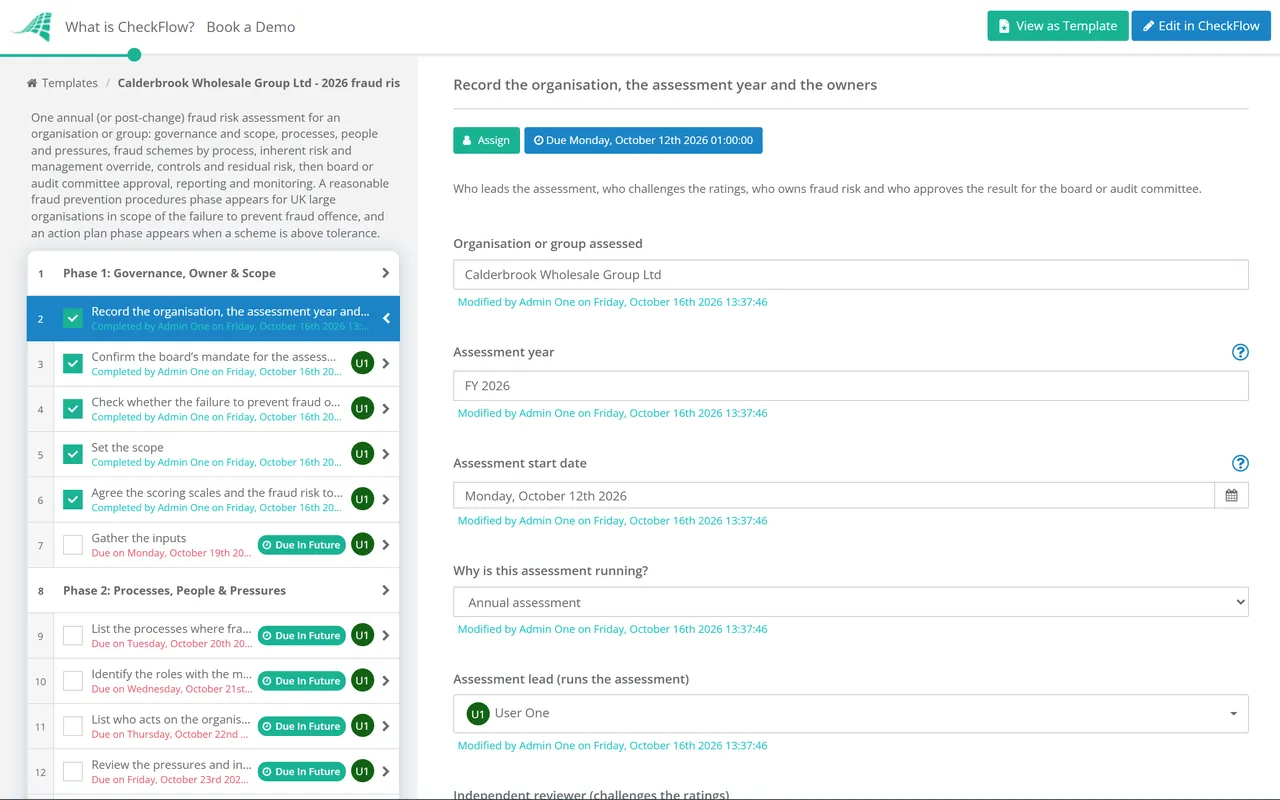
A fraud risk assessment asks how someone could steal from the organisation, deceive it, or deceive others on its behalf, and whether the controls in place would stop them. This free fraud risk assessment checklist is for finance directors, heads of internal audit and compliance and risk leads who run the assessment once a year or after a significant change. One run covers one organisation or group. It names the owners and the scope, maps processes, roles and pressures, identifies fraud schemes process by process, rates inherent risk, looks at management override, maps preventive and detective controls and rates residual risk against your tolerance. An action plan phase appears when a scheme is above tolerance. For a UK large organisation in scope of the failure to prevent fraud offence, a further phase checks your procedures against the six principles in the Home Office guidance. The board or audit committee approves the assessment before it is shared, and every action leaves with an owner and a date.

Fraud Against the Organisation, and Fraud on Its Behalf

The COSO and ACFE Fraud Risk Management Guide treats fraud as a deliberate act or omission meant to deceive, which causes a loss to the victim or a gain to the person behind it. Intent is what separates fraud from error. It is why the Guide recommends a fraud risk assessment of its own rather than a line in the general risk register: a control that catches honest mistakes may not stop someone who plans the act and hides it.

Most assessments look in one direction, at schemes that take money or assets from the organisation. The failure to prevent fraud offence in the Economic Crime and Corporate Transparency Act 2023 looks the other way. It covers fraud by an employee, agent, subsidiary or anyone performing services on the organisation’s behalf, intended to benefit the organisation or its clients. A complete assessment covers both directions and draws on the control reviews and case files that already exist.

Fraud against the organisation

Losses the organisation suffers

Covers: asset misappropriation (false invoices, payroll and expense fraud, theft), corruption (kickbacks, bid rigging, undeclared conflicts of interest) and external fraud such as payment diversion and fake suppliers.

Who commits it: employees, managers, suppliers and outsiders, alone or together.

Where it lands: losses and write-offs, and misstated accounts when it is hidden in the books.

Fraud intended to benefit the organisation

The failure to prevent fraud offence

Covers: the fraud offences in Schedule 13 of the Act, such as fraud by false representation, false accounting, fraudulent trading and cheating the public revenue, committed by an associated person to benefit the organisation or its clients.

In scope: large bodies corporate and partnerships (see the table below), since 1 September 2025.

Defence: reasonable fraud prevention procedures in place at the time of the fraud.

What the Fraud Risk Assessment Checklist Covers

Six phases run in every assessment. Phase 6 appears only for a UK large organisation in scope of the failure to prevent fraud offence, and Phase 7 only when a scheme’s residual risk is above your tolerance.

  1. Phase 1

    Phase 1: Governance, Owner & Scope

    6 tasks

    The answer on the third task decides whether Phase 6 appears. Agree the scales and the tolerance before anyone rates a scheme.

    • Record the organisation, the assessment year and the owners — who leads the assessment, who challenges the ratings, who owns fraud risk and who approves the result for the board or audit committee
    • Confirm the board’s mandate for the assessment — the committee that commissioned it, the date it was minuted and the fraud policy or statement it rests on
    • Check whether the failure to prevent fraud offence applies — a body corporate or partnership is a large organisation if it met two of three conditions in the previous financial year: more than 250 employees, more than £36 million turnover, more than £18 million balance sheet total
    • Set the scope — entities, business units, countries and processes, including subsidiaries and agents that act on the organisation’s behalf
    • Agree the scoring scales and the fraud risk tolerance — one likelihood and impact matrix for every scheme, and the residual rating above which a scheme needs an action plan
    • Gather the inputs — last year’s assessment and open actions, fraud cases and suspicions, whistleblowing reports, audit findings, losses, control test results and data analytics results
  2. Phase 2

    Phase 2: Processes, People & Pressures

    6 tasks

    This phase follows the fraud triangle: opportunity, motive and rationalisation. The Home Office guidance suggests building fraud risk typologies from all three.

    • List the processes where fraud could happen — purchasing and payments, payroll, expenses, sales and revenue, treasury, inventory, financial reporting, tax, grants and regulatory returns, each with an owner
    • Identify the roles with the most opportunity — people who can approve, pay, record, hold assets or change master data, and anyone who works with little oversight
    • List who acts on the organisation’s behalf — agents, subsidiaries, contractors and intermediaries that sell, buy, report or deal with authorities for it
    • Review the pressures and incentives — sales and profit targets, bonuses and commission, financing deadlines, deals in progress, cost cutting and vacancies in key roles
    • Check how the culture treats fraud — whether staff feel able to speak up, how past cases were handled, and whether short cuts that win business are quietly tolerated
    • Run fraud brainstorming sessions with each function — finance, procurement, sales, operations and IT, asking how someone could steal, deceive or misreport in their process and hide it
  3. Phase 3

    Phase 3: Identify Fraud Schemes

    7 tasks

    Work through every category for each process in scope. The first four follow the COSO and ACFE Fraud Risk Management Guide; external fraud and fraud that benefits the organisation complete the picture.

    • Identify asset misappropriation schemes — false or duplicate supplier invoices, ghost employees, inflated expenses, misuse of company cards, and theft of cash, stock or data
    • Identify corruption schemes — kickbacks from suppliers, bid rigging, undeclared conflicts of interest and bribes to win or keep business
    • Identify financial reporting fraud schemes — revenue recorded early or invented, hidden liabilities, manipulated estimates and provisions, and false journal entries
    • Identify non-financial reporting fraud schemes — false figures in regulatory returns, grant and subsidy claims, safety and environmental data, and sustainability reports
    • Identify external fraud schemes — payment diversion through changed supplier bank details, impersonation of executives, fake suppliers, customer account takeover and cyber-enabled theft
    • Identify frauds that would benefit the organisation or its clients — mis-selling, false statements to customers, investors, lenders or regulators, and cheating the public revenue, by employees, agents or subsidiaries
    • Write each scheme into the fraud risk register — who could commit it, how, how it would be concealed, and the process or account it touches
  4. Phase 4

    Phase 4: Inherent Risk & Management Override

    5 tasks

    Rate each scheme before counting any control. Management override gets tasks of its own, because the people who set the controls can also step round them.

    • Rate the inherent likelihood and impact of each scheme — as if no anti-fraud control were in place, using the scales agreed in Phase 1
    • Record why each rating was chosen — a sentence per scheme, so a reviewer and next year’s assessment can follow the reasoning
    • Assess the risk of management override — journals posted or approved by senior people, estimates they set, transactions outside the normal course of business and pressure to meet results
    • Plan responses to override that management cannot switch off — journal entry testing, independent review of estimates and significant unusual transactions, and a reporting line to the audit committee
    • Challenge the ratings across processes — the independent reviewer checks that similar schemes carry similar ratings before any control is counted
  5. Phase 5

    Phase 5: Controls & Residual Risk

    7 tasks

    The answer on the sixth task decides whether Phase 7 appears. Only controls the evidence shows are working count towards residual risk.

    • Map the existing anti-fraud controls to each scheme — preventive or detective, manual or automated, each with a named owner
    • Confirm each key control is in place and working — a walkthrough, recent test results, or findings from the segregation of duties review, the expense audit and internal audit
    • Judge whether each control is adequate for the scheme — a control built to catch honest errors may not stop someone who plans the act and hides it
    • Review how fraud would be detected — data analytics, reconciliations, exception reports and the whistleblowing channel, and how quickly a red flag reaches someone who acts on it
    • Rate the residual likelihood and impact of each scheme — counting only the controls the evidence shows are working
    • Compare each residual rating with the tolerance — and list every scheme that sits above it
    • Record any decision not to add a control — the reason, and the name and position of the person who authorised it
  6. Phase 6 — UK Large Organisations

    Phase 6: Reasonable Fraud Prevention Procedures

    7 tasks

    Shown only when Phase 1 records that the organisation is, or may be, in scope of the failure to prevent fraud offence. Each task checks one of the six principles in the Home Office guidance against the frauds found in Phase 3. The guidance is advisory and gives no safe harbour, so take legal advice on the gaps.

    • Check top-level commitment — a board-endorsed stance against fraud, a named person responsible for the prevention framework, a budget for it, and minuted decisions
    • Check the risk assessment covers the offence — frauds intended to benefit the organisation or its clients, by each type of associated person, including emergency scenarios
    • Check the prevention procedures are proportionate to each risk — controls, incentive schemes and consequences matched to the ratings in this assessment, and written into contracts where the person is not an employee
    • Check due diligence on associated persons — vetting for high-risk roles, checks on agents, contractors and new partners, and fraud prevention in acquisitions
    • Check communication and training — training on the offence and the procedures for the highest-risk roles, and staff and contractors who know the whistleblowing routes
    • Check monitoring and review — how attempted fraud is detected and investigated, and whether the prevention plan has been tested by people who did not write it
    • File the evidence that the procedures were in place — dated policies, training records, due diligence files, test results and this assessment, kept so they can be produced later
  7. Phase 7 — If Above Tolerance

    Phase 7: Fraud Risk Action Plan

    5 tasks

    Shown only when a scheme’s residual risk is above tolerance. Every such scheme leaves this phase with an action plan or a signed acceptance.

    • Choose a response for each scheme above tolerance — a new or redesigned prevention control, more detection, removing the opportunity, or accepting the risk
    • Write the action plan — each action with an owner, a due date and the residual rating it should reach
    • Put interim detective measures in place — extra reviews, targeted data analytics or second approvals until the actions are delivered
    • Plan how each new control will be tested — by someone who did not design it, before it counts towards residual risk
    • Record a formal acceptance for any scheme kept above tolerance — approved by the fraud risk owner, with a date to look at it again
  8. Phase 8

    Phase 8: Report, Approve & Monitor

    6 tasks

    The board or audit committee approval holds the rest of this phase until a decision is recorded.

    • Compile the fraud risk assessment report — the fraud risk profile, the top residual risks, override responses, control gaps, the action plan and any gaps against the six principles
    • Board or audit committee approval of the assessment — the approver records the decision and any conditions; the assessment lead never approves their own work
    • Share the results with risk and control owners — each owner gets their schemes, controls and actions
    • Feed the results into audit and control testing plans — internal audit, control testing and the next segregation of duties review look first where residual risk is highest
    • Track every action to closure — with evidence, and escalate actions that pass their due date
    • Schedule the next assessment and the triggers for an earlier one — a fraud case, an acquisition, a new product, market or system, a reorganisation or a change in the law

The Failure to Prevent Fraud Offence in Brief

The offence is set out in sections 199 to 206 and Schedule 13 of the Economic Crime and Corporate Transparency Act 2023. The Home Office issued guidance on prevention procedures under section 204; the version read for this page was updated on 10 October 2025. The table summarises both and shows where the checklist covers each point. It is a summary, not legal advice: whether an organisation is in scope and whether its procedures are reasonable are questions for your lawyers and, in the end, for a court.

Point What the Act or the guidance says Covered in
In force1 September 2025, by S.I. 2025/349Phase 1
Who can commit itA body corporate or partnership, wherever incorporated or formed, that is a large organisation (s199(1) and (13))Phase 1
Large organisationTwo or more of these in the financial year before the fraud: more than £36 million turnover, more than £18 million balance sheet total, more than 250 employees (s201)Phase 1
Parent undertakingsThe same test on the group’s aggregate figures: more than £36 million net (£43.2 million gross) turnover, more than £18 million net (£21.6 million gross) balance sheet total, more than 250 employees (s202)Phase 1
Associated personAn employee, agent or subsidiary undertaking of the body, or anyone who otherwise performs services for or on its behalf (s199(7))Phases 2 and 6
Fraud offencesThose in Schedule 13, including fraud under section 1 of the Fraud Act 2006, false accounting, false statements by company directors, fraudulent trading and cheating the public revenue, and aiding or abetting any of them (s199(6))Phase 3
Intended benefitThe associated person intends to benefit, directly or indirectly, the body or a person they provide services to on its behalf. The body is not liable for a fraud meant to benefit such a client if the body itself was, or was meant to be, its victim (s199(1) and (3))Phase 3
DefenceThe body had reasonable prevention procedures in place at the time, or it was not reasonable to expect any (s199(4)). The guidance says the body must prove this on the balance of probabilitiesPhases 5 and 6
PenaltyA fine (s199(12))Not applicable
GuidanceSix principles: top-level commitment, risk assessment, proportionate risk-based prevention procedures, due diligence, communication (including training), and monitoring and reviewPhase 6
ReviewThe organisation sets the frequency. The guidance says risk assessments are typically repeated annually or every two years, and a court may find one that has not been reviewed was not fit for purposePhase 8

The method does not depend on the UK offence. COSO’s 2013 Internal Control – Integrated Framework asks, in Principle 8, that an organisation consider the potential for fraud when it assesses risks to its objectives. The COSO and ACFE Fraud Risk Management Guide (second edition, March 2023) builds a programme on five principles, and its second is the fraud risk assessment: identify specific schemes, rate their likelihood and significance, evaluate the existing controls and act on the residual risk. It names four areas the assessment should address: fraudulent financial reporting, fraudulent non-financial reporting, asset misappropriation, and corruption. The Guide also gives the board the job of assessing the risk of management override, which is why Phase 4 treats override on its own. The ACFE’s fraud risk tools site has the Guide’s executive summary and a fraud risk assessment spreadsheet that works alongside this checklist.

Why Run Fraud Risk Assessments in CheckFlow?

1

The same scales every year

The owners, scope, scoring scales and tolerance sit in the first tasks of every run, so this year’s ratings can be compared with last year’s. A recurring schedule starts the next assessment on its date and assigns it to the assessment lead.

2

Only the phases that apply

One answer in Phase 1 adds the failure to prevent fraud phase for a UK large organisation, and one answer in Phase 5 adds the action plan when a scheme is above tolerance. An organisation outside the offence gets a shorter checklist, and one with a scheme above tolerance cannot skip the plan.

3

Approval the board can see

Board or audit committee approval runs as an approval step that holds the reporting tasks until a decision is recorded, and a scheme kept above tolerance needs its own signed acceptance. Brainstorming notes, control evidence and the report sit on the tasks they support, with a dated record of who did what.

CheckFlow runs the assessment work, the evidence and the approvals. It is not a GRC platform or a fraud analytics tool, and it does not calculate scores: the ratings are your team’s, recorded in the tables on each task. Each run’s progress and overdue tasks show on the Reports Grid. CheckFlow gives no legal advice on the failure to prevent fraud offence.

The assessment relies on control work done elsewhere. The Segregation of Duties Review Checklist finds access conflicts, the Expense Audit Checklist tests paid claims, the Vendor Bank Detail Change Verification Checklist guards against payment diversion and the Whistleblowing Report Handling Checklist takes each concern from receipt to closure. The Operational Risk Assessment Checklist covers the wider risk register, the SOX Internal Control Testing Checklist tests the controls of US-listed companies, and the Procurement Compliance Review Checklist goes deeper on purchasing.

AI generator

Didn’t find what you need? Describe it.

Describe the process in a sentence and the AI checklist generator drafts the phases and tasks for you.

Frequently Asked Questions

What is a fraud risk assessment?

It is a structured review of how fraud could be committed against or on behalf of an organisation, and whether its controls would prevent or detect it. The assessment identifies specific schemes process by process, rates their likelihood and impact before controls (inherent risk), maps the preventive and detective controls in place, and rates each scheme again after the controls that work (residual risk). Schemes above the organisation’s tolerance get an action plan. The COSO and ACFE Fraud Risk Management Guide makes the assessment its second principle and expects it to be repeated, not done once.

How do you conduct a fraud risk assessment?

Set the owners, scope and scoring scales first. Then list the processes and the roles with the most opportunity, review pressures and culture, and run brainstorming sessions with each function to identify schemes: asset misappropriation, corruption, financial and non-financial reporting fraud, external fraud and fraud that would benefit the organisation. Rate inherent risk, consider management override separately, map and test the controls, rate residual risk and compare it with your tolerance. Finish with an action plan, a report approved by the board or audit committee, and a date for the next assessment.

What is the failure to prevent fraud offence?

It is a corporate offence in section 199 of the Economic Crime and Corporate Transparency Act 2023, in force since 1 September 2025. A large organisation commits it when an associated person, such as an employee, agent or subsidiary, commits one of the fraud offences in Schedule 13 intending to benefit the organisation or certain of its clients. Nobody senior has to have known about the fraud. The defence is that the organisation had reasonable fraud prevention procedures in place at the time, or that it was not reasonable to expect any. The penalty is a fine.

Which organisations are in scope of the failure to prevent fraud offence?

Large bodies corporate and partnerships, wherever they are incorporated or formed. Under section 201, an organisation is large if it met at least two of three conditions in the financial year before the fraud: more than 250 employees, more than £36 million turnover and more than £18 million balance sheet total. For a parent undertaking, section 202 applies the same test to the group’s aggregate figures. The Home Office guidance adds that the fraud must have a UK connection. Take legal advice on how the test applies to your structure.

What are reasonable fraud prevention procedures?

The Act does not list them. The Home Office guidance, issued under section 204, says an organisation’s procedures should be informed by six principles: top-level commitment, risk assessment, proportionate risk-based prevention procedures, due diligence, communication including training, and monitoring and review. The guidance is advisory and is not a safe harbour: following it does not guarantee a defence, and departing from it does not rule one out. It also says it will rarely be considered reasonable not to have carried out a risk assessment at all.

How often should a fraud risk assessment be done?

The Home Office guidance leaves the frequency to the organisation. It says risk assessments are typically carried out at consistent intervals, annually or once every two years, and that external factors may call for an earlier full or partial review. It warns that a court may find an assessment that has not been reviewed was not fit for purpose. Common triggers for an earlier review are a fraud case, an acquisition, a new product, market or system, a reorganisation or a change in the law.

What is the fraud triangle?

It is a way of thinking about why fraud happens, built on three elements: opportunity, such as weak controls or little oversight; motive, such as financial stress or targets; and rationalisation, such as believing nobody is harmed. The Home Office guidance suggests that risk owners build fraud risk typologies from all three. Phase 2 of this checklist follows that order: processes and roles for opportunity, pressures and incentives for motive, and culture for rationalisation.

Is CheckFlow free for this template?

14-day free trial, no card required. The Business plan is $10 per user per month after the trial. Full details at checkflow.io/pricing.

Rate Every Fraud Scheme, Close the Gaps and Get Sign-Off

Free trial — no credit card required.

14-day free trial, no credit cardFull refund in your first 30 daysUS or EU hosting