A report comes in through the hotline on a Thursday. By Monday the manager it names has heard about it, the seven-day acknowledgement has slipped, and nobody can say who decided whether to investigate.
This free whistleblowing checklist is for compliance officers, HR and legal teams and the designated whistleblowing officer who receive concerns through an internal reporting channel. It takes one report from receipt to closure: recording and acknowledgement, confidentiality, triage, an impartial investigation plan, evidence and interviews, feedback to the reporter, remediation, retaliation checks and records. It follows the EU Whistleblowing Directive, adapts to UK and other regimes, and leaves a reviewed, dated record of every decision on the case.
What the Law Expects From an Internal Reporting Channel
A whistleblowing report is about wrongdoing that affects others: fraud, bribery, a safety failure, a breach of law. The person raising it is protected from retaliation for doing so. Handle a report badly and the wrongdoing continues, while a reporter who is ignored or exposed takes the concern to a regulator or the press.
ISO 37002:2021, the guidance standard for whistleblowing management systems, splits the work into receiving, assessing, addressing and concluding, built on trust, impartiality and protection. The phases below follow that order. What the law adds depends on where your workers are.
EU Whistleblowing Directive
Directive (EU) 2019/1937, Articles 8, 9, 16 and 18
Who: private employers with 50 or more workers must run internal channels. Those with 50 to 249 workers had until 17 December 2023 and may share resources for receiving and investigating reports.
Clocks: acknowledge within seven days; give feedback within a reasonable time, no later than three months after the acknowledgement.
Confidentiality: the reporter’s identity goes no further than authorised staff without their explicit consent, and every report is recorded.
Watch: national laws fill in the detail, such as whether anonymous reports must be followed up and how long records are kept.
UK Public Interest Disclosure
Employment Rights Act 1996 Part IVA, inserted by PIDA 1998
Duty: most employers have no legal duty to run a channel or respond, though government guidance urges both. Workers who make a protected disclosure are protected from detriment (s.47B) and dismissal (s.103A).
New: since 6 April 2026, a disclosure that sexual harassment has occurred or is likely to occur is a qualifying disclosure in its own right (s.43B(1)(da)).
Regulated firms: FCA rules in SYSC 18 require UK banks, building societies and Solvency II insurers to run internal arrangements, give feedback where appropriate and appoint a whistleblowers’ champion.
In the US, a listed company’s audit committee must have procedures for confidential, anonymous employee concerns about accounting or auditing (Exchange Act Rule 10A-3). Section 806 of the Sarbanes-Oxley Act protects public company employees from retaliation, and the SEC pays awards of 10% to 30% when original information leads to sanctions over $1 million.
What the Whistleblowing Report Handling Checklist Covers
Six phases, one checklist per report. Your answers decide which steps appear, and both deadlines run from the date the report was received.
Phase 1
Phase 1: Receive, Record & Acknowledge
The first task’s answers set both deadlines, decide which acknowledgement and feedback steps appear and name the reviewer who signs off the case.
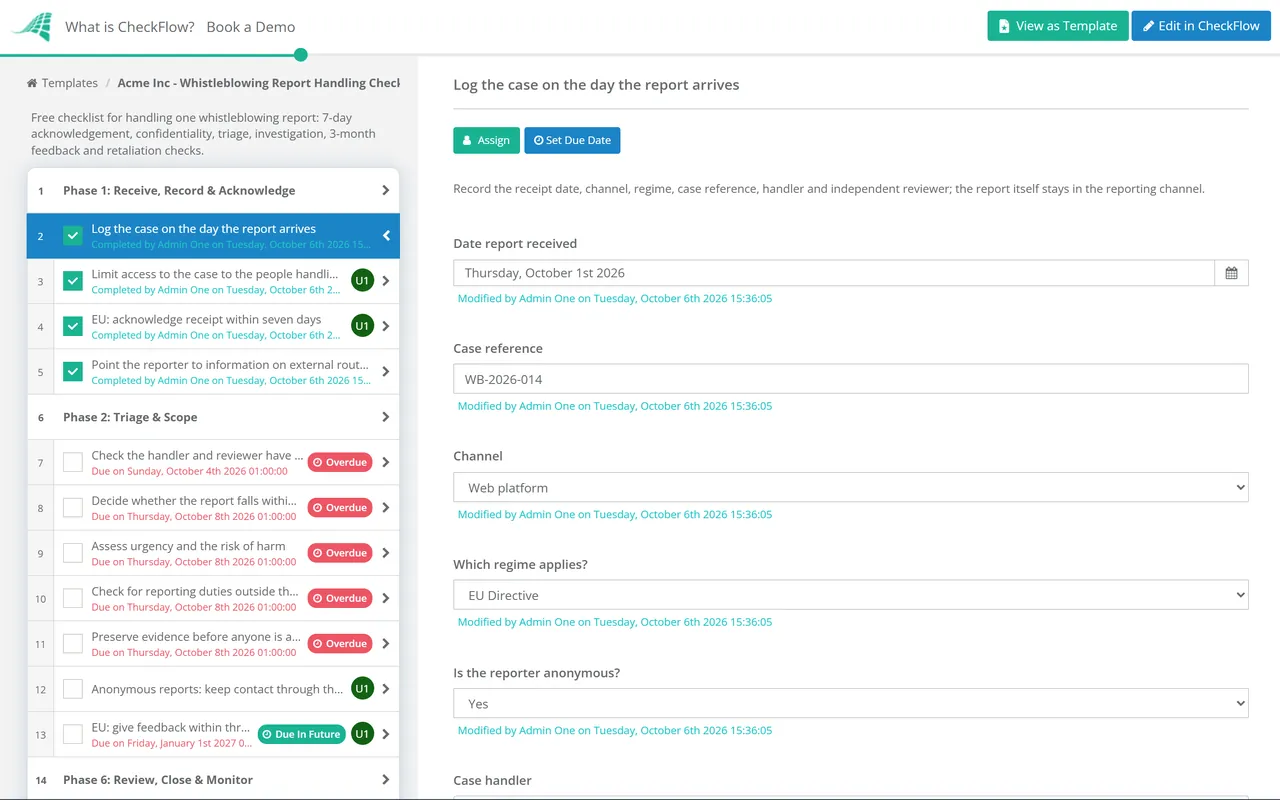
Log the case on the day the report arrives — record the receipt date, channel, regime, case reference, handler and independent reviewer; the report itself stays in the reporting channel
Limit access to the case to the people handling it — Article 16 keeps the reporter’s identity within authorised staff unless they consent; use a case reference, never a name
Write up oral reports and meetings accurately — record with consent or take full minutes, then let the reporter check, correct and sign them, as Article 18 requires
EU: acknowledge receipt within seven days — reply through the channel the reporter used, including the anonymous mailbox, as Article 9(1)(b) requires
UK and elsewhere: acknowledge promptly and explain what happens next — the UK sets no deadline, so check local law elsewhere and treat seven days as the target
Point the reporter to information on external routes — competent authorities in the EU, prescribed persons in the UK; internal reporting is never the only option
Phase 2
Phase 2: Triage & Scope
An out-of-scope report gets a routing task. Phases 3 and 4 appear only when the report is wholly or partly in scope.
Check the handler and reviewer have no conflict with the people named — anyone named in the report, or in the line management of the person concerned, steps aside
Decide whether the report falls within the whistleblowing policy — EU: a breach in an Article 2 area or a national extension; UK: a section 43B category raised in the public interest
Route out-of-scope matters to the right process — a personal grievance about pay or a manager goes to HR, and the reporter is told where it went and why
Assess urgency and the risk of harm — danger to people, ongoing losses, destruction of evidence or a threat of retaliation set the pace for everything that follows
Check for reporting duties outside the organisation — a personal data breach, a regulatory self-report or an insurance notification each run on their own clocks
Preserve evidence before anyone is approached — suspend deletion of the mailboxes, logs and files involved, without alerting the person concerned
Phase 3
Phase 3: Plan the Investigation & Protect the Reporter
Shown only for reports in scope. The anonymous-contact task appears only when the reporter is anonymous.
Appoint an impartial investigator — independent of the person concerned and their reporting line; bring in an external investigator for allegations against senior leaders
Write terms of reference for the investigation — each allegation framed as a question, the evidence to gather, the people to interview and a target date
Map what could reveal who the reporter is — dates, documents and phrasing only they would know; plan interview questions that do not point back to them
Anonymous reports: keep contact through the channel’s secure mailbox — ask follow-up questions there, and make no attempt to identify the reporter
Put protective measures in place — no change to the reporter’s role, pay, shifts or appraisal without review, and tell their manager only what is necessary
Plan when and how to hear the person concerned — Article 22 protects the presumption of innocence and the right to be heard; time it so evidence is not compromised
Phase 4
Phase 4: Investigate & Give Feedback
The regime answer decides which feedback task appears. The findings answer on the last task decides whether Phase 5 appears.
Gather documents and data against the terms of reference — log each source, keep originals intact and set aside personal data that is plainly irrelevant, as Article 17 requires
Interview witnesses and the person concerned — agree a note of each interview, and put every allegation fairly before any conclusion is drawn
EU: give feedback within three months of the acknowledgement — say what action is planned or taken and why, even when the investigation is still running
UK and elsewhere: give feedback where feasible and appropriate — explain what has been done, within the limits set by confidentiality and the rights of others
Record a finding on each allegation — substantiated, partly substantiated, not substantiated or inconclusive, with the evidence behind each
Phase 5
Phase 5: Remediate
Shown only when the findings substantiate at least part of the report.
Refer conduct findings to the disciplinary process — the investigation report is evidence for a separate, fair hearing, not a sanction in itself
Fix the control that failed — give each root cause an action, an owner and a date, and track it to closure
Report to regulators, auditors or the board where required — substantiated fraud or a breach of law can trigger a notification duty or a disclosure to the external auditor
Recover losses and correct records — payments, contracts, financial statements or data affected by the wrongdoing
Feed the lessons into policy and training — flag the affected policy for its next review and brief the teams involved
Phase 6
Phase 6: Review, Close & Monitor
The closure approval is assigned to the independent reviewer named in Phase 1.
Write the final case report — allegations, process, findings, actions and decisions, with the reporter identified only by case reference
Tell the reporter the outcome — as much as confidentiality and the rights of others allow, and how to raise any retaliation they experience
Check how the reporter has been treated since the report — compare appraisals, shifts, pay and assignments with before; in the EU the employer must justify any detriment
Independent reviewer approves the closure — checks impartiality, the investigation and the feedback dates, then records Approved or Not approved
Set the retention date and close the file — keep records only as long as necessary and proportionate; Germany, for example, deletes them three years after closure
Add the case to the channel metrics — days to acknowledge and to feedback, scope, outcome and any retaliation complaint, for the periodic channel review
Whistleblowing Requirements Mapped to the Checklist
The table maps each requirement for handling a single report to its source under the EU Directive and in the UK, and to the phase that records the evidence. National transposing laws and sector rules add to it, so treat the table as a starting point, not legal advice.
Requirement
EU Directive 2019/1937
UK
Evidenced in
Internal channel
Art. 8: private employers with 50+ workers; 50–249 may share resources
No general duty; SYSC 18 for in-scope FCA firms
Phase 1
Secure, confidential channel
Arts. 9(1)(a) and 16
SYSC 18.3.1R: confidential and anonymous reports
Phases 1 and 3
Oral reports and meetings
Arts. 9(2) and 18(2)–(4): records the reporter can check and sign
Good practice
Phase 1
Acknowledgement
Art. 9(1)(b): within seven days
No statutory deadline
Phase 1
External routes
Art. 9(1)(g): information on reporting to competent authorities
Prescribed persons, ERA 1996 s.43F
Phase 1
Protected subject matter
Art. 2 areas of Union law, often widened nationally
ERA 1996 s.43B, incl. sexual harassment from 6 April 2026
Phase 2
Impartial follow-up
Art. 9(1)(c)–(d)
SYSC 18.3.1R: assessment and escalation
Phases 2 and 3
Anonymous reports
Arts. 6(2)–(3) and 9(1)(e): national law decides
SYSC 18.3.1R for in-scope firms
Phase 3
Person concerned
Art. 22: presumption of innocence, right to be heard
No statutory equivalent
Phases 3 and 4
Feedback
Art. 9(1)(f): within three months of acknowledgement
SYSC 18.3.1R: where feasible and appropriate
Phases 4 and 6
Retaliation
Arts. 19 and 21(5): employer must justify any detriment
ERA 1996 ss.47B and 103A
Phases 3 and 6
Records
Art. 18(1): every report, kept only as long as necessary
SYSC 18.3.1R: records and an annual board report
Phase 6
Some of this was moving at the time of review. Every member state has a transposing law, but several arrived years late: on 6 March 2025 the Court of Justice ordered Germany, the Czech Republic, Hungary, Luxembourg and Estonia to pay for late transposition, Germany €34 million. The Commission’s evaluation of the Directive was still under way, after a public consultation that closed on 22 April 2026, so expect amendments to be discussed. Nothing on this page is legal advice.
Why Track Whistleblowing Cases in CheckFlow?
1
Both deadlines set on day one
Dynamic due dates run from the receipt date you record: the acknowledgement at seven days and the feedback at three months. Answer the regime question and only the steps that apply appear, so an EU case and a UK case run on the same template.
2
Need-to-know, by assignment
Tasks go to the named handler and investigator, the case carries a reference rather than a name, and conditional logic keeps the investigation phases hidden until the report is confirmed in scope.
3
Independent sign-off before closure
The closure approval goes to the reviewer named at intake, and the checklist halts until it is answered. Every step records who completed it and when, which is what a tribunal or regulator will ask for.
CheckFlow is not a whistleblowing channel or a case-management system, and it gives no legal advice. Reports should come in through a dedicated, confidential tool, such as a secure web platform or hotline with an anonymous two-way mailbox, and stay there. CheckFlow tracks the handling steps around them, with access limited to the people on the case. A quarterly checklist on a recurring schedule can review the channel itself: volumes, response times, outcomes and retaliation complaints. CheckFlow’s HR checklist software runs the people processes around it.
How quickly must a whistleblowing report be acknowledged?
+
Under the EU Directive, within seven days of receipt, with feedback no later than three months after the acknowledgement, or three months after the seven days ran out if no acknowledgement was sent. National laws can be stricter. UK law sets no deadline, but acknowledging within a week and saying what happens next is the simplest way to keep a reporter inside your process.
Do UK employers have to have a whistleblowing policy?
+
Most do not. The governmentMost do not. Government guidance for employers, updated in April 2026, saysrsquo;s guidance for employers, in its 6 April 2026 version, says there is no legal requirement to have a policy or to respond to disclosures, while setting out why you should. Firms within SYSC 18, such as UK banks, building societies and Solvency II insurers, must have arrangements, and public bodies and regulated sectors often have their own rules. The protection for workers applies either way.
Do we have to accept anonymous whistleblowing reports?
+
The Directive leaves it to each member state, so check the transposing law where your workers are. An anonymous reporter who is later identified and suffers retaliation is still protected. Even where follow-up is optional, a channel with a two-way anonymous mailbox lets you ask questions and give feedback without learning who the reporter is.
What is the difference between a whistleblowing report and a grievance?
+
A grievance is about the worker’s own treatment, such as pay, workload or a dispute with a manager. A whistleblowing report is about wrongdoing with a wider impact. In the UK it must be in the reasonable belief that disclosure is in the public interest. One message can contain both, so the checklist routes the personal part to HR and keeps the rest.
How much feedback does a whistleblower have to get?
+
The Directive defines feedback as information on the action planned or taken and the grounds for it. That does not mean handing over the investigation report or disciplinary outcomes for named colleagues. A short account of what was looked at, what changed and why usually meets the definition.
How long should whistleblowing records be kept?
+
Article 18 requires a record of every report, kept no longer than necessary and proportionate, and data protection law applies throughout. Personal data plainly irrelevant to the report should not be collected or should be deleted. National laws set the figure: Germany’s HinSchG, for example, deletes the documentation three years after the procedure ends unless a longer period is needed.
Is CheckFlow free for this template?
+
14-day free trial, no card required. The Business plan is $10 per user per month after the trial. Full details at checkflow.io/pricing.
Handle Every Report Fairly, on Time and in Confidence
Free trial — no credit card required.
Do you like cookies? 🍪 We use cookies to ensure you get the best experience on our website. Learn more