Business Partnership Due Diligence Checklist Template

A comprehensive framework for evaluating a potential business partner before you are operationally, legally, or reputationally committed to the relationship.

A poorly vetted business partnership does not fail immediately — it fails slowly, expensively, and often with considerable collateral damage. The partner whose financial instability becomes apparent six months into a joint venture. The technology partner whose data security practices expose your customer data after integration. The distribution partner whose reputation in the market contradicts the one they presented in negotiations. Comprehensive due diligence before entering any material business partnership — joint venture, technology integration, distribution agreement, white-label arrangement, or strategic alliance — is the investment that prevents all of these. This free business partnership due diligence checklist gives business development teams, partnership managers, and senior leadership a structured framework for evaluating potential partners across every dimension that determines whether a partnership will succeed.

Use This Template Free See Live Example
No Credit Card Required

Why Partnership Due Diligence Is Treated as Optional — and Why That Is a Mistake

Business partnerships rarely receive the same rigour of due diligence as acquisitions or investments. There is no capital at risk in the same immediate sense. The relationship is framed as collaborative rather than transactional. The business development team wants to close the deal and move on. Legal review is treated as a formality. The result is that significant operational, financial, reputational, and legal risks are discovered after the partnership is live rather than before — when the cost of addressing or exiting them is substantially higher.

Material business partnerships create genuine exposure. A joint venture partner’s financial instability becomes your operational risk when deliverables are missed. A technology partner’s data security failures become your regulatory exposure when you have shared customer data under a contractual or GDPR obligation. A distribution partner’s compliance failures can affect your regulatory standing in their market. A white-label partner’s quality failures carry your brand. Comprehensive due diligence is not bureaucratic caution — it is the minimum appropriate care for any relationship where your organisation’s operations, finances, or reputation are materially dependent on another organisation’s performance.

What the Business Partnership Due Diligence Checklist Covers

This checklist covers eight assessment areas for comprehensive business partnership due diligence — appropriate for joint ventures, technology integrations, material distribution agreements, white-label arrangements, and any strategic partnership involving significant operational, financial, reputational, or legal commitment.

Phase 1

Partnership Overview & Strategic Fit Assessment

Strategic fit assessment should precede all other due diligence. A financially healthy, legally clean, operationally capable partner who is strategically misaligned is still the wrong partner.

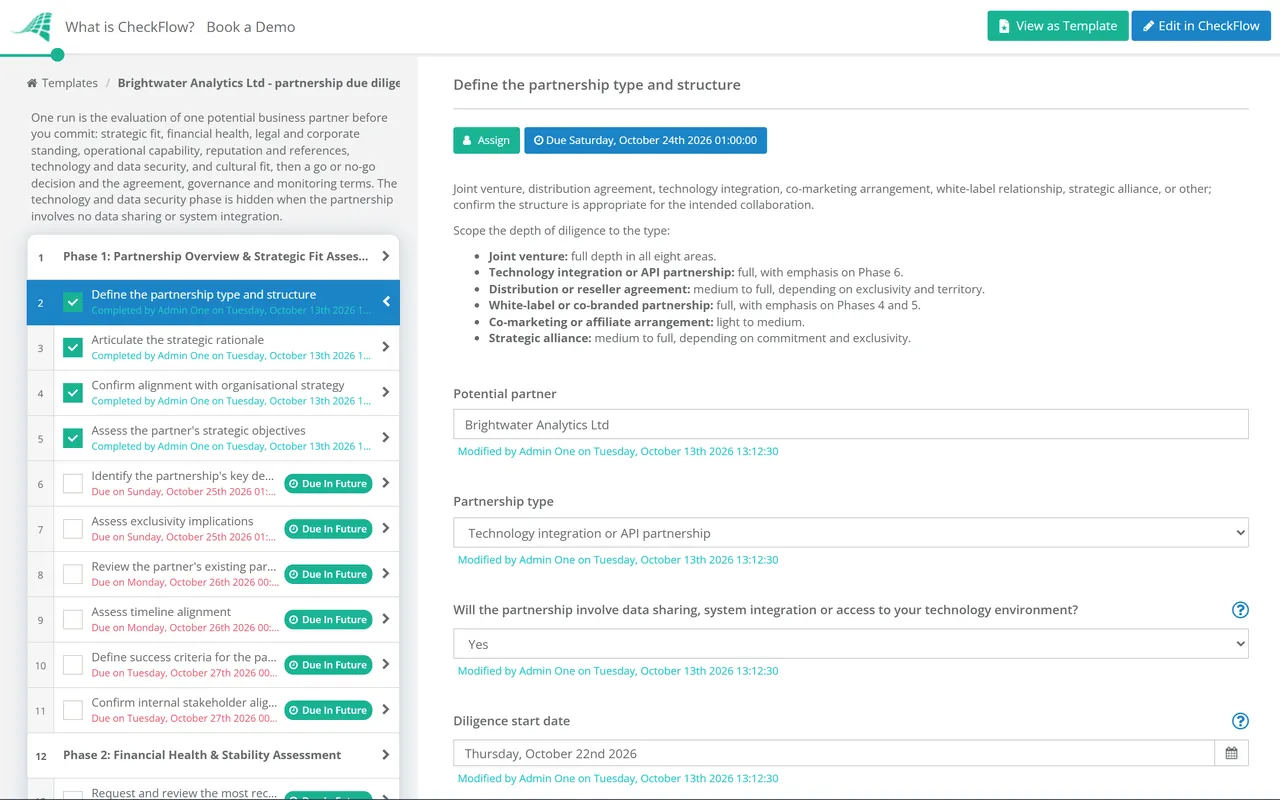
  • Define the partnership type and structure — joint venture, distribution agreement, technology integration, co-marketing arrangement, white-label relationship, strategic alliance, or other; confirm the structure is appropriate for the intended collaboration
  • Articulate the strategic rationale — why is this partnership being pursued? What does each party contribute and what does each party gain?
  • Confirm alignment with organisational strategy — does this partnership advance your core strategic objectives or distract from them?
  • Assess the partner’s strategic objectives — are they entering this partnership for reasons that are compatible with yours long-term?
  • Identify the partnership’s key dependencies — what does each party depend on the other for? What is the impact if either party fails to deliver?
  • Assess exclusivity implications — does this partnership preclude other relationships? Does the partner have competing relationships you should know about?
  • Review the partner’s existing partnership portfolio — who else do they work with? Are there conflicts or complementary relationships?
  • Assess timeline alignment — are both parties’ expected timelines and pace realistic and compatible?
  • Define success criteria for the partnership — agree on what a successful partnership looks like for both parties before the agreement is signed
  • Confirm internal stakeholder alignment — who internally needs to support this partnership for it to succeed? Do they?
Phase 2

Financial Health & Stability Assessment

  • Request and review the most recent two to three years of financial statements — income statement, balance sheet, and cash flow; confirm they are prepared by a credible accountant and audited where applicable
  • Assess revenue trend — is the business growing, stable, or declining? Is the growth or decline explained by the partner?
  • Assess profitability — is the business generating positive operating cash flow? If not, what is the path to profitability and how long is the runway?
  • Review debt and liabilities — confirm total debt obligations, any outstanding loans, and the ratio of debt to equity or revenue
  • Check credit standing — obtain a business credit report from an appropriate credit bureau; review payment history with suppliers and lenders
  • Confirm the partner has sufficient financial capacity to fulfil their partnership obligations — adequate staffing, infrastructure, and working capital for the committed scope
  • Identify any significant customer or revenue concentration — if a large proportion of revenue depends on one or two relationships, assess the risk of that dependency
  • Check for any recent or pending insolvency proceedings, administrations, or restructuring events
  • Assess funding stability — for VC-backed or PE-backed partners, assess the runway and likelihood of continued investor support
  • Document financial assessment findings — overall financial health rating, key risks, and any conditions or monitoring requirements
Phase 3

Legal & Corporate Standing Review

  • Confirm the company is properly incorporated and in good standing — obtain Companies House (UK), Secretary of State (US), or equivalent confirmation of current registration
  • Confirm the company is authorised to operate in all relevant jurisdictions — review business licences, permits, and any jurisdiction-specific operating requirements
  • Review the company’s ownership and corporate structure — confirm the ultimate beneficial owner(s) and review any complex holding structures
  • Conduct sanctions screening — check the company, its directors, and its beneficial owners against OFAC, EU, UN, and other applicable sanctions lists
  • Screen for Politically Exposed Persons (PEPs) — confirm directors and beneficial owners are not PEPs or have disclosed PEP connections
  • Review litigation history — search for any past or pending legal proceedings involving the company, its directors, or its principals
  • Review regulatory history — any regulatory investigations, fines, sanctions, or enforcement actions
  • Confirm intellectual property ownership — any IP material to the partnership is properly owned by the partner and free of encumbrances
  • Review material contracts for change of control or assignment provisions — any customer or supplier contracts that restrict partnership arrangements
  • Engage legal counsel to review findings and advise on any material legal risks identified
Phase 4

Operational Capability & Capacity Assessment

The most common reason business partnerships underdeliver is not strategic misalignment or legal failure — it is operational incapability. The partner genuinely cannot do what they represented they could do.

  • Assess the partner’s core operational capabilities — can they deliver what the partnership requires at the volume, quality, and speed committed?
  • Review team capacity and quality — do they have the right people to support the partnership? Is there key person dependency?
  • Assess operational infrastructure — facilities, technology systems, supply chain, and any other operational assets required to fulfil the partnership commitment
  • Review quality control processes — how does the partner maintain quality standards? Are there ISO or other relevant certifications?
  • Assess scalability — if the partnership succeeds and volume increases, can the partner scale their operations accordingly?
  • Review existing partner and customer load — how many other commitments does the partner currently carry? Will your partnership receive adequate attention and resource?
  • Assess geographic and time zone compatibility — are there operational friction points from geography, language, or time zone differences?
  • Review business continuity arrangements — what happens if the partner experiences a significant operational disruption? Do they have business continuity plans?
  • Confirm insurance coverage — appropriate professional indemnity, public liability, and any other relevant insurance is in place
  • Document operational capability findings — overall capability assessment, capacity risks, scalability assessment, and any conditions
Phase 5

Reputation & Reference Checks

  • Conduct online and media research — news coverage, industry press, social media, and any public controversy or negative coverage
  • Review customer and client feedback — Trustpilot, Google Reviews, Glassdoor (for culture), G2, Capterra, or other relevant review platforms
  • Request a minimum of three references from current or recent partners — organisations who have worked with the partner in a similar capacity
  • Conduct at least one back-channel reference — a contact in your network who knows the partner but was not provided as a reference
  • Conduct reference calls with structure — ask specifically about delivery against commitments, communication quality, how they behaved when things went wrong, and whether the reference would partner with them again
  • Review the partner’s public positioning — their website, case studies, and client list; confirm it is consistent with what they have represented to you
  • Assess industry standing — are they respected in their market? Are they members of relevant industry bodies?
  • Check director backgrounds — LinkedIn profiles, prior company histories, and any public adverse information
  • Assess ESG and values alignment — environmental practices, diversity and inclusion record, and any public controversies relevant to your organisation’s values and stakeholder expectations
  • Document reputation findings — overall reputation assessment, reference call summary, any concerns identified, and how they were addressed
Phase 6

Technology & Data Security Assessment

Technology and data security due diligence is non-negotiable for any partnership involving data sharing, system integration, or access to your technology environment. GDPR and equivalent regulations make this a legal obligation, not just good practice.

  • Confirm the partner’s approach to information security — do they have a documented information security policy? Is it current?
  • Review relevant certifications — ISO 27001, SOC 2, Cyber Essentials, or other applicable certifications; confirm they are current and relevant to the scope of the partnership
  • Request a completed due diligence questionnaire (DDQ) — covering access controls, data handling, incident response, and third-party risk management
  • Assess data handling and privacy practices — how will the partner process any shared customer or employee data? Confirm GDPR, CCPA, or applicable data protection compliance
  • Confirm a Data Processing Agreement (DPA) will be required and is appropriate for the scope of data sharing
  • Review incident history — any significant data breaches, security incidents, or regulatory notifications in the past three years
  • Assess third-party risk management — how does the partner manage the security of their own suppliers and subcontractors?
  • Confirm system integration security — for API or direct system integrations, assess authentication standards, data in transit encryption, and access controls
  • Assess business continuity and disaster recovery — what is their recovery capability for critical systems?
  • Document technology and security findings — security posture assessment, data risk assessment, required contractual protections, and any conditions
Phase 7

Cultural & Values Alignment Assessment

  • Assess organisational culture fit — how does the partner organisation operate? Is the working style compatible with yours?
  • Evaluate decision-making style — are they fast and entrepreneurial, or deliberate and process-driven? Is that compatible with the pace the partnership requires?
  • Assess communication norms — how do they prefer to communicate? Is their communication style compatible with your team’s expectations?
  • Review their approach to conflict and problem resolution — reference calls are the best source for this; how did they behave when a previous partnership encountered difficulty?
  • Assess commitment to the partnership — is this a strategic priority for them or a peripheral activity? Will it receive the attention it requires from their senior team?
  • Evaluate values alignment — review their public commitments on ESG, diversity, and ethics; confirm alignment with your organisation’s values and stakeholder expectations
  • Assess customer and employee treatment — Glassdoor reviews, employee NPS, and customer feedback all provide signals about how the organisation actually operates
  • Identify potential cultural friction points — different risk tolerances, different quality standards, different approaches to transparency
  • Conduct in-person or video meetings with key partnership contacts — cultural fit is difficult to assess through documents alone
  • Document cultural findings — overall compatibility assessment, specific friction points identified, and how they might be managed
Phase 8

Partnership Agreement, Governance & Ongoing Monitoring

  • Engage legal counsel to draft or review the partnership agreement — do not use a template agreement for any material partnership
  • Confirm the agreement covers scope and deliverables — what each party commits to and how performance is measured
  • Confirm the agreement covers exclusivity — what activities or geographies are exclusive, and what are not
  • Confirm IP ownership and licensing — who owns IP created during the partnership? What licences are granted?
  • Confirm revenue sharing, cost allocation, and payment terms — how financial flows between the parties are managed
  • Confirm liability and indemnification — how is liability apportioned for failures by either party?
  • Confirm data protection obligations — DPA, data processing scope, and breach notification requirements
  • Confirm exit provisions — how can either party exit the partnership, under what conditions, with what notice period, and what happens to shared assets or customers
  • Define the governance framework — who leads the partnership on each side, how decisions are made, how disputes are resolved, and how frequently the partnership is formally reviewed
  • Establish an ongoing monitoring programme — annual financial review, periodic performance review, and a structured process for addressing issues as they arise

This checklist is available as a free, runnable template in CheckFlow — with tasks assigned across your business development, legal, financial, and technology teams, progress tracked in real time, and a complete documented record of every assessment finding.

Use This Template Free

How Diligence Scope Varies by Partnership Type

Not all business partnerships require the same depth of diligence. The checklist above covers comprehensive assessment for material partnerships. The guide below indicates how scope adapts by partnership type.

Joint venture

Full — all eight areas with maximum depth

Specific focus: Financial stability and capacity; governance structure; exit provisions; IP ownership of jointly created assets.

JV creates shared liability and often a new legal entity — the highest-risk partnership structure and the one requiring most rigorous diligence.

Technology integration / API partnership

Full — particular emphasis on Phase 6 (technology and data security)

Specific focus: Security certifications; data handling practices; DPA; incident history; API security standards.

Technology integrations create data sharing obligations and potentially shared liability for security incidents.

Distribution or reseller agreement

Medium to full — dependent on exclusivity and territory

Specific focus: Market reputation; customer references; financial capacity to invest in the relationship; compliance practices in their market.

A distribution partner’s conduct in their market reflects on your brand. Their financial instability affects your market access.

White-label or co-branded partnership

Full — particular emphasis on Phase 5 (reputation) and Phase 4 (operational quality)

Specific focus: Brand compatibility; quality standards; customer complaint history; ability to maintain consistent quality at scale.

Your brand appears on their output. Quality failures become reputational failures for both parties.

Co-marketing or affiliate arrangement

Light to medium — proportionate to value and exclusivity

Specific focus: Reputation; brand alignment; marketing practices; any regulatory restrictions on the partner’s marketing activity.

Even lightweight marketing partnerships create brand association. A partner’s controversy becomes your PR problem.

Strategic alliance

Medium to full — dependent on commitment level and exclusivity

Specific focus: Strategic alignment; cultural compatibility; leadership commitment; competitive conflict.

Strategic alliances depend heavily on relationship quality at the executive level — cultural and values assessment carries more weight than in transactional partnerships.

Why Run Business Partnership Diligence in CheckFlow?

1

Coordinate across every team involved in the assessment

Business partnership due diligence involves business development, legal, finance, IT security, and potentially HR and operations — all assessing different aspects of the same partner simultaneously. CheckFlow assigns each phase to the right team member, notifies them of their responsibilities, and gives the partnership lead a live view of what has been completed and what is outstanding across every workstream — without weekly status meetings to reconstruct progress.


2

Nothing material is missed in the rush to close

Business development teams feel pressure to close partnerships quickly — relationships are warm, the opportunity feels time-sensitive, and due diligence feels like bureaucratic delay. CheckFlow’s structured checklist ensures that every required assessment is completed or explicitly documented as deferred and accepted risk before the agreement is signed. The findings that surface during diligence are the findings that would otherwise surface after the partnership is live — when addressing them costs far more.

3

A documented record for every partnership decision

Every completed assessment task is logged with a timestamp and the name of the responsible team member. The full diligence record — financial assessment, reference call notes, legal review findings, security questionnaire responses, and final recommendation — is archived in CheckFlow. When a partnership encounters difficulty and internal review asks what due diligence was conducted before signing, the answer is complete and immediately accessible.

Business partnerships with technology components require particular attention to data security and ISO 27001 compliance. CheckFlow’s ISO 27001 Compliance Checklist covers the information security controls you should expect a mature technology partner to have in place — and that you should verify during Phase 6 of this assessment. See the ISO 27001 Compliance Checklist →

For organisations that evaluate multiple potential partners simultaneously — or conduct annual reviews of existing partnerships — CheckFlow’s recurring checklist feature can schedule annual partner reviews automatically, ensuring the relationship is assessed against current criteria rather than the original diligence conducted at onboarding.

Frequently Asked Questions

What is business partnership due diligence?

+

Business partnership due diligence is the structured process of evaluating a potential business partner before entering a material commercial relationship — joint venture, technology integration, distribution agreement, white-label arrangement, strategic alliance, or any other partnership involving significant operational, financial, reputational, or legal commitment. It covers eight core assessment areas: strategic fit, financial health and stability, legal and corporate standing, operational capability and capacity, reputation and reference checks, technology and data security, cultural and values alignment, and partnership agreement and governance terms. Comprehensive due diligence ensures that material risks are identified before the partnership is live rather than after — when the cost of addressing or exiting them is substantially higher.

How is business partnership due diligence different from vendor due diligence?

+

Business partnership due diligence and vendor due diligence share several common areas — financial health, legal standing, and operational capability — but differ in purpose and depth. Vendor due diligence evaluates a supplier’s ability to deliver a defined product or service reliably and compliantly. Business partnership due diligence evaluates a broader strategic relationship where both parties contribute to and benefit from a shared objective — and where misalignment, cultural incompatibility, or strategic divergence can cause as much damage as operational failure. Partnership diligence consequently places greater weight on strategic fit, cultural alignment, executive commitment, and the governance structure of the relationship itself.

What are the most common reasons business partnerships fail?

+

Research and practitioner experience consistently identify five primary causes of business partnership failure. First, strategic misalignment — partners have different long-term objectives that become apparent only after the relationship is established. Second, operational incapability — one party cannot deliver what they committed to at the required volume, quality, or speed. Third, financial instability — a partner’s deteriorating financial position creates operational risk or forces an unexpected exit. Fourth, cultural incompatibility — different working styles, communication norms, risk tolerances, or values create friction that erodes the relationship over time. Fifth, governance failure — the partnership lacked clear decision-making processes, escalation paths, and performance review mechanisms from the start. All five are identifiable through structured due diligence.

Does all business partnership due diligence require legal counsel?

+

Legal counsel is essential for reviewing the partnership agreement itself — particularly for joint ventures, technology integrations with data sharing obligations, or any partnership involving IP creation or licensing. For lighter commercial arrangements, the legal review may be limited to the contract itself. The structured assessment phases — financial health, operational capability, reputation, and cultural alignment — can be conducted internally by the business development team using a structured checklist. The general principle is to engage legal counsel for any partnership involving legal entity creation, significant IP, regulated activities, or data sharing obligations — and to use a structured internal process for all other diligence phases.

Should existing partnerships be periodically re-assessed?

+

Yes. Businesses change — sometimes significantly — over the life of a partnership. A partner whose financial health was strong at the time of the original due diligence may have deteriorated. Their security certifications may have lapsed. Key personnel who were central to the relationship’s success may have left. Regulatory changes may have created new compliance obligations. An annual partner review — proportionate in depth to the materiality and exclusivity of the relationship — is appropriate for any partnership involving significant operational, financial, reputational, or legal dependency. CheckFlow’s recurring checklist feature can schedule these reviews automatically.

Is CheckFlow free to use for this template?

+

You can start a free 14-day trial with no credit card required, giving you full access to all features including this template. The Business plan is $10 per user per month after the trial. Full details at checkflow.io/pricing.

Evaluate Every Partner Thoroughly Before You Commit

Free trial — no credit card required.