
Who is the customer?
Test: identity, ownership and purpose of the relationship.
Timing: at onboarding and periodic or trigger reviews.
Output: a verified file and a risk rating.
Last reviewed: October 2026
No Credit Card Required
Printed from checkflow.io/templates/financial-services/sanctions-screening-checklist
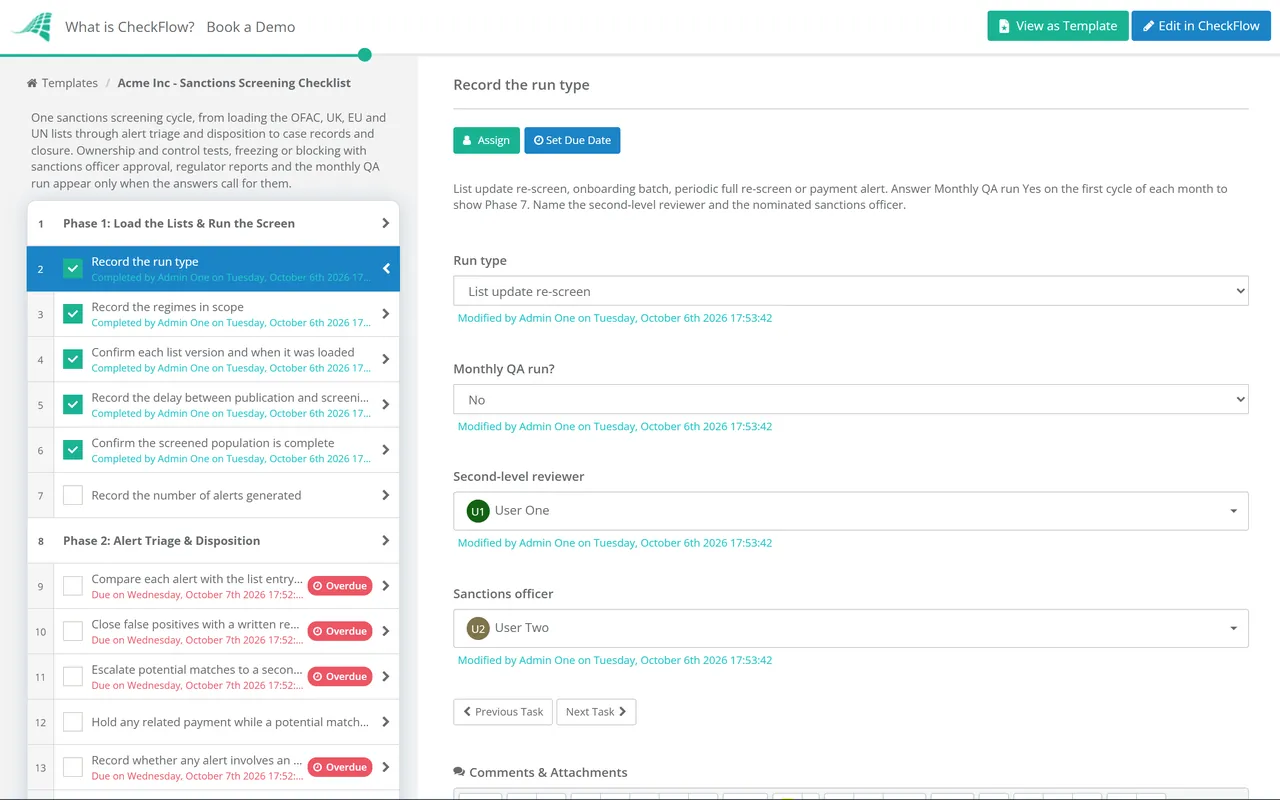
Sanctions screening checks customers, their owners and controllers, and payments against government lists of designated persons. This free checklist is for sanctions and financial crime teams at banks, payment and e-money firms, brokers, wealth managers and fintechs subject to US (OFAC), UK (OFSI) or EU sanctions. It runs one screening cycle from list update to closure: loading the lists, re-screening, triaging alerts, testing ownership and control, freezing or rejecting on a true match, reporting to each regulator on time and keeping the records. Ownership analysis, true-match handling and the monthly QA review only appear when the answers call for them.
Three phases run on every cycle. Ownership and control, true-match handling, regulator reporting and the monthly QA review switch on only when the answers in earlier phases call for them.
Assigned to the sanctions analyst on duty. The match answers recorded in Phase 2 decide which freeze and reporting tasks appear later.
Shown only when an alert involves a designated person in an entity’s ownership or control chain.
Shown only when a true match is confirmed or cannot be ruled out. The decision is an approval task for the nominated sanctions officer.
Tasks appear for the regime of the confirmed match, with due dates set from the date of the action.
Shown on the first cycle of each month. The QA checker must not have dispositioned the alerts being sampled.
The three regimes overlap but differ on ownership, reporting deadlines and record keeping. Which apply to you depends on where you are, your customers and the currencies you handle, so treat the table as a starting point, not legal advice.
| Requirement | United States (OFAC) | United Kingdom (OFSI) | European Union | Phase |
|---|---|---|---|---|
| Lists | SDN List and non-SDN lists | UK Sanctions List, the only source since 28 January 2026 | EU consolidated financial sanctions list | 1 |
| Screening frequency | Risk-based, per OFAC’s 2019 compliance framework | Risk-based | From 10 July 2027, regularly and on every new designation for financial institutions (AMLR Art. 26(4)) | 1, 7 |
| Ownership | 50% or more, aggregated, direct or indirect (50 Percent Rule) | More than 50% of shares or votes, or board appointment rights | 50% or more, aggregated (Best Practices, July 2024) | 3 |
| Control | Not part of the rule; treat with caution | Control test applies | Control criteria apply | 3 |
| Action on a match | Block, or reject a prohibited transaction | Freeze; do not make funds available | Freeze; do not make funds available | 4 |
| Report a match | Blocked and rejected reports within 10 business days, 31 CFR 501.603–604 | As soon as practicable, for relevant firms | To the national competent authority; two weeks under Reg. 269/2014 | 5 |
| Annual report | Blocked property as at 30 June, by 30 September | Frozen assets review; 2026 deadline 30 November | No EU-wide equivalent; check national rules | 5 |
| Records | 10 years, since 21 March 2025 (31 CFR 501.601) | No single sanctions period; AML records 5 years | AML records 5 years | 6 |
Some of this is moving. In February 2026 the UK government opened a call for evidence on the ownership and control test, focused on the hypothetical element of control; it closed on 13 April 2026. The government has said it is exploring aggregation and a “50% or more” threshold to align with the US and EU, but at the time of writing the UK test is unchanged. OFSI also revised its enforcement guidance in February 2026, including an Early Account Scheme that can reduce a penalty for a firm that gives a full, early account of a breach. OFAC extended its record-keeping period from five to 10 years to match the longer statute of limitations enacted in April 2024, and has required electronic reporting through its reporting system since August 2024.
Open a cycle by hand, on a daily recurring schedule, or from your screening tool through the API and webhooks when a new list loads. Each cycle has an owner, and an unworked one shows as overdue.
When Phase 2 records a true match, conditional logic opens the freeze and reporting phases for the regimes in scope, with the OFAC 10-business-day reports due from the date of the block or rejection.
Screening reports, registry extracts and filed reports attach to their tasks. The sanctions officer’s decision is an approval task, and the timestamped activity trail exports for your record-keeping file.
CheckFlow is not a screening engine or list provider, and it does not match names or block payments. It runs the workflow around your screening tool: who loaded the list, who cleared each alert and why, who approved the freeze and when each report went in. CheckFlow’s compliance checklist software covers the rest of the financial crime calendar, and the fintech overview shows how payment firms run it.
Sanctions screening is one pillar of the wider programme reviewed in the AML Compliance Programme Review Checklist, where list update times and alert ageing feed the MLRO’s monthly pack. Re-screening at each KYC refresh follows the KYC Periodic Review Checklist, and new customers are screened at onboarding through the Customer Due Diligence Checklist.

AML Compliance Programme Review Checklist

KYC Periodic Review Checklist
Customer Due Diligence Checklist

Business Partnership Due Diligence Checklist

Regulatory Examination Preparation Checklist
Describe the process in a sentence and the AI checklist generator drafts the phases and tasks for you.
It is the process of checking customers, their beneficial owners and controllers, and the parties to payments against official lists of designated persons, such as OFAC’s SDN List, the UK Sanctions List and the EU consolidated list. Potential matches are investigated, false positives are closed with a reason, and true matches are frozen, blocked or rejected and reported.
US and UK rules leave the frequency to a risk-based approach, but because liability does not depend on knowledge, most financial institutions re-screen the whole customer base whenever a list they apply changes, and screen payments in real time. From 10 July 2027 the EU AMLR requires financial institutions to check on every new designation as well as regularly.
Under OFAC’s rule, an entity owned 50% or more in aggregate, directly or indirectly, by one or more blocked persons is itself blocked, even if it is not on the list. Since July 2024 EU guidance also uses 50% or more with aggregation. The UK test is more than 50% of shares or voting rights or the right to appoint a board majority, plus a separate control test; aggregation and a 50% threshold are being considered but not adopted.
To OFAC, within 10 business days of blocking property or rejecting a transaction, through the OFAC Reporting System. To OFSI, as soon as practicable once a relevant firm knows or has reasonable cause to suspect it is dealing with a designated person. In the EU, reports go to the national competent authority; under the Russia regime the deadline is two weeks.
For OFAC, at least 10 years after the transaction, and for blocked property 10 years after it is unblocked. The longer period applies from 21 March 2025. UK and EU sanctions rules set no single equivalent, so most firms keep screening records for at least their five-year AML record-keeping period, and many align with the US 10 years.
14-day free trial, no card required. The Business plan is $10 per user per month after the trial. Full details at checkflow.io/pricing.
14-day free trial, no credit cardFull refund in your first 30 daysUS hosting, EU on request