Freight Invoice Audit Checklist Template

Check a period’s carrier invoices before you pay them: matched to shipments and proof of delivery, with rates, weights, fuel and accessorials checked against the agreement, disputes raised and payment approved.

Last reviewed: November 2026

Printed from checkflow.io/templates/transport-logistics/freight-invoice-audit-checklist

This free freight audit checklist is for shippers in any country, and the logistics and accounts payable people who check carrier invoices before they are paid. One run is one period’s invoices, planned back from the payment run. It gathers the rate agreements, accessorial schedules and fuel tables, collects the invoices, your own shipment records and proof of delivery, matches each invoice to its shipment, and catches duplicates and charges for cancelled loads. It checks the base rate, weight, dimensions, class, zone and service, the fuel surcharge and accessorials against the agreement, claims refunds for service failures and raises disputes, then ends with an approval before payment, coding, the payment run and a report of the period’s findings. Notes for US, UK and international road carriers appear when you tick them.

Checking Freight Bills Before Payment, Not Approving Any Invoice

A freight invoice audit checks a period’s carrier invoices against what was agreed, shipped and delivered before they are paid: each invoice matched to a real shipment, billed once, at the agreed rate, with only the fuel and extra charges the agreement allows, and any service failure claimed back. This checklist runs that audit for one period, owned by logistics or accounts payable, and ends with an approval for payment. It works for road, parcel, air and sea carriers in any country, with notes for US, UK and international road carriers.

Approving any supplier’s invoice, with its budget checks and approvers, is the Invoice Approval Workflow Checklist, and the whole payables cycle is the Accounts Payable Process Checklist. A brand moving to a new 3PL checks the 3PL’s first invoice against the rate card in the 3PL Onboarding Checklist. Following a shipment to delivery and handling its exceptions is the Shipment Tracking Workflow Checklist, vetting a new carrier before its first load is the Carrier Onboarding & Vetting Checklist, and reviewing your suppliers as a whole, carriers included, is the Vendor Oversight Checklist.

This checklist

Auditing a period’s freight invoices

Who runs it: a shipper’s logistics or accounts payable team.

Covers: every carrier invoice for the period matched to its shipment and proof of delivery, and its rate, weight, class, zone, service, fuel surcharge and accessorials checked against the agreement, with disputes and refunds.

Output: an approved payment, disputes raised with the evidence, and a report of the period’s findings.
Any supplier

Invoice approval workflow

Who runs it: accounts payable and the budget holders.

Covers: receiving any supplier’s invoice, matching it to the order and receipt, approval by the right person and payment.

Output: an approved invoice, in the Invoice Approval Workflow Checklist.

One 3PL

Moving to a new 3PL

Who runs it: a brand moving its fulfilment to a new third-party logistics provider.

Covers: the contract, SLAs and rate card, data, test orders, go-live, and the first invoice checked against the rate card.

Output: a live 3PL, in the 3PL Onboarding Checklist.

What the Freight Invoice Audit Checklist Covers

Nine phases take one period’s carrier invoices from the agreements to the report. The first task records the period and the date of the payment run, which sets every due date: the audit starts three working weeks before it, and the report follows a week after. It also asks which rules apply to the period’s carriers: US carriers add a check on charges billed after the original bill and notes on credit periods, freight bills, freight class, brokered loads and dispute time limits; UK carriers add notes on VAT invoices and conditions of carriage; international road carriage under CMR adds notes on the consignment note and the limitation period. Answering that there are charges to dispute adds the tasks to raise the disputes, decide what to pay meanwhile, and track them after payment. The approver’s decision is the gate: nothing after it can be completed until the approver completes it with Approved or Approved with changes, and Not approved shows a rework task above it and leaves it open.

  1. Phase 1

    Phase 1: Set Up the Audit

    3 tasks

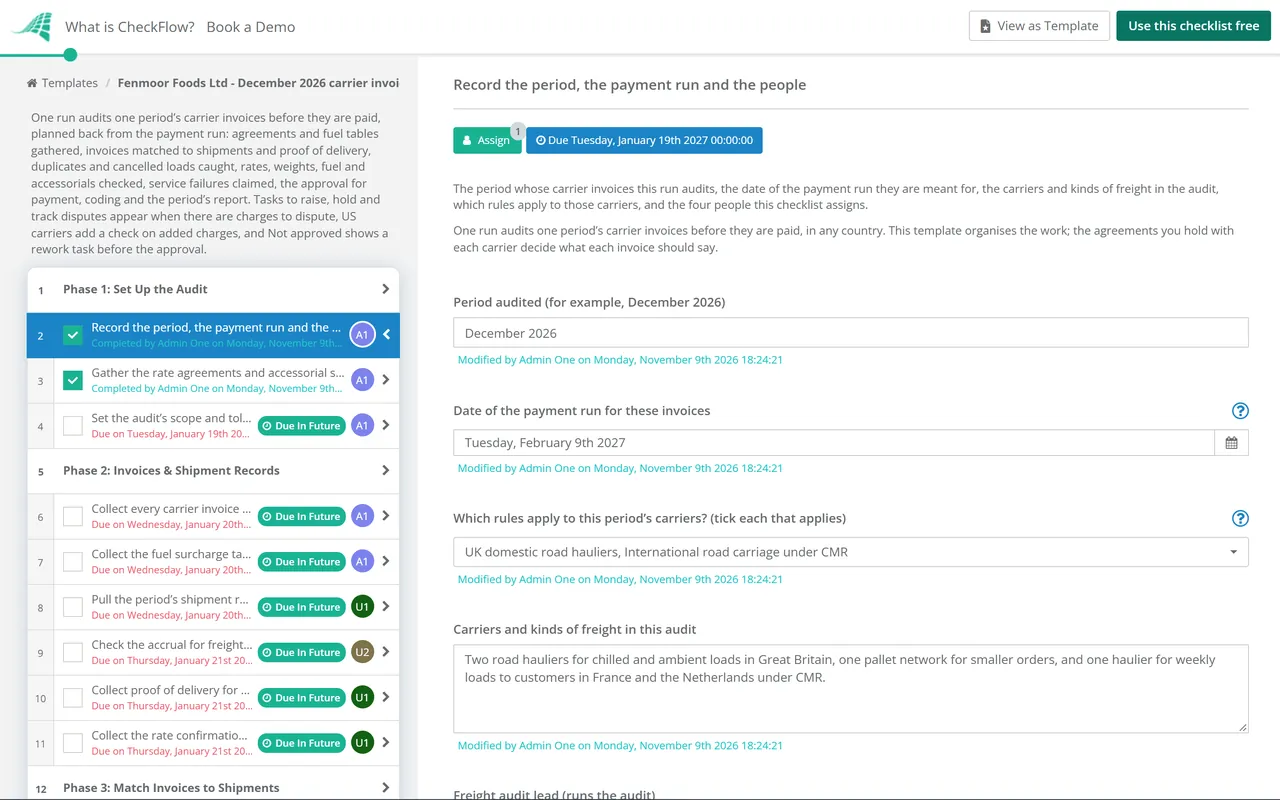
    Owned by the freight audit lead. Enter the date of the payment run these invoices are meant for: every due date counts back from it in working days, and this template allows three working weeks before it for the audit. Gather the agreements you check the invoices against before the invoices arrive.

    • Record the period, the payment run and the people — the period whose carrier invoices this run audits, the date of the payment run they are meant for, the carriers and kinds of freight in the audit, which rules apply to those carriers, and the four people this checklist assigns
    • Gather the rate agreements and accessorial schedules — each carrier’s signed rate agreement or contract, its accessorial schedule and payment terms, any rules tariff, service guide or conditions of carriage the agreement names, and any rate change agreed in writing for the period
    • Set the audit’s scope and tolerance — which carriers, kinds of freight and charges this run audits, which invoices it leaves out and why, and the tolerance below which a difference is accepted without a dispute; this template leaves the tolerance to your own policy
  2. Phase 2

    Phase 2: Invoices & Shipment Records

    6 tasks

    Bring the invoices and your own shipment records together. The audit checks each invoice against what you shipped, what was agreed and what was delivered, so each of those needs your own record, not only the carrier’s copy.

    • Collect every carrier invoice for the period — invoices from email, carrier portals and electronic billing gathered into one register with the carrier, the invoice number and date, your shipment reference and the amount; invoices that arrive later are added before Phase 3 ends
    • Collect the fuel surcharge tables and index prices — each carrier’s fuel table or percentage from its agreement, and the published index price for each week or month the table uses, so each shipment’s surcharge can be worked out from its ship date
    • Pull the period’s shipment records — every load and parcel shipped in the period from your TMS, despatch or warehouse system, with its reference, carrier, ship date, origin, destination, pieces, weight and dimensions as shipped, and the service ordered, plus every load booked and then cancelled
    • Check the accrual for freight not yet invoiced — shipments in the period with no invoice yet, listed with their agreed cost for the period’s accrual, as your month-end close requires; if the close has already passed, the accrual made then checked against the invoices that arrived
    • Collect proof of delivery for each shipment — the signed delivery note, proof of delivery or the carrier’s electronic confirmation, with the delivery date and time and any shortage or damage noted at delivery
    • Collect the rate confirmations for spot loads — the written quote or rate confirmation for each load booked outside the agreements, with any extra charges agreed at booking
  3. Phase 3

    Phase 3: Match Invoices to Shipments

    5 tasks

    Every invoice should belong to one real shipment that was delivered, and be billed once. Invoices that match nothing, duplicates and charges for cancelled loads are caught here, before anyone checks a rate.

    • Match each invoice to its shipment — each invoice linked to a shipment in your own records by its reference, bill of lading or consignment note number, ship date, origin and destination; an invoice that matches no shipment is set aside and questioned with the carrier
    • Confirm each billed shipment was delivered — the proof of delivery found for each invoice, with shipments not delivered, delivered short or still in transit marked for the checks in Phases 4 and 5
    • Check for duplicate invoices — the same shipment billed twice, such as the same invoice or shipment number, the same amount and date, a reissued invoice already paid, one invoice sent both by email and through a portal, or one load billed by both a broker and the carrier it used
    • Check for charges on cancelled or unshipped loads — invoices for loads that were booked and then cancelled, or never collected; a cancellation charge is paid only where the agreement or the rate confirmation provides for it, at the agreed amount
    • Check each invoice shows what you need to pay it — the carrier’s legal name and remittance address, the invoice number and date, your reference, the ship date, origin and destination, pieces and weight, each rate and charge set out, any tax, the currency and the total; an invoice missing these is sent back for a corrected one
  4. Phase 4

    Phase 4: Check Charges Against the Agreement

    7 tasks

    Work out what each shipment should have cost from the agreement, your shipment record and the fuel table, and compare it with the invoice line by line. A change made after shipping, such as a reweigh, needs the carrier’s evidence.

    • Check the base rate on each invoice — the line-haul or base rate, the minimum charge and any discount against the agreement or the rate confirmation for that lane, zone or distance, at the rate in force on the ship date
    • Check the weight, dimensions and freight class — the billed weight against the weight shipped, any dimensional or volumetric weight worked out with the divisor or ratio in the agreement, pallet counts and sizes, and the freight class where one applies; a reweigh or reclass is accepted only with the carrier’s inspection record
    • Check the zone, distance and service level — the origin and destination postcodes or zones, the mileage used for rates by distance, and the service billed against the service ordered, such as an express or timed service billed where a standard one was booked
    • Check the fuel surcharge — the surcharge worked out from the carrier’s fuel table and the index price for the ship date, applied only to the charges the agreement names, and not charged at all where an all-in rate already includes fuel
    • Check accessorial charges — each extra charge, such as waiting time, tail lift, residential or timed delivery, redelivery, storage or a toll, allowed by the agreement or confirmed at booking, billed at the agreed rate, and backed by evidence, such as arrival and departure times beyond the agreed free time for waiting
    • Check tax, currency and totals — the tax rate and treatment, the currency and any exchange rate the agreement sets, and the arithmetic of each line and each total
    • Check added charges against the 180-day rule — US motor carriers only: any bill for charges added after the original bill, such as a reweigh, a reclass or a late accessorial, checked for when it was issued, since a carrier must issue it within 180 days of the receipt of the original bill to have the right to collect those charges
  5. Phase 5

    Phase 5: Service Failures & Refunds

    3 tasks

    A charge for a service that was not given is not paid. Late and failed deliveries are checked against what the agreement or the carrier’s guarantee promises, and loss and damage go to a separate claim.

    • Check deliveries against the service promised — late deliveries, missed collections and failed deliveries found from the proof of delivery and tracking records, against the transit time or guaranteed service in the agreement or the carrier’s service guide
    • Claim service guarantee refunds and credits — a refund or credit claimed through the carrier’s own process and within its time limit for each failure the agreement or the carrier’s guarantee covers, and no charge paid for a premium service, such as a timed delivery, that was not given
    • Pass loss and damage to the cargo claims process — shipments lost, damaged or short passed to whoever handles cargo claims, since a claim follows its own process, evidence and time limits; this template pays or disputes each invoice on its own terms and does not take a claim off an invoice unless the agreement allows it
  6. Phase 6

    Phase 6: Findings & Disputes

    4 tasks

    Record every difference in one place, then decide which to dispute. Answering that there are charges to dispute adds the tasks to raise them with each carrier, decide what to pay meanwhile, record the replies and, after the payment run, track them to the end.

    • Record the differences found — each difference with the invoice, the carrier, the kind of error, the amount billed, the correct amount and the difference, and the differences inside your tolerance marked as accepted
    • Raise disputes with each carrier — a written dispute to each carrier through its own process, listing each invoice, the charge disputed, the correct amount and the evidence, and asking for a credit note or a corrected invoice
    • Decide what to pay on disputed invoices — for each disputed invoice, pay the undisputed part and hold the rest, hold the whole invoice, or pay in full and claim a credit, as the agreement allows, recorded for the payment recommendation
    • Record the carriers’ replies before the payment run — credit notes and corrected invoices received, disputes the carrier rejected with its reasons, and disputes still open, carried into the payment recommendation
  7. Phase 7

    Phase 7: Approval for Payment

    3 tasks

    The approver decides what is paid. Nothing after the approval can be completed until the approver completes it, with Approved or Approved with changes. Not approved shows a rework task above it and leaves the approval open.

    • Prepare the payment recommendation — the invoices to pay in full, pay in part and hold, the total to pay by carrier, the differences found and recovered, and anything the approver should know, such as a large spot load or a carrier with repeated errors
    • Rework the audit before approval — not approved only: each point the approver raised put right, such as a check repeated, a dispute added or an invoice moved between pay and hold, and the payment recommendation updated
    • Approve the invoices for payment — Approved, Approved with changes or Not approved, with the changes or the reasons, recorded by the approver alone
  8. Phase 8

    Phase 8: Coding & Payment

    4 tasks

    Accounts payable codes and pays only what was approved, holds the rest, and tells each carrier why a payment is short.

    • Code each approved invoice — each invoice coded to the account, cost centre or department in your chart of accounts, with freight you recharge to a customer or a project marked for re-billing
    • Check the carriers’ bank details before payment — each carrier’s bank details matched against your supplier records, and any change confirmed by a call to a number from your own records before it is used
    • Pay the approved invoices in the payment run — only the approved amounts paid, held invoices left out, and part payments made as recorded
    • Send remittance advice with the reasons for short payments — each carrier told what was paid, which invoices were held or paid in part and why, and which credit notes are expected
  9. Phase 9

    Phase 9: Follow-Up & Reporting

    6 tasks

    Report the period’s findings, fix the causes of errors that recur, and follow open disputes until each one is settled. In this template the report falls five working days after the payment run.

    • Report the period’s findings — the total billed and paid, the differences found and recovered, by carrier and by kind of error, disputes still open and service failures, to the people the audit reports to
    • Fix the causes of repeated errors — errors that recur, such as an old rate still loaded in a carrier’s system, a fuel table applied to the wrong charges, or wrong weights or addresses on your own shipping documents, raised with the carrier or your own team, each with an owner
    • Update the rate records for the next period — new agreements, rate changes, fuel tables and accessorial schedules filed for the next audit, and the scope and tolerance reviewed
    • Track open disputes until they are settled — each dispute followed up until the carrier issues a credit note, a corrected invoice or a rejection with its reasons, and escalated under the agreement if it stalls
    • Check credit notes and refunds against what was agreed — each credit note or refund checked against the agreed amount and set against the right invoice or the next payment
    • File the audit record — the invoice register, the findings, the disputes and replies, the approval and the payment record kept together, for as long as your records policy says

What to Check Each Freight Charge Against

What to check each charge against

The checks in Phases 3 to 5, with what each one compares and the evidence to keep for a dispute.

Charge or check Compare it with Evidence to keep
Duplicate billingInvoice and shipment numbers, amounts and dates already paid or in this period’s register, and any broker’s invoice for the same loadBoth invoices and the payment record
Cancelled or unshipped loadYour booking and shipment recordsThe cancellation, and the clause or rate confirmation that allows any cancellation charge
Base rate and minimum chargeThe rate agreement or rate confirmation for the lane, zone or distance, in force on the ship dateThe rate line used
Weight and dimensionsThe weights and dimensions you shipped, and the dimensional or volumetric divisor in the agreementYour despatch record, and the carrier’s reweigh or inspection record if it changed them
Freight class (US less-than-truckload)The class on your bill of lading and any class agreed in the rate agreementThe bill of lading and the carrier’s inspection record
Zone, distance and serviceThe postcodes or zones, the mileage used and the service you bookedYour booking
Fuel surchargeThe fuel table in the agreement and the index price for the ship dateThe table and the index price used
AccessorialsThe accessorial schedule, or what was agreed at bookingArrival and departure times, delivery notes and booking confirmations
Service failuresThe transit time or guarantee in the agreement or the carrier’s service guideProof of delivery and tracking records
Tax, currency and totalsThe tax treatment, currency and exchange rate the agreement setsThe recalculated invoice

Billing and dispute rules by where the carriage happens

The notes the first task’s rules question adds. Your agreement with each carrier sets the rest.

Where Rule What the source says
US motor carriersWhat a freight bill shows49 CFR 373.103: a for-hire, non-exempt motor carrier of property issues a freight or expense bill for each shipment, showing among other things the weight, volume or measurement where it applies to the rating, the exact rates assessed and the total charges due, including the nature and amount of any charges for special service
US motor carriersCredit and presenting bills49 CFR 377.203 and 377.205: where a carrier extends credit, the credit period is 15 days from the day after the freight bill is presented, unless the carrier’s tariff sets another of no more than 30 calendar days; the bill is presented within 7 days, not counting Saturdays, Sundays or legal holidays, of receiving the shipment, or of delivering it on collect shipments. These rules are written for tariff charges, and payment terms in a contract may differ; where they apply, a payment run later than the credit period allows may be late, and a tariff may add service or collection charges
US motor carriersAdded charges and contested bills49 U.S.C. 13710(a)(3): a carrier must issue any bill for added charges within 180 days of the receipt of the original bill, and a shipper must contest the original bill or a subsequent bill within 180 days of receipt of the bill. Under 49 U.S.C. 14101(b), a contract can expressly waive these rights in writing
US carriersRecovering overcharges49 U.S.C. 14705(b) and (g): a civil action to recover overcharges begins within 18 months after the claim accrues, and a claim related to a shipment accrues on delivery or tender of delivery. Under 49 U.S.C. 14101(b), a contract can expressly waive these rights in writing
US brokered loadsThe broker’s record49 CFR 371.3: a broker keeps a record of each transaction for three years, and each party to a brokered transaction has the right to review it
UK domestic roadContract termsThe contract and the conditions of carriage it names set the charges and the steps and time limits for disputes. The Road Haulage Association provides its conditions of carriage to its members
UKVAT invoicesHMRC VAT Notice 700, section 16: a VAT-registered customer needs a VAT invoice as evidence to reclaim the VAT charged; paragraph 16.3 lists what it shows
International road (CMR)Charges on the consignment noteCMR Article 6(1)(i): the consignment note contains the charges relating to the carriage
International road (CMR)Total loss and delayArticle 23(4): where the carrier is liable for a total loss, the carriage charges, customs duties and other charges are refunded in full (in proportion for a partial loss). Article 23(5): for delay, if the claimant proves damage resulted, compensation not exceeding the carriage charges
International road (CMR)LimitationArticle 32: one year for an action arising out of carriage under the Convention (three years for wilful misconduct); a written claim suspends the period until the carrier rejects it in writing

Where this comes from. eCFR, title 49: section 373.103, part 377, subpart B and section 371.3, current to 5 November 2026 (none of them has a suspended or temporary version); the US Code on GovInfo: 49 U.S.C. 13710 and 49 U.S.C. 14705, and on Cornell LII 49 U.S.C. 14101; the CMR in the Schedule to the Carriage of Goods by Road Act 1965 on legislation.gov.uk; HMRC’s VAT Notice 700 (updated 25 June 2026); the Road Haulage Association; and the NMFTA’s NMFC page. All read on 9 November 2026. No law requires a freight audit: the rules above set what a bill shows and how long you have to question it, unless a contract under 49 U.S.C. 14101(b) waives those rights. This table is a guide, not legal advice.

Why Audit Your Freight Invoices in CheckFlow?

1

No payment before someone approves

The approval is assigned to the approver alone, and the checklist halts there: coding, the payment run and the remittance advice cannot be completed until the approver completes it with Approved or Approved with changes. Not approved shows a rework task above the approval and leaves it open. See how approvals that halt a checklist work.

2

Only the notes and tasks your carriers need

Tick the rules that apply to the period’s carriers. US carriers add the 180-day check on added charges and notes on credit periods, freight bills, freight class, brokered loads and dispute limits; UK carriers add notes on VAT invoices and conditions of carriage; CMR adds notes on the consignment note and the limitation period. Charges to dispute add the tasks to raise, hold and track them.

3

Every difference in one record

Name the audit lead, the transport contact, accounts payable and the approver on the first task, and every step is assigned from those fields and dated from the payment run. Each difference goes in the findings table on the task that records it, and the Reports Grid lists each period’s audit with its answers, while Analytics shows where tasks are waiting.

CheckFlow does not read carrier invoices, load rate tables or fuel indexes, or work out what a shipment should cost: those stay with your team, your TMS and any freight audit software you use. CheckFlow makes sure every period gets the same checks in the same order, with an owner and a due date for each, an approval before payment, and a record of who checked what and when. See how a checklist runs.

Vet a new carrier with the Carrier Onboarding & Vetting Checklist, follow shipments with the Shipment Tracking Workflow Checklist, approve other supplier invoices with the Invoice Approval Workflow Checklist, and run the payables cycle with the Accounts Payable Process Checklist.

AI generator

Didn’t find what you need? Describe it.

Describe the process in a sentence and the AI checklist generator drafts the phases and tasks for you.

Frequently Asked Questions

What should a freight audit checklist include?

The rate agreements, accessorial schedules and fuel tables gathered first; every carrier invoice matched to its shipment and proof of delivery; checks for duplicates and charges for cancelled loads; the base rate, weight, dimensions, class, zone, service, fuel surcharge and accessorials checked against the agreement; service failures and refunds claimed; disputes raised and tracked; an approval before payment; coding; and a report of the period’s findings. This template covers those steps for one period’s invoices.

What is a freight bill audit?

A freight bill audit checks each carrier invoice against what was agreed, shipped and delivered before it is paid: the right shipment, billed once, at the agreed rate, with only the fuel and extra charges the agreement allows. An approval workflow checks that a purchase was authorised; a freight audit works out what the shipment should have cost and compares. This template runs the audit for one period and ends with an approval for payment.

Which freight invoice errors should an audit look for?

Duplicate invoices, charges for cancelled or undelivered loads, an old or wrong rate, a billed weight or size that differs from what was shipped, a changed freight class, the wrong zone or service level, a fuel surcharge worked out from the wrong index or applied to the wrong charges, extra charges the agreement does not allow, and tax or arithmetic errors. This template has a task for each and records every difference in one table.

How do you check a fuel surcharge on a carrier invoice?

Take the fuel table from the carrier’s agreement, find the index price it uses for the week or month the shipment was collected, read off the percentage or rate, and apply it only to the charges the agreement names. The agreement names the index, for example the US Energy Information Administration’s weekly diesel price or the UK government’s weekly road fuel prices. Check that an all-in rate is not charged fuel again.

How do you check accessorial charges?

Check each extra charge, such as waiting time, tail lift, residential delivery or redelivery, against the agreement’s accessorial schedule or what was confirmed at booking: is it allowed, at the agreed rate, and backed by evidence? For waiting time, compare the arrival and departure times with the free time agreed. A charge with no evidence is questioned with the carrier, not paid on trust. This template records each one it questions.

How long do you have to dispute a freight invoice in the US?

For motor carriers, 49 U.S.C. 13710(a)(3)(B) says a shipper must contest the original bill or a subsequent bill within 180 days of receipt of the bill in order to have the right to contest such charges, and a carrier must bill added charges within 180 days of receipt of the original bill. A civil action to recover overcharges must begin within 18 months after the claim accrues (49 U.S.C. 14705(b)). Under 49 U.S.C. 14101(b), a contract can expressly waive these rights in writing, so check yours.

Should freight invoices be audited before or after payment?

Before, where you can: a charge corrected before payment needs no refund. This template audits a period’s invoices before its payment run, holds disputed amounts as the agreement allows, and tracks open disputes after payment until a credit note or a reasoned rejection arrives. A review of invoices already paid can still find overcharges, which are then claimed from the carrier within the time limits that apply.

What should you do when a carrier reweighs or reclasses a shipment?

Ask for the carrier’s evidence, such as its inspection record, weight certificate or photographs, and compare it with your bill of lading, your own weights and dimensions, and any class agreed in your rate agreement. Accept the change if the evidence supports it, and dispute it in writing if it does not. If your own shipping data was wrong, correct it at source so the next shipment is billed right.

Does a freight audit cover loss and damage claims?

Not in this template. It notes shipments that were lost, damaged or short and passes them to whoever handles cargo claims, because a claim follows its own process, evidence and time limits. The audit deals with the charges: it claims refunds for service failures the agreement or the carrier’s guarantee covers, and for international road carriage under CMR, Article 23(4) says that where the carrier is liable for a total loss, the carriage charges are refunded in full.

Is CheckFlow free for this template?

14-day free trial, no card required. The Business plan is $10 per user per month after the trial. Full details at checkflow.io/pricing.

Check Every Freight Invoice Before You Pay It

Free trial — no credit card required.

14-day free trial, no credit cardFull refund in your first 30 daysUS hosting, EU on request