A structured invoice approval process — with defined thresholds, documented authorisations, and no invoice reaching payment without the right eyes having seen it.
Every uncontrolled invoice approval process carries the same risks: invoices approved too quickly by someone who has no visibility of whether the goods were received, whether the price was agreed, or whether the invoice has been paid before. Invoices stuck waiting for an approver who is travelling while early payment discount windows expire. No audit trail showing who approved what, when, and on what basis. And occasionally — the fraudulent invoice that slipped through because the process relied on memory and goodwill rather than structure. A structured invoice approval workflow defines who reviews invoices, at what threshold, in what sequence, with what documentation, and within what timeframe. This free checklist gives finance teams and business owners a framework for building a controlled, efficient, and auditable invoice approval process.
Problem: Any employee can approve any invoice. A junior team member approves a £50,000 professional services invoice without understanding what it was for or whether the work was delivered.
Fix: A written approval authority matrix with defined spend thresholds by role and category — reviewed annually and enforced in the process.
Bottleneck at a single approver
Problem: Every invoice routes to the same manager. When that manager is travelling, at a conference, or simply busy, the entire invoice queue stalls for days. Suppliers call chasing payment. Early payment discounts expire. Supplier relationships suffer.
Fix: Defined backup approvers for each approval level — with authority to approve in the primary approver’s absence — and a turnaround time standard that triggers escalation.
Verbal or informal approvals
Problem: A manager sends a one-line email saying “looks fine, pay it.” The invoice is paid. There is no record of who authorised the payment, when, or whether they reviewed the invoice against a PO. When the auditor asks for evidence of authorisation, there is none.
Fix: All approvals documented in the system with a named approver, timestamp, and approval level.
No escalation for exceptions
Problem: An invoice that does not match the PO, or that includes disputed items, sits in a queue with no owner and no resolution process. It is eventually paid or eventually ignored — neither of which is correct.
Fix: A defined exception handling process with a named owner, documented dispute, and resolution timeline.
What the Invoice Approval Workflow Checklist Covers
This checklist covers five phases of the invoice approval workflow — from initial receipt through to pre-payment authorisation and documentation archiving.
Phase 1
Invoice Receipt & Initial Validation
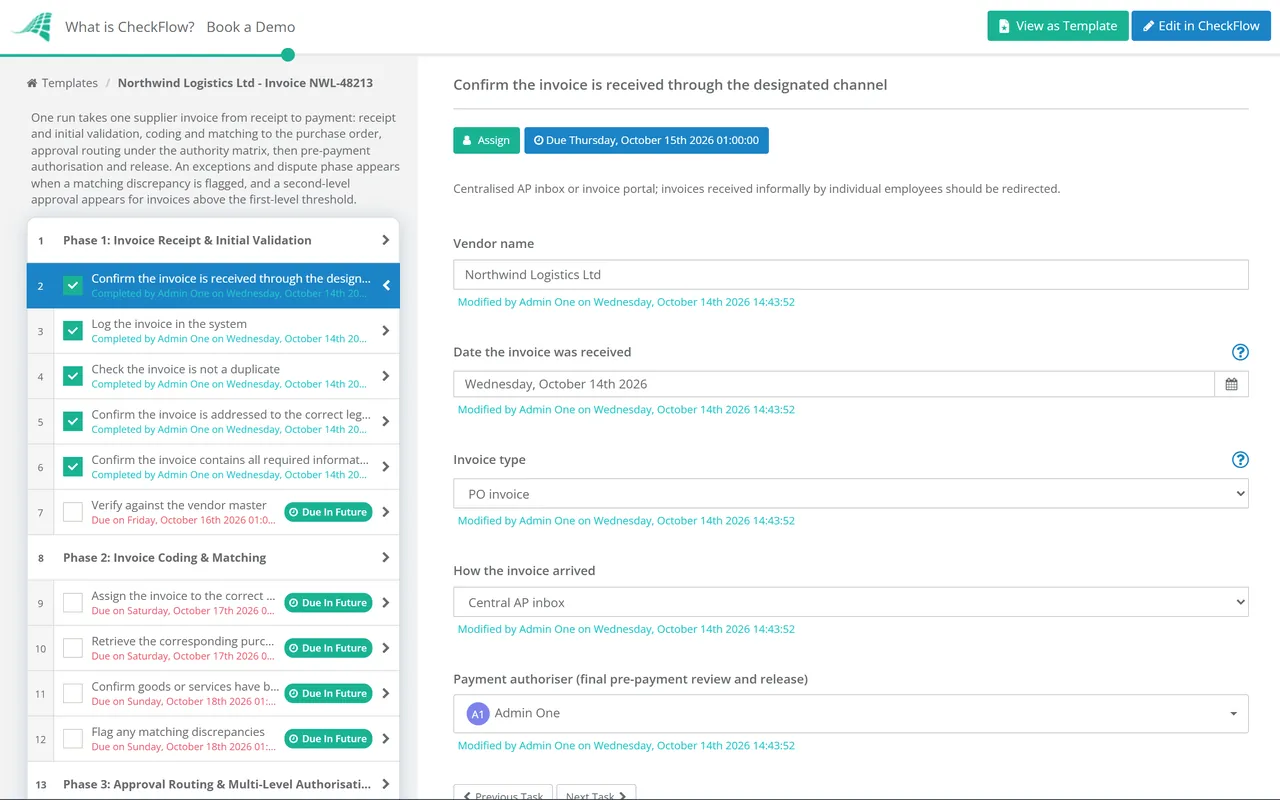
Confirm the invoice is received through the designated channel — centralised AP inbox or invoice portal; invoices received informally by individual employees should be redirected
Log the invoice in the system — vendor name, invoice number, invoice date, due date, and amount
Check the invoice is not a duplicate — confirm the invoice number and vendor/amount combination has not been previously processed
Confirm the invoice is addressed to the correct legal entity — particularly important for group companies with multiple trading entities
Confirm the invoice contains all required information — vendor legal name, address, VAT/tax number where applicable, invoice number, date, payment terms, and line item detail
Verify against the vendor master — confirm the vendor exists in the approved vendor list; do not approve invoices from vendors not in the system
Phase 2
Invoice Coding & Matching
Assign the invoice to the correct GL account and cost centre
Retrieve the corresponding purchase order — confirm the PO exists and is still open; match the invoice amount and quantities to the PO
Confirm goods or services have been received — via goods receipt note or service delivery confirmation
Flag any matching discrepancies — price variance, quantity difference, or goods not yet received; route to the exception process
For non-PO invoices — confirm the appropriate authorisation process for invoices without a purchase order is applied
Phase 3
Approval Routing & Multi-Level Authorisation
The approval authority matrix is the governance framework for the entire approval workflow. It must be documented, current, and enforced — not a remembered convention that varies with who happens to be available.
Confirm the approval authority matrix is current — who can approve at what spend level; confirm any recent personnel changes are reflected
Route the invoice to the correct first-level approver — based on invoice amount, category, and cost centre
Confirm the first-level approver is reviewing the invoice content — not just clicking approve; approvers should confirm the goods/services were received, the price was agreed, and the vendor is correct
Apply the turnaround time standard — invoices unapproved beyond the defined window trigger an escalation notification
Route to second-level approver for invoices above the first-level threshold — automatically if the workflow is defined; manually with a clear escalation path
Confirm the backup approver process — when the primary approver is unavailable, who has delegated authority? Delegation must be documented, not assumed
Document the final approval — named approver, timestamp, and approval level recorded in the system
Phase 4
Invoice Exceptions & Dispute Management
Define what constitutes an exception — price variance, quantity discrepancy, goods not received, duplicate suspected, or missing documentation
Assign a named exception owner — every exception has a person responsible for resolving it; exceptions without owners are exceptions that never get resolved
Place the invoice on hold — clearly marked in the AP system as disputed; the vendor notified promptly that there is a query
Communicate the dispute to the vendor — within a defined timeframe (typically 48 hours of identifying the issue); with specific detail about what is disputed
Set and track the resolution timeline — exceptions outstanding beyond the defined period escalate to the finance manager
Document the resolution — the outcome of the dispute, whether a credit note was received, and the final approved payment amount
Phase 5
Pre-Payment Authorisation & Release
Conduct a final pre-payment review — confirm the invoice has completed the full approval chain; no steps skipped
Confirm payment terms and due date — within the payment window; early payment discount applied if applicable
Confirm bank details match the vendor master — not the invoice; vendor bank details on invoices can be fraudulently modified (mandate fraud)
Ensure the payment authoriser is different from the invoice approver — segregation of duties maintained through to payment
Release to the payment run — with the payment amount, method, and date confirmed
Archive the complete approval trail — invoice, supporting documents, all approval records, and payment confirmation filed together
Building an Approval Authority Matrix for Invoice Authorisation
The approval authority matrix is a table showing who can approve invoices at each spend level. It is the governance framework that the entire approval workflow depends on.
Spend level
First approver
Second approver
Notes
Up to $500 / £500
Team lead
—
Single approval
$500–$2,500 / £500–£2,500
Department manager
—
Single approval
$2,500–$10,000 / £2,500–£10,000
Department manager
Finance manager
Dual approval required
$10,000–$50,000 / £10,000–£50,000
Director
Finance director
Dual approval required
Over $50,000 / £50,000
CEO / CFO
Board approval
As required by governance framework
The specific thresholds should reflect your organisation’s size and risk appetite. The principle — that higher spend requires more senior and more independent scrutiny — is universal. Update the matrix whenever personnel change, organisation structure changes, or risk appetite changes.
Why Run Invoice Approval in CheckFlow?
1
Enforced approval routing that cannot be bypassed
In most organisations, the approval routing described in the matrix exists as a document somewhere. In practice, invoices are emailed to whoever is available. CheckFlow’s structured approval workflow enforces the matrix: invoices above a defined threshold automatically require a second named approver before they can advance to payment preparation. The structure is in the process, not in individual compliance.
2
Turnaround time standards with automatic escalation
An invoice that is waiting for approval by an unavailable approver is invisible without a system. CheckFlow tracks the time each invoice has spent in each approval stage and sends escalation notifications when the defined turnaround standard is exceeded — giving the finance manager visibility into bottlenecks before they cause late payment penalties.
3
An audit trail that proves every approval
When a payment is questioned in an audit — “who authorised this?” — the answer should be available in seconds. CheckFlow records every approval with the approver’s name, their approval level, and the exact timestamp. The documentation that demonstrates controlled authorisation exists automatically.
Invoice approval is one phase within the broader AP cycle. CheckFlow’s Accounts Payable Process Checklist covers the full lifecycle from vendor setup through to reconciliation. See the Accounts Payable Process Checklist →
For finance teams needing month-end visibility across all outstanding invoices and payables, CheckFlow’s Month-End Close Checklist coordinates AP reconciliation as a structured step. See the Month-End Close Checklist →
What is an invoice approval workflow and what should it include?
+
An invoice approval workflow is the structured process by which invoices are reviewed, validated, and authorised before payment is made. It should include: invoice receipt and initial validation (confirming the invoice is complete, not a duplicate, and from an approved vendor), invoice coding and matching (against the purchase order and goods receipt), approval routing (to the correct approver based on a defined approval authority matrix), exception handling (for invoices that do not match or are disputed), pre-payment authorisation (a final check before the invoice is released to the payment run), and documentation archiving (maintaining a complete audit trail for every approval). Segregation of duties — particularly that the invoice approver is not the payment authoriser — should be enforced throughout.
What is mandate fraud and how does the invoice approval process prevent it?
+
Mandate fraud occurs when a fraudster contacts an organisation posing as a supplier or vendor and requests a change to their bank account details. The organisation updates its records and subsequently makes payments to the fraudster’s account rather than the legitimate supplier. It is one of the most common and costly financial frauds affecting businesses. The invoice approval process prevents mandate fraud through two controls: always verifying bank details against the vendor master file (not the invoice), and treating any request to change bank details with heightened scrutiny — verifying the change request through a known, independently-verified contact at the vendor before updating the record.
What spend threshold should trigger a second approver?
+
This depends on the organisation’s size, risk appetite, and governance requirements. A reasonable starting framework for a mid-size business is single approval up to £2,500/$2,500, dual approval for £2,500–£25,000, and board or director-level approval for amounts above. Regulated industries, listed companies, and organisations with strong external audit requirements typically have lower thresholds. The most important principle is that the matrix is formally documented, applied consistently, reviewed when personnel change, and not bypassed under time pressure.
How long should invoice approval take?
+
Best practice is 24–48 hours for standard invoices, with a defined escalation trigger if the invoice is still unapproved after that window. Exceptional invoices — those requiring second-level approval, those flagged for exception, or those over a high-value threshold — may take longer, but should have a defined maximum and a named owner. Payment terms should inform the urgency: an invoice with net 14 payment terms that takes five days to approve leaves little room for payment processing. The approval turnaround standard should be set with payment terms in mind.
Is CheckFlow free for this template?
+
14-day free trial, no card required. The Business plan is $10 per user per month after the trial. Full details at checkflow.io/pricing.
Every Invoice Approved by the Right Person, Documented, Before Payment
Free trial — no credit card required.
Do you like cookies? 🍪 We use cookies to ensure you get the best experience on our website. Learn more