Shipment Tracking Workflow Checklist Template

A shipment that leaves the supplier’s dock and arrives at your warehouse without anyone tracking it in between is a shipment that surprises you — with a delay you did not anticipate, damage you cannot recover for, or a customs hold that stops production.

Shipment tracking is not a passive exercise. The value of tracking a shipment is not knowing where it is — it is knowing where it is early enough to act on that information. A shipment flagged as delayed three weeks before its expected receipt can be mitigated — through expediting an alternative source, adjusting production schedules, or communicating proactively with customers. The same delay identified on the expected delivery date produces a crisis rather than a decision. Supply chain disruptions cost the average company 42% of one year’s profits every decade, according to McKinsey research — and most of those disruptions are not unforeseeable events but foreseeable events that were not monitored or responded to early enough. A structured shipment tracking workflow converts tracking from a passive status-check into an active risk management discipline — with defined responsibilities, defined escalation triggers, defined exception responses, and a complete delivery record that supports goods receipt, invoice matching, and carrier claim management. This free checklist gives procurement managers, logistics coordinators, and supply chain teams a structured framework for the full shipment tracking workflow.

Use This Template Free See Live Example
No Credit Card Required

Incoterms — Why Understanding the Handover Point Changes Every Tracking Decision

Incoterms (International Commercial Terms) define the point at which risk and responsibility for a shipment transfers from seller to buyer. Under EXW (Ex Works), the buyer is responsible from the moment goods leave the supplier’s premises. Under DDP (Delivered Duty Paid), the seller remains responsible until the goods are delivered and cleared through customs at the destination. Between these extremes is a spectrum of terms — FOB (Free on Board), CIF (Cost, Insurance, Freight), DAP (Delivered At Place) — each with different risk and cost allocation implications.

Understanding the Incoterms in every supply contract determines who is responsible for arranging and paying for freight and insurance, who bears the risk if the shipment is delayed or damaged, who is responsible for customs clearance and import duties, and who should be tracking the shipment at each stage. A procurement team that tracks a DDP shipment from dispatch is adding work that is the supplier’s responsibility — while a team that fails to track an EXW or FOB shipment (where risk has transferred to the buyer) is failing to manage its own exposure.

EXW — Ex Works

Buyer’s responsibility from origin

Buyer takes responsibility at the seller’s premises. Buyer arranges all transport, insurance, export clearance, and import clearance. Maximum tracking responsibility for the buyer from day one.

FOB — Free on Board

Risk transfers at origin port

Seller is responsible until the goods are loaded onto the vessel. Buyer is responsible for freight, insurance, and import clearance from the origin port. Buyer should track from vessel loading.

DDP — Delivered Duty Paid

Seller responsible to destination

Seller is responsible for all freight, insurance, export and import clearance, and delivery to the named destination. Buyer’s tracking responsibility begins at delivery. Minimum tracking burden for the buyer.

What the Shipment Tracking Workflow Checklist Covers

Six phases covering the complete shipment lifecycle — from order confirmation and shipment setup through dispatch, in-transit monitoring, exception management, goods receipt, and discrepancy resolution.

Phase 1

Order Confirmation & Shipment Setup

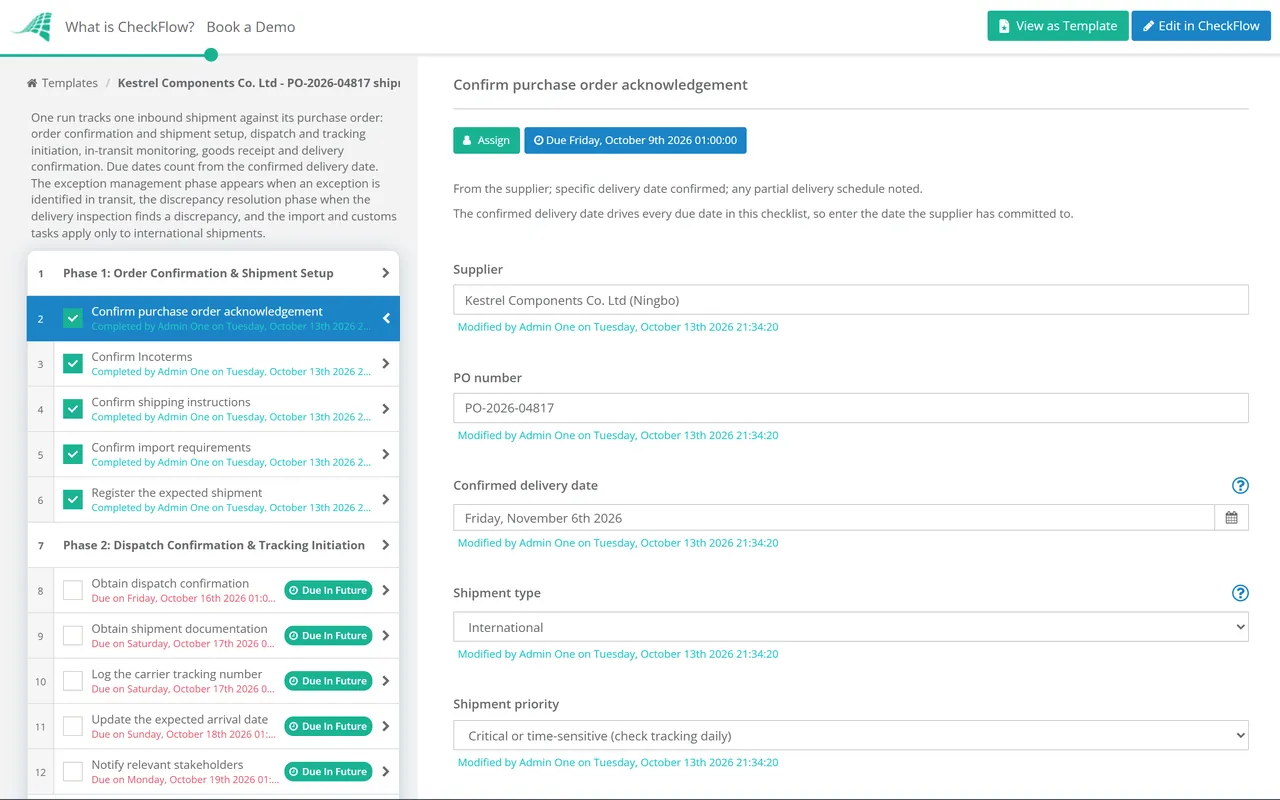
  • Confirm purchase order acknowledgement — from the supplier; specific delivery date confirmed; any partial delivery schedule noted
  • Confirm Incoterms — for the shipment; who is arranging freight and insurance? Confirm with the purchasing team and logistics
  • Confirm shipping instructions — for buyer-arranged freight (EXW/FOB): nominated carrier, booking reference, collection date, and any special handling requirements communicated to the supplier
  • Confirm import requirements — for international shipments: import licences, phytosanitary certificates, customs broker engaged; all requirements confirmed before dispatch
  • Register the expected shipment — in the shipment tracking log: PO number, supplier, expected dispatch date, expected arrival date, carrier, and shipping responsibility
Phase 2

Dispatch Confirmation & Tracking Initiation

  • Obtain dispatch confirmation — from the supplier on the day of dispatch; confirming actual dispatch date and quantity shipped
  • Obtain shipment documentation — commercial invoice, packing list, bill of lading (sea) or airway bill (air), certificate of origin (if required), and any inspection or compliance certificates
  • Log the carrier tracking number — in the shipment tracking system; initiate tracking
  • Update the expected arrival date — based on actual dispatch date and transit time; flag any change from the original confirmed date
  • Notify relevant stakeholders — warehouse team (expected receipt date), production planning (if materials are production-critical), finance (for liability recognition if appropriate per Incoterms)
Phase 3

In-Transit Monitoring

  • Check tracking status at defined intervals — daily for critical or time-sensitive shipments; every 2–3 days for standard shipments
  • Identify any exceptions — delay notifications, port congestion, weather disruption, customs holds, carrier incidents; logged immediately
  • Assess the impact of any exception — what is the revised ETA? What operations or commitments are affected?
  • Escalate significant delays — to the production or operations team and to the procurement lead; initiate mitigation actions (alternative source, schedule adjustment, customer communication) as early as possible
  • Monitor customs clearance progress — for international shipments; confirm the customs broker has all required documents; any query from customs authorities responded to promptly
Phase 4

Exception Management

Exception management is where shipment tracking generates its greatest value. The ability to respond to a delay three weeks before the delivery date vs the day before is the difference between a mitigated impact and an unmitigated crisis.

  • For significant delays: assess mitigation options — alternative source of the same or substitute material, air freight upgrade (if shipment was sea), expediting the existing shipment, production schedule adjustment
  • For damaged goods: initiate a claim — document the damage (photos, carrier report); notify carrier or insurer within the time limit specified in the contract or bill of lading
  • For lost shipments: initiate a trace — with the carrier; if not recovered, an insurance claim; re-order if operationally required
  • For customs holds: respond to the customs query immediately — through the customs broker; any delay in responding extends the hold
  • Document all exceptions — for carrier performance tracking and future contract renegotiations
Phase 5

Goods Receipt & Delivery Confirmation

  • Inspect the delivery on arrival — quantity against the packing list and PO; condition on arrival; any damage or shortage noted on the carrier’s delivery receipt before signing
  • Record the goods receipt — in the inventory management system; quantity, date, condition; triggers the three-way matching process in AP
  • Quarantine any non-conforming goods — damaged or incorrect items separately identified; not put into stock
  • Notify the supplier of any shortage or damage — immediately; with photographic evidence; reference the PO and delivery documentation
  • Confirm receipt to the supplier and procurement team — closes the shipment tracking record
Phase 6

Delivery Discrepancy Resolution

  • Short deliveries — confirm whether a back-order is expected; update the open PO quantity; chase delivery of the balance
  • Wrong goods — arrange return at supplier’s cost (if supplier error); confirm replacement delivery timeline
  • Damaged goods — claim from the carrier (if damage occurred in transit) or the supplier (if goods were dispatched damaged); document fully; replacement or credit agreed
  • Excess delivery — confirm whether the excess is accepted (and invoiced) or returned; update the PO accordingly
  • Update the tracking record — with the resolution; close the shipment

Why Run Your Shipment Tracking Workflow in CheckFlow?

1

Proactive exception tracking rather than reactive discovery

The shipment delay that is discovered on the expected delivery date produces a crisis; discovered two weeks before, it produces a managed response. CheckFlow’s daily in-transit monitoring tasks ensure critical shipments are checked proactively — not just when someone remembers to look.

2

Exception escalation and mitigation tracking

A shipment exception that is noted but not acted upon is worse than no tracking — it creates a record of a known problem that was not mitigated. CheckFlow’s exception management phase assigns a mitigation task for every significant delay or damage event, with a named owner and a deadline for the response decision.

3

A complete shipping record for claims and performance management

Carrier claims require documentation of exactly what was ordered, what arrived, when, and in what condition. Carrier performance analysis requires historical data on delays, damage rates, and exception frequency. Every shipment tracked through CheckFlow creates a complete record — from PO to receipt — that supports both.

Goods receipt confirmation closes the shipment tracking process and initiates three-way matching. CheckFlow’s Purchase Order Approval Checklist covers the full PO-to-payment process including three-way matching. See the Purchase Order Approval Checklist →

Delivery performance is one of the key supplier KPIs. CheckFlow’s Supplier Performance Evaluation Checklist covers the structured process for evaluating supplier delivery performance against commitments. See the Supplier Performance Evaluation →

Frequently Asked Questions

What should a shipment tracking workflow include?

+

A shipment tracking workflow covers six phases: order confirmation and shipment setup (PO acknowledgement, Incoterms confirmation, shipping instructions for buyer-arranged freight, import requirements for international shipments, and shipment registration), dispatch confirmation and tracking initiation (dispatch confirmation, document collection, carrier tracking number logging, expected arrival update, and stakeholder notification), in-transit monitoring (regular tracking checks at defined intervals, exception identification, impact assessment, escalation), exception management (delay mitigation, damage claims, lost shipment tracing, customs hold response), goods receipt (delivery inspection, goods receipt recording, non-conforming goods quarantine), and discrepancy resolution (short delivery follow-up, wrong goods return, damage claims, excess delivery management).

What are Incoterms and why do they matter for shipment tracking?

+

Incoterms (International Commercial Terms, published by the International Chamber of Commerce) are standardised trade terms that define the responsibilities, costs, and risks of the buyer and seller at each stage of a shipment. They determine who pays for freight and insurance, who is responsible for export and import customs clearance, and most importantly, the exact point at which risk transfers from seller to buyer. For shipment tracking, this matters because: under seller-responsible terms (e.g. DDP, DAP), the seller bears the risk of in-transit loss or damage and is responsible for arranging tracking; under buyer-responsible terms (e.g. EXW, FOB), the buyer bears the risk from the designated handover point and must actively track the shipment to manage its own exposure.

What documents should accompany an international shipment?

+

Standard documents for international shipments include: commercial invoice (description of goods, quantity, value, Incoterms, and buyer/seller details — required for customs valuation), packing list (detailed breakdown of contents by package for customs clearance and goods receipt verification), bill of lading (for sea freight — the contract of carriage and document of title) or airway bill (for air freight — non-negotiable transport document), certificate of origin (where preferential tariff treatment or import restrictions require proof of where goods were manufactured), and any product-specific certificates required at the destination (phytosanitary certificate for agricultural products, CE Declaration for products entering the EU, FDA documentation for goods entering the US).

How should a damaged delivery be handled?

+

Damaged deliveries should be handled as follows: note the damage in writing on the carrier’s delivery receipt before signing (this creates the carrier’s acknowledgement of the damage at delivery); photograph the damage immediately, including packaging and the goods themselves; notify the carrier within the timeframe specified in the bill of lading or delivery terms (typically 24–72 hours for visible damage; 7–14 days for concealed damage); notify the supplier simultaneously; do not use the damaged goods until liability is agreed; raise a formal claim against the carrier or insurer with all supporting documentation. Failure to note damage on the delivery receipt significantly weakens a subsequent claim.

Is CheckFlow free for this template?

+

14-day free trial, no card required. The Business plan is $10 per user per month after the trial. Full details at checkflow.io/pricing.

Track Every Shipment Early Enough to Act — Not Late Enough to React

Free trial — no credit card required.