A structured, audit-ready accounts payable process — from invoice receipt to payment confirmation — with segregation of duties enforced at every critical control point.
An accounts payable process without controls is a fraud vector. An AP process without structure is a cash flow liability. The invoice that never got matched against the purchase order. The vendor payment approved by the same person who submitted it. The duplicate invoice that processed because no one checked the invoice number. These are not rare failures — the ACFE reports that 29% of organisations lack adequate AP internal controls, and AP fraud consistently accounts for a significant share of reported financial misconduct. A structured AP process addresses all of them: standardising how invoices enter the system, enforcing three-way matching before approval, routing approvals through a defined hierarchy that separates duties, scheduling payments to optimise working capital, and maintaining an audit trail for every transaction. This free accounts payable process checklist gives finance teams, controllers, and accounting managers a structured framework for a controlled, efficient, and audit-ready AP cycle.
The Three Ways AP Processes Fail — and What Each One Costs
Fraud and duplicate payments
What happens: An invoice is submitted and paid twice because the duplicate check was not run. A fraudulent vendor is created because no one validated the bank details. The same person who approves invoices also makes the payment — with no second pair of eyes.
The cost: AP fraud and duplicate payments cost organisations an estimated average of 0.5% of annual revenue. For a $10M business, that is $50,000.
Prevention: Three-way matching, segregation of duties, and duplicate invoice checking as mandatory steps before any payment is made.
Late payments and supplier relationship damage
What happens: Invoices sit in an inbox waiting for an approver who is travelling. A vendor’s payment terms are not captured in the system, so the early payment discount expires. A disputed invoice sits unresolved for three months because no one owns the resolution process.
The cost: Lost early payment discounts, supplier relationship damage, and potentially the loss of preferred payment terms.
Prevention: A structured approval workflow with defined turnaround times, payment term capture at invoice entry, and a clear dispute resolution process.
Audit failures and compliance exposure
What happens: The year-end audit asks for supporting documentation for 50 transactions. The team spends two days finding invoices across shared drives, email inboxes, and paper files. Three cannot be found at all.
The cost: Audit delays, qualified audit findings, and regulatory exposure.
Prevention: A structured AP process that systematically archives all supporting documentation — POs, goods receipt notes, invoices, approvals, and payment confirmations — against every transaction.
What the Accounts Payable Process Checklist Covers
This checklist covers seven phases of the AP cycle — from vendor master file management through to reconciliation and reporting. Every phase contains the key controls that protect the organisation from fraud, error, and audit exposure.
Phase 1
Vendor Setup & Master File Management
The vendor master file is the foundation of AP security. A poorly controlled vendor master is where the vast majority of AP fraud begins — with the creation of fictitious or modified vendor records.
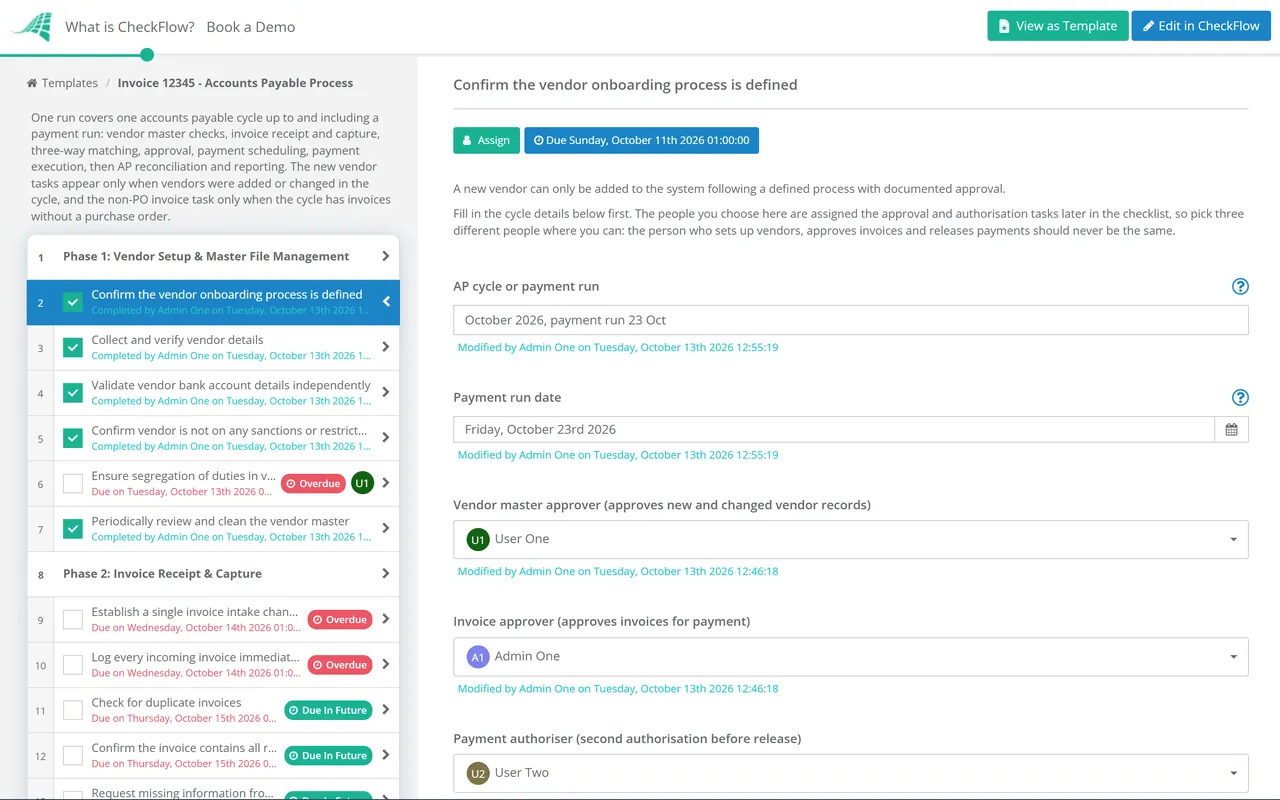
Confirm the vendor onboarding process is defined — a new vendor can only be added to the system following a defined process with documented approval
Collect and verify vendor details — legal name, registered address, bank account details, tax identification number (EIN/UTR), and relevant compliance documents
Validate vendor bank account details independently — do not rely solely on information submitted by the vendor; verify via a secondary channel before first payment
Confirm vendor is not on any sanctions or restricted party list — particularly for international vendors; document the check
Ensure segregation of duties in vendor setup — the person who creates a vendor record should not be the same person who approves it
Periodically review and clean the vendor master — deactivate inactive vendors, verify bank details for active vendors, and flag any unusual vendor additions
Phase 2
Invoice Receipt & Capture
Establish a single invoice intake channel — a dedicated AP email address or invoice portal; invoices received outside this channel should be redirected
Log every incoming invoice immediately — date received, vendor name, invoice number, invoice date, and amount entered into the AP system or register
Check for duplicate invoices — confirm the invoice number and vendor/amount combination has not been previously received or paid
Confirm the invoice contains all required information — vendor name and address, invoice number, invoice date, payment terms, line item detail, and total amount
Request missing information from the vendor — do not process incomplete invoices; log the outstanding request and track resolution
Assign the invoice to the correct cost centre and budget code — coded correctly before entering the approval workflow
Phase 3
Invoice Validation & Three-Way Matching
Three-way matching is the primary control against fraudulent or erroneous AP payments. An invoice that cannot be matched to a purchase order and a goods receipt note should never proceed to approval.
Retrieve the corresponding purchase order — confirm the PO number on the invoice matches an approved PO in the system
Retrieve the goods receipt note or service confirmation — confirm the goods or services on the invoice have actually been received and confirmed
Perform three-way match — confirm the invoice amount, quantities, and unit prices match the PO and the goods receipt within the accepted tolerance
Flag and escalate any matching exceptions — price variances, quantity discrepancies, or goods not yet received; do not process until resolved
For invoices without a PO — apply the non-PO invoice policy; confirm two-way matching (invoice to service confirmation) and additional approval is obtained
Record the matching outcome — matched, partially matched with explanation, or exception with escalation status
Phase 4
Invoice Approval Workflow
Route the invoice to the correct approver — based on amount threshold, department, and cost centre; the approval routing should be defined and consistent
Confirm approval authority thresholds are documented — who can approve at each level; confirm thresholds are current and reflect actual authority
Set and enforce turnaround time standards — invoices awaiting approval for more than the defined period should trigger an escalation reminder
Segregate approval from payment — the person who approves an invoice must not be the person who makes the payment; this is a fundamental internal control requirement
Document the approval — a named approver with timestamp; verbal or informal approvals are insufficient for audit purposes
Return rejected invoices with a documented reason — the vendor and the internal requestor both notified; rejection tracked in the AP system
Phase 5
Payment Scheduling & Working Capital Optimisation
Capture payment terms at invoice entry — net 30, net 60, or any early payment discount terms; payment due date calculated and recorded
Identify early payment discount opportunities — 2/10 net 30 terms (2% discount for payment within 10 days) represent significant savings at scale; flag for prioritisation
Schedule payments in batches — a regular payment run cadence (weekly or bi-weekly) rather than ad hoc payments; exceptions managed with documented approval
Review the payment batch before processing — confirm all invoices in the batch have been approved, are within their payment window, and are not duplicates
Confirm payment method is correct — BACS, ACH, wire transfer, or cheque; confirm bank details against the vendor master, not the invoice
Phase 6
Payment Execution & Confirmation
Obtain payment authorisation — a second authorisation step before payment is released; particularly important for payments above a defined threshold
Process the payment — through the approved payment channel; confirm payment amount matches the approved invoice total
Record the payment reference — payment date, amount, reference number, and method recorded against the invoice in the AP system
Send remittance advice to the vendor — confirming payment details, the invoice(s) the payment covers, and the expected value date
File all supporting documentation — PO, goods receipt, invoice, approval, and payment confirmation stored together and accessible for audit
Monitor for payment confirmation — verify the payment has cleared; investigate any rejected or returned payments promptly
Phase 7
AP Reconciliation & Reporting
Reconcile the AP ledger to the general ledger — monthly; confirm all posted invoices and payments are correctly reflected
Reconcile vendor statements — for major vendors, reconcile the vendor’s statement against the AP ledger; identify and resolve any discrepancies
Review the AP ageing report — invoices outstanding beyond payment terms; investigate and resolve long-outstanding items
Identify and resolve disputed invoices — invoices held pending dispute resolution should be tracked, owned, and resolved within a defined timeframe
Produce the AP liability report — total outstanding AP liabilities by due date; input to cash flow forecasting
Review AP process metrics — invoice cycle time, exception rate, on-time payment rate, and early payment discount capture; identify improvement opportunities
Three-Way Matching — The Primary AP Internal Control
Three-way matching is the comparison of three documents before any invoice is approved for payment.
Document 1
Purchase Order
What it confirms: That the goods or services were formally ordered by an authorised person within the organisation, at the agreed price and quantity.
Why it matters: Without a PO, there is no documented basis for believing the invoice relates to a legitimate business purchase.
Document 2
Goods Receipt Note (GRN) or Service Confirmation
What it confirms: That the goods or services were actually received and accepted by the organisation.
Why it matters: Payment for goods or services not yet received — or not received at all — is one of the most common forms of AP fraud.
Document 3
Supplier Invoice
What it confirms: That the vendor is requesting payment for the correct amount, for the correct quantity, at the agreed price.
Why it matters: Invoices with incorrect amounts, quantities, or unit prices that are not caught before approval result in overpayment.
CheckFlow’s AP checklist enforces all three documents before the approval phase can begin — the match cannot be skipped under payment deadline pressure.
Why Run Your AP Process in CheckFlow?
1
Segregation of duties enforced by process, not policy
The most critical AP internal control — that the person approving invoices is never the same person making payment — is often stated in policy and violated in practice when teams are under pressure. CheckFlow’s structured AP checklist assigns approval and payment tasks to different named roles, making the separation structural rather than relying on individual discipline.
2
A complete, searchable audit trail for every transaction
Every step in CheckFlow’s AP checklist is timestamped and attributed to the person who completed it. The PO reference, matching outcome, approval name, payment method, and remittance confirmation are all logged against each invoice. When an audit asks for complete documentation for a specific transaction, it is available in minutes rather than days.
3
Visibility across the entire AP pipeline simultaneously
Finance managers managing 50 invoices at different stages — some awaiting matching, some in approval, some overdue for payment — need a single view of the full pipeline. CheckFlow’s grid shows every invoice’s current stage and outstanding tasks simultaneously, so the team knows exactly where to focus without opening individual email chains.
The invoice approval step within AP deserves its own structured process. CheckFlow’s Invoice Approval Workflow Checklist covers the full multi-level approval process in detail — from receipt through to authorised payment release. See the Invoice Approval Workflow Checklist →
AP reconciliation is a key step in the month-end close. CheckFlow’s Month-End Finance & Accounting Close Checklist coordinates AP reconciliation within the broader financial close cycle. See the Month-End Close Checklist →
The AP process covers how a business receives, validates, approves, records, and pays supplier invoices. It spans seven areas: vendor master file management (setting up and controlling vendor records), invoice receipt and capture (logging and coding incoming invoices), invoice validation and three-way matching (comparing the invoice to the purchase order and goods receipt note), the approval workflow (routing invoices through defined approval levels), payment scheduling (batching payments to optimise working capital and capture early payment discounts), payment execution (processing and confirming payments), and reconciliation and reporting (reconciling the AP ledger to the general ledger, reviewing ageing, and producing cash flow input). Strong internal controls — particularly three-way matching and segregation of duties — are embedded throughout.
What is three-way matching in accounts payable?
+
Three-way matching is the comparison of three documents before any invoice is approved for payment: the purchase order (confirming the goods or services were formally ordered by an authorised person at an agreed price), the goods receipt note or service confirmation (confirming the goods or services were actually received), and the supplier invoice (confirming the vendor is requesting payment for the correct amount and quantity). All three documents must align within accepted tolerance before the invoice proceeds to approval. Three-way matching is the primary control against paying for goods not ordered, not received, or incorrectly priced.
What is segregation of duties in accounts payable?
+
Segregation of duties in AP means that no single person should have control over all steps of the payment cycle. Specifically: the person who creates or maintains vendor records should not be the same person who approves invoices; and the person who approves invoices should not be the same person who makes payments. When one person controls vendor setup, invoice approval, and payment execution simultaneously, they have the ability to create a fictitious vendor, raise a fraudulent invoice, and approve and make payment — all without any oversight. Segregation of duties removes this risk by requiring multiple parties to complete the cycle.
How often should the AP ledger be reconciled?
+
Monthly reconciliation is the minimum for most businesses — aligning the AP ledger to the general ledger as part of the month-end close process. Major vendor statement reconciliations should also be conducted monthly or at least quarterly, particularly for high-volume supplier relationships. The AP ageing report should be reviewed monthly to identify invoices outstanding beyond payment terms. Year-end requires a more comprehensive AP reconciliation as part of the audit preparation process.
Is CheckFlow free for this template?
+
14-day free trial, no card required. The Business plan is $10 per user per month after the trial. Full details at checkflow.io/pricing.
Run a Controlled, Audit-Ready AP Process for Every Invoice
Free trial — no credit card required.
Do you like cookies? 🍪 We use cookies to ensure you get the best experience on our website. Learn more