SQF / BRCGS Audit Preparation Checklist Template

A certification audit goes well when the gaps are found early, every finding has an owner and a date, and the site has been audited on every shift before the auditor arrives.

Last reviewed: November 2026

Printed from checkflow.io/templates/quality-assurance/sqf-brcgs-audit-preparation-checklist

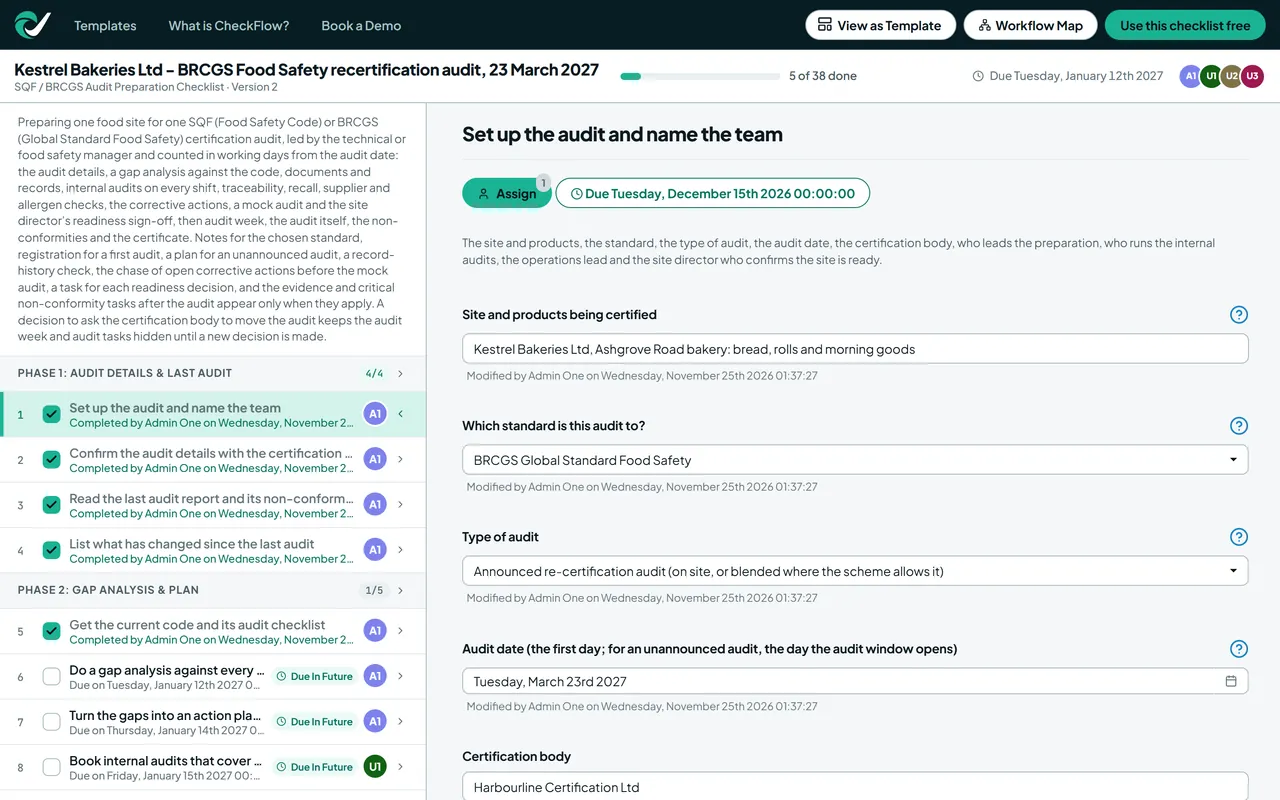
This free SQF / BRCGS audit preparation checklist is for technical and food safety managers at food manufacturing sites certificated, or seeking certification, to the SQF Food Safety Code or the BRCGS Global Standard Food Safety. One run prepares one site for one certification audit, chosen on the first task: the standard, the type of audit (initial, announced or unannounced) and the audit date. Over about 14 weeks the manager confirms the details with the certification body, reads the last report, does a gap analysis against the current code, brings documents and records up to date, runs internal audits on every shift, tests traceability and the recall procedure, and closes the corrective actions before a mock audit. The site director then confirms the site is ready, and after the audit the checklist records the non-conformities, sends the evidence by the scheme’s deadline and records the certificate. The 14-week timeline is this template’s choice: change the offsets to fit your site. Notes for each standard come from SQFI’s free code and BRCGS’s own pages, read in November 2026; the checklist does not replace either standard or your certification body’s instructions.

Certification Audit Preparation, Food Safety Plan or Supplier Audit?

SQF and BRCGS Food Safety are certification schemes benchmarked by the Global Food Safety Initiative (GFSI). At each audit a licensed certification body audits the site against the scheme’s code, grades what it finds and decides whether to certify. This checklist covers the weeks before that audit and the follow-up after it, for one site and one standard.

It sits beside the site’s other food safety work rather than replacing it. The hazard analysis and food safety plans are built and reviewed in the HACCP Food Safety Checklist, which this checklist calls on once to confirm the plans are current. A pharmaceutical site’s self-inspection belongs in the GMP Audit Checklist, and a finance team preparing for its auditors in the External Audit Preparation Checklist.

This checklist

Certification audit preparation

Asks: will this site meet the SQF or BRCGS code on the day of its certification audit, and what has to be fixed first?

When: about 14 weeks before each initial, re-certification or unannounced audit window, and in the weeks after it.

Output: a gap analysis, internal audit findings and corrective actions, a mock audit, the site director’s readiness decision, the non-conformities answered and the certificate recorded.
Food safety plan

Hazard analysis and plan

Asks: what can go wrong with this product and process, and how is each hazard controlled?

When: when a plan is built, and at each review or change, in the HACCP Food Safety Checklist.

Output: the hazard analysis, critical control points, limits, monitoring and verification. This checklist only confirms the plans are current before the audit.

Supplier

Supplier audit

Asks: does one of our suppliers meet our requirements?

When: when a supplier is approved or reviewed, in the Supplier Audit Checklist.

Output: findings and corrective action requests for the supplier. Here, the site is the one being audited, by its certification body.

What the SQF / BRCGS Audit Preparation Checklist Covers

Nine phases prepare one site for one certification audit, counted in working days from the audit date. Phases 1 and 2 confirm the audit details, read the last report, check the site against the current code and plan the actions and internal audits. Phases 3 to 5 bring documents and records up to date, audit every shift and test traceability, the recall procedure, suppliers, allergens and environmental monitoring. Phase 6 holds the mock audit until no corrective action is left open without a temporary control, and Phase 7 is the site director’s readiness sign-off six working days before the audit: nothing after it can be completed until it is done. A Not ready decision either asks the certification body to move the audit, which keeps the audit week and audit tasks hidden until a new decision, or goes ahead on the date with the gaps contained first. Phases 8 and 9 cover audit week, the audit, the non-conformities and the certificate. The standard chosen on the first task adds notes for SQF or BRCGS; an initial audit adds registration, an unannounced audit adds a plan for the window, a short record history adds a check with the certification body, and non-conformities add the evidence task, with a task for the site director when one is critical.

  1. Phase 1

    Phase 1: Audit Details & Last Audit

    6 tasks

    The technical or food safety manager starts about 14 weeks before the audit. Enter the audit date on the first task first: every due date counts in working days from it. Then confirm the details with the certification body and read what the last audit found.

    • Set up the audit and name the team — the site and products, the standard, the type of audit, the audit date, the certification body, who leads the preparation, who runs the internal audits, the operations lead and the site director who confirms the site is ready
    • Confirm the audit details with the certification body — the date or window, how many days, the auditor, the edition or issue of the code, the scope of products and processes, any exclusions, any additional modules, and any part done remotely
    • Register the site and agree the scope for a first audit — for SQF, the site registered on the SQFI Assessment Database; for either standard, an approved certification body chosen, the scope and any exclusions agreed in writing before the audit
    • Read the last audit report and its non-conformities — each non-conformity from the last audit or surveillance audit, its root cause and corrective action, whether the fix has held, and the customer complaints and audits since
    • List what has changed since the last audit — new products, lines, equipment, building work, suppliers, people in key roles, customer requirements, and any change to the code, its edition or its position statements
    • Keep the site ready for an unannounced audit — who greets the auditor on any shift, where the records are, cover for key people, and the shutdowns and non-production days agreed with the certification body
  2. Phase 2

    Phase 2: Gap Analysis & Plan

    6 tasks

    About ten weeks out, the manager gets the current code and checks the site against every clause, then turns the gaps into a plan with owners and dates and books the internal audits.

    • Get the current code and its audit checklist — the edition or issue the audit is to, its checklist or self-assessment tool, the guidance that goes with it and any position statements, saved where the team can find them
    • Do a gap analysis against every clause — each requirement marked met, partly met or not met, with the evidence for it, starting with the requirements the code marks as mandatory or core
    • Agree with the certification body what record history it expects — how many days or weeks of records the auditor will want for new or changed procedures, and whether the date should move to give them time
    • Turn the gaps into an action plan with owners and dates — each gap with what will be done, who does it and by when, every date before the mock audit, and the larger fixes before the internal audits in Phase 4, so an audit checks each one
    • Book internal audits that cover every requirement and every shift — who audits which clauses and areas, on which shifts, including nights, weekends and cleaning shifts, by auditors who do not audit their own work
    • Brief senior management on the gaps and what is needed — the gaps, the action plan, the money, people and time it needs, and decisions only senior managers can make
  3. Phase 3

    Phase 3: Documents, Plans & Records

    6 tasks

    About eight weeks out, the documents and records are brought up to date, so that the internal audits that follow check the system the auditor will see.

    • Bring the food safety manual, policies and procedures up to date — each document current, approved and controlled, matching what is done on the floor, with old versions withdrawn from use
    • Review the HACCP and food safety plans — each plan checked against the products, lines and changes listed in Phase 1, with critical limits, monitoring, verification and validation records in place
    • Check the prerequisite programme records — cleaning, pest control, maintenance, calibration, glass and hard plastics, water, waste and personal hygiene, sampled over recent weeks for gaps and missing signatures
    • Check specifications for raw materials, packaging and finished products — each specification current, approved, agreed with the customer where they ask for it, and matching the label and the recipe
    • Hold the management review before the audit — food safety objectives, trends in complaints, audits, incidents and testing, the culture plan, resources, and the decisions taken, recorded with who attended
    • Check training records and the people the code names — the training matrix against each role, refreshers due, agency and new staff, and the named food safety lead and their deputy with their training records
  4. Phase 4

    Phase 4: Internal Audits on Every Shift

    4 tasks

    About six weeks out, the internal audit lead audits the documented system and then the factory on every shift, the way the certification body will, and every finding gets a corrective action.

    • Audit the documented system against the code — documents and records for each clause, following a product or batch from raw material to dispatch through the records
    • Audit the factory on every shift — hygiene, foreign body and allergen controls, the condition of the site inside and out, and how people work, observed on day, night, weekend and cleaning shifts
    • Record the internal audit findings — each finding with the clause, where it was seen, the evidence and how serious it is, graded the way the standard grades non-conformities
    • Raise a corrective action for every finding — the root cause, the action, an owner and a date before the mock audit, through the site’s own corrective action process
  5. Phase 5

    Phase 5: Traceability, Recall & Site Checks

    7 tasks

    About five weeks out, the team tests the systems an auditor tests: a trace, a recall, supplier approval, allergens and environmental monitoring, and walks the site.

    • Test traceability forwards and backwards — one finished product traced back to its raw materials and packaging and forward to its customers, with a quantity check and the time it took
    • Test the recall and withdrawal procedure — the contact list current, a test call to a sample of contacts, who decides, and how the regulator and customers would be told
    • Review the environmental monitoring programme and results — the sampling plan against the zones and risks, the results and their trend, and the follow-up of each positive result
    • Check supplier approval and the approved supplier list — every raw material and packaging supplier approved on a risk basis, certificates and questionnaires in date, and no purchases from suppliers not on the list
    • Check allergen controls and labels — the allergen matrix against current recipes, changeover cleaning and its validation, label checks at the line, and the labels against the specifications
    • Walk the site inside and out with fresh eyes — the building fabric, maintenance, pest control, storage, staff facilities, the yard and the areas outside the scope, as the auditor will see them
    • Review complaints, incidents and product testing — complaint trends and investigations, incidents and near misses, product and shelf-life testing, and the laboratories used
  6. Phase 6

    Phase 6: Corrective Actions & Mock Audit

    4 tasks

    Three weeks out, the manager counts the corrective actions still open with no temporary control. The mock audit waits until that count is 0: a count above 0 hides the mock audit tasks and shows a task to deal with those actions first.

    • Count the corrective actions still open — every action from the gap analysis, the internal audits, the site checks and the last audit, closed only when someone has checked the fix
    • Close the corrective actions still open before the mock audit — each open action finished and checked, or contained with a temporary control and a date, so the mock audit tests the site as the auditor will find it
    • Run a mock audit as the certification body would — a full audit by someone who did not prepare the area, with an opening meeting, a trace from goods in to dispatch, interviews on the floor, every shift sampled and a closing meeting
    • Fix what the mock audit found — each mock audit finding corrected and checked, or contained with a temporary control, before the readiness sign-off
  7. Phase 7

    Phase 7: Readiness Sign-Off

    3 tasks

    Six working days before the audit the site director chooses a decision. Nothing after the sign-off can be completed until it is completed. Each Not ready decision shows a task before the sign-off: one to ask the certification body to move the audit, which keeps the audit week and audit tasks hidden, and one to contain the gaps when the audit goes ahead on its date.

    • Ask the certification body to move the audit — the request in writing to the certification body, the reason, and its answer
    • Contain the open gaps and prepare to explain them to the auditor — each gap still open with its temporary control, an owner and a date, ready to show the auditor; the site director then completes the sign-off with this decision
    • Confirm the site is ready for the audit — the site director reads the gap analysis, the corrective actions, the mock audit and anything still open, and completes this task with the decision
  8. Phase 8

    Phase 8: Audit Week & the Audit

    6 tasks

    Applies only when the readiness decision is anything other than asking the certification body to move the audit. In audit week the staff are briefed and the audit room is set up. At the audit the manager goes with the auditor, keeps a note of every request and finding, and records the non-conformities by grade at the closing meeting. When an unannounced auditor arrives, change the audit date on the first task to that day: the work before it is done, and the audit and follow-up tasks then count from the real audit.

    • Brief staff on every shift about the audit — what the auditor will look at, that they may be asked about their job, to answer honestly and show rather than tell, and who to call when the auditor arrives
    • Prepare the audit room, records and guides — a room, the documents and records the auditor will ask for to hand, a guide for each area, protective clothing for the auditor and the opening meeting attendees
    • Finish the actions the site director named — each action named on the readiness sign-off finished and checked before the audit
    • Hold the opening meeting and go with the auditor — the scope and plan confirmed, guides for each area, a note of every document requested and every concern raised as it happens
    • Record the non-conformities by grade — each non-conformity with its clause, grade and the evidence the auditor gave, as read out at the closing meeting
    • Attend the closing meeting and agree the findings — each finding understood and its evidence clear, anything disputed raised there and then, and the next steps and deadlines the certification body gives
  9. Phase 9

    Phase 9: Non-Conformities & Certificate

    5 tasks

    Applies only when the readiness decision is anything other than asking the certification body to move the audit. After the audit the manager sends the corrective action evidence within the scheme’s deadline, checks the report and records the certificate, its grade or rating and the next audit date.

    • Act on a critical non-conformity — the product affected contained, customers told where needed, and the certification body’s instructions on what it means for the certificate followed
    • Check the audit report — the report checked against the notes from the audit, the non-conformities as agreed at the closing meeting, and any error raised with the certification body
    • Send the corrective action evidence by the scheme’s deadline — for each non-conformity, the correction, the root cause, the corrective action and the evidence, sent in the form the certification body asks for, before its deadline
    • Record the certificate, its grade or rating and the next audit date — the outcome as the report and certificate give it, the certificate number and expiry, the next audit due date and whether it will be announced or unannounced
    • Share the result and carry the lessons into next year — the result shared with staff and customers who ask for it, the findings fed into the next management review, and the next audit’s date and type in the plan

SQF and BRCGS Food Safety Audits Side by Side

The rules below are taken from SQFI’s free SQF Food Safety Code: Food Manufacturing, Edition 10 (Part A, updated 1 September 2026), and from BRCGS’s own pages and position statements, all read on 24 November 2026. They change between editions: check the code and your certification body before each audit.

Topic SQF Food Safety Code BRCGS Global Standard Food Safety
Who owns itSQFI (the Safe Quality Food Institute)BRCGS
Edition for audits in 2027Edition 10 from 1 January 2027, a date SQFI says depends on GFSI benchmarking and may move later; Edition 9 before thenIssue 9, with position statements F926 (version 5, 6 October 2026); check brcgs.com for a new issue
Getting the codeFree on sqfi.com through the Code Selector, printable, with an audit checklistBRCGS’s guide says it can be accessed free of charge through the BRCGS Store, with a self-assessment checklist on its site
Re-certification audit dateWithin 30 calendar days either side of the anniversary of the last day of the initial certification auditAnnounced or blended announced audits on or before the audit due date on the certificate
Unannounced auditsOne re-certification audit in every three years, in that 60-day window; a 90-day blackout period can be agreed; annual unannounced audits by choiceAt least once in every three years; the certification body says which year, within 3 months of the last audit, but not the date
Grades of findingMinor, major and critical non-conformances, with core clause minors and majorsMinor, major and critical non-conformities
Closing the findingsCorrective actions approved by the auditor and closed in the SQFI Assessment Database within 40 calendar days of the end of the auditCorrective action, root cause analysis and a preventive action plan, closed out within 28 days following the audit
The resultA score of 100 less the deductions and a rating: Certified (80 to 100), Certified with Surveillance (70 to 79) or, below 70, a failed or suspended auditA grade on the audit report; the certificate within 42 calendar days of the first day of the audit

Sources. SQF: the SQF Food Safety Code: Food Manufacturing, Edition 10, Part A (A2:11 re-certification timing, A2:14 unannounced audits, A2:18 non-conformances, A2:19 audit rating, A2:21 corrective actions), and SQFI’s Edition 10 FAQ, which says that until Edition 10 is recognised by GFSI, Edition 9 is the only GFSI-recognised SQF programme. BRCGS: How to get certified, the Guide to Certification and the Issue 9 position statements on the BRCGS Food Safety page; the grades of finding are as LRQA, a certification body, describes them. The BRCGS standard itself is not quoted here.

Other codes. SQF publishes separate codes for other sectors, such as storage and distribution, and BRCGS publishes other standards, such as Storage and Distribution and Packaging Materials. This checklist is written for a food manufacturing site; use the code for your own sector.

Why Prepare for SQF and BRCGS Audits in CheckFlow?

1

Fourteen weeks of work, each step with a name and a date

The technical manager, the internal audit lead, the operations lead and the site director are chosen on the first task, and every step is assigned to one of them with a due date counted from the audit date. Move the audit date and every due date moves with it.

2

Every gap and finding becomes an action

The gap analysis, the internal audits on every shift and the site checks all feed one list of corrective actions with owners and dates. The mock audit waits until no action is left open without a temporary control, so it tests the site the auditor will find.

3

Notes for the standard you are audited to

Choose SQF or BRCGS on the first task and the checklist shows that scheme’s notes: the edition in force, the code and its checklist, the deadline for corrective action evidence and how the certificate is issued. A first audit adds registration and an unannounced audit adds a plan for the window.

4

The site director signs off before the audit

Nothing after the readiness decision can be completed until the site director completes that approval step, and a decision to ask for a new audit date keeps the audit tasks hidden until the site is ready. Each site’s preparation shows its progress in the Reports Grid, and a schedule can start next year’s run in time (recurring checklists; enter the audit date on each new run).

CheckFlow does not replace the SQF code, the BRCGS standard, your certification body or your food safety management system, and it does not grade your site. It runs the preparation around them: who does what by when, what each audit found, which actions are still open and what the auditor raised. CheckFlow’s manufacturing checklist software shows how plants run their other routines the same way.

Review a food safety plan with the HACCP Food Safety Checklist, audit a supplier with the Supplier Audit Checklist, run a real recall with the Product Recall Checklist, and work a repeat finding through the CAPA (Corrective & Preventive Action) Checklist.

AI generator

Didn’t find what you need? Describe it.

Describe the process in a sentence and the AI checklist generator drafts the phases and tasks for you.

Frequently Asked Questions

What is the difference between SQF and BRCGS certification?

Both are food safety certification schemes benchmarked by GFSI, and both certify a site after an audit by a licensed certification body. SQF is owned by SQFI, which publishes its codes free on sqfi.com; BRCGS publishes the Global Standard Food Safety. They differ in their rules: re-certification timing, unannounced audits, how findings are graded and the deadline to close them. The table on this page sets them side by side.

How do you prepare for an SQF audit?

Get the current code from sqfi.com through the Code Selector, check the site against every clause, mandatory and core clauses first, and turn the gaps into actions. Make sure the primary SQF Practitioner and the substitute are named, the records show the system working, internal audits cover every shift, and corrective actions are closed. SQFI recommends at least 90 days of records before an initial audit or a re-certification audit during an edition change. Finish with a mock audit.

How do you prepare for a BRCGS (BRC) audit?

BRCGS’s own steps are to read the standard and its Interpretation Guideline, train, do a gap analysis with its self-assessment checklist, plan and implement the actions, and run internal audits, contacting an approved certification body early and scheduling the audit when ready. Read the current position statements as well. This checklist adds a mock audit and a readiness sign-off before the audit, and the corrective action evidence afterwards, which BRCGS says is closed out within 28 days following the audit.

When do SQF Edition 10 audits start?

SQFI says audits to Edition 10 of the SQF Food Safety Codes are expected to start on 1 January 2027. The date depends on GFSI benchmarking and may move later, but not earlier, and until Edition 10 is recognised by GFSI, Edition 9 is the only GFSI-recognised SQF programme. An audit before the start date is to Edition 9, and a surveillance audit after an Edition 9 audit stays on Edition 9. Check with SQFI and your certification body.

Is there a BRCGS Food Safety Issue 10 yet?

Not when this page was checked on 24 November 2026: the BRCGS Food Safety page lists Issue 9 resources, and its position statements for Issue 9 were last updated on 6 October 2026. Check brcgs.com before your audit for any new issue and the date audits to it start, and ask your certification body which issue your audit will be to.

How long do you have to close non-conformities after a food safety certification audit?

It depends on the scheme. Under SQF Edition 10, corrective actions must be approved by the auditor and closed in the SQFI Assessment Database within 40 calendar days of the end of the audit, with extensions only in limited cases. BRCGS says non-conformities are closed out within 28 days following the audit. Your certification body gives the exact deadline after the closing meeting: enter it on the evidence task.

What happens at an unannounced SQF or BRCGS audit?

The auditor arrives without a date being given. Under SQF it is one re-certification audit in every three years, within 30 days either side of the anniversary, fully on site, and refusing entry suspends the certificate. Under BRCGS the certification body tells the site which year it falls in, and the site must agree terms and report shutdowns in time. This checklist adds a task to keep the site ready through the window.

What should a mock audit before a certification audit cover?

Everything the real audit will: an opening meeting, a trace from goods in to dispatch through the records, a walk of the whole site inside and out, interviews with staff on the floor, every shift sampled, and a closing meeting with graded findings. It works best when someone who did not prepare the area runs it, two to three weeks before the audit, leaving time to fix what it finds.

Is CheckFlow free for this template?

14-day free trial, no card required. The Business plan is $10 per user per month after the trial. Full details at checkflow.io/pricing.

Walk Into Your Certification Audit Ready

Free trial — no credit card required.

14-day free trial, no credit cardFull refund in your first 30 daysUS hosting, EU on request