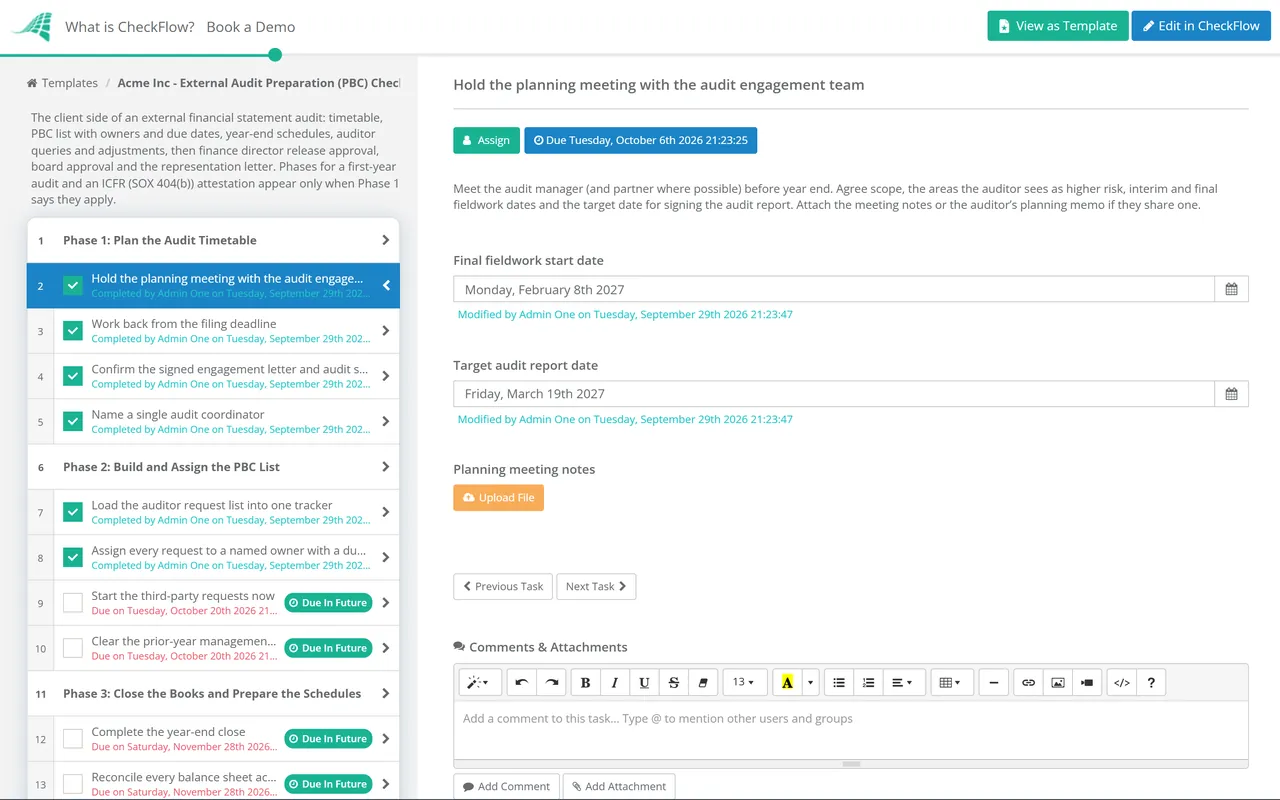
Every request has a name and a date
Each PBC item becomes a task assigned to one person with a due date, and the schedule is attached to the task it answers. The coordinator sees what is done, what is late and who to chase, without a spreadsheet.
Every year-end audit starts with the auditor’s PBC (prepared by client) list, from bank reconciliations to board minutes. Many finance teams track it in a spreadsheet that is stale by the first week of fieldwork. This free audit preparation checklist covers the client side of an external financial statement audit, for controllers, finance directors and audit coordinators, from the planning meeting to board approval and a debrief. Two scope questions add phases for a first-year audit and an internal control (ICFR) attestation. Every request has an owner and a due date, and the finance director approves the pack before it is released.
The audit firm owns the methodology: risk assessment, materiality, sampling and the opinion. The company owns the evidence. The PBC list is where the two meet.
The delays are predictable: reconciliations never reviewed, schedules that do not tie to the trial balance, third-party documents nobody requested until the auditor asked. Each gap becomes a query, each query a wait, and extra time often means extra fees. A preparation checklist moves that work earlier and gives every item an owner.
Examples: timetable, PBC list, reconciliations, schedules, query log, representation letter.
Cadence: annual, plus any interim visit.
Output: a complete, reviewed evidence pack and approved financial statements.
Tooling: a checklist with owners, due dates, attached evidence and approvals.
Examples: engagement acceptance, risk assessment, materiality, testing, the opinion.
Cadence: per engagement, under the firm’s quality management system.
Output: working papers, the audit report and a management letter.
Tooling: audit methodology software and a CPA audit checklist.
Five core phases run for every audit. Two more switch on from the scope questions in Phase 1: one for a first-year audit, one for an ICFR attestation.
Owned by the financial controller. Start before year end: the timetable drives every later date.
Owned by the audit coordinator.
Owned by the financial controller, with tasks assigned to each preparer.
Conditional: its tasks appear only when Phase 1 records a first-year audit or a new audit firm.
Conditional: its tasks appear only when Phase 1 records an ICFR attestation, as in an integrated audit under PCAOB AS 2201 where SOX 404(b) applies.
Includes an approval: the finance director signs off the pack before release, and a returned pack goes back to its preparers.
Includes an approval by the board or audit committee. Management signs the representation letter, not the audit coordinator.
Formats differ between firms, but the content is consistent. Draft owners from this table before the official list arrives.
| Audit area | Typical items requested | Typical owner | Notes |
|---|---|---|---|
| Cash and bank | Bank reconciliations, statements, list of all accounts (including closed ones), confirmation authorities | Treasury or AP lead | Banks reply to the auditor directly, so sign the authority early |
| Revenue and receivables | Revenue by stream, key contracts, aged debtors, post year-end credit notes, bad-debt provision | Revenue accountant, credit control | Expect cut-off testing and questions on ASC 606 or IFRS 15 judgements |
| Inventory | Count instructions and sheets, costing, obsolescence provision | Operations, cost accountant | If inventory is material the auditor normally attends the count |
| Fixed assets and leases | Register roll-forward, additions invoices, disposals, lease schedule | Financial controller | ASC 842 or IFRS 16 schedules need discount rates and lease modifications |
| Payables and accruals | Aged creditors, supplier statement reconciliations, accruals with support | AP lead | Post year-end payments are used to search for unrecorded liabilities |
| Payroll and benefits | Payroll to ledger reconciliation, headcount, bonus and pension schedules | Payroll, HR | An outsourced payroll provider’s SOC 1 report is often requested |
| Tax | Tax computation or provision, deferred tax, VAT or sales tax reconciliations | Tax lead or adviser | Often the last item finished; book adviser time early |
| Debt and equity | Loan agreements, covenant calculations, share register, board approvals | Finance director, company secretary | A covenant breach can change debt classification and going concern |
| Related parties | Related party list, transactions and balances, directors’ interests | Company secretary | Auditors compare it with board minutes and the ledgers |
| IT general controls | System list, user access listings, change logs, SOC 1 reports | IT manager | Reports need their parameters and run date to count as evidence |
| Legal and commitments | Legal matters list, lawyer contacts for legal letters, contracts, guarantees | General counsel | Lawyers reply to the auditor directly and can take weeks |
| Subsequent events and going concern | Post year-end minutes, cash flow forecasts, going concern assessment | Finance director | Stays open until the report is signed |

The requests are similar everywhere. The rules around the audit are not.
| Topic | United States | United Kingdom and elsewhere |
|---|---|---|
| Auditing standards | AICPA AU-C for private companies; PCAOB standards for SEC issuers | ISAs (UK), issued by the FRC; most other countries use the IAASB’s ISAs or a local version |
| Internal control reporting | SOX 404(b) auditor attestation for accelerated and large accelerated filers; others file only the 404(a) management assessment | No auditor attestation. UK Code companies make a board declaration on material controls (Provision 29) for periods from 1 January 2026; the auditor gives no assurance on it |
| Filing deadline | Form 10-K: 60, 75 or 90 days after year end, depending on filer status | Companies House: 9 months (private) or 6 months (public). Listed issuers publish within 4 months |
| Who needs an audit | No general federal requirement for private companies; lenders and investors often require one | UK small companies meeting two of £15m turnover, £7.5m balance sheet and 50 employees can be exempt (periods from 6 April 2025). EU states set their own thresholds |
In May 2026 the SEC proposed simplifying filer status and narrowing who needs a 404(b) attestation. It is a proposal, not a final rule: plan on current requirements and confirm your status with your auditor. None of this is legal advice.
Each PBC item becomes a task assigned to one person with a due date, and the schedule is attached to the task it answers. The coordinator sees what is done, what is late and who to chase, without a spreadsheet.
Answer the first-year and ICFR questions in Phase 1 and conditional logic shows or hides the matching phases. The finance director’s release approval and the board’s sign-off are assigned to named people and timestamped.
A recurring schedule starts the checklist a set number of weeks before each year end. Last year’s debrief notes sit in the completed checklist, and the record of who prepared, reviewed and approved each item can be exported.
CheckFlow is not audit software, and it does not replace your auditor’s request portal or your accounting system. Keep uploading through the firm’s portal and use CheckFlow for the internal side: who owes what, by when, and who reviewed it. Auditors should use the CPA Audit Checklist instead, and CheckFlow’s compliance checklist software shows how reviews, evidence and approvals work across your compliance calendar.
A clean audit starts with a clean close. The Month-End Close Checklist and our month-end close guide make Phase 3 shorter. If you use a payroll bureau or hosted ERP, the SOC Report Review Checklist helps you review their SOC 1 report before it goes in the pack.
PBC stands for “prepared by client”. The PBC list is the auditor’s request list: every schedule, reconciliation and document the audit team needs from the company, each with a reference number and due date. It is normally issued after the planning meeting and grows during fieldwork. Treat it as a project plan: each item needs an owner, a date and a reviewer.
A timetable worked back from the filing deadline, the PBC list with named owners, reviewed reconciliations, lead schedules tied to the trial balance, documented judgements, early third-party requests, one query log, a process for adjustments, board approval and the signed representation letter. End with a debrief: next year’s improvements come from writing down what went wrong this year.
Plan before the year ends. The planning meeting, timetable and third-party requests belong in the last quarter, and anything that depends on a count, a bank or a lawyer must be arranged before year end. The schedules follow the close. Your filing deadline sets the back end: a UK private company has nine months to file at Companies House, while an SEC large accelerated filer has 60 days to file its 10-K.
Management with overall responsibility for the financial statements, normally the chief executive and chief financial officer or their equivalents. Under AICPA AU-C 580 and PCAOB AS 2805 it is dated as of the date of the auditor’s report; ISA 580 and ISA (UK) 580 say as near as practicable to that date and not after it. It is often signed the day the board approves the accounts, so agree the wording early.
The new auditor must get comfortable with your opening balances as well as the current year. Expect requests about prior-year balances, policies and systems, and for your consent so the predecessor auditor can answer questions and share working papers. See AU-C 510, PCAOB AS 2610 and ISA (UK) 510. Answering Yes to the first-year question adds Phase 4.
SEC-registered companies must be audited. US private companies have no general federal requirement, but lenders and investors often insist. A UK private company meeting two of the small company criteria can usually claim exemption, but public companies, banks and insurers cannot, and shareholders holding 10% can still demand an audit. EU member states set their own thresholds. Check with your adviser.
14-day free trial, no card required. The Business plan is $10 per user per month after the trial. Full details at checkflow.io/pricing.