Product Recall Checklist Template

A recall runs against the clock: the regulators told at once, every lot traced, every customer reached and every unit accounted for before anyone calls it closed.

Last reviewed: November 2026

Printed from checkflow.io/templates/quality-assurance/product-recall-checklist

This free product recall checklist is for quality, regulatory and supply chain teams at manufacturers, importers, brand owners and distributors of food and consumer products. One run is one recall or market withdrawal, from the day the problem comes to light to closing it with the authorities. It brings the recall team together and holds the stock you control, assesses the hazard and who is at risk, and checks the product is not covered by a regime of its own, such as medicines, medical devices or vehicles. The recall decision maker chooses a consumer-level recall, a trade-level withdrawal or no action, and the strategy sets the depth, the remedy and the effectiveness checks. Each market ticked on the first task adds its notification: FDA and the Reportable Food Registry or CPSC in the US, the local authority and the FSA or FSS, or Trading Standards, in Great Britain, the rules for Northern Ireland, and the competent authorities or the Safety Business Gateway in the EU. The lots are traced, sales stopped and customers, retailers and consumers told. Returns are recorded and reconciled, effectiveness checked and the stock destroyed or reworked. The run ends with the root cause, the CAPA, a review and the decision maker’s approval to close.

A Recall, a CAPA or a Crisis Plan?

A product recall takes back a product that may have reached consumers; a withdrawal stops it in the supply chain before it does. Either way the problem is outside the business, the first deadlines to tell the regulators are immediate or a matter of hours, and the job is not finished until every unit is accounted for. This checklist runs one real recall or withdrawal of food or a consumer product, from the day the problem comes to light to closing it with the authorities.

It is not the fix inside the factory, and it is not a crisis plan. The CAPA (Corrective & Preventive Action) Checklist and the Defect Reporting & Resolution Checklist remove the cause, and this checklist links to them from its root cause phase. The Crisis Management Plan Checklist prepares the team and the statements before anything goes wrong. A rehearsal of a recall is a mock recall; this checklist is for the real event.

This checklist

One product recall

Use it when: food or a consumer product you supplied may be unsafe or breaks the rules, and some of it has left your control.

Covers: the hazard assessment, the decision and its level, the regulator notices for each market, the trace, the notices, retrieval, effectiveness checks, disposal and closing.

Output: every unit accounted for, every authority told and the recall closed.
The fix

CAPA and defect handling

Use it when: a nonconformity needs its cause found and removed, whether or not anything reached customers.

Covers: containment inside the business, the root cause, the corrective and preventive actions and the check that they worked.

Output: a verified fix, in the CAPA (Corrective & Preventive Action) Checklist.

Before it happens

Crisis management plan

Use it when: preparing the team, the authority to act and the statements for any serious incident, a recall among them.

Covers: the crisis team, escalation, communication planning and testing the plan.

Output: a tested plan, in the Crisis Management Plan Checklist.

What the Product Recall Checklist Covers

Nine phases take one recall from the day the problem comes to light to closing it with the authorities. The first task records the date the business became aware of the problem, which sets every due date, and every market and product type the affected stock reached, which adds the notification task for each one. The decision in Phase 3 adds the consumer notices and the remedy for a consumer-level recall, or a check that nothing reached consumers for a trade-level withdrawal. Every notification comes before the recall decision maker’s approval to close.

  1. Phase 1 — Trigger

    Phase 1: Trigger & Recall Team

    5 tasks

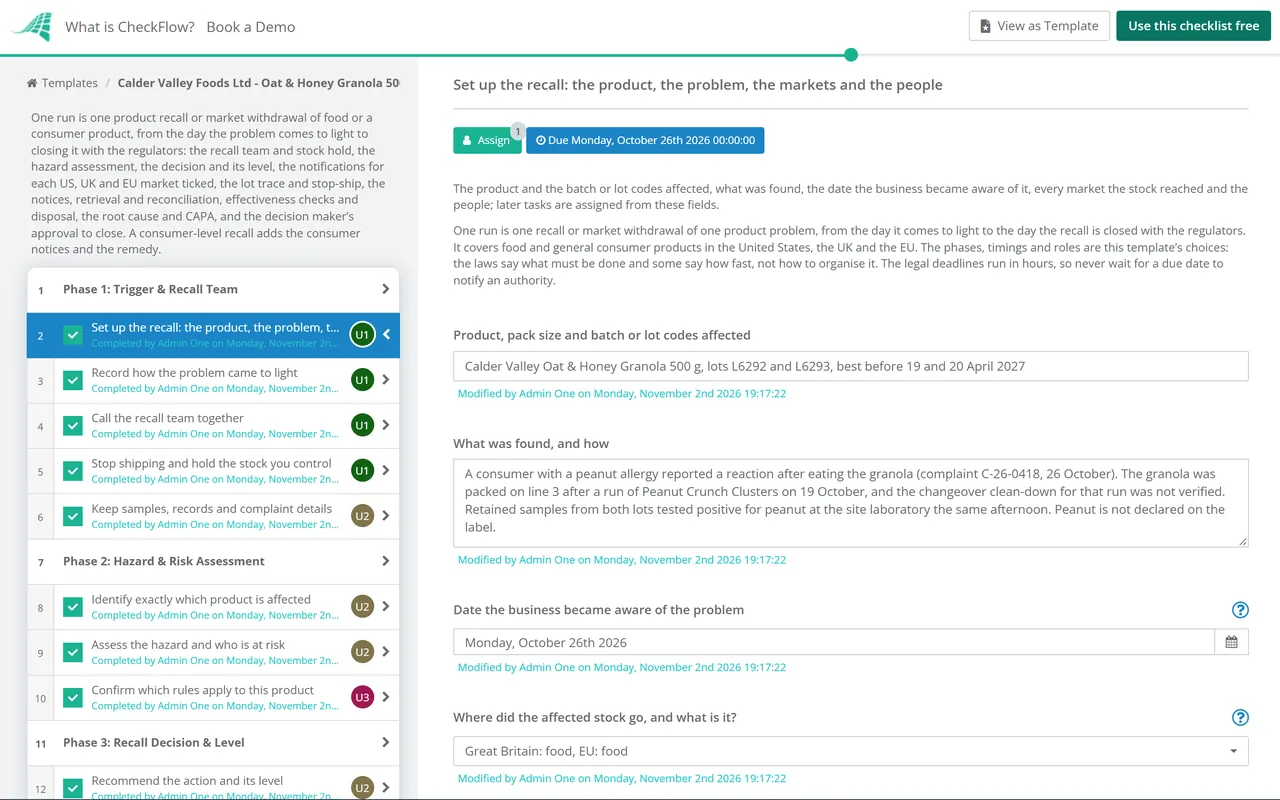
    Owned by the recall coordinator, on the day the problem comes to light. Enter the date the business became aware of it on the first task: every due date counts from it in working days. Tick each market and product type the affected stock reached, and its regulator tasks appear. Hold the stock you control at once, before anything is decided.

    • Set up the recall: the product, the problem, the markets and the people — the product and the batch or lot codes affected, what was found, the date the business became aware of it, every market the stock reached and the people; later tasks are assigned from these fields
    • Record how the problem came to light — the first report, test result or notice, when it arrived and who received it, with copies of what was received
    • Call the recall team together — the coordinator, the decision maker, quality, regulatory, supply chain and communications, with a log of each decision, who made it and when
    • Stop shipping and hold the stock you control — every warehouse, line and store you control told to stop shipping the affected lots, and the stock labelled and held until the decision
    • Keep samples, records and complaint details — retained samples and returned units kept safely, with the production, test and complaint records for the affected lots
  2. Phase 2 — Assess

    Phase 2: Hazard & Risk Assessment

    4 tasks

    Owned by the quality lead, on the same day. Draw the line around exactly which product is affected, assess the hazard and who is at risk, and confirm that this product is covered by the food or consumer product rules rather than a sector regime of its own. Do not wait for complete figures: notify with what is known and update it.

    • Identify exactly which product is affected — product names, codes, pack sizes, lot or batch numbers, date marks and production dates, and why the lots either side are or are not affected
    • Assess the hazard and who is at risk — the hazard, the people most at risk (children, people with allergies, older people), how serious the harm could be, how likely it is and any injuries or illness reported so far
    • Confirm which rules apply to this product — whether the product is food, a general consumer product or a product with its own recall regime, and which law applies in each market ticked on the first task
    • Run the recall under the product’s own regime — shown when the product has a recall regime of its own: the regime, the authority, its reporting deadlines and how this checklist will be used alongside it
  3. Phase 3 — Decide

    Phase 3: Recall Decision & Level

    4 tasks

    The recall decision maker decides, on the same day, whether to recall from consumers, withdraw from the trade or take no action. The answer adds the consumer notice tasks, a check that no stock reached consumers, or a task to record why there is no recall. The strategy follows the next working day.

    • Recommend the action and its level — the quality lead’s recommendation: recall from consumers, withdraw from the trade or no action, with the reasons and the evidence behind them
    • Decide the action and its level — the recall decision maker’s decision, with the reasons; the answer adds the tasks that level needs
    • No recall: record why and tell the authorities already notified — shown when the decision is no recall or withdrawal: the reasons, the evidence, and what each authority notified in Phase 4 was told
    • Agree the recall strategy — how deep the recall goes, whether a public warning is needed, the remedy, the level of effectiveness checks and the timetable, written down and shared with the team
  4. Phase 4 — Notify

    Phase 4: Regulator Notification

    11 tasks

    Owned by the regulatory contact, on the day of awareness: the laws and FDA’s recall guidance say immediately, forthwith or within 24 hours. Each market ticked on the first task has its own task here. Send what is known now and update the authority as facts arrive, then record every notification and its reference.

    • US food: notify FDA of the recall — shown for US food: FDA’s recall coordinator for your area (FDA’s Office of Inspections and Investigations) told of the recall, with the product, the reason, the risk, the quantities, the distribution and the proposed strategy
    • US food: decide whether it is a reportable food — shown for US food: whether there is a reasonable probability that the food will cause serious adverse health consequences or death, and if so the report to the Reportable Food Registry within 24 hours
    • US consumer product: report to CPSC under section 15(b) — shown for US consumer products: the initial report to CPSC within 24 hours of having information that reasonably supports the conclusion that the product is reportable
    • Great Britain food: tell the local authority and the FSA or FSS — shown for food in Great Britain: the local authority (or port health authority) and the FSA incidents team told, or Food Standards Scotland for a business in Scotland
    • Great Britain consumer product: notify an enforcement authority in writing — shown for consumer products in Great Britain: written notice to an enforcement authority, such as your local Trading Standards service or your Primary Authority, of the risk and the action taken
    • Northern Ireland: notify under the rules that apply there — shown for Northern Ireland: for consumer products, the district council or other lead UK authority; for food, the district council and the FSA
    • EU food: inform the competent authorities — shown for food in the EU: the competent authority in each Member State where the food was supplied told, with the action taken to protect consumers
    • EU consumer product: notify through the Safety Business Gateway — shown for consumer products in the EU: the market surveillance authorities of each Member State where it was sold informed through the Safety Business Gateway, with the risk, the measures taken and the quantities still on the market
    • Another country: check and meet its rules — shown when stock went to another country: its authority, its notification deadline and its rules for recall notices, checked with local advice
    • Record every notification and its reference — each authority told, when, by whom, the reference it gave and the contact for updates, so the progress reports later go to the right people
    • US consumer product: agree the corrective action plan with CPSC — shown for US consumer products: the corrective action plan, the notices and the remedy agreed with the CPSC compliance officer before the recall is announced
  5. Phase 5 — Trace

    Phase 5: Lot Trace, Stop-Ship & Quarantine

    4 tasks

    Owned by the supply chain lead. Stop sales in every channel you control at once, then trace in the first two working days: the affected lots back to their materials and forward to every customer, and a quarantine area prepared for what comes back.

    • Stop sales in every channel you control — own shops, websites, marketplace listings and sales teams stopped from selling the affected lots, and any orders in progress held
    • Trace the affected lots back to their materials and suppliers — the raw materials, components and suppliers behind the affected lots, and whether other products used the same ones
    • List every customer who received the affected lots — the quantity made, the quantity shipped and every direct customer, distributor, retailer and online channel that received each lot
    • Set up quarantine for stock that comes back — a separate, labelled area for returned stock, a record of what arrives and from whom, and no rework or disposal until it is agreed
  6. Phase 6 — Notices

    Phase 6: Customer, Retailer & Consumer Notices

    8 tasks

    Owned by the communications lead, in the first three working days. Every direct customer gets the notice first. A consumer-level recall adds the point-of-sale notice, the public recall notice, direct notices to consumers you can identify, the remedy and the support groups. A trade-level withdrawal adds a check that nothing reached consumers.

    • Send the recall notice to every direct customer — a notice to every customer on the distribution list naming the product and lots, the reason, what to stop and what to do with the stock, how to reply and whether to pass it on to their own customers
    • Set up the remedy and the helpline — shown for a consumer-level recall: the refund, repair or replacement offered, how consumers claim it, and a free phone line or online form to answer questions
    • Brief the people who answer customers — customer service, sales and reception given the notice, a short script, the remedy and who to pass injury reports and media calls to
    • Get point-of-sale notices into stores — shown for a consumer-level recall: a point-of-sale notice sent to every retailer with the date to display it and how long to keep it up
    • Publish the consumer recall notice — shown for a consumer-level recall: the recall notice on your website and social channels and sent to the authorities to publish, with a clear description of the product, the hazard, what to do and the remedy
    • Contact the consumers you can identify directly — shown for a consumer-level recall: everyone you can identify from orders, registrations or loyalty schemes contacted directly, with the same message as the notice
    • Trade-level: confirm none of the stock reached consumers — shown for a trade-level withdrawal: each customer confirms that none of the affected lots was sold or passed to consumers
    • Tell support groups and specialist media where it helps — shown for a consumer-level recall: allergy, patient or consumer groups and the trade press or specialist media told where the people at risk follow them
  7. Phase 7 — Retrieve

    Phase 7: Retrieval, Remedy & Reconciliation

    4 tasks

    Owned by the supply chain lead over the following weeks. Chase every customer who has not replied, record what comes back and what is corrected or refunded, reconcile it against what was shipped and send the progress reports each authority asks for. The first returns record falls three weeks after awareness and the reconciliation a few days later, which is this template’s choice.

    • Chase every customer who has not replied — a second notice or a call to every customer who has not confirmed what stock they hold and what they did with it
    • Record returns, corrections and refunds — the stock returned, corrected or destroyed at each customer, and the consumer refunds, repairs and replacements given, by customer or channel
    • Send the progress reports the authorities ask for — each authority sent its progress report at the interval it set: customers notified and responding, quantities returned or corrected, effectiveness checks and the expected end date
    • Reconcile what was made, shipped and recovered — for each lot, the quantity distributed against the quantity returned, corrected, destroyed or otherwise accounted for, with the gap explained
  8. Phase 8 — Verify

    Phase 8: Effectiveness Checks & Disposal

    4 tasks

    Owned by the quality lead and the supply chain lead. Check, at the level the strategy set, that customers received the notice and acted on it and that the product is off sale. Decide what happens to the recovered stock, then destroy or rework it and keep the records.

    • Check that customers received the notice and acted on it — the effectiveness checks at the level set in the strategy: customers contacted by visit, call or letter to confirm they received the notice and removed or corrected the stock
    • Check stores and online listings for the product — a sample of stores visited and online marketplaces searched for the affected lots, with any found still on sale removed and the seller told
    • Decide what happens to the recovered stock — for each lot, whether the stock is destroyed, reworked, relabelled, repaired or returned to a supplier, with the authority’s agreement where it is needed
    • Destroy or rework the stock and keep the records — the stock destroyed or reworked as decided, with certificates of destruction or rework records matched to the reconciliation
  9. Phase 9 — Close

    Phase 9: Root Cause, CAPA & Close

    7 tasks

    Owned by the quality lead and the recall coordinator. Find the root cause and open the corrective action, review how the recall went, then the recall decision maker approves closing it. Nothing after that approval can be completed until they decide. Closing with the authorities and filing the records follow.

    • Find the root cause — why the problem happened and why it was not caught sooner, checked against the evidence from Phase 1 and the trace in Phase 5
    • Open the corrective and preventive action — the corrective action to remove the cause and the preventive action for similar products and lines, each with an owner and a date, tracked in your CAPA process
    • Review how the recall went — what worked and what did not: the speed of each step, the trace, the notices, the response rates, the decisions and the recall plan itself, with changes agreed
    • Recall decision maker approves closing the recall — the recall decision maker reviews the reconciliation, the effectiveness checks, the disposal records and the open CAPA, and approves closing the recall or keeps it open
    • Not approved: extend the recall — shown when closing is not approved: the further notices, retrieval or effectiveness checks needed, done and recorded, then the decision on the approval changed
    • Ask each authority to close the recall — each authority notified in Phase 4 sent a closing report, with the final reconciliation and the disposal records, and its confirmation that the recall is closed recorded
    • Close the run and file the records — the notices, notifications, reconciliation, effectiveness checks, disposal records and the review filed together, and the CAPA reference kept for follow-up

Product Recall Rules in the US, UK and EU

Which law covers which product and market

The first task asks where the affected stock went and what it is, and adds the notification task for each answer. The deadlines are quoted from the law; the clocks run in hours, not working days.

Market and product The law Who to tell How fast (the law’s words)
United States: food21 CFR Part 7, subpart C (voluntary recalls); the Reportable Food Registry (21 U.S.C. 350f)FDA’s OII recall coordinator for your area (21 CFR 7.46 still says “district office”); reportable foods through the Reportable Food RegistryRecall: “requested to notify immediately”. Reportable food: “as soon as practicable, but in no case later than 24 hours”
United States: consumer productConsumer Product Safety Act section 15(b) (15 U.S.C. 2064(b)); 16 CFR part 1115The Consumer Product Safety Commission“shall immediately inform the Commission”; the rule says “within 24 hours”
Great Britain: foodRegulation (EC) No 178/2002, Article 19 (assimilated law)The local or port health authority and the FSA incidents team, or Food Standards Scotland“immediately”
Great Britain: consumer productGeneral Product Safety Regulations 2005, regulation 9An enforcement authority, in writing, such as Trading Standards or your Primary Authority“forthwith”
Northern IrelandConsumer products: Regulation (EU) 2023/988 since 13 December 2024. Food: the FSA’s recall guidance covers Northern IrelandThe district council or other lead UK authority, and the FSA for foodFood: “immediately” (Article 19, as the FSA guidance sets out). Consumer products: as for the EU
EU: foodRegulation (EC) No 178/2002, Article 19The competent authority in each Member State“immediately”
EU: consumer productRegulation (EU) 2023/988 (General Product Safety Regulation), Articles 9, 20 and 35 to 37Market surveillance authorities, through the Safety Business GatewayDangerous product: “immediately”. Accident: “without undue delay”

Products with their own recall rules

Phase 2 asks whether the product is covered by a regime of its own, and adds a task to run the recall under it.

Not covered here Where its rules come from
Medicines and medical devicesMHRA in the UK and FDA in the US; medicinal products are outside the EU General Product Safety Regulation
Vehicles and their equipmentDVSA’s code of practice in the UK and NHTSA in the US; motor vehicles are outside the US definition of a consumer product
US meat and poultry productsUSDA FSIS: notify the District Office within 24 hours (9 CFR 418.2)
Cosmetics, tobacco, pesticides, boats and aircraft in the USOutside the US definition of a consumer product (15 U.S.C. 2052(a)(5)); other laws apply

Where this comes from. The legal texts on eCFR, Cornell LII, legislation.gov.uk and EUR-Lex: 21 CFR 7.46, 21 U.S.C. 350f, 15 U.S.C. 2064, 16 CFR 1115.14, GPSR 2005 regulation 9, Regulation 178/2002 Article 19 and Regulation (EU) 2023/988, with guidance from the FSA, Food Standards Scotland, OPSS and CPSC, all read in November 2026.

A change to watch in Great Britain. The Product Regulation and Metrology Act 2025 gives ministers powers to make new product safety regulations, but no new general product safety regulations had been made under it when this page was checked, and OPSS says the 2005 Regulations continue to apply in Great Britain (OPSS). Food is outside the Act. Check before you rely on this table.

Why Run Product Recalls in CheckFlow?

1

The right regulator for every market

Tick each market and product type on the first task, and the notification task for each one appears, with the law, the authority and the deadline in the law’s own words: FDA and the Reportable Food Registry, CPSC, the FSA or Food Standards Scotland, Trading Standards, or the EU’s Safety Business Gateway. Every notification is due on the day of awareness and comes before the approval to close.

2

Only the notices this recall needs

The recall decision maker records the level once. A consumer-level recall adds the point-of-sale notice, the public recall notice, direct notices to consumers, the remedy and the support groups. A trade-level withdrawal adds a check that nothing reached consumers, and no recall adds a task to record why.

3

Every unit accounted for before it closes

The distribution list, the returns, the reconciliation and the effectiveness checks are tables on the tasks that fill them. Nothing after the closing approval can be completed until the decision maker approves it, and a Not approved adds a task to extend the recall. The Reports Grid lists every recall with its stage and its overdue tasks.

CheckFlow does not send notifications to regulators or publish recall notices: you send them through each authority’s own channel and record the time and the reference on the task. Nothing on this page is legal advice. CheckFlow makes sure every recall gets the same steps in the same order, with an owner and a due date for each, an approval before it closes, and a record of what was done.

Find and fix the cause with the Root Cause Analysis (8D) Checklist and the CAPA (Corrective & Preventive Action) Checklist. For food, keep the hazard controls that should have caught the problem under review in the HACCP Food Safety Checklist, and prepare the wider response with the Crisis Management Plan Checklist.

AI generator

Didn’t find what you need? Describe it.

Describe the process in a sentence and the AI checklist generator drafts the phases and tasks for you.

Frequently Asked Questions

What is the difference between a product recall and a withdrawal?

A withdrawal stops a product in the supply chain before it reaches consumers; a recall gets back product that consumers may already have. The EU General Product Safety Regulation defines both terms that way, and the FSA uses the same split for food, adding that a recall tells consumers what to do. FDA also uses market withdrawal for a minor violation it would not take action on, and stock recovery for product still under the firm’s control.

How quickly must a product recall be reported to the regulator?

It depends on the market and the product. In the US, a CPSC section 15(b) report is due within 24 hours of having reportable information, and a reportable food within 24 hours of deciding it is one; FDA requests notice of a food recall immediately. In Great Britain, a consumer product notice goes to an enforcement authority forthwith, and food incidents immediately. In the EU, both a dangerous consumer product and unsafe food are notified immediately. This template puts every notification on the day of awareness.

What are FDA recall classes I, II and III?

FDA assigns the class after its health hazard evaluation. Class I is a reasonable probability that the product will cause serious adverse health consequences or death. Class II may cause temporary or medically reversible adverse health consequences, or the probability of serious consequences is remote. Class III is not likely to cause adverse health consequences. FDA advises the recalling firm of the class it assigns, and this template records it on the FDA notification task.

When does a business have to report a product to the CPSC?

When a manufacturer, distributor or retailer has information which reasonably supports the conclusion that a consumer product breaks a CPSC safety rule or a relied-upon voluntary standard, breaks another rule or ban the CPSC enforces, contains a defect that could create a substantial product hazard, or creates an unreasonable risk of serious injury or death. CPSC’s rule says an investigation should not exceed 10 days unless longer is reasonable, and the report is due within 24 hours of having that information.

What must an EU product safety recall notice include?

Article 36 of the General Product Safety Regulation requires a written recall notice headed “Product safety recall”, with a picture, the name, brand and identification numbers of the product, when and where it was sold, a clear description of the hazard, an instruction to stop using it at once, the remedies on offer, a free phone number or online service, and encouragement to share it. Words such as voluntary or precautionary must be avoided. The Commission’s template is Implementing Regulation (EU) 2024/1435.

Do the General Product Safety Regulations 2005 still apply in the UK?

In Great Britain, yes: OPSS says the 2005 Regulations continue to apply there. In Northern Ireland they were superseded on 13 December 2024 by the EU General Product Safety Regulation. The Product Regulation and Metrology Act 2025 lets ministers replace the GB rules with new regulations, but none had been made when this page was checked in November 2026, so check before relying on it. Food recalls follow food law, not these regulations.

What is a recall effectiveness check?

A check that the people who received the recall notice got it and acted on it. FDA describes effectiveness checks by visit, call or letter at five levels, from Level A (every consignee) to Level E (none), chosen in the recall strategy. This template records the level in Phase 3, runs the checks in Phase 8 with a table of who was checked and what was found, and asks the decision maker to approve closing only once they show it worked.

Does this template cover medicines, medical devices or vehicles?

No. It covers food and general consumer products in the US, the UK and the EU. Medicines and medical devices (MHRA in the UK, FDA in the US), vehicles (DVSA in the UK, NHTSA in the US), US meat and poultry products (USDA FSIS) and other products with their own recall regime follow their own rules. Phase 2 asks whether one applies and adds a task to run the recall under it.

Is CheckFlow free for this template?

14-day free trial, no card required. The Business plan is $10 per user per month after the trial. Full details at checkflow.io/pricing.

Run Every Recall the Same Way, Against the Clock

Free trial — no credit card required.

14-day free trial, no credit cardFull refund in your first 30 daysUS hosting, EU on request