Food Allergen Management Checklist Template

Allergen mistakes often start well before service: a supplier’s changed recipe nobody noticed, a matrix last updated two menus ago, or an allergy mentioned at the table that never reached the kitchen.

Last reviewed: October 2026

This free food allergen management checklist is for owners, general managers, head chefs and allergen leads in restaurants, cafés, pubs, hotels, takeaways and other food businesses. One run is one review of a site’s allergen controls, held once a year and again whenever the menu, a recipe or a supplier changes. It names who is responsible and gathers the records, then checks the allergen matrix against every recipe and label, supplier specifications and substitutions, the allergen information and labels customers see, storage and cross-contact in the kitchen, and how allergen orders are taken, passed to the kitchen and served. Staff training and the procedure for an allergic reaction come next, with an incident review when a reaction or near miss was reported. A UK or US answer adds the matching legal notes and labelling task, and the manager approves the updated allergen information before it goes into use.

What the Food Allergen Management Checklist Covers

Eight phases follow one allergen review of a food business’s premises. A review started by a menu, recipe or supplier change adds a task to record what changed. The incident tasks in Phase 7 appear only when a reaction, complaint or near miss was reported since the last review, and the manager approves the updated allergen information before it reaches customers.

  1. Phase 1

    Phase 1: Set Up the Review

    5 tasks

    Answer which rules apply and why the review is happening first; they add the matching legal notes and tasks. Every due date counts from the date the review starts.

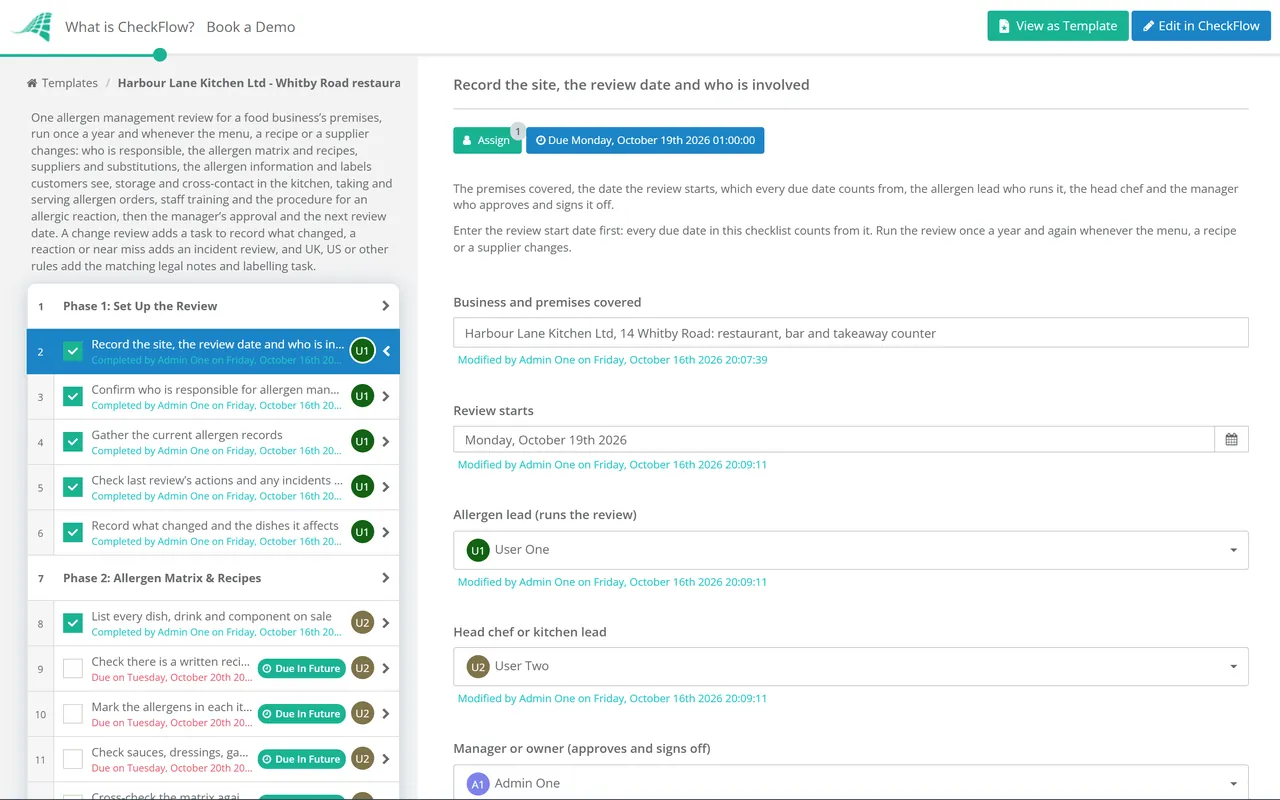
    • Record the site, the review date and who is involved — the premises covered, the date the review starts, which every due date counts from, the allergen lead who runs it, the head chef and the manager who approves and signs it off
    • Confirm who is responsible for allergen management — one named person with overall responsibility, and a responsible member of staff on every shift to handle customers’ allergen requests
    • Gather the current allergen records — the allergen matrix, recipes, ingredient specifications and labels, the allergen sign and menu wording, training records and the last review
    • Check last review’s actions and any incidents since — open actions from the last review, and any allergic reaction, complaint or near miss since; the answer decides whether the incident tasks in Phase 7 appear
    • Record what changed and the dishes it affects — new or changed dishes, recipes, ingredients or suppliers, and every dish whose allergens could change as a result, so the review checks those first
  2. Phase 2

    Phase 2: Allergen Matrix & Recipes

    6 tasks

    The matrix is only as accurate as the recipes and labels behind it. Work from the ingredient labels and specifications, never from memory.

    • List every dish, drink and component on sale — including specials, sauces, dressings, sides, drinks and anything given away free, which needs allergen information too
    • Check there is a written recipe for each item — every ingredient and sub-ingredient listed, so the dish is made to the same specification each time
    • Mark the allergens in each item on the matrix — against each of the 14 allergens in the UK or the 9 major food allergens in the US, naming the specific nut or cereal
    • Check sauces, dressings, garnishes and toppings — the parts most often missed, such as a nut garnish, a mustard dressing, a stock cube with celery or a Worcestershire sauce with fish
    • Cross-check the matrix against the ingredients in stock — each product’s label or specification sheet, with ingredients kept in their original or labelled containers
    • Keep full ingredient lists for other allergens customers ask about — so staff can check foods outside the regulated list, never guess, and tell the customer when accurate information is not available
  3. Phase 3

    Phase 3: Suppliers, Specifications & Substitutions

    6 tasks

    An allergen mistake can start before the kitchen: a new supplier, a product changed by its manufacturer or a substitute delivered without warning.

    • List the approved suppliers for each ingredient — with the assurances you rely on from each one, and anyone buying from outside the list
    • Collect a current specification for every ingredient — the product specification sheet or label for each one, replacing any that are out of date
    • Ask each supplier to tell you about allergen changes — agreed in writing, so a reformulated product does not arrive unannounced
    • Check the delivery check procedure — whoever receives goods confirms the product delivered is the one ordered before it is put away
    • Review substitutions since the last review — each one approved, recorded and the allergen information updated before the substitute was used
    • Check suppliers’ ‘may contain’ warnings are passed on — precautionary allergen information from a supplier reaches the customer, unless your own risk assessment replaces it
  4. Phase 4

    Phase 4: Allergen Information & Labelling

    7 tasks

    Check what customers actually see and hear. The labelling tasks shown depend on which rules apply, and the distance-selling task on whether you take orders by phone or online.

    • Check how customers get allergen information — written information on the menu, a matrix or a booklet, backed by a conversation with trained staff
    • Check the sign or menu message asking customers about allergies — prominent where customers choose their food, and asking them to tell staff about a food allergy, intolerance or coeliac disease
    • UK: check labels on food prepacked for direct sale — the name of the food and a full ingredients list with the 14 allergens emphasised, on sandwiches, salads and anything else packed on the premises before it is ordered
    • US: check labels on food packaged on site — the common name, the ingredients and the food source of each major food allergen, as Food Code 3-602.11 sets out for food packaged in the establishment
    • Check buffet, counter and self-service items one by one — allergen information for each item rather than for the buffet as a whole, visible and easy to read where the customer chooses
    • Check allergen information for phone, online and delivery orders — available before the order is completed and again when the food arrives, with each allergen-free meal clearly labelled
    • Review free-from, gluten-free and vegan claims — drop any claim the kitchen cannot guarantee; a vegan dish is not automatically free from milk, egg, fish, crustaceans or molluscs
  5. Phase 5

    Phase 5: Storage, Preparation & Cross-Contact

    5 tasks

    Cooking does not remove allergens. Separation, labelling and cleaning are what keep an allergen off the wrong plate.

    • Walk the stores, fridges and freezers — ingredients in sealed, labelled containers, open packs closed, and decanted products still identifiable by their allergens
    • Check the spillage procedure — what staff do when one ingredient spills onto another, and whether they know it
    • Watch an allergen order being prepared — clean utensils and boards, hands washed between dishes, separate equipment and clean oil; gluten-free chips are never cooked in oil used for battered fish
    • Check cleaning removes allergen residues — surfaces, equipment and utensils cleaned so no food debris or crumbs remain, with clear cleaning instructions in the kitchen
    • Decide which dishes the kitchen cannot make allergen-safe — where cross-contact cannot be avoided, staff tell the customer the dish cannot be made free from that allergen
  6. Phase 6

    Phase 6: Taking & Serving Allergen Orders

    6 tasks

    Observe a real service where you can. Follow one allergen order from the first question to the plate on the table.

    • Check staff ask every customer about allergen requirements — at the table, at the counter and on the phone, with a clear sign or menu message where asking everyone is not possible
    • Check who takes allergen orders on each shift — every server, or a named supervisor or chef the order is handed to, and every member of staff knows which
    • Check what the allergen conversation covers — the foods to avoid, whether the customer has seen the written information, the risk of cross-contact and any changes that can be made to a dish
    • Check how the order is recorded and passed to the kitchen — in writing on the ticket or order screen, with the kitchen confirming it has received and understood it
    • Check the dish is marked at the pass and confirmed at the table — a label or flag so it reaches the right person, and the server confirming the allergen requirement as they serve it
    • Check pre-orders and group bookings are confirmed on the day — allergen requirements taken in advance are checked again with each person before the food is served
  7. Phase 7

    Phase 7: Training & Allergic Reactions

    7 tasks

    Staff must be trained on allergens and know what to do if a customer has a reaction. The incident tasks appear only when a reaction, complaint or near miss was reported since the last review. This checklist records your procedure; it is not medical advice.

    • Check every member of staff has had allergen training — kitchen, front-of-house and delivery staff, with the course and the date, such as the FSA’s free food allergy training
    • Check the person in charge on each shift can answer allergen questions — which items on today’s menu contain which allergens, the symptoms of a reaction and where the written information is kept
    • Book refresher training and training on the changes — for anyone without training in the last year, every new starter, and the whole team when the menu or a recipe changes
    • Review the procedure for an allergic reaction — call an ambulance straight away (999 in the UK, 911 in the US), help the person use their own adrenaline auto-injector if they have one, and keep them lying down or sitting, never standing or walking
    • Walk the shift team through the reaction procedure — who calls the ambulance, who stays with the customer, who meets the crew at the door, and keeping the dish and any packaging
    • Review each reaction, complaint or near miss since the last review — what was ordered, what the customer was told, where the process failed and what was done at the time
    • Fix the cause and check it has worked — change the recipe, the matrix, the order process or the training, then check the fix in the next service
  8. Phase 8

    Phase 8: Action Plan, Approval & Next Review

    6 tasks

    The updated allergen information is approved before it reaches customers. Nothing after the approval step can be completed until the manager records a decision.

    • Record every gap found and who will close it — from every phase, with an owner and a date for each action
    • Update the matrix, recipes and written allergen information — every change from this review, with the date of the new version on each document
    • Manager approves the updated allergen information — the matrix, menus, labels and online information checked against the recipes before they go into use
    • Replace every old copy and brief the team — printed and online menus, the matrix on display, staff copies and delivery app listings, then a pre-shift briefing on what changed
    • Manager signs off the review — every gap has an owner, every change is in use and the team has been briefed
    • Set the next review date — within a year, and sooner whenever the menu, a recipe, an ingredient or a supplier changes

The 14 UK Allergens and the 9 US Major Food Allergens

Every US major food allergen is also on the UK list, with wheat as one of the cereals containing gluten. The UK list adds celery, lupin, molluscs, mustard, sulphites and the other gluten cereals. Build your matrix against the list that applies where you trade, and expect imported products to be labelled to the other list. The table is a starting point for the matrix, not legal advice.

Allergen UK: the 14 allergens US: the 9 major food allergens
CeleryYes, including celeriacNot a major food allergen
Cereals containing glutenYes: wheat (including spelt and Khorasan), rye, barley and oats, with the cereal namedWheat only
CrustaceansYes, such as prawns, crabs and lobsterYes, as crustacean shellfish, with the species named on labels
EggsYesYes
FishYesYes, with the species named on labels
LupinYesNot a major food allergen
MilkYes, including lactoseYes
MolluscsYes, such as mussels, oysters and squidNot a major food allergen; only crustacean shellfish are
MustardYesNot a major food allergen
PeanutsYesYes
SesameYesYes, since 1 January 2023 under the FASTER Act
SoybeansYesYes
Sulphur dioxide and sulphitesYes, above 10 mg/kg or 10 mg/litre as sulphur dioxideNot a major food allergen; sulfites at 10 parts per million or more must be declared on food labels
Tree nutsYes: almond, hazelnut, walnut, cashew, pecan, Brazil, pistachio and macadamia, with the nut namedYes, with the type of nut named on labels

Exemptions. Both lists leave out some highly processed ingredients. The US definition excludes highly refined oils, and the UK list excludes, for example, fully refined soybean oil and wheat-based glucose syrups. Check the supplier’s specification before you mark a product free of an allergen.

Other allergens. People react to foods outside both lists: the FDA says more than 160 foods have been identified as causing food allergies. Keep full ingredient lists so staff can answer accurately, and tell the customer when you cannot.

Why Run Allergen Management Reviews in CheckFlow?

1

A review that happens on time

A yearly recurring schedule starts each site’s review on its date, with every due date counted from the start. A new menu or a supplier change starts one by hand from the same template, and the change task records what moved. Reviews still open show on the Reports Grid.

2

Every link in one record

Matrix rows, supplier specifications, substitutions, label photos and training dates sit on the task that checked them, with who did it and when. Each check records In order or Gaps found, and every gap goes into one action plan with an owner and a date.

3

No new matrix without approval

The manager approves the updated allergen information before it goes into use, and nothing after that approval step can be completed until a decision is recorded. A UK or US answer adds the matching legal notes and labelling task.

CheckFlow does not analyse recipes or test food for allergens. That stays with your chef, your suppliers and their specifications. It makes sure the review happens, that every gap has an owner, and that the information customers rely on is checked and approved before it changes. Compliance checklist software shows how recurring reviews like this one run across sites.

Train each new starter to take and serve allergen orders with the Restaurant Employee Training Checklist, brief the day’s allergens in the Restaurant Opening & Closing Checklist, and keep allergens in your hazard analysis with the HACCP Food Safety Checklist. New suppliers go through the Supplier Onboarding Checklist before their products reach the matrix.

AI generator

Didn’t find what you need? Describe it.

Describe the process in a sentence and the AI checklist generator drafts the phases and tasks for you.

Frequently Asked Questions

What are the 14 allergens?

In the UK, food businesses must tell customers if food they provide contains any of these as an ingredient: celery, cereals containing gluten (such as wheat, rye, barley and oats), crustaceans, eggs, fish, lupin, milk, molluscs, mustard, peanuts, sesame, soybeans, sulphur dioxide and sulphites above ten parts per million, and tree nuts such as almonds, hazelnuts, walnuts, cashews, pecans, Brazil nuts, pistachios and macadamias. The rule also covers additives and processing aids still present in the food. Customers can still ask about other foods.

What are the 9 major food allergens in the US?

Milk, eggs, fish, crustacean shellfish, tree nuts, peanuts, wheat, soybeans and sesame. The Food Allergen Labeling and Consumer Protection Act of 2004 named the first eight, and the FASTER Act, signed on 23 April 2021, made sesame the ninth from 1 January 2023. The FDA Food Code uses the same definition, and its 2022 and 2026 editions require food establishments to give written notification of major food allergens in unpackaged food, where your state or locality has adopted them.

Do restaurants have to give allergen information in writing?

In England, the Food Information Regulations 2014 let a business give allergen information for food that is not prepacked by any means, including orally, as long as a notice, menu, ticket or label tells customers to ask staff. Wales and Northern Ireland have their own Food Information Regulations 2014. The FSA’s best practice is written information backed by a conversation. In the US, the 2022 and 2026 Food Code require written notification of major food allergens in unpackaged food, so check the edition your health department enforces.

What is Natasha’s Law?

The name for the UK labelling rules for food prepacked for direct sale (PPDS): food packed on the premises where it is sold before the customer orders it, such as sandwiches, salads and pies made and sold on site. Since 1 October 2021 these foods need a label with the name of the food and a full ingredients list, with the 14 allergens emphasised, for example in bold. Food packed after the customer orders it is not PPDS, though its allergen information must still be given.

How often should a food business review its allergen information?

FSA guidance does not set a fixed period, but the information must be accurate and up to date at all times. Its best practice guidance says to check regularly whether ingredients have changed, keep recipes so each dish is made the same way, and update the information after any substitution. A full review once a year, plus a review whenever the menu, a recipe or a supplier changes, is a practical rhythm. The FSA’s allergen checklist also suggests allergen training for staff every year.

What should staff do if a customer has an allergic reaction?

Call an ambulance straight away: 999 in the UK, 911 in the US. The NHS advises using the person’s adrenaline auto-injector if they have one, having them lie down, or sit up slowly if they are struggling to breathe, and not letting them stand or walk, with a second auto-injector after 5 minutes if symptoms have not improved. The FDA advises stopping eating the food and seeking medical attention. This is not medical advice: follow the emergency operator’s instructions.

What is an allergen matrix?

A chart with every dish and drink down one side and the allergens across the top, marking which allergens each item contains. The FSA publishes a free matrix template, and its best practice guidance suggests making written allergen information available without customers having to ask, such as on the menu or a matrix on display. Name the specific nut or cereal, build the matrix from recipes and ingredient labels rather than memory, and update it whenever a recipe or an ingredient changes.

Is CheckFlow free for this template?

14-day free trial, no card required. The Business plan is $10 per user per month after the trial. Full details at checkflow.io/pricing.

Keep Every Allergen Record Accurate and Approved

Free trial — no credit card required.

14-day free trial, no credit cardFull refund in your first 30 daysUS or EU hosting