Kaizen Event Checklist Template

Most kaizen events end with a good report-out and a wall of sticky notes. A month later the old way is back, because nobody owned the open actions or checked that the new standard held.

Last reviewed: October 2026

This free kaizen event checklist is for kaizen leads, continuous improvement managers and process owners who run focused improvement events of a few days on one process, in a factory, a warehouse or an office. One run is one kaizen event. It charters the event with a measured problem, a scope and two or three targets, and the sponsor approves the charter before any preparation starts. Then it picks and releases the team, measures the baseline, maps the current state and books the room and the support. The event days go and see the process, find the waste and its causes, try changes in the area and write the new standard work. The last day measures the results against the targets and lists the open actions at the report-out. A 30-day follow-up checks that the change held. A task to clear changes that touch safety or quality checks appears when needed, and a recovery phase appears when the targets are missed.

A Kaizen Event Is Six Weeks of Work, Not Five Days

Kaizen means continuous improvement: small changes, made often, by the people who do the work. A kaizen event, also called a kaizen blitz or kaizen workshop, packs that into a few days on one process. The Lean Enterprise Institute says such events commonly last five days, and that during the event a team identifies and implements a significant improvement in a process. It also warns that gains made in an event are quickly lost when people go back to the old way of working. That is why this checklist starts six weeks before the event and ends 30 days after it.

A kaizen event is one of several improvement tools, and it is not always the right one. A continuous improvement cycle runs PDCA as a standing programme, one cycle after another. A root cause analysis (8D) investigates a problem whose cause nobody knows yet. A 5S audit keeps a workplace in order once it has been improved, and the process standardisation checklist writes and maintains the standard work an event produces.

Kaizen event

A few days on one process

Use it when: the problem sits in one process, the team can see it, and the change is small enough to try in days.

Produces: a changed process, new standard work, results against the targets and a list of open actions.

Ends with: a 30-day review that checks the change held. This template.
Improvement cycle

PDCA as a standing programme

Use it when: a team improves its own process continuously, one small cycle after another.

Produces: a steady stream of tested changes and an improvement register.

Ends with: the next cycle. A kaizen event can be one turn of it, done at speed.

Unknown cause

Root cause analysis comes first

Use it when: a defect or complaint keeps coming back and nobody can prove why.

Produces: a verified root cause and escape point, with permanent fixes.

Ends with: a closed 8D. An event run before the cause is known tends to fix symptoms.

What the Kaizen Event Checklist Covers

Eight phases take one kaizen event from charter to a result that has lasted 30 days. The sponsor approves the charter before any preparation starts, and nothing after it can be completed until they do. A task to clear changes that touch safety, quality checks or the customer appears when the team's ideas need it, and Phase 8 appears only when the 30-day review finds the targets missed or the change slipping.

  1. Phase 1 — 6 weeks before

    Phase 1: Charter the Event

    6 tasks

    A kaizen event with a vague aim spends its first two days arguing about what it is for. Write the problem, the scope and two or three measured targets on one page, and get the sponsor to approve it. Nothing after the charter can be completed until the sponsor approves it, so no team is released and no room is booked for an event nobody has agreed to.

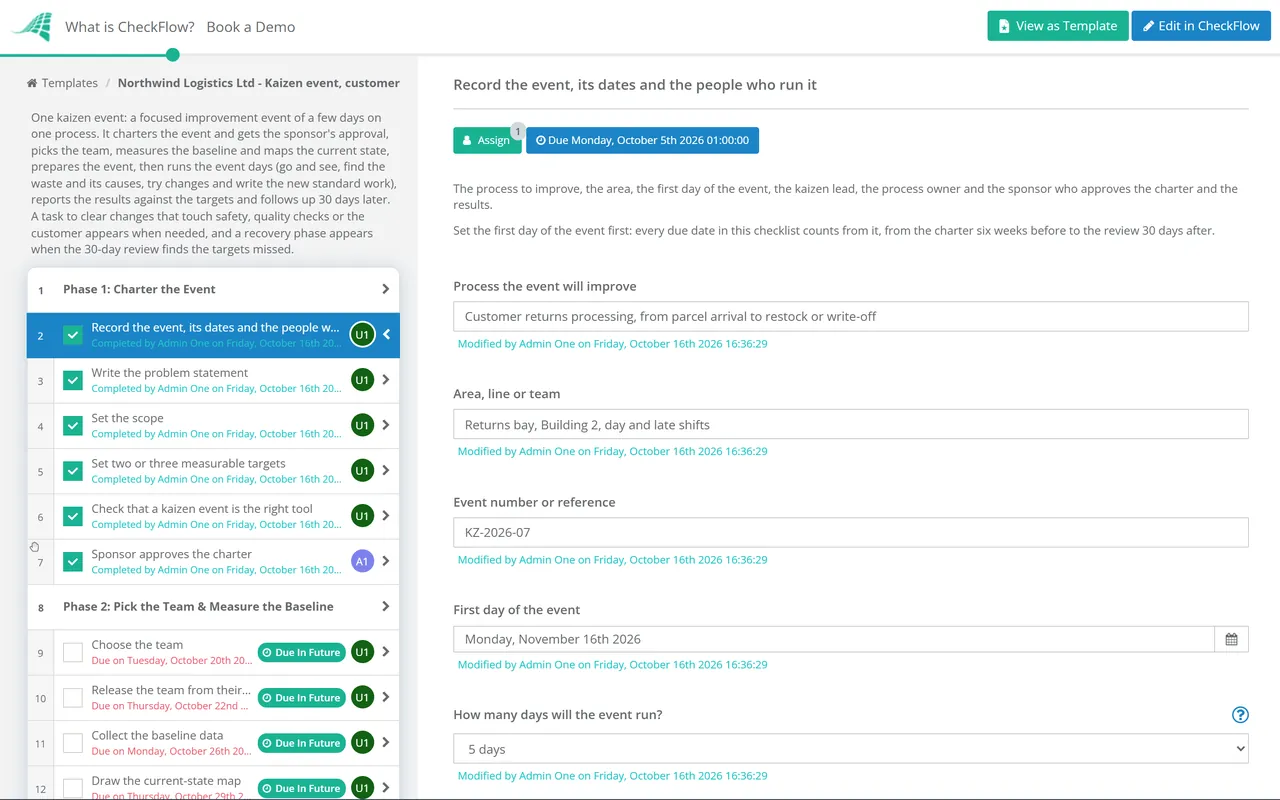
    • Record the event, its dates and the people who run it — the process to improve, the area, the first day of the event, the kaizen lead, the process owner and the sponsor who approves the charter and the results
    • Write the problem statement — what goes wrong in the process today, where and how often, in measured terms and with no solution written into it
    • Set the scope — the first and last step of the process, the area and shifts covered, and what the team may and may not change during the event
    • Set two or three measurable targets — each with today’s figure, the target figure and how it will be measured, such as lead time, steps, walking distance, errors or floor space
    • Check that a kaizen event is the right tool — one process a small team can change within days; a problem whose cause nobody knows needs root cause analysis first, and a full redesign needs a longer project
    • Sponsor approves the charter — problem, scope, targets, dates, team size and the limits the team works within; preparation starts only once the charter is approved
  2. Phase 2 — 4 to 2 weeks before

    Phase 2: Pick the Team & Measure the Baseline

    6 tasks

    The team needs people who do the work every day, and it needs a baseline measured before the event, the same way it will be measured afterwards. Without the baseline, the report-out compares the new process with a memory of the old one.

    • Choose the team — people who do the work every day, someone from the step before and the step after, and one or two outsiders who will ask why
    • Release the team from their normal work for the event days — agree cover with each person’s manager, so nobody is pulled back to the day job halfway through
    • Collect the baseline data — the figures behind each target, measured the same way they will be measured after the event, over enough days to show a normal spread
    • Draw the current-state map — every step, wait, handoff and queue as the process runs today, walked in the area rather than drawn from the procedure
    • Gather the current standard work and procedures — work instructions, procedures, forms and layouts as issued, with a note of where practice differs from them
    • Tell the people in the area about the event — what it is for, when it runs, who is on the team, and how anyone can put an idea forward before it starts
  3. Phase 3 — Final 2 weeks

    Phase 3: Prepare the Event

    5 tasks

    An event loses half a day every time the team waits for a key, a maintenance fitter or an IT login. Book the room and the area, put the support people on call and fix the report-out time before the first day.

    • Book the room, time in the area and the materials — a room close to the work, time on the line or at the desks agreed with the supervisor, and the materials and small budget the team will need
    • Put support people on call for the event days — maintenance, IT, facilities, safety and quality people who can make or approve a change on the same day
    • Set the agenda for each day — what the team does each day, with the report-out time fixed and the sponsor’s attendance confirmed
    • Send the team the charter, the baseline and the agenda — with where to meet on the first day and what to wear or bring for the area
    • Confirm the event is ready to run — team released, baseline and map in hand, support on call and the area expecting the team; if not, move the date rather than start short
  4. Phase 4 — Day 1

    Phase 4: Go and See

    5 tasks

    The first day belongs in the area, not the meeting room. The team watches the process as it runs, times it and corrects the map with what it saw, so every idea later in the week rests on facts the whole team has seen.

    • Open the event with the sponsor — the sponsor says why the process matters and what the limits are; the lead goes through the charter, the targets and the agenda
    • Teach the team the basics they need — the seven wastes, how to time a step and how to read the map, kept short so the team gets to the area quickly
    • Go and see the process where the work is done — walk it end to end, follow one item or piece of work all the way through, and ask the people doing it what gets in their way
    • Time the steps and measure the distances — several cycles of each step, the waiting time between steps, and how far people and items travel
    • Correct the current-state map with what the team saw — steps added, removed or reordered, and measured figures in place of the assumed ones
  5. Phase 5 — Days 2 to 4

    Phase 5: Find the Waste & Try the Changes

    8 tasks

    The middle of the event is a cycle: find the waste, ask why it is there, try a change in the real process, measure it and keep what works. A task to clear the changes that touch safety, quality checks or the customer appears when the team says any of its ideas do.

    • Mark the waste on the map — tag each step as adding value, needed but not adding value, or waste, and name the type of waste
    • Ask why for the biggest wastes — five whys or a fishbone at the step itself, until the team reaches a cause it can change during the event
    • Generate ideas and pick the ones to try — many ideas first, then rate each on effect and effort, and choose the ones the team can test before the report-out
    • Clear the changes that touch safety, quality checks or the customer — a guard, a safety rule, an inspection or test step, or what the customer receives: get the approval your own procedures require before the trial
    • Try the changes in the area — move, remove or rearrange in the real process with the people who do the work, one change at a time where you can
    • Measure the process with the changes in place — the same measures, measured the same way as the baseline
    • Adjust or undo what did not work — keep what moved the measures, rework what nearly did, and put back anything that made the process worse
    • Write the new standard work — the work sequence, the time each step should take and the stock or work in progress held at each point, ready to train
  6. Phase 6 — Last day

    Phase 6: Results & Report-Out

    6 tasks

    The report-out shows the sponsor and the area what changed, against the targets in the charter. Anything the team could not finish goes on one open actions list, with one owner and a date for each, so the work carries on after the team breaks up.

    • Train everyone who runs the process on the new standard — every shift, including people who were not on the team; anyone not trained by the end of the event goes on the open actions list
    • Measure the results against the targets — each target with its baseline, the result at the end of the event and what the result is based on
    • List the open actions — everything the team could not finish during the event, each with one owner and a date, most within 30 days
    • Hold the report-out — the team presents the before and after, the results, the new standard work and the open actions to the sponsor and the area
    • Sponsor accepts the results and the open actions — and agrees the support the open actions need and the date of the 30-day review
    • Thank the team and share the result with the area — post the before and after on the area board, and say what changed because of their work
  7. Phase 7 — 30 days after

    Phase 7: 30-Day Follow-Up

    7 tasks

    Most of what slips after an event slips in the first weeks, as people go back to the old way when nobody is watching. The open actions are checked every week, the new standard is observed on different shifts, and the measures are taken again before the sponsor closes the event. A recovery phase appears when the 30-day review finds the targets missed or the change slipping.

    • Check the open actions every week — chase each owner, update the list and take any action that is stuck to the sponsor
    • Check the new standard work is being followed — watch the process on different shifts, without warning, against the standard work written during the event
    • Measure the process again, 30 days on — the same measures, measured the same way, over a normal period of work
    • Confirm the open actions are closed — each one done and checked, or given a new date and a reason by its owner
    • Hold the 30-day review with the sponsor — results against the targets, whether the change has held and what is left to do
    • Record the lessons for the next event — what helped and what got in the way, from the charter to the follow-up, written so the next kaizen lead can find it
    • Sponsor closes the event or keeps it open — closed when the targets are met and the change has held; kept open while the recovery in Phase 8 runs
  8. Phase 8 — If targets are missed

    Phase 8: Recover the Targets

    6 tasks

    Applies only when the 30-day review finds the targets missed or the change only partly held. Find out why before adding more actions: a change that slipped needs a different fix from a change that never worked.

    • Find out why the targets were missed or the change slipped — the standard not followed, a change that did not hold at full volume, an open action not done, or a cause the event never reached
    • Run a root cause analysis where the event did not reach the cause — a cause the team could not find or prove during the event needs a proper investigation, not another round of ideas
    • Agree the recovery actions with the sponsor — what will change, who owns each action and by when, including any retraining on the standard
    • Set a second review date — far enough out for the recovery actions to take effect over a normal period of work
    • Hold the second review — the same measures, measured the same way, and whether the standard is now followed on every shift
    • Sponsor closes the event after the second review — closed, closed with the gap accepted, or passed to a new event or a longer project with the reasons recorded

A Five-Day Kaizen Event, Week by Week

The event days are the visible part of a kaizen event. The weeks before decide whether the team has the data, the people and the support to change anything, and the weeks after decide whether the change lasts. The timeline below is for a five-day event that starts on a Monday, which is how this checklist sets its due dates. For a three or four-day event, bring the Days 2 to 4 work forward and keep the rest.

When What happens What it produces Common mistake
6 weeks beforeProblem, scope and targets written; the sponsor approves the charterAn approved one-page charterA target nobody measured, or a solution written into the problem statement
4 to 2 weeks beforeTeam chosen and released; baseline measured; current state mapped in the areaBaseline figures and a current-state mapMeasuring the baseline one way and the result another
Final 2 weeksRoom, area time, materials and support booked; agenda and report-out time setAn event that can start on timeNo maintenance or IT support on call, so changes wait for a ticket
Day 1Go and see the process, time the steps, correct the mapFacts the whole team has seenSpending the day in the meeting room
Days 2 to 4Find the waste, ask why, try changes in the area, measure them, write the standard workA changed process and new standard workPlanning changes on paper instead of trying them
Last dayTrain the shifts, measure the results, list open actions, hold the report-outResults against the targets and an open actions listOpen actions with no owner or date
30 days afterCheck actions weekly, observe the standard, measure again, review with the sponsorA result that has held, or a recovery planNo follow-up, so the old way comes back

The seven wastes. The Lean Enterprise Institute lists Taiichi Ohno's seven wastes as overproduction, waiting, conveyance, processing, inventory, motion and correction. On Day 2 the team tags each step on the map against them. In an office, conveyance is a file passed between desks or systems, inventory is work waiting in a queue, and correction is rework after an error. The guide to lean manufacturing principles explains each one, and the guide to value stream mapping shows how to draw the current-state map.

Targets the team can measure in a week. Choose measures the team can take again on the last day and 30 days later, the same way each time: lead time, the number of steps or handoffs, walking distance, errors or rework, floor space, or work waiting at a step. A measure that needs a quarter of data to move belongs in a longer project.

Why Run Kaizen Events in CheckFlow?

1

No preparation without an approved charter

The sponsor is chosen on the first task, and the charter approval is assigned to them alone. Nothing after the approval step can be completed until they record a decision, so a team is never released for an event with no agreed problem, scope or targets. The sponsor also accepts the results at the report-out and closes the event after the 30-day review.

2

Every date counts from the first day of the event

Enter the first day of the event and every task falls due on the right day, from the charter six weeks before to the review 30 days after. Move the event and the dates move with it. The Reports Grid shows every event in progress and which tasks are overdue, so a kaizen lead running several events sees where each one stands.

3

The follow-up is part of the event

The open actions list, the observation of the new standard and the 30-day measurements are tasks with owners and dates, not good intentions. When the review finds the targets missed, a recovery phase appears, set up with conditions in the template designer. The baseline, the map, the photos and the results sit on the task that produced them.

CheckFlow does not draw your value stream map or time your steps for you. Draw the map on paper or in your own tool and attach it to the tasks. CheckFlow runs the work around the event: who does each step, by when, with what evidence, and who approved it. CheckFlow for manufacturing shows how plants run their other quality and production checks the same way.

An event usually ends with new standard work. Keep it current with the Process Standardization Checklist, and keep the improved area in order with the 5S Audit Checklist. For improvement as a standing programme rather than a single event, use the Continuous Improvement Cycle Process Checklist, and read the guide to continuous improvement for where kaizen sits among the other models.

AI generator

Didn’t find what you need? Describe it.

Describe the process in a sentence and the AI checklist generator drafts the phases and tasks for you.

Frequently Asked Questions

What is a kaizen event?

A kaizen event is a short, focused improvement event, usually a few days, in which a small team improves one process. It is also called a kaizen blitz or kaizen workshop. The team goes to where the work is done, measures it, finds the waste, tries changes in the real process and writes new standard work. A good event is chartered weeks in advance with measurable targets, and followed up afterwards to check the change held.

How long does a kaizen event last?

The event itself commonly lasts five days, according to the Lean Enterprise Institute, and shorter events of three or four days are also run. The work around it takes longer. This checklist charters the event about six weeks before, measures the baseline and books the support in the weeks after that, and follows up for 30 days after the report-out. Its due dates assume a five-day event starting on a Monday; for a shorter event, bring the middle tasks forward.

What is the difference between kaizen and a kaizen event?

Kaizen is the everyday habit of improvement: everyone, every day, making small changes to their own work. A kaizen event is one concentrated burst of it, with a team taken off their normal work for a few days to improve one process. Daily kaizen often runs as a PDCA cycle, which the continuous improvement cycle checklist covers. An event suits a problem that is too big for a daily suggestion but small enough to change in a week.

Who should be on a kaizen event team?

The people who do the work every day come first, because they know where it goes wrong. Add someone from the step before and the step after, a person from maintenance, IT or quality who can make changes, and one or two outsiders who will ask why things are done the way they are. The kaizen lead facilitates and the process owner takes the process back afterwards. The sponsor approves the charter and the results but is not usually on the team.

What should a kaizen event charter include?

The problem in measured terms, without a solution written into it. The scope: the first and last step, the area and shifts covered, and what the team may not change. Two or three targets, each with today's figure, the target figure and how it will be measured. The dates, the team, the kaizen lead, the process owner and the sponsor, and any limits on spending. The sponsor approves it before any preparation starts.

What are the seven wastes in a kaizen event?

The Lean Enterprise Institute lists Taiichi Ohno's seven wastes as overproduction, waiting, conveyance, processing, inventory, motion and correction. During the event the team tags each step on the current-state map as adding value, needed but not adding value, or waste, and names the type of waste. The point is not the label but the question that follows: why is this waste here, and what can we change this week?

How do you sustain the results of a kaizen event?

Plan the follow-up before the event ends. Train everyone who runs the process on the new standard work, put every unfinished item on an open actions list with one owner and a date, and fix the date of a 30-day review at the report-out. In the weeks after, check the actions every week, watch the process on different shifts against the standard, and measure it again the same way as the baseline. If the targets are missed, find out why before adding more actions.

Is CheckFlow free for this template?

14-day free trial, no card required. The Business plan is $10 per user per month after the trial. Full details at checkflow.io/pricing.

Make Every Kaizen Event Last Past the Report-Out

Free trial — no credit card required.

14-day free trial, no credit cardFull refund in your first 30 daysUS or EU hosting