Continuous Improvement Cycle Process Checklist Template
The organisation that improves incrementally and consistently over three years outperforms the one that pursues transformation once and never sustains it. Continuous improvement is not a project — it is a discipline.
The concept of continuous improvement — expressed as Kaizen in Japanese manufacturing philosophy, as the PDCA cycle in quality management, and as the foundation of ISO 9001 — rests on a simple but powerful insight: improvement should not wait for a crisis or a transformation programme. It should happen constantly, at every level of the organisation, driven by the people closest to the work. Nike doubled in size between 2015 and 2021, from $100 billion to over $200 billion, with PDCA-based quality management among the operational disciplines that supported this growth. The Mayo Clinic and Nestlé have both documented significant efficiency improvements through systematic continuous improvement programmes. The discipline behind these outcomes is not complexity — it is consistency. A structured improvement cycle that starts with a well-defined problem, tests solutions before committing to them, measures results honestly, and standardises what works before beginning the next cycle. This free checklist gives quality managers, operations leaders, and improvement teams a structured framework for the full continuous improvement cycle.
Developed by: Dr. W. Edwards Deming; adopted globally as the continuous improvement backbone of ISO 9001
Best for: Incremental improvements, process simplification, everyday Kaizen, and organisations starting their improvement journey
Cycle speed: Fast — can run in days to weeks for small-scope improvements
Rigour: Structured but accessible; does not require statistical expertise
Used by: Teams at all levels; quality management systems; healthcare (Plan-Do-Study-Act); manufacturing; service organisations
DMAIC — Define-Measure-Analyse-Improve-Control
DMAIC (Define-Measure-Analyse-Improve-Control)
Developed by: Motorola; refined through GE’s Six Sigma programme
Best for: Complex problems with high variability, statistically significant defect reduction, and large-scale process redesign
Cycle speed: Weeks to months — requires data collection and statistical analysis
Rigour: High — typically requires trained Six Sigma practitioners (Green Belt, Black Belt)
Used by: Large manufacturers, healthcare systems, financial services firms with significant process complexity
For most organisations running improvement cycles at the process and team level, PDCA is the right tool. DMAIC adds statistical rigour for high-complexity, high-stakes improvement projects. Both are better than no systematic approach.
The Continuous Improvement Cycle Checklist
Five phases covering the full PDCA improvement cycle — from problem identification and root cause analysis through pilot implementation, results measurement, standardisation, and programme governance.
Phase 1 — Plan
Phase 1 (Plan): Problem Identification & Root Cause Analysis
The most common continuous improvement failure is starting with a solution rather than a problem. A solution is a guess about the root cause of a problem. A solution implemented without confirmed root cause will address a symptom and leave the underlying cause untouched.
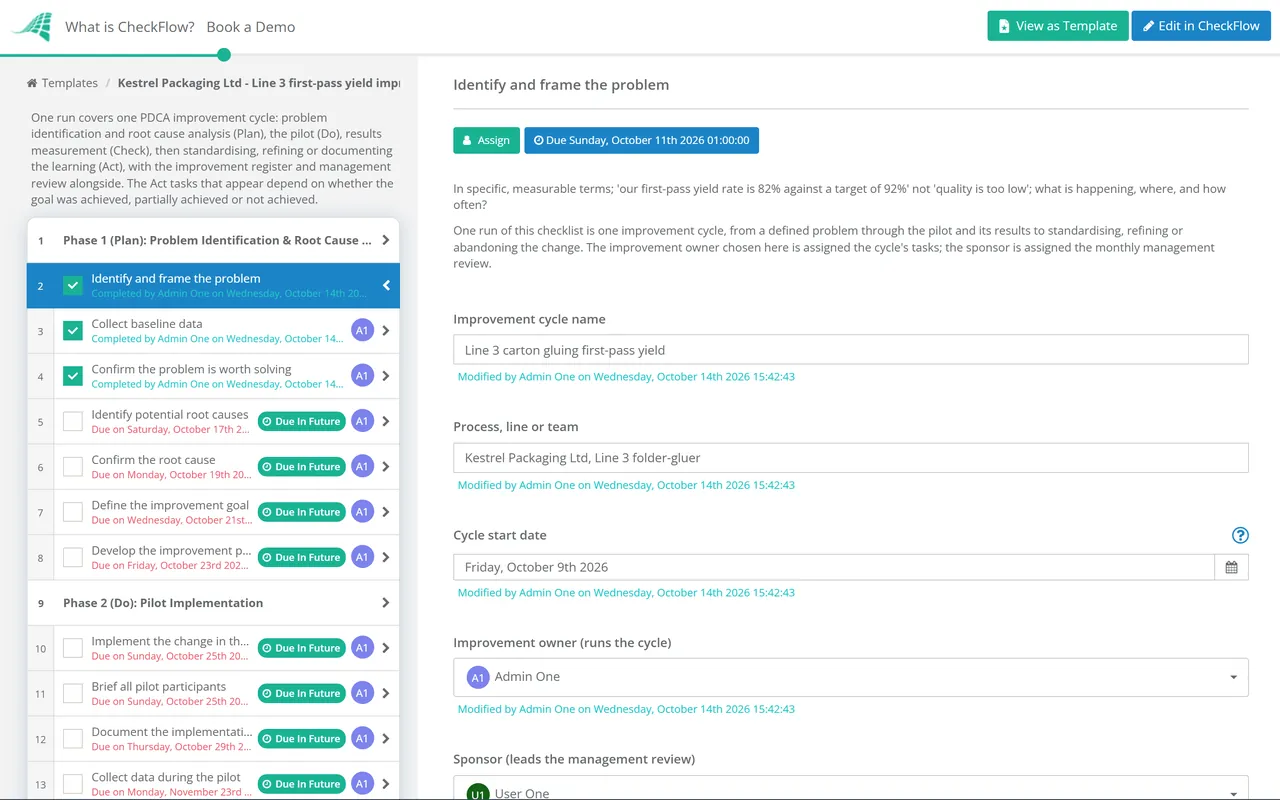
Identify and frame the problem — in specific, measurable terms; “our first-pass yield rate is 82% against a target of 92%” not “quality is too low”; what is happening, where, and how often?
Collect baseline data — quantifying the current state; the measurement that will be used to assess improvement after the change is made; established now, before any change
Confirm the problem is worth solving — what is the cost of not fixing it? Revenue impact, quality impact, customer impact, safety impact? Prioritise against other improvement opportunities
Identify potential root causes — using structured tools: 5 Whys (ask “why?” five times to trace from symptom to root cause), Fishbone/Ishikawa diagram (mapping causes across 6M categories: Man, Machine, Method, Material, Measurement, Mother Nature), or Pareto analysis (identifying the 20% of causes producing 80% of the problem)
Confirm the root cause — with data; a suspected root cause that cannot be evidenced is a hypothesis; test it before building a solution on it
Define the improvement goal — specific, measurable, and time-bound; “increase first-pass yield from 82% to 92% within 3 months”
Develop the improvement plan — the specific change to be tested; the pilot scope; the measurement method; the responsible owner
Phase 2 — Do
Phase 2 (Do): Pilot Implementation
The PDCA “Do” phase is a controlled experiment, not a full deployment. The smallest scale that can produce meaningful data is the right scale for the pilot. Testing on one line before rolling out to all lines; one team before all teams; one site before all sites.
Implement the change in the pilot scope — as defined in the plan; do not expand scope during the pilot
Brief all pilot participants — what is changing, why, what is expected of them, and how results will be measured
Document the implementation — start date, scope, conditions, and any deviations from the plan that occurred during implementation
Collect data during the pilot — the same measurement as the baseline; consistently; over a period long enough to be statistically meaningful
Phase 3 — Check
Phase 3 (Check): Results Measurement & Analysis
Compare pilot results to baseline — did the metric improve? By how much? Against the goal set in Phase 1
Assess whether the improvement was caused by the change — or by other factors; confirmation of causal relationship is essential before standardisation
Identify any unintended consequences — did the change cause any new problems? Reduce performance in any area not being measured?
Compare to the goal — was the goal achieved? Partially? Not at all?
Document the findings — results, analysis, and conclusions; the learning from this cycle is the input to the next
Phase 4 — Act
Phase 4 (Act): Standardise, Iterate, or Abandon
The Act phase has three possible outcomes. Each is equally valid. The improvement that did not work as expected is not a failure — it is data. The discipline is in acting on the data rather than on the original plan.
If successful: Standardise the change — update SOPs and work instructions to reflect the new standard; train all affected personnel; roll out from pilot scope to full scope
If successful: Establish the new baseline — the post-improvement metric becomes the new standard from which the next improvement cycle starts
If partially successful: Refine the approach — what needs to change? Re-enter the PDCA cycle at Plan with the refined hypothesis
If unsuccessful: Document the learning — what was learned? What does the data suggest? Restart at Plan with a different hypothesis
Communicate the outcome — to the team and any stakeholders; both successful and unsuccessful outcomes shared transparently; the culture of continuous improvement depends on psychological safety to report honest results
Launch the next improvement cycle — continuous improvement never stops; the completed cycle reveals the next opportunity
Phase 5 — Governance
Phase 5: Programme Governance & Management Review
Maintain an improvement register — all active improvement cycles tracked; each with problem statement, goal, phase, owner, and target date
Prioritise the improvement backlog — against impact and effort; the highest-impact, lowest-effort improvements are addressed first
Monthly management review of improvement programme — cycles completed this month; impact achieved; active cycles and their status; any resource or systemic barriers
Celebrate and share successes — completed improvement cycles with meaningful results communicated to the wider organisation; the cultural signal that improvement is valued
The 5 Whys — the Simplest Root Cause Tool in Any Quality Toolkit
The 5 Whys technique, developed at Toyota as part of the Toyota Production System, is the most accessible root cause analysis tool in quality management. The method is simply to ask “why?” repeatedly — typically five times — until the root cause (not the symptom) is identified. A defective product returned by a customer is a symptom; the fact that the inspection step was skipped because the production schedule was overloaded is a root cause; and the fact that production schedule management has no buffer for quality holds is the systemic cause that, if addressed, prevents the whole chain of events.
Example: Customer returned a batch of products because of defects.
1
Why were defective products shipped? — The final inspection did not catch the defects.
2
Why did the final inspection miss the defects? — The inspector was using the wrong acceptance criteria for this product variant.
3
Why was the wrong acceptance criteria being used? — The inspection checklist was not updated when the product specification changed.
4
Why was the inspection checklist not updated? — There is no process to link product specification changes to inspection checklist updates.
5
Why is there no such process? — Change control does not include quality documents as affected documents.
Root cause: The change control process does not include quality inspection documents. Fixing this prevents every future occurrence of this class of problem.
Why Run Your Continuous Improvement Programme in CheckFlow?
1
A consistent improvement cycle structure for every project
Improvement cycles that are run differently depending on who is leading them — some rigorously, some informally — produce inconsistent outcomes and cannot be compared across the organisation. CheckFlow’s continuous improvement checklist provides every improvement project with the same PDCA structure: problem statement, baseline data, root cause, pilot plan, measurement, and standardisation — regardless of team or leader.
2
An improvement register that makes the programme visible
Improvement programmes that exist only in the quality manager’s spreadsheet are programmes that management cannot oversee, prioritise, or resource. CheckFlow’s improvement register tracks every active cycle — its phase, its goal, its owner, and its impact — creating the programme visibility that enables management review and resource allocation.
3
Standardisation built into the Act phase
The improvement that is piloted successfully and then not standardised is the improvement that degrades within weeks as old habits return. CheckFlow’s Act phase includes SOP update, training delivery, and full-scope rollout as required tasks — ensuring the improvement survives the pilot.
Continuous improvement cycles often identify defects as the improvement opportunity. CheckFlow’s Defect Reporting & Resolution Checklist covers the structured defect management process that feeds improvement cycles. See the Defect Reporting & Resolution Checklist →
The Act phase of a successful improvement cycle requires updating the standard operating procedure for the improved process. CheckFlow’s Process Standardisation Checklist covers the structured SOP development and implementation process. See the Process Standardisation Checklist →
The PDCA cycle (Plan-Do-Check-Act) is a four-phase iterative improvement methodology developed by Dr. W. Edwards Deming. Plan: identify the problem, analyse root causes using tools like the 5 Whys or fishbone diagram, establish a measurable improvement goal, and develop a change to test. Do: implement the change on a small pilot scale, collect data, and document conditions. Check: compare pilot results to the baseline, assess whether the change caused the improvement, and identify any unintended consequences. Act: standardise the change and update SOPs if successful; refine and re-enter the cycle if partially successful; document the learning and start again if unsuccessful. The cycle then repeats with a new opportunity identified from the improved baseline.
What is the difference between Kaizen and PDCA?
+
Kaizen is a philosophy of continuous improvement — a mindset and cultural commitment to making things incrementally better every day. PDCA is the structured method most commonly used to execute Kaizen improvement cycles. Kaizen without PDCA is a culture without a process; PDCA without Kaizen is a process without culture. In practice, Kaizen events (focused, time-bound improvement sessions — typically 3–5 days) use the PDCA cycle as their methodology, while daily Kaizen (individual suggestions and small team improvements) may use a lighter version of the same cycle.
What is root cause analysis and why is it important?
+
Root cause analysis is the process of identifying the underlying, systemic cause of a problem rather than addressing its surface symptoms. A defect found in a product is a symptom; the process step that produces the defect is the proximate cause; the absence of a process control that would have prevented the variation is the root cause. Addressing only the symptom — reworking the defective product — produces no improvement in the process and the defect recurs. Addressing the root cause eliminates the entire class of problem. The most commonly used root cause tools are the 5 Whys, the Ishikawa (fishbone) diagram, fault tree analysis, and Pareto analysis.
How does the continuous improvement cycle connect to ISO 9001?
+
The ISO 9001 quality management standard is explicitly structured around the PDCA cycle. The standard requires organisations to Plan quality objectives and processes, Do (implement the planned processes), Check (monitor, measure, and audit the processes and their outputs), and Act (take corrective action and improvement decisions). ISO 9001 clause 10 specifically covers continual improvement, requiring organisations to identify and act on opportunities for improvement and to use CAPA (corrective and preventive action) processes to address non-conformances.
Is CheckFlow free for this template?
+
You can start a free 14-day trial with no credit card required, giving you full access to all features including this template. The Business plan is $10 per user per month after the trial. Full details at checkflow.io/pricing.
Run Every Improvement Cycle With the Same Structured PDCA Process — Consistently, Measurably
Free trial — no credit card required.
Do you like cookies? 🍪 We use cookies to ensure you get the best experience on our website. Learn more