The documents not provided at the start of a tenancy become the documents that cannot protect the landlord at the end of it. A thorough move-in process is not just good tenant relations — it is the legal foundation the tenancy stands on.
The move-in process is the moment when the landlord’s legal obligations crystallise. In England, the landlord who does not provide the gas safety certificate before the tenant moves in has committed a criminal offence. The landlord who does not protect the deposit within 30 days and serve the prescribed information cannot recover the deposit from the court-administered scheme, faces a financial penalty, and — critically — cannot serve a valid notice to end the tenancy. The landlord who does not conduct a thorough, signed, photographic move-in inventory has no evidenced baseline against which to claim deposit deductions when the tenant leaves. These are not administrative details — they are the legal foundations that either protect the landlord’s investment or leave it exposed. A structured tenant onboarding checklist ensures every legal obligation is met at move-in, every compliance document is provided, every material is handed over, and the tenant starts the tenancy with a clear understanding of their responsibilities and the property’s systems. This free checklist gives landlords and property managers a structured framework for the full tenant move-in process.
Process framework, not legal advice. Tenancy law varies significantly between jurisdictions. The obligations described apply to England unless otherwise stated. Consult a qualified property solicitor for advice specific to your jurisdiction and circumstances.
What the Landlord Must Provide at Move-In (England)
Document
If Not Provided
Gas Safety Certificate (current)
Criminal offence; cannot charge for gas; may affect ability to end tenancy
EICR (current)
Compliance failure; potential fine
Energy Performance Certificate
Cannot advertise property to let; potential fine
“How to Rent” Guide (current version)
Cannot serve valid Section 8 notice in many circumstances
Deposit prescribed information (within 30 days of receipt)
Financial penalty 1–3× deposit; cannot end tenancy with valid notice
Tenancy agreement (signed)
No clear written terms; all terms default to statutory minimum
The Tenant Onboarding Checklist
Six phases covering the full tenant move-in process — from pre-move-in preparation through lease signing, move-in inspection, key handover, property orientation, and welcome communication.
Phase 1
Pre-Move-In Preparation
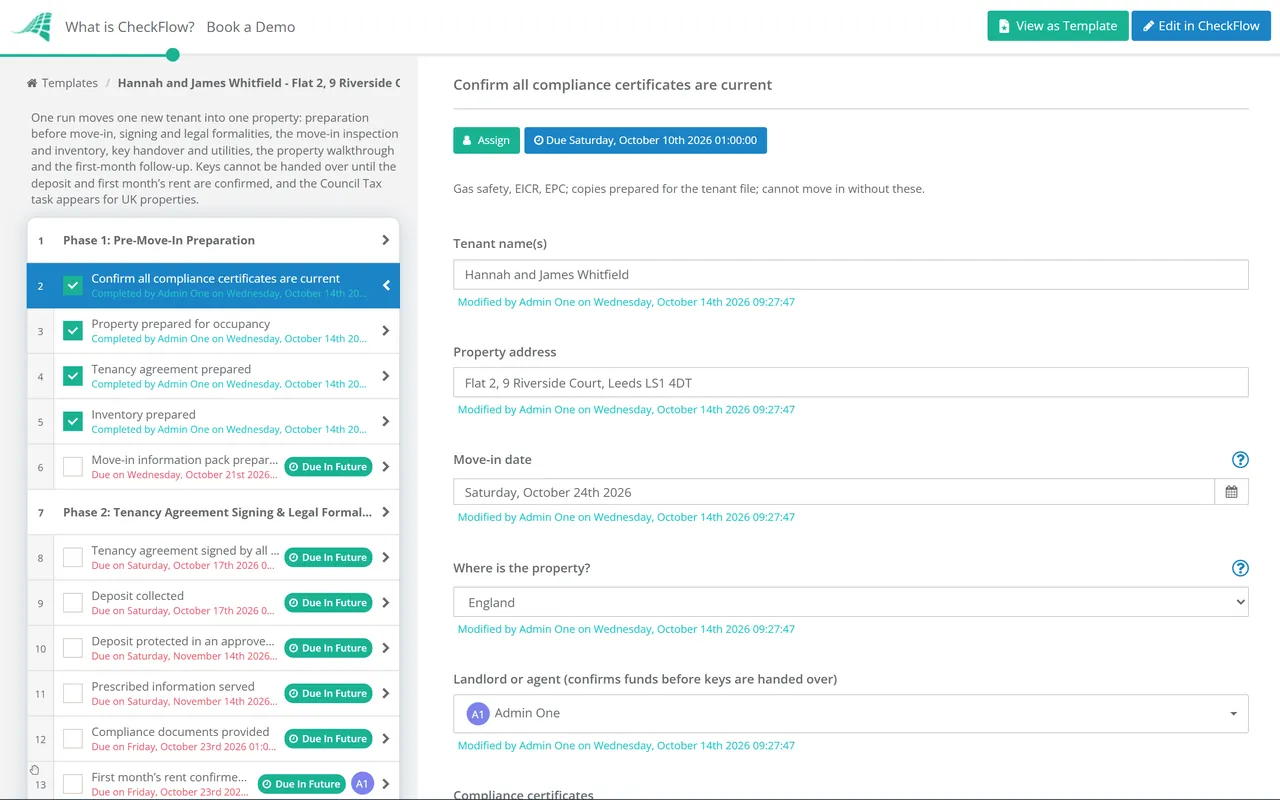
Confirm all compliance certificates are current — gas safety, EICR, EPC; copies prepared for the tenant file; cannot move in without these
Property prepared for occupancy — clean; all appliances working; any agreed repairs complete; property in the condition the tenant agreed to when viewing
Tenancy agreement prepared — correct tenancy type (Assured Shorthold in England for most residential lettings); all clauses reviewed; rent, deposit, and tenancy dates confirmed
Inventory prepared — full written inventory with photographs of every room, every item of furniture, every appliance, and every surface; dated; two copies for signing
Move-in information pack prepared — property manuals, appliance instruction manuals, bin collection schedule, emergency contacts (gas, electricity, water, plumber), and property rules/lease clauses summary
Phase 2
Tenancy Agreement Signing & Legal Formalities
Tenancy agreement signed by all adult tenants — and by the landlord or agent; each party retains a signed copy
Deposit collected — confirmed received in cleared funds before keys are handed over
Deposit protected in an approved scheme — within 30 days of receipt; DPS, MyDeposits, or TDS (England); scheme protection reference obtained
Prescribed information served — within 30 days of deposit receipt; includes the scheme leaflet and the prescribed information document; tenant signs to confirm receipt
Compliance documents provided — gas safety certificate, EICR, EPC, and the “How to Rent” guide (England); tenant signs to confirm receipt; copies retained on the landlord’s file
First month’s rent confirmed received — before keys handed over; standing order or bank transfer details confirmed for future payments
Phase 3
Move-In Inspection & Inventory Sign-Off
The move-in inventory is the most important document in the landlord-tenant relationship. It is the only objective record of the property’s condition at the start of the tenancy against which the condition at checkout will be compared. A thorough, signed, photographic inventory protects the landlord’s deposit claim. An absent or inadequate inventory means deposit deductions cannot be evidenced.
Conduct the move-in inspection with the tenant — walking through every room together; both parties see the baseline condition at the same time
Review the inventory together — confirming each item; tenant notes any disagreements or amendments
Both parties sign the inventory — landlord and all adult tenants; dated with the move-in date
Photographs taken — of every room, every significant item, and any existing damage; timestamped; stored in the tenancy file
Meter readings taken — gas, electricity, and water (where applicable); photographed and recorded; given to the tenant and retained by the landlord
Phase 4
Key Handover & Utility Setup
Keys handed over — all sets; number of sets confirmed and recorded; tenant signs to acknowledge receipt
Utility accounts transferred or set up — electricity, gas, and water providers confirmed; tenant contacts existing providers with meter readings and move-in date to establish their own accounts
Broadband and telecoms — any existing provider notified; tenant arranges their own account
Council Tax (UK) — local authority notified of new tenant; tenant registers for council tax in their name
Phase 5
Property Orientation & System Walkthrough
Heating and hot water system explained — how to operate; boiler location; when annual service is due; how to report a fault
Emergency shut-off locations shown — gas stopcock, main electrical consumer unit, water stop tap; tenant knows where they are
Security systems demonstrated — alarm codes (where applicable); window and door locks; any key safe or security system instructions
Maintenance reporting procedure explained — how to report a maintenance issue; who to contact; expected response times; what constitutes an emergency
Any specific property rules — waste and recycling arrangements, parking, communal areas, no-smoking terms; confirmed understood
Phase 6
Welcome Communication & First-Month Follow-Up
Welcome email or letter — confirmation of all contact details; rent payment details; maintenance reporting contact; a warm, professional welcome
Provide emergency contacts list — gas emergency (National Gas UK: 0800 111 999), electricity emergency, water emergency, landlord/agent contact, and out-of-hours emergency contact
Check in at week 1 — brief contact to confirm the tenant has settled in; any immediate maintenance issues? Any questions?
All documentation filed — signed tenancy agreement, signed inventory, deposit protection evidence, compliance document provision records, and meter readings; in the property file
Every legal document provided and evidenced at move-in
The landlord who needs to prove — in court, in a tribunal, or in a deposit dispute — that they provided the gas safety certificate before move-in, served the prescribed information within 30 days, and provided the current How to Rent guide needs a dated, documented record. CheckFlow’s move-in checklist records each document provision as a completed step with a timestamp and the confirming party.
2
A signed, photographed inventory in the tenancy file
The move-in inventory process — walking through with the tenant, reviewing every room, taking timestamped photographs, and obtaining signatures — is the most important 90 minutes in the tenancy. CheckFlow’s inventory phase guides the process and stores the completed inventory in the tenancy file automatically.
3
A consistent move-in experience across every tenancy
The tenant who moves into a well-prepared property, receives all their documents, understands the systems, and gets a follow-up call after week one begins the tenancy as a satisfied customer. CheckFlow’s tenant onboarding checklist delivers this experience consistently — regardless of which property manager conducts the move-in.
Tenant onboarding begins with successful screening. CheckFlow’s Tenant Screening Checklist covers the preceding evaluation process. See the Tenant Screening Checklist →
The move-in inventory sets the baseline for the move-out deposit assessment. CheckFlow’s Property Management Checklist covers the full tenancy lifecycle including the move-out process. See the Property Management Checklist →
A tenant onboarding checklist covers six phases: pre-move-in preparation (compliance certificates confirmed current, property prepared, tenancy agreement drafted, inventory prepared, information pack assembled), tenancy agreement signing and legal formalities (all adults sign, deposit collected and protected within 30 days, prescribed information served, compliance documents provided with signature confirmation, first month’s rent confirmed), move-in inspection and inventory (conducted with the tenant, signed by both parties, timestamped photographs, meter readings), key handover and utilities (keys recorded, utility accounts transferred, council tax notification), property orientation (heating, emergency shut-offs, security, maintenance reporting), and welcome communication (contact details, emergency contacts, week-1 check-in, file completed).
Why is the move-in inventory so important?
+
The move-in inventory is the legally admissible record of the property’s condition at the start of the tenancy. When the tenancy ends, deposit deductions for damage or missing items must be evidenced against the move-in inventory — if the inventory does not exist, or does not document the item or condition in question, the deduction cannot be sustained in a tenancy deposit dispute. In cases decided by the Tenancy Deposit Scheme adjudication services, a signed and photographed move-in inventory is the single most important evidence a landlord can produce. An absent or inadequate inventory consistently results in deposit deductions being refused.
What is the deposit protection requirement in England?
+
In England, landlords who receive a security deposit for an Assured Shorthold Tenancy must: protect the deposit in an approved Tenancy Deposit Scheme (the Deposit Protection Service, MyDeposits, or the Tenancy Deposit Scheme) within 30 days of receiving it, and serve the prescribed information (the specific documents required by law, including the scheme’s leaflet and a completed prescribed information form) on the tenant within 30 days. Failure to comply means the landlord cannot serve a valid notice to end the tenancy, is liable for a financial penalty of between one and three times the deposit amount, and cannot recover the deposit via the scheme’s dispute resolution service.
What utilities need to be transferred at tenant move-in?
+
At tenant move-in, the following utility accounts should be transferred to the tenant’s name: gas (if supply is in the landlord’s name, notify the supplier with the move-in date and meter reading), electricity (same process), and water (in England, water is supplied by regional monopoly providers and the local water company should be notified of the new occupant). Council tax liability transfers to the tenant from the move-in date — the landlord should notify the local authority and the tenant should register. For properties where utilities are included in the rent, these accounts remain in the landlord’s name but the meter readings should still be documented.
Is CheckFlow free for this template?
+
You can start a free 14-day trial with no credit card required, giving you full access to all features including this template. The Business plan is $10 per user per month after the trial. Full details at checkflow.io/pricing.
Move Every Tenant In With Every Document Right, Every System Explained, and Every Protection in Place
Free trial — no credit card required.
Do you like cookies? 🍪 We use cookies to ensure you get the best experience on our website. Learn more