Are the numbers right?
Owner: the controller and the accounting team.
Output: reconciled balances, a locked period and draft management accounts.
Done when: every account is reconciled and the period is locked.
Every month, finance turns a locked trial balance into a pack that leadership can act on: KPIs, results against budget and forecast, the reasons behind each variance, an updated outlook and the decisions needed. The numbers are rarely the slow part. The slow part is everything around them: budget holders who send commentary late or not at all, KPI definitions that drift from month to month, a pack that goes out without a proper review, and three versions in circulation afterwards. This free management reporting pack checklist gives FP&A teams, financial controllers and finance directors a monthly process that starts once the month-end close is locked. It covers setting up the month’s pack, calculating KPIs from the locked ledger, variance analysis, commentary and reforecast, assembly and FD or CFO approval, and distribution with follow-up on the actions agreed. In a quarter-end month with a board meeting, a board pack phase appears automatically.
The month-end close ends with reconciled accounts, adjusted journals and a locked period. The Month-End Close Checklist takes you to that point, including a first set of management accounts. The management reporting pack starts there. Its job is not to prove the numbers are right, but to explain what happened, what it means for the year, and what leadership should do about it.
Treating the pack as the last step of the close is why so many packs are rushed. The close has accountants as its owners and the ledger as its evidence. The pack needs budget holders, sales and operations data, the forecast and a senior reviewer, and it has a fixed audience and a fixed meeting date. It deserves its own process with its own owners and deadlines.
Owner: the controller and the accounting team.
Output: reconciled balances, a locked period and draft management accounts.
Done when: every account is reconciled and the period is locked.
Owner: FP&A or the finance director, with every budget holder.
Output: KPIs, explained variances, an updated forecast and the decisions required.
Done when: the approved pack has reached its readers and the actions have owners.
Seven phases take the pack from set-up to following up the actions it produces. Phase 6 adds the board pack and appears only in quarter-end months with a board meeting.
Runs in the first days of the month, while the close is still in progress.
Shown only in a quarter-end month with a board meeting. In other months the pack goes straight to distribution.
Packs vary with the business, but most good ones share a structure. What matters more than the exact pages is that every page has a source and an owner, and that the order stays the same every month so readers know where to look. Use the table to assign the pages in your own pack.
| Page | Contents | Source | Owner |
|---|---|---|---|
| Executive summary | Three to five key messages, decisions required, actions from last month | The rest of the pack | Finance director |
| KPI dashboard | Financial and operational KPIs with trend and target | Ledger and source systems, via the KPI dictionary | FP&A |
| Results | Month and year to date against budget, forecast and prior year | Locked trial balance | Financial controller |
| Balance sheet and cash | Working capital, cash, facility headroom and covenants | Ledger and the weekly cash forecast | Treasury or controller |
| Department pages | Results and commentary for each cost centre or business unit | Ledger and budget-holder commentary | Budget holders |
| Outlook | Full-year forecast, risks and opportunities | Reforecast model | FP&A |
Set the variance threshold once. A threshold with both a percentage and an amount, such as 10% and a fixed sum that suits the size of the business, stops the pack filling up with commentary on small lines while making sure large ones are always explained. Agree it with the FD, write it into the KPI dictionary and apply it every month, so a change in the number of explanations reflects the business rather than the mood of whoever prepared the pack.
Control the versions. Most pack errors that reach leadership are not calculation errors. They are an earlier draft sent by mistake, or a figure corrected on one page but not another. Number every version, keep drafts inside finance, and distribute only the version the FD or CFO approved. If a correction is needed after distribution, issue a new numbered version with a note of what changed, rather than replacing the file quietly.
Why the pack matters beyond the meeting. For public companies, the internal pack can shape the published accounts. Segment reporting under US GAAP (ASC 280) and IFRS 8 follows the management approach: segments and segment measures are based on what the chief operating decision maker regularly reviews. Since ASU 2023-07, US public companies also disclose significant segment expenses regularly provided to that person, and the person’s title. Adding or removing a page can therefore change a disclosure, so involve your financial reporting team before restructuring the pack. From 1 January 2027, IFRS 18 requires companies to disclose and reconcile management-defined performance measures, the subtotals of income and expenses they use in public communications. If a KPI in the pack, such as adjusted EBITDA, also appears in results announcements or investor presentations, its definition in the pack should match the one in the accounts.
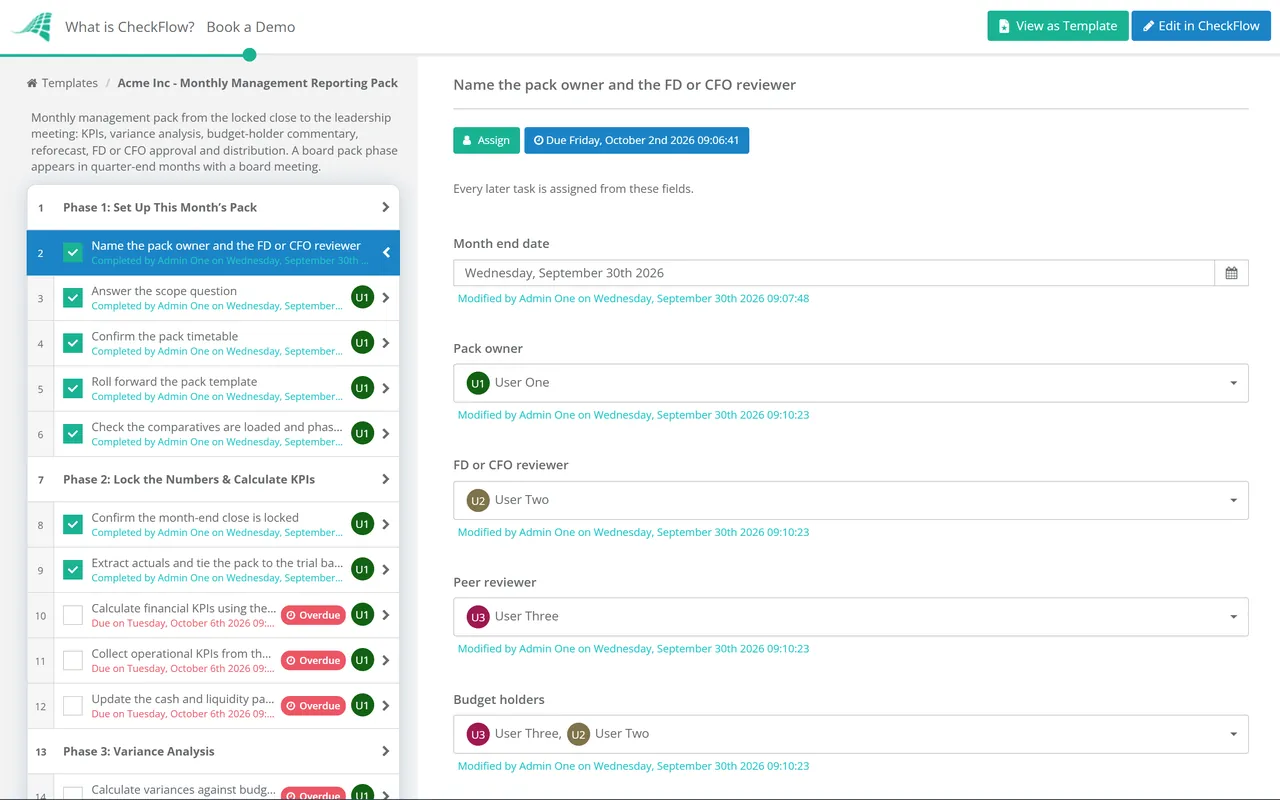
A monthly schedule starts the checklist on the first working day, with the pack owner, reviewer and due dates set. The commentary deadline is a dated task for each budget holder, not a reminder email.
Answer one question at the start and the board pack phase appears in quarter-end months, with the extra pages, the reconciliation to the quarter-end close and CEO approval. In other months it stays out of the way.
The FD or CFO approval stops the checklist until it is given, so nothing is distributed unreviewed. The approved pack is attached to the task, and the record shows who approved which version, who received it and when.
The pack is only as good as the close behind it. The Month-End Close Checklist locks the numbers, the Weekly Cash Flow Forecast Checklist feeds the cash page, and the Annual Budget Planning Checklist sets the budget every variance is measured against.
In quarter-end months, the Quarter-End Close Checklist adds the tax, covenant and filing work that the board pack reports on. Both run on CheckFlow’s recurring checklist software, one monthly and one quarterly.
Describe the process in a sentence and the AI checklist generator drafts the phases and tasks for you.
It is the monthly set of reports finance gives the leadership team: KPIs, results against budget, forecast and prior year, commentary on the significant variances, an updated full-year outlook and the decisions required. Unlike statutory accounts, it has no required format. Its structure is set by what leadership needs to run the business.
Most packs include an executive summary, a KPI dashboard, the income statement for the month and year to date, the balance sheet and cash position, department or business unit pages with commentary, and the full-year outlook with risks and opportunities. Keep the order the same every month so readers can find what they need quickly.
As soon as the close is locked and the commentary is in. Many finance teams aim to issue within a few working days of the close finishing, and the timetable should count back from the leadership meeting date. A pack that arrives two weeks into the following month is used to review history rather than to make decisions.
A single document that defines every measure in the pack: how it is calculated, where the data comes from, who owns it and when the definition last changed. It stops KPIs drifting as different people prepare the pack, and it lets a reader check exactly what a number means. Any change to a definition should be approved and noted in the pack for the month it takes effect.
The budget holder who owns the line, with finance reviewing it. Finance can calculate a variance, but the person running the department knows why it happened and what they are doing about it. Give each budget holder a deadline, the figures and a specific question, and send the commentary back if it only restates the numbers. For the line-by-line work with each budget holder, run the Budget Variance Review Checklist first and take its commentary into the pack.
The board pack is usually quarterly and more strategic: results for the quarter and year to date, the full-year outlook and scenarios, KPI trends over several quarters, covenant headroom and the decisions the board is asked to take. It should agree to the quarter-end close. In this template the board pages are an extra phase that appears in quarter-end months, so the monthly and board packs come from the same numbers.
14-day free trial, no card required. The Business plan is $10 per user per month after the trial. Full details at checkflow.io/pricing.
14-day free trial, no credit cardFull refund in your first 30 daysUS hosting, EU on request