Inventory Management for Manufacturing Environments Checklist Template
Too much inventory stops your cash from working. Too little stops your production line. A structured inventory management process keeps exactly the right amount in exactly the right place — and knows when it does not.
Printed from checkflow.io/templates/manufacturing-production/inventory-management-manufacturing-checklist
Manufacturing inventory is the tension between two costs that pull in opposite directions. Carrying too much raw material inventory is working capital sitting on a shelf — capital that could be deployed elsewhere, that deteriorates, becomes obsolete, or occupies space that costs money. Carrying too little raw material stops the production line — with idle labour, missed delivery commitments, and the expediting premiums that emergency procurement demands. Work-in-progress that accumulates between production stages creates its own cost: the capital tied up in partially assembled product, the quality risk of defects discovered later rather than earlier, and the floor space consumed by material that is not yet creating customer value. Finished goods that sit unsold represent the customer demand forecast that was wrong. A structured manufacturing inventory management process navigates all three inventory types with discipline: setting reorder points based on actual demand and lead time data, counting regularly enough to trust the numbers, coordinating with suppliers based on production requirements rather than informal request, and using data rather than intuition to decide how much stock to carry. This free checklist gives operations managers, inventory controllers, and plant managers a structured framework for the full manufacturing inventory management cycle.
ABC Analysis — Why Not All Inventory Deserves the Same Management Attention
A-Class
A-Class Inventory
Characteristics: High value, high impact. Typically 20% of SKUs but 70–80% of inventory value. Critical raw materials, high-cost components, fast-moving finished goods.
The cost of getting it wrong: Running out stops production. Overstocking ties up significant working capital.
B-Class
B-Class Inventory
Characteristics: Moderate value and importance. Approximately 30% of SKUs and 15–25% of inventory value. Regular-use materials and components.
Management intensity: Moderate. Defined reorder points, periodic cycle counting, standard supplier arrangements.
The cost of getting it wrong: Material, but manageable. Moderate production impact.
C-Class
C-Class Inventory
Characteristics: Low individual value. Approximately 50% of SKUs but only 5% of inventory value. Consumables, fasteners, maintenance supplies.
Management intensity: Minimal. Higher safety stock, less frequent counting, simpler reorder triggers (bin-kanban or visual systems).
The cost of getting it wrong: Low individual cost but high nuisance impact if stockouts cause line stoppages for minor items.
The Manufacturing Inventory Management Checklist
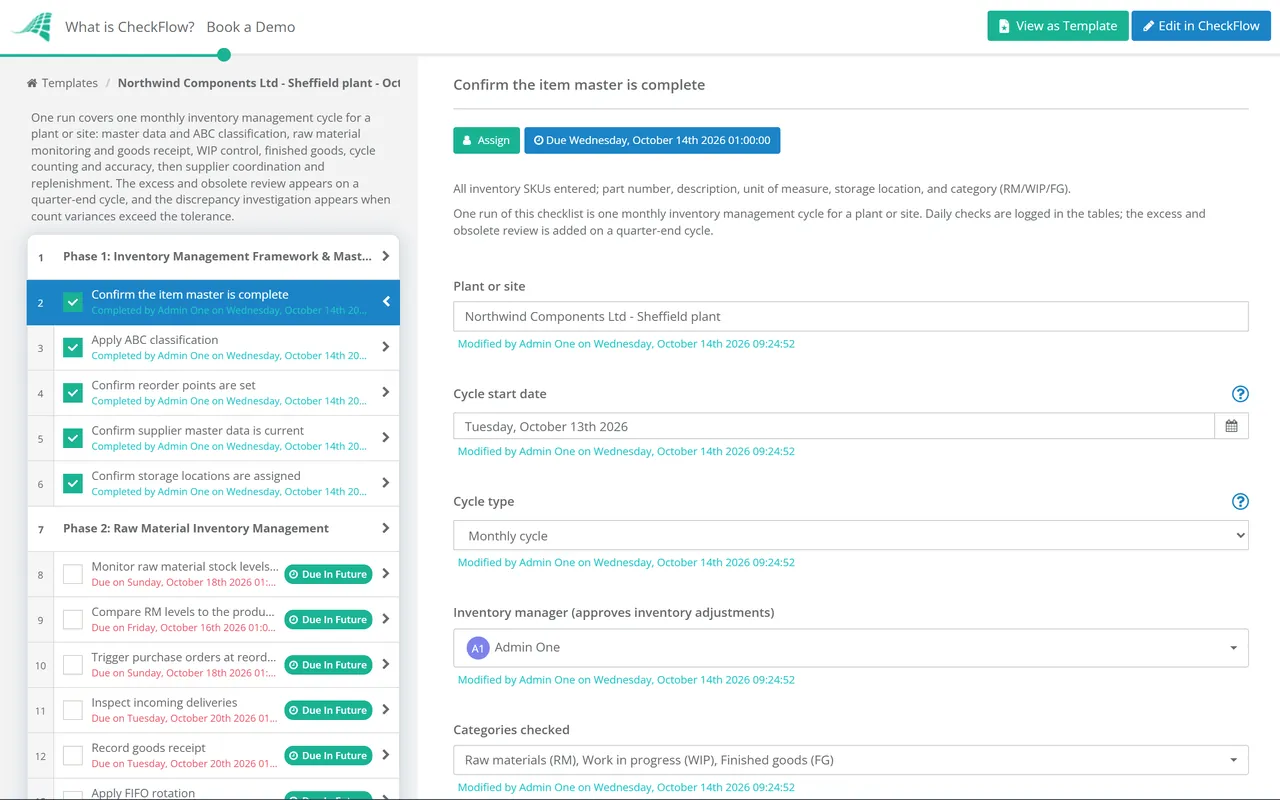
Six phases covering the complete inventory management cycle — from item master and framework setup through raw material, WIP, and finished goods management, cycle counting, and supplier coordination.
1
Phase 1
Inventory Management Framework & Master Data
5 tasks
Inventory management begins with master data. An inventory management system is only as reliable as the data it contains — incorrect part numbers, wrong unit of measure, inaccurate lead times, or missing supplier data produces incorrect decisions regardless of how sophisticated the process.
Confirm the item master is complete — all inventory SKUs entered; part number, description, unit of measure, storage location, and category (RM/WIP/FG)
Apply ABC classification — categorise all items by annual usage value (unit cost × annual consumption); A/B/C determines management intensity
Confirm reorder points are set — for all A and B items; based on average lead time, daily usage rate, and safety stock
Confirm supplier master data is current — lead times, minimum order quantities, and preferred contacts for all active suppliers
Confirm storage locations are assigned — each SKU has a defined location; FIFO or FEFO (first expired first out for date-sensitive materials) applied consistently
2
Phase 2
Raw Material Inventory Management
6 tasks
Monitor raw material stock levels daily — A-class items at minimum; confirm stock on hand matches the system record
Compare RM levels to the production schedule — is there sufficient raw material to cover the next production run? For the next week? For the next month?
Trigger purchase orders at reorder points — when stock falls to the defined reorder point, initiate the purchase order immediately; do not wait until stock is critical
Inspect incoming deliveries — quantity against PO; quality against specification; document any discrepancy; do not accept and store non-conforming material without a defined process
Record goods receipt — in the inventory system immediately on acceptance; not the next day
Apply FIFO rotation — older stock consumed before newer stock; date-sensitive materials (food, pharma, chemicals with shelf life) on FEFO
3
Phase 3
Work-In-Progress (WIP) Control
4 tasks
WIP that accumulates between production stages is not neutral — it is a cost: tied-up working capital, quality risk from defects discovered late, and floor space that has a real occupancy cost.
Define WIP control points — where does WIP accumulate between production stages? What is the maximum acceptable WIP level at each point?
Monitor WIP levels against defined limits — excess WIP indicates a downstream bottleneck; investigate and address
Identify and segregate non-conforming WIP — any WIP that does not meet quality specifications is tagged and held; not commingled with conforming product
Confirm WIP records are accurate — the system reflects actual WIP quantity and stage; not a theoretical calculation
4
Phase 4
Finished Goods Inventory Management
4 tasks
Confirm finished goods records are accurate — quantity, location, and status (available, allocated, on hold) in the system; matches the physical count
Manage finished goods against customer orders — confirmed orders allocated to specific inventory; available stock versus committed stock clearly distinguished
Monitor finished goods ageing — stock that has been in finished goods for more than the defined ageing limit reviewed; risk of obsolescence assessed
Apply FIFO — oldest stock shipped first; critical for any product with a shelf life
5
Phase 5
Cycle Counting & Inventory Accuracy
6 tasks
Annual physical inventory counts are disruptive and inaccurate. Cycle counting — counting a subset of inventory regularly throughout the year — maintains high accuracy continuously without production shutdown.
Define the cycle count schedule — A-class items counted most frequently (monthly or quarterly), B-class less frequently, C-class annually
Execute cycle counts as scheduled — a defined count area or category; physical count independent of the system record (count blind)
Reconcile count results against the system — identify discrepancies; variances above the defined tolerance investigated before adjusting
Investigate discrepancies — transaction recording errors, theft, damage, or misclassification; root cause identified and addressed
Adjust inventory records — after investigation and approval; adjustments documented with reason code
Track inventory accuracy percentage — (accurate locations / total locations counted) × 100; target 95%+ for Class A; trend tracked over time
6
Phase 6
Supplier Coordination & Replenishment Management
5 tasks
Share the production schedule with key suppliers — forward visibility enables suppliers to prepare capacity; reduces lead times and emergency orders
Manage purchase orders against the production plan — order quantities and timing driven by MRP/production schedule, not intuition
Monitor supplier on-time delivery performance — track actual versus promised delivery dates; chronic late delivery affects safety stock and reorder point calculations
Review safety stock levels periodically — when lead times change, demand variability changes, or supplier reliability changes, safety stock must be recalculated
Manage excess and obsolete inventory — quarterly review; identify stock with no forecast demand; return to supplier, scrap, or sell off before write-off
How to Calculate Your Reorder Point — the Number That Prevents Stockouts Without Overstocking
Reorder Point = (Average Daily Usage × Lead Time) + Safety Stock
Average Daily Usage = total consumption over a period ÷ number of days
Lead Time = average calendar days from PO placement to goods receipt
Safety Stock = buffer stock held to cover demand spikes or delivery delays = Z × standard deviation of lead time demand (or simplified: maximum daily usage × maximum lead time − average daily usage × average lead time)
Example: Average daily usage: 100 units · Average lead time: 7 days · Safety stock: 150 units
Reorder point: (100 × 7) + 150 = 850 units
When stock on hand reaches 850 units, place the next purchase order. At this point, you have enough stock to cover average demand during the replenishment lead time, plus safety stock to absorb variability. Reorder points should be recalculated when lead times, demand rates, or demand variability changes.
Why Run Your Inventory Management in CheckFlow?
1
Daily inventory monitoring as a structured recurring task
Inventory monitoring only works if it happens — consistently, at the right frequency, by the right person. CheckFlow's recurring checklist feature generates daily RM monitoring tasks for A-class items and cycle count tasks on the defined schedule. The checks happen because the process schedules them, not because someone remembers.
2
Goods receipt and discrepancy documentation in the process
Incoming materials accepted without inspection, or without documented discrepancies, create quality problems downstream. CheckFlow's inventory management checklist includes goods receipt inspection as a required task before the received material can be marked as accepted and moved to the storage location.
3
A complete inventory transaction record for audit and analysis
Every cycle count result, every discrepancy investigation, every supplier delivery variance, and every excess stock review completed through CheckFlow is timestamped and archived. The inventory accuracy trend data that drives process improvement is built as the process runs.
Inventory requirements are driven by the production schedule. CheckFlow’s Manufacturing Production Scheduling Checklist covers the scheduling process that determines raw material requirements. See the Production Scheduling Checklist →
Changes to product specifications or BOMs affect inventory requirements. CheckFlow’s Manufacturing Change Order Checklist covers the process for managing changes that affect materials and inventory. See the Manufacturing Change Order Checklist →
Other Manufacturing & Production Checklist Templates
Describe the process in a sentence and the AI checklist generator drafts the phases and tasks for you.
Frequently Asked Questions
What does manufacturing inventory management cover?
Manufacturing inventory management covers three inventory categories across six process areas: framework setup (item master, ABC classification, reorder points, supplier master, storage assignment), raw material management (daily monitoring, production schedule comparison, reorder triggering, goods receipt inspection, FIFO rotation), WIP control (defining accumulation points, monitoring against limits, segregating non-conforming product), finished goods management (accuracy, order allocation, ageing monitoring), cycle counting (scheduled counting by ABC class, count-to-system reconciliation, discrepancy investigation), and supplier coordination (schedule sharing, PO management, delivery performance tracking, safety stock review, excess and obsolete management).
What is cycle counting and why is it better than annual physical inventory?
Cycle counting is the practice of counting a defined subset of inventory items on a regular, rolling schedule throughout the year — rather than conducting a single comprehensive physical count annually. A-class items are typically counted monthly or quarterly; B-class less frequently; C-class annually. Cycle counting is more effective than annual inventory because: errors are identified and corrected continuously rather than accumulating for a year; production can continue during cycle counts (no shutdown required); counting smaller batches regularly produces higher accuracy than one large annual count; and discrepancy patterns can be identified and addressed before they become significant.
What is safety stock and how is it calculated?
Safety stock is the buffer inventory held above the expected consumption during the replenishment lead time — to protect against demand spikes or supplier delivery delays. The simplified calculation is: (Maximum Daily Usage × Maximum Lead Time) minus (Average Daily Usage × Average Lead Time). For example, if maximum daily usage is 130 units and maximum lead time is 10 days, but average daily usage is 100 units and average lead time is 7 days: safety stock = (130 × 10) − (100 × 7) = 1,300 − 700 = 600 units. Safety stock should be recalculated when lead times change, when demand variability increases, or when a supplier’s reliability changes.
What is ABC analysis in inventory management?
ABC analysis classifies inventory items by their relative importance — typically measured as annual usage value (unit cost multiplied by annual consumption). A-class items represent approximately 20% of SKUs but 70–80% of total inventory value; these receive the most management attention (tight reorder points, frequent counting, close supplier monitoring). B-class items represent approximately 30% of SKUs and 15–25% of value; moderate management intensity. C-class items represent approximately 50% of SKUs but only 5% of value; simpler management with higher safety stock. The principle is that management resources should be concentrated where the financial impact is greatest — not applied uniformly across all items regardless of value.
Is CheckFlow free for this template?
You can start a free 14-day trial with no credit card required, giving you full access to all features including this template. The Business plan is $10 per user per month after the trial. Full details at checkflow.io/pricing.
Keep Exactly the Right Amount of Inventory — Not Too Much, Not Too Little