Fire Extinguisher Inspection Checklist Template

Most extinguisher checks are a glance at the service tag once a year. The one hidden behind pallets, the one with a broken seal and the one used on a bin fire last month stay on the wall until someone needs them.

Last reviewed: October 2026

Fire extinguishers need a quick check every month, not just a service once a year. This free fire extinguisher inspection checklist is for facilities managers, site managers, fire wardens and the responsible person who keeps a building’s extinguishers in working order. One run is one monthly round of every portable extinguisher on a site, and it is built to run on a monthly recurring schedule. It starts from the extinguisher register and last month’s open items, then checks each extinguisher’s location, access and signs, and its condition: pin and seal, gauge, body, hose and labels. Faults are put right on the spot, or the unit comes out of service and a spare goes in its place. In the month the annual service is due, a phase for the competent person’s service appears. An escalation phase appears when an extinguisher is out of service, and the round closes with the record and the responsible person’s sign-off.

A Monthly Inspection Is Not the Annual Service

Extinguishers are only useful if they are where people expect them, charged and working on the day of a fire. The law in both countries puts that on whoever runs the premises. In England and Wales, article 17 of the Regulatory Reform (Fire Safety) Order 2005 requires the responsible person to keep fire safety equipment under a suitable system of maintenance, in efficient working order and in good repair. In the US, OSHA’s 29 CFR 1910.157 makes the employer responsible for inspecting, maintaining and testing every portable extinguisher in the workplace.

Both split the work the same way: a short visual check every month by someone on site, and an annual service by a competent person, with longer-interval tests on top. This checklist is the monthly round, with the annual service added in the month it is due. Deciding how many extinguishers you need, and of what type, belongs in the Fire Risk Assessment Checklist. The rest of the building is covered by the Facility Inspection Checklist.

Monthly inspection

Someone on site, every month

Asks: is every extinguisher in place, easy to reach, sealed, charged and undamaged?

When: every month; more often where vandalism or harsh conditions make it sensible.

Output: a recorded round, defects put right or units replaced, and the register up to date.
Annual service

A competent person, every year

Asks: does each extinguisher still work as it should, inside and out?

When: once a year, by a technician with the training and experience for the work.

Output: a service certificate or report and a new dated service label on each extinguisher.

Longer-interval tests

The technician, every few years

Asks: is the shell still safe to hold its pressure?

When: in the US, a hydrostatic test every 5 or 12 years depending on the type, and 6-yearly maintenance for some dry chemical extinguishers. In the UK, at the intervals in the maintenance standard and the manufacturer’s instructions.

Output: a test certificate, or the extinguisher condemned and replaced.

What the Fire Extinguisher Inspection Checklist Covers

Seven phases follow one monthly round of every portable extinguisher on a site. Phase 5 appears only in the month the annual service is due. Phase 6 appears only when an extinguisher is taken out of service, and the round stays open until the responsible person confirms every point has cover again.

  1. Phase 1

    Phase 1: Plan the Round

    6 tasks

    Answer which rules apply first; it adds the matching legal notes and tasks. Every due date counts from the date and time the round starts.

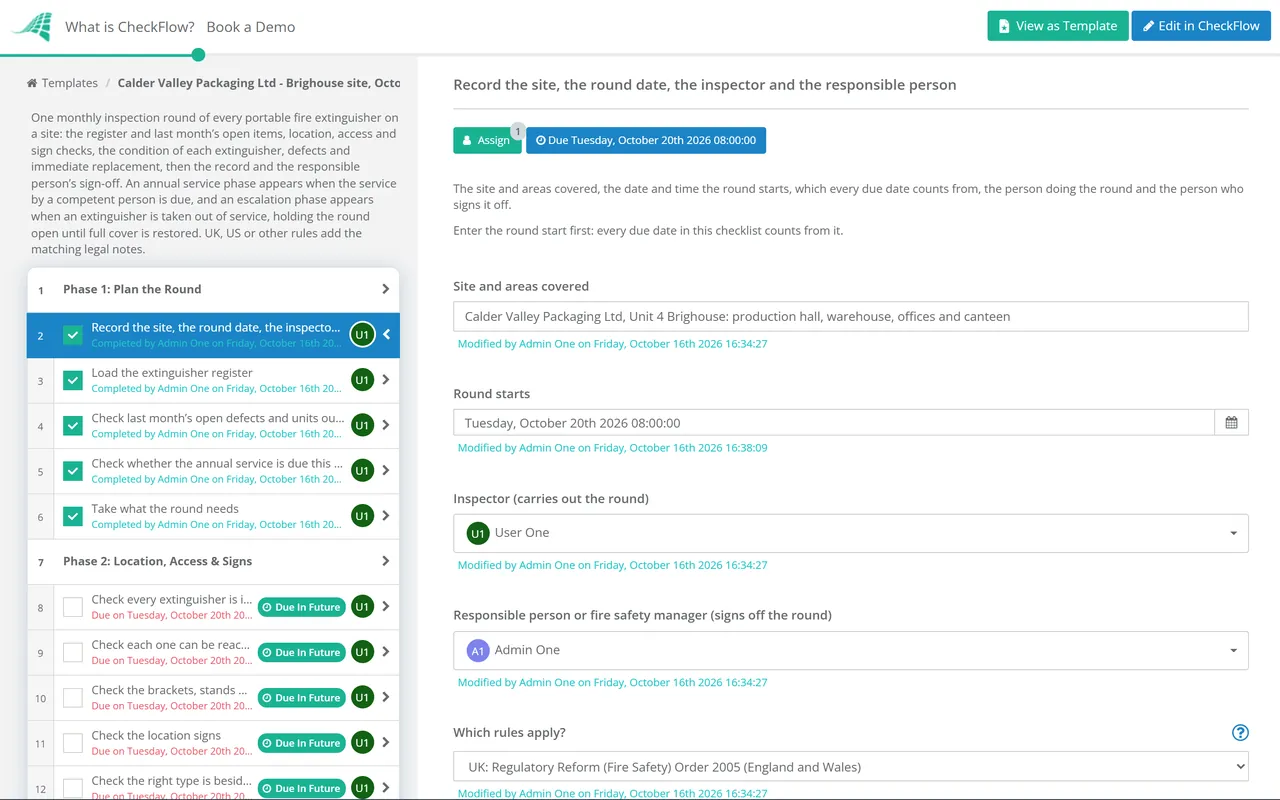
    • Record the site, the round date, the inspector and the responsible person — the site and areas covered, the date and time the round starts, which every due date counts from, the person doing the round and the person who signs it off
    • Load the extinguisher register — every extinguisher on the site by number, location, type and last service date, so none is missed on the round
    • Check last month’s open defects and units out of service — any extinguisher still away for recharge or repair, and the spare standing in for it
    • Check whether the annual service is due this month — from the last service date on each label and in the register; the answer decides whether Phase 5 appears
    • US: check the 6-year maintenance and hydrostatic test dates — stored pressure dry chemical extinguishers that need a 12-year hydrostatic test are emptied and maintained every 6 years, and each type is hydrostatically tested at the interval in Table L-1
    • Take what the round needs — the register and floor plan on a phone or tablet, a camera for photos, and spare location signs
  2. Phase 2

    Phase 2: Location, Access & Signs

    6 tasks

    Walk every point on the floor plan in the same order each month. Each task records one result for all the extinguishers on the round.

    • Check every extinguisher is in its designated place — each one at the point the register and floor plan show, none missing, moved or swapped for another type
    • Check each one can be reached and seen — nothing stacked in front of it, no furniture, stock or vehicles in the way, and visible from the route people use
    • Check the brackets, stands and mounting height — on its wall bracket or stand, secure, and at a height people can lift it off, about 1 m to the handle for larger extinguishers and 1.5 m for smaller ones in UK guidance
    • Check the location signs — a sign at each point where the extinguisher is not easy to see, present, legible and not covered
    • Check the right type is beside each hazard — for example carbon dioxide near electrical equipment and a Class F extinguisher in the kitchen, as the fire risk assessment sets out
    • Check for layout changes since the last round — new partitions, racking, rooms or hazards that leave an area without an extinguisher close enough
  3. Phase 3

    Phase 3: Condition of Each Extinguisher

    7 tasks

    Look and handle; never test-discharge an extinguisher. A unit that fails any check here is taken out of service in Phase 4.

    • Check the safety pin and tamper seal — the pin in place and the seal unbroken; a broken or missing seal can mean the extinguisher has been used
    • Read the pressure gauge on stored pressure extinguishers — the needle in the operating zone; carbon dioxide extinguishers have no gauge and are checked at the service
    • Check the body for damage and corrosion — dents, rust, corrosion, cracks in the head or a leaking valve
    • Check the hose, horn and nozzle — not cracked, split, perished or blocked, and fitted securely
    • Check the operating instructions and labels — legible and facing outwards, with the type and the classes of fire it is for easy to read
    • Check the service label — present, filled in, and showing a service within the last 12 months
    • Ask whether any extinguisher was used since the last round — even a short burst; a used extinguisher is recharged before it goes back, and a fire nobody reported is reported now
  4. Phase 4

    Phase 4: Defects & Immediate Replacement

    6 tasks

    The result of the round decides what follows. An extinguisher that cannot be put right on the spot comes out of service and is replaced straight away.

    • Record the result of the round — all pass, faults put right on the spot, or extinguishers that must come out of service; the answer decides what follows
    • Record each defect — the extinguisher number, where it is, what is wrong and what was done, with a photo
    • Put right what can be fixed on the spot — return a moved extinguisher to its point, clear the access, refit a sign or turn a label to face out; recharging and resealing are for the competent person
    • Take each faulty extinguisher out of service — a used, low-pressure, damaged or unsealed unit is removed from its point and labelled do not use so nobody relies on it
    • Put a replacement in its place straight away — a spare of the same type and rating at the same point, so no area is left without cover
    • Book the recharge or repair with the service company — with a job reference and the date each unit is due back
  5. Phase 5 — If the service is due

    Phase 5: Annual Service by a Competent Person

    6 tasks

    Shown only when the annual service is due this month. The service is done by a competent person, such as a service company certificated for the work, not by the monthly inspector.

    • Book the annual service with a competent person — a service company or technician with the training and experience for the work, for a date this month
    • Give the technician the register and access to every point — including locked plant rooms, stores and roof spaces, so no extinguisher is missed
    • Record the work done on each extinguisher — serviced, refilled, recharged, tested or condemned, and the next service due
    • Collect the service certificate or report — signed by the technician, with a new service label dated on every extinguisher serviced
    • Record the service date for each extinguisher — on its label and in the register, so next month’s round can see every unit is in date
    • Replace condemned or obsolete extinguishers — with new ones of the right type and rating at the same points, and the register updated
  6. Phase 6 — If an extinguisher is out of service

    Phase 6: Out-of-Service Escalation

    5 tasks

    Shown only when an extinguisher came out of service. The round cannot be closed until the responsible person confirms every point has a working extinguisher again.

    • Check every empty point has cover — a spare in place, or another extinguisher of the right type close by until the unit is back
    • Escalate any point without cover to the responsible person the same day — with the area affected, the hazard there and when cover will be back
    • Tell the people working in the affected area — where the nearest working extinguisher is until cover is restored
    • Chase each unit away for recharge or repair — until it is back at its point or replaced, with the date it returned
    • Responsible person confirms full cover is restored — every point on the register has a working extinguisher of the right type before the round is closed
  7. Phase 7

    Phase 7: Record & Sign Off

    6 tasks

    The record of every round, not only the ones with defects, shows the equipment is kept in working order.

    • Update the extinguisher register — new and moved extinguishers, replacements, spares in use and service dates
    • Record the round in the fire safety logbook — the date, who did it, the result and any defects, in the logbook or an electronic record
    • Pass findings to whoever owns the fire risk assessment — wrong types, layout changes, repeated tampering or an extinguisher used on a fire are reasons to review it
    • Note any training needs — staff who do not know which extinguisher to use or when not to tackle a fire
    • Responsible person reviews and signs off the round — every defect has an action, every point has cover and repeat problems at the same point are spotted
    • Confirm the date of next month’s round — on the recurring schedule, with the same inspector or a named cover

Fire Extinguisher Inspection Rules in the UK and US

The duty is the same on both sides of the Atlantic: keep every extinguisher in place and working. The US writes the inspection intervals into a federal standard. In England and Wales the Order sets the duty to maintain, and government guidance for responsible persons sets out the monthly check and the annual service. Use the table to set your own site rules; it is not legal advice.

Topic England and Wales (Fire Safety Order and government guidance) United States (29 CFR 1910.157)
Who is responsibleThe responsible person: the employer where the workplace is under their control, otherwise whoever controls the premises, or the owner (article 3). Equipment is kept under a suitable system of maintenance, in efficient working order and good repair (article 17)The employer, for the inspection, maintenance and testing of all portable extinguishers in the workplace ((e)(1))
Monthly checkGuidance, not a fixed legal interval: brief checks that extinguishers remain serviceable, with a monthly check enough in normal conditionsPortable extinguishers visually inspected monthly ((e)(2))
Annual serviceMaintenance by a competent person every year. Government guidance names BS 5306-3 for maintenanceAn annual maintenance check; stored pressure extinguishers do not need an internal examination ((e)(3))
RecordsA record of testing and maintenance in a logbook or an electronic recordThe annual maintenance date recorded and kept for one year after the last entry or the life of the shell, whichever is less ((e)(3)). The section does not say the monthly inspection must be written down
Longer-interval workAt the intervals in the maintenance standard and the manufacturer’s instructionsHydrostatic tests at 5 or 12 years by type (Table L-1), and when there is new corrosion or mechanical damage; some stored pressure dry chemical units emptied and maintained every 6 years ((e)(4), (f))
Out of serviceNo separate rule; a faulty unit is repaired or replaced so the equipment stays in efficient working order (article 17)Alternate equivalent protection while an extinguisher is away for maintenance or recharging ((e)(5))
SitingEasily accessible and indicated by signs (article 13). Guidance: on escape routes near exits and beside specific hazards, handles at about 1 m or 1.5 m, and ideally no more than 30 m to reach oneMounted, located and identified so they are readily accessible ((c)(1)); travel distance 75 feet or less for Class A and 50 feet or less for Class B hazards ((d)(2), (d)(4))
TrainingAdequate safety training when people start and when risks change, repeated periodically where appropriate (article 21)An educational programme on extinguisher use at initial employment and at least annually ((g)(1), (g)(2))

Scotland and Northern Ireland have their own fire safety law. HSE notes that in Scotland the general fire safety duties are in Part 3 of the Fire (Scotland) Act and the Fire Safety (Scotland) Regulations. In most premises in Great Britain the local fire and rescue authority enforces fire safety law; HSE does on construction sites.

Industry standards. BS 5306-3 in the UK and NFPA 10 in the US are the detailed standards for inspecting and maintaining portable extinguishers. They are paid documents: work from your own copy or your service company’s procedures for the details this table leaves out.

Why Run Fire Extinguisher Inspections in CheckFlow?

1

A round waiting every month

A monthly recurring schedule starts each site’s round on time, assigned to its inspector, with every due date counted from the round’s start. A round that has not been finished shows as an open checklist on the Reports Grid.

2

Every extinguisher on one register

The register table lists each extinguisher by number, location, type and last service, so a missing one stands out. Each check records one result for the round, with a box for the units that failed and photos taken in a phone browser.

3

No point left without cover

An extinguisher taken out of service opens an escalation phase. The responsible person confirms full cover is restored, and nothing after that approval step can be completed until they record a decision. Every result, photo and decision is kept with who did it and when.

CheckFlow does not service extinguishers or decide which ones a building needs. That belongs to the responsible person, the fire risk assessor and the service company. It makes sure the round happens every month, that faults reach someone who can fix them, and that a gap at an extinguisher point is closed and signed off. Compliance checklist software shows how recurring inspections like this one run across sites.

Decide the number, type and position of extinguishers in the Fire Risk Assessment Checklist, practise the evacuation with the Fire Drill & Evacuation Checklist, and keep alarms, emergency lighting and other plant serviced through the Preventive Maintenance Checklist. The wider building check sits in the Facility Inspection Checklist.

AI generator

Didn’t find what you need? Describe it.

Describe the process in a sentence and the AI checklist generator drafts the phases and tasks for you.

Frequently Asked Questions

How often should fire extinguishers be inspected?

Every month, with an annual service on top. OSHA’s 29 CFR 1910.157 requires portable extinguishers to be visually inspected monthly and given an annual maintenance check. In England and Wales the law sets the duty to maintain them rather than a period, and government guidance for responsible persons says a monthly check should be enough in normal conditions, with maintenance by a competent person every year. Some extinguishers also need longer-interval tests, such as hydrostatic tests every 5 or 12 years in the US.

What should a monthly fire extinguisher inspection include?

Check that each extinguisher is in its designated place, easy to reach and see, on its bracket or stand and signed where it is not obvious. Then check its condition: safety pin and tamper seal intact, the gauge needle in the operating zone on stored pressure units, no dents, rust or leaks, the hose and nozzle sound, the instructions legible and a service label within the last 12 months. Record the result and replace any unit that fails.

Who can carry out fire extinguisher inspections?

The monthly visual check can be done by someone on site who knows what to look for, such as a facilities assistant or a fire warden. The annual service is different. UK government guidance says it is done by a competent person, and suggests a contractor certificated for the work by an independent body as one way to check competence. In the US the employer is responsible for the inspection, maintenance and testing, and hydrostatic tests must be done by trained persons with suitable equipment.

Do monthly fire extinguisher inspections need to be recorded?

In the US, 1910.157 requires the annual maintenance date to be recorded and kept for one year after the last entry or the life of the shell, whichever is less. It does not say the monthly inspection must be written down, but a written round is the simplest way to show it happened. In England and Wales, government guidance asks for a record of testing and maintenance in a logbook or an electronic record. This checklist is that record, with the date, inspector and result of every round.

What happens if a fire extinguisher fails its inspection?

Put right what you can on the spot, such as moving it back to its point or clearing access. If it has been used, has lost pressure, has a broken seal or is damaged, take it out of service, label it and put a spare of the same type in its place straight away. In the US, 1910.157 requires alternate equivalent protection while an extinguisher is away for maintenance or recharging. Then book the recharge or repair with your service company.

When does a fire extinguisher need a hydrostatic test?

In the US, Table L-1 of 1910.157 sets the interval by type: 5 years for types such as stored pressure water, foam and carbon dioxide, and 12 years for stored pressure dry chemical extinguishers with mild steel, brazed brass or aluminium shells. Those 12-year dry chemical units are also emptied and maintained every 6 years, unless they are non-refillable. An extinguisher with new evidence of corrosion or mechanical damage is tested too. In the UK, follow the maintenance standard and your service company’s advice.

Where should fire extinguishers be located?

Where people can reach them quickly and safely. UK government guidance suggests placing them on escape routes near the exit from a room or floor, and beside specific hazards such as flammable liquids, hung with the handle at about 1 m for larger extinguishers and 1.5 m for smaller ones, so that ideally nobody travels more than 30 m to one. In the US, 1910.157 sets a travel distance of 75 feet or less for Class A hazards and 50 feet or less for Class B.

Is CheckFlow free for this template?

14-day free trial, no card required. The Business plan is $10 per user per month after the trial. Full details at checkflow.io/pricing.

Check Every Extinguisher, Every Month

Free trial — no credit card required.

14-day free trial, no credit cardFull refund in your first 30 daysUS or EU hosting