
Safety Audit Checklist Template

A structured, repeatable workplace safety audit — from documentation review to corrective action planning.

Workplace safety audits only work when they are thorough, consistent, and actually completed on schedule. This free safety audit checklist template gives health and safety managers, EHS officers, and facilities teams a structured way to conduct a comprehensive workplace safety audit — covering safety management documentation, physical environment inspection, equipment and electrical safety, fire and emergency procedures, PPE compliance, and corrective action planning. Use it as a reference for periodic inspections or run it as a live, trackable checklist in CheckFlow — with tasks assigned to the right people, findings logged with evidence, and every corrective action tracked to completion.

Use This Template Free See Live Example
No Credit Card Required

What Is a Safety Audit Checklist?

A safety audit checklist is a structured evaluation tool used to systematically assess whether a workplace meets applicable health and safety regulations, internal safety policies, and recognised best practices. It guides safety managers and EHS officers through a comprehensive review of every aspect of workplace safety — from the documentation and management systems that underpin a safety programme to the physical conditions, equipment, and emergency procedures that protect workers day to day.

Safety audits serve several distinct purposes: they identify hazards and control gaps before incidents occur, verify compliance with OSHA regulations (or equivalent local requirements), provide documented evidence for regulatory inspections and ISO 45001 certification, and generate prioritised corrective action plans that drive continuous improvement.

Most organisations are required to conduct safety audits at regular intervals — annually at a minimum, and more frequently in higher-risk industries such as manufacturing, construction, and healthcare. A structured checklist ensures that every audit covers the same ground, regardless of who conducts it, and that findings are documented and tracked through to remediation.

What the Safety Audit Checklist Covers

This checklist is organised into six areas that together cover the full scope of a workplace safety audit — from pre-audit preparation and documentation review through to physical inspection, emergency procedures, and corrective action planning.

Area 1

Pre-Audit Preparation

  • Define the scope and objectives of the audit (full site, specific department, or targeted inspection)
  • Confirm applicable regulations and standards (OSHA, ISO 45001, local health and safety law)
  • Assign audit team members and responsibilities
  • Gather and review previous audit reports, incident records, and near-miss logs
  • Review any outstanding corrective actions from previous audits
  • Notify relevant department heads and facilities managers of the audit schedule
  • Confirm audit tools are available (camera, measuring equipment, PPE for inspectors)
  • Review the site layout, processes, and any changes since the last audit
  • Confirm access arrangements for all areas in scope
Area 2

Documentation & Management Systems

  • Verify a written health and safety policy exists, is current, and is signed by senior management
  • Confirm the safety policy is communicated to and accessible by all employees
  • Verify risk assessments are documented for all significant workplace hazards and are current
  • Confirm COSHH (or equivalent hazardous substance) assessments are in place where applicable
  • Verify safety roles and responsibilities are formally assigned and documented
  • Confirm safety training records are maintained and up to date for all employees
  • Verify accident and incident reporting procedures are documented and understood by all staff
  • Review the accident and incident log — confirm all incidents have been recorded and investigated
  • Verify near-miss reporting is in place and that reports are acted upon
  • Confirm a management review of safety performance is conducted at defined intervals
  • Verify required safety notices and OSHA posters (or equivalent) are displayed correctly
Area 3

Physical Environment & Housekeeping

  • Inspect all walkways, aisles, and corridors — confirm they are clear, well-lit, and free from trip hazards
  • Verify floors are in good condition — no damaged, uneven, or slippery surfaces
  • Confirm adequate lighting is in place throughout the facility including storage areas and stairwells
  • Inspect storage areas — confirm materials are stored safely, heavy items at lower heights, and racking is structurally sound
  • Verify waste disposal procedures are being followed and waste is not accumulating in work areas
  • Inspect welfare facilities (toilets, rest areas, drinking water) — confirm they are clean, functional, and adequate
  • Verify outdoor areas, car parks, and pedestrian routes are safe and maintained
  • Confirm adequate ventilation is in place in all work areas
  • Check temperature levels are appropriate for the type of work being carried out
  • Inspect any areas of recent maintenance, construction, or refurbishment for temporary hazards
Area 4

Equipment, Machinery & Electrical Safety

  • Verify all machinery has appropriate guarding in place and guards are in good condition
  • Confirm lockout/tagout (LOTO) procedures are documented and being followed for maintenance and servicing tasks
  • Verify pre-use inspection procedures are in place for powered equipment and vehicles
  • Confirm forklift trucks, mobile elevated work platforms, and other vehicles have current inspection certificates and operator certifications
  • Inspect electrical installations and panels — confirm no exposed wiring, overloaded circuits, or damaged equipment
  • Verify portable electrical equipment is subject to regular PAT testing and records are maintained
  • Confirm extension leads and temporary wiring are used appropriately and not overloaded
  • Verify pressure vessels, lifting equipment, and other statutory plant have current inspection certificates
  • Confirm all equipment defects and faults are reported and tagged out of service promptly
  • Verify maintenance schedules are in place and being followed for all critical equipment
Area 5

Fire Safety & Emergency Procedures

  • Verify a current fire risk assessment is in place, documented, and acted upon
  • Confirm all fire exits are clearly marked, unobstructed, and functional
  • Inspect fire doors — confirm they close fully, are not propped open, and seals are intact
  • Verify fire extinguishers are correctly positioned, in date, and have current inspection tags
  • Confirm fire alarm system has been tested within the required timeframe and test records are maintained
  • Verify emergency lighting is functional and tested regularly
  • Confirm evacuation routes and assembly points are clearly marked and known to all employees
  • Verify fire evacuation drills have been conducted within the required period and records are maintained
  • Confirm fire wardens are appointed, trained, and their details are current
  • Verify emergency procedures cover scenarios beyond fire (chemical spill, medical emergency, intruder, severe weather) and are communicated to staff
  • Confirm first aid provision is adequate — trained first aiders, stocked first aid kits, and eye wash stations where required
Area 6

PPE, Hazardous Materials & Corrective Action Planning

  • Verify PPE requirements have been assessed for all relevant tasks and are documented
  • Confirm appropriate PPE is available, accessible, and in good condition for all employees who require it
  • Verify employees are trained on correct PPE use and replacement procedures
  • Confirm hazardous substances are correctly labelled, stored, and handled in accordance with assessments
  • Verify safety data sheets (SDS) are available and accessible for all hazardous substances on site
  • Confirm spill kits and containment equipment are in place where hazardous substances are stored or used
  • Compile all audit findings with severity and priority ratings (critical, high, medium, low)
  • Photograph all hazards and unsafe conditions identified during the inspection
  • Identify any items requiring immediate remediation before work resumes
  • Assign owners and target completion dates to all corrective actions
  • Present findings to management and safety committee
  • Schedule re-audit for any critical or high-priority findings
  • Document audit completion and archive as evidence for regulatory purposes
  • Schedule next audit date

This checklist is available as a free, runnable template in CheckFlow — with tasks assigned to safety officers, facilities teams, and department managers, findings captured with notes and photo evidence, and every corrective action tracked to completion.

Use This Template Free

Why Run Your Safety Audit in CheckFlow?

1

Consistent audits across every site and cycle

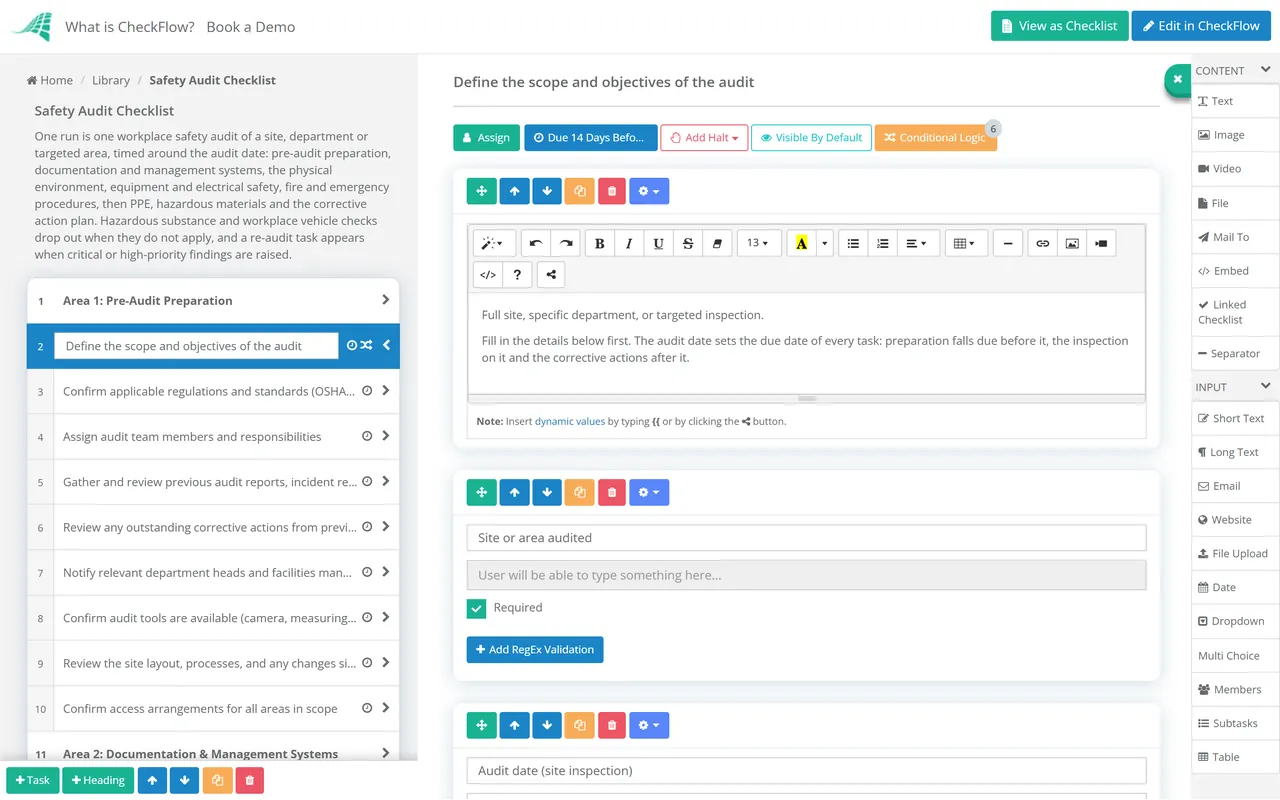
Build the checklist once as a reusable template. Run a new instance for every audit — whether monthly, quarterly, or annually — with the site, assigned inspector, and audit date pre-filled at launch. Every audit covers the same ground, in the same order, regardless of who conducts it. For organisations with multiple sites, run separate instances simultaneously and track them all from one dashboard.

Template Designer


2

Capture findings and evidence in context

CheckFlow’s file upload and long text controls let inspectors capture photos of hazards, record observations, and document conditions directly within the checklist — at the point of inspection, not in a separate report written afterwards. Every finding is attached to the specific checklist item it relates to, creating a structured record that is easy to review and present.

Checklist Features
3

Track corrective actions to completion

Every finding from the audit becomes a trackable action in CheckFlow — assigned to an owner, given a due date, and monitored through to completion. Automatic reminders fire before and after deadlines. When your next audit cycle begins, the record of what was found last time and what was done about it is already there.

Audit Trail

Frequently Asked Questions

What is the purpose of a workplace safety audit?

+

A workplace safety audit is a systematic evaluation of whether a workplace meets applicable health and safety regulations, internal policies, and recognised best practices. Its primary purposes are to identify hazards and control gaps before incidents occur, verify compliance with OSHA regulations or equivalent local requirements, provide documented evidence for regulatory inspections and ISO 45001 certification, and generate a prioritised corrective action plan. Safety audits also demonstrate due diligence — evidence that an organisation has actively assessed and managed safety risks, which is important in the event of an incident, inspection, or legal proceedings.

How often should a safety audit be conducted?

+

Most organisations conduct a comprehensive safety audit at least annually. Higher-risk industries — manufacturing, construction, warehousing, and healthcare — typically audit more frequently, with some areas subject to monthly or quarterly inspections. Specific equipment and systems (fire alarms, electrical installations, lifting equipment) have their own statutory inspection schedules which run independently of the general safety audit. CheckFlow’s recurring checklist feature lets you schedule safety audits automatically at any frequency so they are never missed or deferred.

What is the difference between a safety audit and a safety inspection?

+

A safety inspection is typically a shorter, more frequent check of specific physical conditions — equipment, housekeeping, fire safety. A safety audit is a more comprehensive evaluation that also examines the underlying management systems: whether the right policies are in place, whether risk assessments are current, whether training records are complete, and whether the safety management system as a whole is functioning effectively. In practice, most organisations use both — frequent inspections to catch physical hazards promptly, and periodic audits to assess the broader safety programme.

Who should conduct a workplace safety audit?

+

A safety audit can be conducted internally by the health and safety manager or EHS officer, or externally by a specialist safety consultant. Internal audits benefit from existing knowledge of the site and processes; external audits provide independent verification and may be required for ISO 45001 certification. For comprehensive audits, involving multiple people — safety officer, facilities manager, and department heads — improves coverage and creates shared accountability. CheckFlow allows tasks to be assigned to each person separately so everyone completes their relevant sections independently.

Can this checklist be used for ISO 45001 compliance?

+

Yes. This checklist covers the core operational controls and documentation requirements of ISO 45001 (Occupational Health and Safety Management Systems), including hazard identification and risk assessment, documented information and records, operational planning and control, emergency preparedness, and management review. It can be customised in CheckFlow to add organisation-specific controls or to map specific items to ISO 45001 clauses. Every completed checklist produces a timestamped audit trail suitable for presenting as compliance evidence during certification audits.

Is CheckFlow free to use for this template?

+

You can start a free 14-day trial with no credit card required, giving you full access to all features including this template. The Business plan is $10 per user per month after the trial. Full details at checkflow.io/pricing.

Start Running Consistent Safety Audits Today

Free trial — no credit card required.