Contract Obligation Management Checklist Template

A signed contract is a set of promises on both sides. Once it is filed, they are easy to lose: a report nobody chased, a certificate that ran out, a service credit never claimed, a notice date that passed.

Last reviewed: November 2026

Printed from checkflow.io/templates/legal-contract-management/contract-obligation-management-checklist

This free contract obligations checklist runs one signed contract through its term, for contract managers, procurement and legal teams and the business owners who rely on the contract. The contract manager opens the record from the hand-off at signature and extracts every obligation on both sides, each with an owner, a trigger and a due date. Service levels and service credits, reports and notices, payments and price reviews, insurance and certificates are set up next, with a place for the evidence of each obligation and a calendar with reminders. The first quarterly review checks every obligation due, meets the other party and writes up the actions: a missed obligation adds a fix, and a serious or repeated failure adds escalation and a remediation plan. The approver signs off the review and any formal action before credits are claimed, a notice is sent or a variation is agreed. Later reviews and the yearly checks follow, and seven months before the end of the term the record hands off to the Contract Renewal Reminder Checklist.

Contract Obligations, Contract Review or the Renewal Decision?

Contract obligation management is the work after signature: making sure both parties do what the contract says, on time, and that you can show it. The Contract Review & Approval Checklist ends by filing the contract and naming owners for its main obligations. This checklist starts there and keeps going for the whole term, and the Contract Renewal Reminder Checklist takes over for the decision at the end.

The Vendor Oversight Checklist looks across all your vendors once a year, and the Supplier Performance Evaluation Checklist scores a supplier against its KPIs. This checklist is one contract, both sides, every obligation, from signature to the renewal decision.

This checklist

One signed contract through its term

Covers: the obligations on both sides with owners, triggers and dates; service levels and credits; reports, payments and price reviews; insurance and certificates; evidence and the calendar; quarterly reviews, escalation and variations; the renewal hand-off.

Run by: the contract manager, with the business owner and finance; the approver signs off formal action.

Output: a register you can trust, evidence for every obligation and a performance record for the renewal decision.

Before signature

Contract review and approval

Covers: one contract through risk triage, legal and commercial review, negotiation, approval, signature and filing.

Use it: to get the contract signed. Its last phase hands this checklist the filed contract and the named owners. Contract Review & Approval Checklist.

At the end of the term

The renewal decision

Covers: the renewal dates, a review of the contract, the decision to renew, renegotiate, end or re-tender, and the notice.

Use it: when this checklist hands off, seven months before the end of the term. Contract Renewal Reminder Checklist.

What the Contract Obligation Management Checklist Covers

Nine phases take one signed contract from the hand-off at signature to the end of its term. Two dates on the first task drive the due dates: the set-up and the first quarterly review count on from the start date in business days, and the renewal hand-off counts back seven months from the end date, so the template needs a term of at least 12 months. The dates are fixed from those two answers and do not stretch or shrink: for a contract that has been running for a while, enter the date you take it on as the start date. Service levels add Phase 3, and what the first review finds adds a fix, escalation or a variation. The approver’s sign-off of the review is the gate: no claim, notice or variation is sent until it is done.

  1. Phase 1

    Phase 1: Contract Record & People

    4 tasks

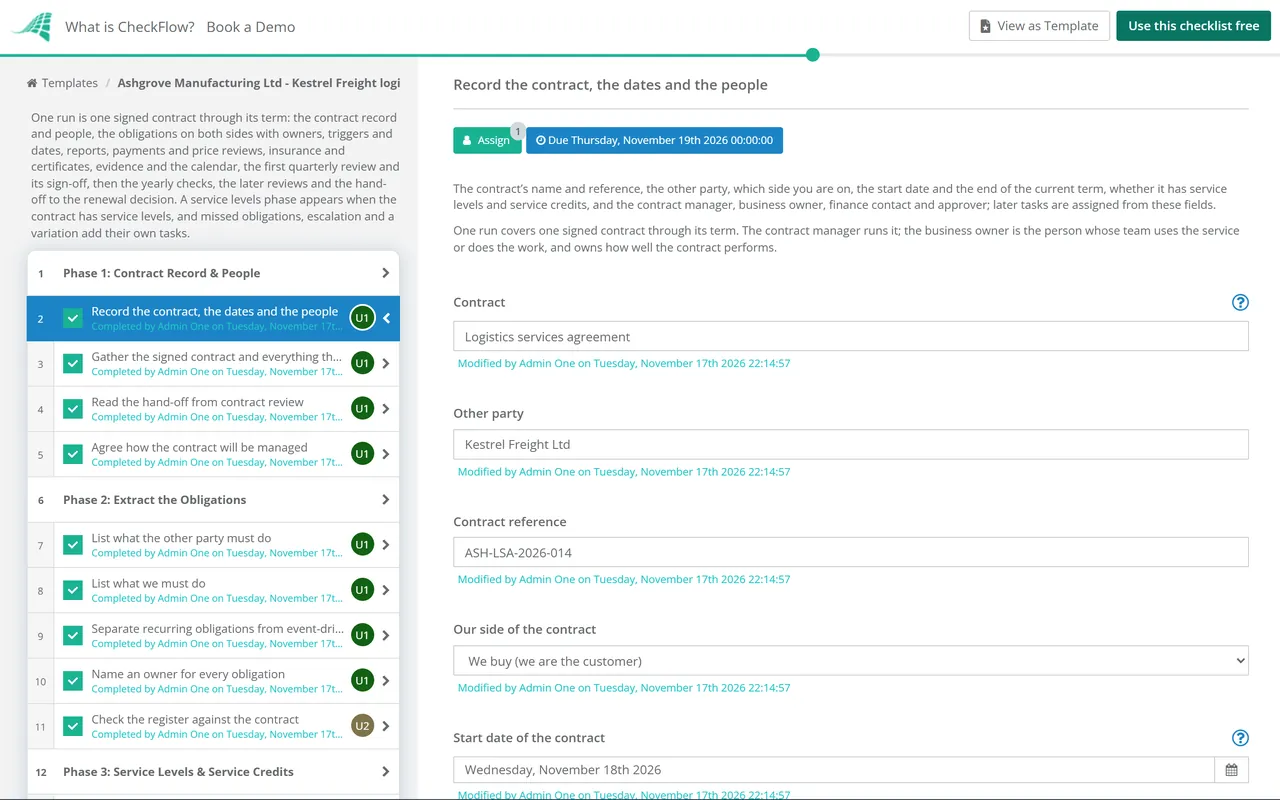
    The contract manager opens the record as soon as the contract is signed, starting from the hand-off at the end of contract review. Enter the start date and the end date of the current term first: the set-up and the first review count on from the start date, and the renewal hand-off counts back from the end date.

    • Record the contract, the dates and the people — the contract’s name and reference, the other party, which side you are on, the start date and the end of the current term, whether it has service levels and service credits, and the contract manager, business owner, finance contact and approver; later tasks are assigned from these fields
    • Gather the signed contract and everything that changes it — the signed copy with every schedule, annex and order form, any side letters, amendments or variations already agreed, and the documents the contract refers to, such as a service description or a policy
    • Read the hand-off from contract review — the risk notes, the obligations and owners named at signature, the renewal and notice dates already set, and anything the negotiators promised that the business must now deliver
    • Agree how the contract will be managed — the day-to-day contacts on both sides, how often you will meet, how performance will be reported and where the evidence will be kept
  2. Phase 2

    Phase 2: Extract the Obligations

    5 tasks

    An obligation is anything the contract says either party must do, give, keep or tell, by a date or when something happens. Extract both sides: what you must do is as easy to miss as what the other party must do. Each one gets an owner, a trigger and a due date, so nothing depends on someone remembering a clause.

    • List what the other party must do — every duty on the other party, clause by clause: the services and deliverables, standards it must meet, reports and notices it must send, insurance it must hold, and anything it must ask permission for, such as using subcontractors
    • List what we must do — every duty on your side: payments, forecasts or orders you must give, information, access and approvals the other party relies on, and limits such as confidentiality or exclusivity
    • Separate recurring obligations from event-driven ones — recurring duties, such as a monthly report or a yearly certificate, get dates in the calendar; event-driven duties, such as a notice of a change of control, a data breach or a price change, get a trigger and a deadline counted from it, so the owner knows what to do when the event happens
    • Name an owner for every obligation — a named person, not a team, for each line on both lists, confirmed with them and their manager; the business owner covers anything without one until it is filled
    • Check the register against the contract — a second person reads the contract against the two lists, looking for duties in the schedules and definitions, and for dates that run from something other than the start date
  3. Phase 3

    Phase 3: Service Levels & Service Credits

    4 tasks

    Applies only when the contract has service levels. A service level is a measured target, such as on-time delivery or a response time, and a service credit is the reduction in charges the contract gives when a target is missed. Write down exactly how each one is measured before the first period’s data arrives.

    • List each service level and how it is measured — the measure, the target, the measurement period, the data source, who measures it and any exclusions the contract allows, such as delays the customer causes
    • Agree the performance report with the other party — its format, the date each month or quarter it arrives, the raw data behind it, and who checks it on your side; if you give the service levels, the report is yours to send
    • Set out how service credits are worked out and given — the formula, any cap, whether credits must be claimed or are applied automatically, any time limit for a claim, and how they appear on the invoice
    • Note what happens after repeated failures — any critical service level, a repeated-failure threshold, a right to a remediation plan, step-in or termination, and what the contract says must be done first, such as a notice and a chance to put things right
  4. Phase 4

    Phase 4: Reports, Payments & Price Reviews

    4 tasks

    Money obligations run both ways and are the easiest to check. The contract manager lists the reports and notices; the finance contact sets up the invoice checks and the dates on which prices may change.

    • List every report and notice the contract requires — management information, performance reports, forecasts, statements of compliance, and any notice either party must give, with the recipient, the method and the deadline the notices clause sets
    • Set up the payment schedule and invoice checks — the charges, payment terms, milestones, any deposit or retention, and the checks before an invoice is approved: rates against the contract, volumes against delivery records, and credits deducted
    • Record the price review and indexation dates — when prices may change, by how much or by which index, how much notice is needed and who must agree; put the first date in the calendar
    • Note minimum volumes, commitments and rebates — any minimum spend or volume, forecasts you must give, rebates or volume discounts, and when each is measured, so a shortfall is seen early
  5. Phase 5

    Phase 5: Insurance, Certificates & Other Duties

    5 tasks

    Some duties are shown with a document: an insurance certificate, a certification, a licence. Collect each one now with its expiry date, so the next one is asked for before the old one runs out. Then note the duties that only matter when something happens: data, consents and audits.

    • Collect the insurance certificates the contract requires — each cover the contract names, such as public liability, professional indemnity or goods in transit, with the insurer, the limit, the expiry date and any requirement to note your interest
    • Collect certifications, licences and accreditations — anything the contract requires either party to hold, such as a security certification, a quality accreditation or an operating licence, with its scope and expiry date
    • Record data protection and security duties — where personal data is shared: the data processing terms, the security standards, the breach notice deadline in the contract, audit rights and where data must be kept
    • Note the restrictions and consents — what needs the other party’s consent or yours, such as subcontracting, assignment, changes to key people or locations, or publicity, and any exclusivity or non-solicitation terms
    • Note audit and inspection rights — the right to audit or inspect sites and records, how much notice is needed, how often, and who pays
  6. Phase 6

    Phase 6: Evidence & the Obligations Calendar

    5 tasks

    An obligation is only met if you can show it was. This phase sets where the evidence for each one goes and puts every dated obligation in a calendar with reminders, before the first quarter’s work is reviewed.

    • Set up an evidence folder for each obligation — one place per obligation or group of obligations (reports received, certificates, minutes, invoices checked, notices sent), named so anyone can find the proof without asking
    • Put every dated obligation in the calendar — each recurring and dated obligation from the register, with a reminder to its owner before it falls due; event-driven obligations stay in the register with their triggers
    • Confirm each owner knows their obligations — each owner gets their lines from the register, the evidence they must keep and the date of the first one, and confirms they can meet it
    • Brief the business owner and finance — the obligations that matter most, the service levels, the money dates, the notice and renewal dates, and what to do if something goes wrong between reviews
    • Set the dates of the quarterly reviews — agree the first review with the other party for soon after the first quarter ends, and book the later ones; this checklist runs the first review and logs the later ones
  7. Phase 7

    Phase 7: First Quarterly Review

    8 tasks

    The first quarter ends three months after the start date. Collect the evidence, check every obligation due in the quarter on both sides, and meet the other party with the facts. What the check finds decides what is added: a fix for something missed, or escalation for a serious or repeated failure.

    • Collect the quarter’s performance data and evidence — the other party’s reports, your own records, invoices, complaints and incidents, and the evidence folders for every obligation due in the quarter
    • Check service level performance against the targets — each service level for each period against its target, using the agreed data, with exclusions applied only as the contract allows; work out any service credits due
    • Check every obligation due in the quarter, ours and theirs — each line in the register due in the quarter: met on time, met late or missed, with the evidence; record what was missed and why
    • Agree the fix for each missed obligation — with the owner on whichever side missed it: what will be done, by when, and how you will know; carry each fix into the next review
    • Escalate a serious or repeated failure — to the senior contacts named in the contract’s escalation or dispute clause, in the order and within the times it sets, with the facts and the evidence
    • Ask for a remediation plan — where the contract gives a right to one, ask in the form it requires; check the plan deals with the cause, has dates and says how success will be measured
    • Hold the quarterly review with the other party — performance against the service levels, every obligation missed or at risk on both sides, open issues, forecasts and changes coming, and actions with owners and dates
    • Write up the review and the proposed actions — the performance summary, missed obligations and their fixes, any service credits due either way, any escalation or formal step proposed, and any variation needed, for the approver
  8. Phase 8

    Phase 8: Sign-Off & Action

    9 tasks

    The approver signs off the review and any formal action before it goes to the other party: a claim for credits, a formal notice or a change to the contract commits your organisation. Escalation and a request for a remediation plan happen at working level before the sign-off. Nothing after the sign-off can be completed until it is done.

    • Rework the review or its actions — change what the approver would not approve and send it back; the approver then changes the decision on the sign-off and completes it
    • Approve the review outcome and any formal action — the approver reads the write-up and approves, approves with changes or does not approve; complete this task with the decision
    • Send the review record and actions to the other party — the agreed summary, the actions with owners and dates, and anything the contract says must be in writing, sent by the method its notices clause sets
    • Claim the service credits due to us — in the form and within any time limit the contract sets, with the calculation; check they appear on the next invoice
    • Give the service credits we owe — work them out on the contract’s formula, tell the customer and apply them on the invoice, or as the contract says
    • Send any formal notice the approver agreed — a notice of breach, a request to remedy or another formal step, after legal advice, in the form and to the address the notices clause sets; keep proof of delivery
    • Agree the variation in writing — the change, its price and its start date, written as the contract’s change or amendment clause requires
    • Get the variation signed by both parties — by people with authority under each side’s signing rules, then filed with the contract
    • Update the register and calendar after the review — new dates, fixed obligations, any variation, credits claimed or given, and the actions to check at the next review
  9. Phase 9

    Phase 9: Through the Term & Renewal Hand-Off

    6 tasks

    The rest of the term repeats the quarterly review and the yearly checks. Seven months before the end of the term this checklist hands off to the renewal decision, with the performance record the decision needs.

    • Apply each price review on its date — check each proposed change against the contract’s mechanism and notice, have it approved, update the rate card and the invoice checks, and log it
    • Check insurance and certificates before each expiry — ask for the renewed certificate before each one recorded in Phase 5 runs out, and log it
    • Hold and log each later quarterly review — repeat the first review’s steps each quarter (evidence, service levels, every obligation due, the meeting, the write-up and the approver’s sign-off of any formal step) and log each one here
    • Prepare the performance record for the renewal decision — the service level history, obligations missed on both sides, credits, escalations and variations over the term, and the business owner’s view of whether the contract still meets the need
    • Hand off to the renewal decision — start the renewal decision with the notice deadline, the performance record and the owner; start earlier for a high-value contract or one you may re-tender
    • Close this record when the term ends — record the outcome of the renewal decision, file the evidence, and start a new run for a renewed or new contract; if the contract ended, check its exit duties were done

What Goes in an Obligations Register, and What Each Review Answer Adds

Eight kinds of obligation

The two registers in Phase 2 hold every one of these, for both parties, not only the service levels.

Kind of obligation Examples Trigger or timing Evidence to keep
Services and deliverablesThe services, deliverables and standards in the service descriptionOngoing, or by milestone datesDelivery records, acceptance notes, the other party’s reports
Service levels and service creditsOn-time delivery, response and fix times, availabilityEach measurement periodThe agreed performance data, the results, credits claimed or given
Reports and noticesManagement information, forecasts, notice of a delay, a change or a breachA set date, or a deadline counted from an eventThe report or notice as sent, with the date and proof of delivery
Payments and pricesCharges, payment terms, milestones, price reviews and indexation, minimum volumes, rebatesInvoice dates, review dates, measurement periodsChecked invoices, approved price changes, rebate statements
Insurance, certifications and licencesLiability and other cover, security or quality certifications, operating licencesExpiry datesCurrent certificates, with the next renewal date
Data protection and securityProcessing terms, security standards, breach notice deadlines, auditsOngoing, or counted from an incidentAudit results, security reports, incident records
Consents and restrictionsSubcontracting, assignment, key people, exclusivity, confidentialityWhen the event arisesConsents asked for and given, in writing
Our own obligationsPayments, forecasts, information, access and approvals the other party relies onSet dates, or when the other party asksWhat was sent, and when

What the first review adds

Two answers in Phase 7 decide what the run adds before and after the sign-off.

Answer at the first quarterly review What it adds When
None: every obligation was metNothing: the write-up goes to the approverNo extra steps
Some, put right at working levelA task to agree each fix with its owner and dateBefore the review meeting
Serious or repeated: escalateThe fixes, escalation under the contract’s own clause and a remediation plan, then a formal notice if the approver agreesBefore the sign-off, with the notice after it
The contract needs to changeAgreeing the variation in writing and having it signedAfter the sign-off

Nothing on this page is law: the contract governs. Its definitions, deadlines, notice rules and remedies are the rules, and this template types none of them. World Commerce & Contracting (WorldCC) publishes contract management standards, research and training, much of it for members; this template does not draw on them.

Public contracts can carry duties of their own. Under the Procurement Act 2023, which covers contracting authorities in England, Wales and Northern Ireland and UK-wide bodies but generally not devolved Scottish authorities (they follow Scottish procurement law), a contracting authority must set at least three key performance indicators before entering into a public contract worth more than £5 million, unless it considers that performance could not appropriately be assessed that way (section 52; frameworks, concessions, light touch contracts and private utilities’ contracts are excluded), and must assess performance against them at least once in every 12 months of the contract and on termination (section 71). A public body using this checklist should add those duties to its register; the GOV.UK guidance on key performance indicators explains them, including the differences for Wales and Northern Ireland.

Why Manage Contract Obligations in CheckFlow?

1

Every obligation has an owner and a date

The registers in Phase 2 name an owner for each obligation on both sides, and every task is assigned from the people on the first task. Due dates count from the start and end dates, and overdue alerts go to every assignee.

2

Nothing formal goes out unsigned

The approver’s sign-off is a gate: credits cannot be marked claimed, a notice sent or a variation agreed in the checklist until it is done. A serious failure adds the escalation steps before it. See how approval steps work.

3

A record ready for the renewal decision

Each review, credit, escalation and variation is on the run with its evidence. Every contract’s run sits on the Reports Grid with its answers, so an overdue review or a lapsed certificate stands out, and Analytics shows completion and overdue work by person and by step.

CheckFlow does not read your contract or replace your contract repository. It runs the work around the contract: who extracted which obligation, who owns it, what the evidence shows, what each review found and who approved each formal step.

Get the contract signed with the Contract Review & Approval Checklist and decide its future with the Contract Renewal Reminder Checklist. Look across every vendor once a year with the Vendor Oversight Checklist, score a supplier against its KPIs with the Supplier Performance Evaluation Checklist, and check the data terms with the Data Processing Agreement (DPA) Review Checklist. An IT provider measuring its own service levels can use the SLA Performance Review Checklist, and a contract that ends can be closed with the Vendor Offboarding Checklist.

AI generator

Didn’t find what you need? Describe it.

Describe the process in a sentence and the AI checklist generator drafts the phases and tasks for you.

Frequently Asked Questions

What is contract obligation management?

Contract obligation management is the work after a contract is signed: finding every obligation in it, on both sides, giving each an owner, a trigger and a due date, and checking it is met, with evidence. It covers service levels, reports and notices, payments and price reviews, insurance and certificates, and the duties that only apply when something happens, such as a notice of a change of control. It runs until the renewal decision at the end of the term.

What should a contract obligations checklist include?

The signed contract and everything that changes it; a register of what the other party must do and what you must do, each with an owner, a trigger and a due date; service levels and how credits work; reports, notices, payments and price review dates; insurance and certificates with their expiry dates; a place for the evidence of each obligation; a calendar with reminders; regular reviews with escalation and variations; and a hand-off to the renewal decision. This checklist covers each one.

What is the difference between recurring and event-driven obligations?

A recurring obligation falls due on a schedule, such as a monthly performance report, a quarterly review or a yearly insurance certificate, so it can go in a calendar. An event-driven obligation applies only when something happens, such as a delay, a data breach, a change of key people or a change of control, and may have a deadline counted from the event. This checklist puts recurring ones in the calendar and gives each event-driven one its trigger and deadline in the register.

How do you track contract obligations after signing?

Start a register as soon as the contract is signed: each obligation, its clause, the owner, the trigger or frequency, the next due date and the evidence that shows it was met. Put every dated obligation in a calendar with a reminder to its owner, keep the evidence in one place per obligation, and check the register at each review. This checklist does that for one contract, and the Reports Grid shows every contract’s run side by side.

What is a service credit?

A service credit is a reduction in the charges that a contract gives the customer when the provider misses a service level, worked out on a formula the contract sets, sometimes with a cap. Some contracts apply credits automatically on the invoice; others need the customer to claim them, sometimes within a time limit. Whether credits are the customer’s only remedy for a missed service level depends on the contract’s wording, so read it and take advice before relying on either view.

What should you do when the other party misses an obligation?

Check the evidence and what the contract says first. The contract may set steps that come before any remedy, such as an escalation route, a remediation plan or a notice with time to put things right. Agree a fix with an owner and a date, escalate a serious or repeated failure through the contract’s own clause, and take legal advice before any formal notice. In this checklist the approver signs off any formal step before it is sent.

How often should a contract’s obligations be reviewed?

As often as the contract and its risk need. The contract may set the meetings and reports in a governance clause; where it does not, this template uses a quarterly review, the first just after the first three months, and checks insurance, certificates and price reviews each year. A high-value or high-risk contract may need monthly service meetings as well. Dated obligations are checked when they fall due, not only at the review.

Who should own contract obligations?

Each obligation needs one named person who does it or checks it, in the team that works with the contract day to day where possible. In this checklist the contract manager keeps the register and runs the reviews, the business owner owns how well the contract performs, the finance contact owns payments, invoices and credits, and the approver signs off formal action. Your own obligations to the other party need owners too.

When does obligation management hand over to the renewal decision?

This checklist hands off seven months before the end of the current term, with the performance record for the term, so there is time to decide whether to renew, renegotiate, end or re-tender before the notice deadline. That is this template’s choice: start earlier for a high-value contract, one you may re-tender or one with a long notice period. The Contract Renewal Reminder Checklist runs the decision itself.

Is CheckFlow free for this template?

14-day free trial, no card required. The Business plan is $10 per user per month after the trial. Full details at checkflow.io/pricing.

Keep Every Promise in the Contract, on Both Sides

Free trial — no credit card required.

14-day free trial, no credit cardFull refund in your first 30 daysUS hosting, EU on request